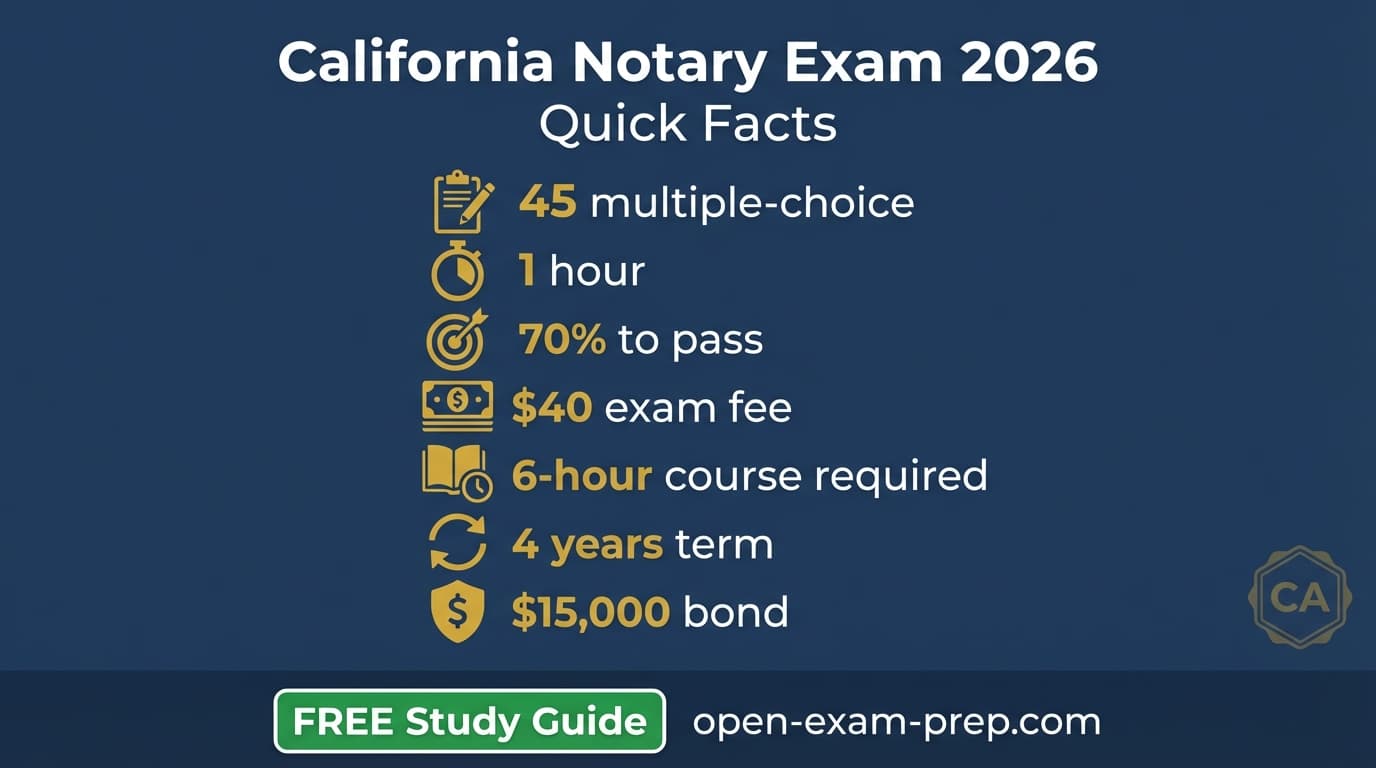
California Notary Public Exam Overview
The California Notary Public Examination is administered by CPS HR Consulting on behalf of the California Secretary of State (SOS). Every one of the 45 multiple-choice questions is drawn directly from the current California Notary Public Handbook, so the exam rewards candidates who study the official source material rather than generic notary content.
California is one of only a handful of states that requires an exam at all, and it pairs that exam with a mandatory 6-hour education course, Live Scan background check, and a $15,000 surety bond — a deliberately rigorous process. Passing qualifies you to join roughly 137,000 active notaries statewide (per the SOS active-notary database), serving the largest notarization market in the country.
This guide walks the entire path: eligibility, the course, exam registration and logistics, the application, bond and oath, journal and seal rules, fees, your timeline to commission, and renewal. Every number below is verified against the California SOS and the Notary Public Handbook.
Exam Format at a Glance
| Component | Details |
|---|---|
| Administered by | CPS HR Consulting (for the CA Secretary of State) |
| Total Questions | 45 multiple-choice (40 scored + 5 unscored) |
| Time Limit | 60 minutes |
| Passing Score | 70 (scaled) |
| Exam + Application Fee | $40 new / $20 retake |
| Education Required | 6-hour approved course (3-hour refresher for renewals) |
| Results | Mailed ~15 business days after the exam |
| Commission Term | 4 years |
| Surety Bond | $15,000 |
Of the 45 questions, 40 are scored and determine whether you pass; the remaining 5 are unscored pilot questions CPS HR uses to develop future exams. You will not know which five are unscored, so treat every question as if it counts. The passing standard is a scaled score of 70, and results are mailed to you about 15 business days after your test date.
The Commission Process, Step by Step
Most candidates underestimate that the exam is only step three of seven. Here is the full path the SOS lays out:
- Confirm eligibility — be at least 18 and a legal California resident.
- Complete the approved education course — 6 hours for new applicants (3-hour refresher if renewing on time).
- Register for the exam with CPS HR and take it (bring your course proof, photo ID, a 2"x2" passport photo, application, and payment).
- Submit fingerprints via Live Scan for the DOJ/FBI background check.
- Await your commission packet from the Secretary of State.
- Purchase your notary materials — sequential journal and an official seal/stamp.
- File your oath and $15,000 bond with the county clerk within 30 days of the commission start date.
Start-to-commission typically takes 4 to 8 weeks, with the Live Scan background check the main variable.
Eligibility Requirements
To qualify for a California notary commission you must:
- Be 18 years of age or older (no maximum age).
- Be a legal resident of California.
- Complete the approved education course (6 hours; 3-hour refresher only if you currently hold a commission and renew before it expires).
- Pass the state examination with a scaled score of 70.
- Clear a background check via Live Scan fingerprinting (DOJ and FBI).
A criminal conviction does not automatically disqualify you, but the SOS reviews each disclosed offense and may deny or revoke a commission for disqualifying convictions.
Exam Registration and Test-Day Logistics (CPS HR)
Because CPS HR runs the exam, registration and exam-day rules trip up candidates who only study notary law. Get these right:
- Fees: $40 for new applicants (exam + application processing) or $20 for a retake after a prior failure. Pay by check or money order payable to the Secretary of State — cash is not accepted at the exam site.
- Bring to the exam: your six-hour (or three-hour) Proof of Completion certificate, the completed application, a 2"x2" color passport photo, your registration confirmation letter, current photo ID (CA driver license/ID or other government photo ID), and your payment.
- Format: 45 closed-book multiple-choice questions in 60 minutes.
- Results: CPS HR mails your pass/fail result roughly 15 business days later — you will not get a score on the spot.
- Retakes: if you fail, you can retake the exam (next available session) for the $20 fee; results stay valid for one year.
Start Your FREE California Notary Exam Prep
The single best way to pass is repeated practice against handbook-accurate questions. Our completely free California Notary prep gives you that, plus an AI tutor that explains every answer.
Prefer to read first? See the full California Notary study guide for topic-by-topic coverage.
Key Topics Covered on the Exam
The exam draws its 40 scored questions from five official content areas. Here is the breakdown based on the official exam outline:
| Topic Area | Weight | Scored Questions |
|---|---|---|
| Misconduct / Fees | 37.5% | 15 |
| Notarial Acts / Documentation | 30.0% | 12 |
| Administrative Procedures | 12.5% | 5 |
| Identification / Subscribing Witness | 10.0% | 4 |
| Immigration / Foreign Language | 10.0% | 4 |
1. Misconduct / Fees — 37.5% (15 Questions)
This is by far the highest-weighted topic on the exam, making up more than a third of your scored questions. Do not underestimate it. If you only have time to master one area, make it this one.
Fee Schedule:
| Service | Maximum Fee |
|---|---|
| Acknowledgment | $15 per signature |
| Jurat | $15 per signature |
| Certified copy of POA | $15 |
| Each additional signature | $15 |
| Immigration form (per individual) | $15 |
The $15-per-signature cap (Government Code 8211) is per signature, not per document — a deed with three signers can be billed up to $45. Notaries may charge separate, unregulated fees for travel, copies, or faxing. Two services are required to be free: notarizing veterans' benefits claim documents and vote-by-mail ballot materials.
Prohibited Conduct:
- Cannot notarize your own signature
- Cannot notarize when you have a direct financial interest in the transaction
- Cannot certify vital records (births, deaths, marriages)
- Cannot provide legal advice or prepare legal documents (unauthorized practice of law)
- Cannot notarize incomplete documents
- Cannot use misleading advertising
"Notario Publico" Prohibition:
- A California notary may not use the term "Notario Publico" or any non-English equivalent in advertising or business materials
- Violations carry significant penalties because the term implies attorney-level authority in many Latin American countries
- This is a heavily tested concept
Conflicts of Interest:
- Financial interest in the transaction disqualifies a notary from performing the act
- Family relationships involving a financial benefit create a conflict
- Notaries must remain impartial witnesses
Grounds for Suspension, Revocation, and Penalties:
- Failure to maintain bond or file oath
- Conviction of a felony or certain misdemeanors
- Fraud or dishonesty in performing notarial acts
- Charging fees above the statutory maximum
- Know the difference between mandatory revocation and discretionary suspension
2. Notarial Acts / Documentation — 30.0% (12 Questions)
Acknowledgments:
- Signer acknowledges signing voluntarily
- Most common notarial act
- Used for deeds, deeds of trust, powers of attorney
- Certificate must include venue, date, signer identification
Jurats (Verification on Oath or Affirmation):
- Signer swears content is true
- Must sign in notary's presence
- Notary administers oath/affirmation
- Common for affidavits and depositions
Proof of Execution:
- Third party proves another person signed
- Subscribing witness procedure
- Used when signer cannot appear
- Strict requirements under California law
Copy Certification:
- Certify copies of powers of attorney
- Cannot certify vital records (births, deaths, marriages)
- Limited to specific document types
Journal and Record Keeping: California requires a sequential journal including:
- Date, time, and type of notarial act
- Type of document notarized
- Signer's name and signature
- Type of ID presented
- Address (for real property documents)
- Thumbprint for certain documents
Thumbprint Requirements: Required for:
- Deeds and deeds of trust
- Quitclaim deeds
- Powers of attorney affecting real property
3. Administrative Procedures — 12.5% (5 Questions)
Commission Requirements:
- Must be 18 years or older
- California resident (or work in CA)
- Complete 6-hour approved education course
- Pass the state examination
- Pass background check (Live Scan)
- Obtain $15,000 surety bond
Oath of Office:
- Must be administered by county clerk
- File oath and bond within 30 days of commission
- Receive official notary stamp/seal
Government Code and Civil Code:
- Government Code §8200-8230 (notary provisions)
- Civil Code §1185-1197 (acknowledgments)
- Civil Code §1189 (certificate forms)
- Know specific code sections tested on exam
4. Identification / Subscribing Witness — 10.0% (4 Questions)
Satisfactory Evidence of Identity:
| Acceptable ID | Requirements |
|---|---|
| CA Driver License/ID | Current or issued within 5 years |
| US Passport | Current or issued within 5 years |
| Foreign Passport | Current (stamped by USCIS) |
| US Military ID | Current |
Credible Witnesses:
- Two credible witnesses required
- Each must personally know the signer
- Must present satisfactory ID to notary
- Used when signer lacks acceptable ID
Personal Knowledge:
- Notary personally knows the signer
- Should be reserved for well-known individuals
- Document basis for identification in journal
5. Immigration / Foreign Language — 10.0% (4 Questions)
This is a distinct topic area that many candidates overlook. It accounts for 10% of your scored questions.
Permissible Immigration Services:
- Notaries may assist with completing immigration forms
- Must not provide legal advice about immigration matters
- Cannot represent individuals before immigration authorities
- Services are limited to translating or filling in forms as directed by the client
Fee Limitations for Immigration Forms:
- Maximum fee of $15 per individual per set of immigration forms
- Fees must be posted in a conspicuous location
- Cannot charge for services not actually rendered
"Notario Publico" Prohibition (Immigration Context):
- Especially relevant when serving immigrant communities
- Using "Notario Publico" or similar terms is a serious violation
- Designed to prevent exploitation of individuals who may believe a notary has attorney-level powers
Foreign Language Document Handling:
- Notaries may notarize documents in a foreign language
- Notary does not need to read or understand the language of the document
- Communication with the signer about the nature of the act is still required
- If the signer does not speak English, a translator may be used but the notary must be satisfied the signer understands the act
Study Timeline for Success
| Week | Focus Area | Hours |
|---|---|---|
| Week 1 | Complete 6-hour education course | 6 |
| Week 1-2 | Misconduct, fees, and prohibited conduct (37.5% of exam) | 6-7 |
| Week 2 | Notarial acts and documentation (30% of exam) | 5-6 |
| Week 2-3 | Administrative procedures, codes, and commission process | 3-4 |
| Week 3 | Identification, subscribing witness, and immigration topics | 3-4 |
| Week 3-4 | Practice exams and review | 5-6 |
Total recommended study time: 28-33 hours (including required course)
Pro tip: Spend the most time on Misconduct/Fees and Notarial Acts/Documentation — together they account for 67.5% of your scored questions.
🎯 Free Practice Questions Available
Test your knowledge with hundreds of free practice questions designed specifically for the California Notary exam — every item maps to the official handbook topics above.
California-Specific Exam Tips
1. Prioritize Misconduct and Fees
With 37.5% of the exam devoted to this single topic, you cannot afford to skim it. Know the fee schedule cold, understand every prohibited act, and memorize the "Notario Publico" advertising rule. Many candidates focus too heavily on notarial acts and underestimate how much misconduct content appears on the test.
2. Master the Journal Requirements
California's journal is mandatory and detailed:
- Sequential entries required
- Cannot skip lines
- Must include thumbprint for real property
- When your commission ends (resign, expire, or revoked), the journal must be delivered to the county clerk within 30 days (Government Code 8209)
3. Know the Code Sections
Key California codes appear on the exam:
- Government Code §8200 — Notary appointment
- Government Code §8206 — Seal requirements
- Civil Code §1189 — Certificate forms
- Civil Code §1185 — Acknowledgment requirements
4. Do Not Ignore Immigration Topics
Immigration/Foreign Language is a full 10% of the exam. Many candidates skip this area entirely. Know the $15-per-individual fee limit for immigration forms and the strict prohibition on using "Notario Publico" or similar foreign-language equivalents.
5. Key Numbers to Remember
| Topic | California Requirement |
|---|---|
| Total questions | 45 (40 scored + 5 unscored) |
| Passing score | 70 scaled score |
| Education | 6 hours |
| Commission term | 4 years |
| Bond amount | $15,000 |
| Max fee per signature | $15 |
| Max fee per immigration form | $15 per individual |
| Journal at commission end | Deliver to county clerk within 30 days |
Common Mistakes to Avoid
- Underestimating Misconduct/Fees — This is 37.5% of the exam; give it the most study time
- Skipping the required course — 6-hour course is mandatory
- Ignoring journal requirements — California is strict
- Forgetting thumbprints — Required for real property
- Confusing act types — Know acknowledgment vs. jurat
- Not knowing ID requirements — Memorize acceptable IDs
- Overlooking immigration topics — 10% of scored questions cover immigration forms and foreign language rules
- Not knowing the "Notario Publico" rule — This prohibition appears across multiple topic areas
After Passing Your Exam
Your passing result is valid for one year. Within that window:
- Submit Live Scan fingerprints for the DOJ/FBI background check (if not already done).
- Await your commission packet from the Secretary of State.
- Obtain your $15,000 surety bond from an approved provider.
- Purchase a sequential journal and an official seal/stamp meeting state specifications — both are required before you notarize.
- File your oath and bond with the county clerk within 30 days of the commission start date (miss this and the commission is void).
- Begin practicing — your commission is valid for 4 years.
Renewing Your Commission
California does not auto-renew. To stay continuously commissioned:
- Take the exam early — the SOS recommends testing at least six months before your current commission expires (results are valid one year).
- Use the 3-hour refresher course instead of the full 6 hours — but only if you renew before your current commission lapses. If it expires, you must repeat the full 6-hour course.
- Re-do Live Scan, bond, oath, and seal as a new commission cycle.
2026 California Updates
- Remote Online Notarization (RON) is NOT yet live for California-commissioned notaries. SB 696 (signed 2023) authorizes RON, but it becomes operative only when the SOS finishes the supporting technology — no later than January 1, 2030. Anyone advertising California RON commissions today is premature.
- Out-of-state RON is recognized: since October 2024, California accepts documents validly notarized via RON by notaries in states where RON is already legal.
- Exam fee remains $40 new / $20 retake, and the maximum notary fee remains $15 per signature.
- Continue using a tamper-evident sequential paper journal — California has not authorized electronic journals for traditional notarizations.
Start Your California Notary Career Today
The California Notary Public commission opens doors to serving the nation's largest notarization market. With handbook-accurate study and repeated practice, most candidates pass on the first attempt.
Our free study materials include:
- ✅ Complete topic coverage
- ✅ Practice questions with explanations
- ✅ California law specifics (Government Code, Civil Code)
- ✅ Study guides and summaries
- ✅ AI-powered study assistance
Don't pay for expensive prep courses when everything you need is available FREE.

 Free CE
 Buy on Amazon
 Take courses on Udemy
 California notary training