View
ViewStamps vs. Embossers: Understanding the Two Types of Notary Seals
Before spending a dollar on notary supplies, you need to understand exactly what you are buying — because ordering the wrong type of seal can make your notarizations invalid.
Notary Stamp (Rubber / Self-Inking): A stamp creates an ink impression on paper. You press it down, and it leaves a clear, readable mark showing your name, commission number, expiration date, state, county, and (in some states) a state seal image. Ink impressions photocopy and scan perfectly, which is why most states require stamps as the official notary seal.
Notary Embosser (Seal Press): An embosser creates a raised impression by physically pressing the paper between two metal dies. The result is a three-dimensional seal you can feel with your fingertips. Embossed seals are extremely difficult to forge because they physically alter the paper — you cannot replicate them with a photocopier or printer.
The critical difference: Ink stamps are readable on copies; embossed seals are not. An embossed impression is essentially invisible on a photocopy, scan, or fax. This is exactly why most states have moved to requiring ink stamps as the primary seal — documents need to be reproducible in today's digital world.
Why many notaries carry both: Even in states that only require an ink stamp, many notaries also use an embosser. The stamp satisfies the legal requirement and ensures copies are readable. The embosser adds an additional anti-fraud layer to the original document. Together, they provide maximum security — the ink stamp is visible on copies, and the raised seal proves the original was physically notarized.
State-by-State Notary Seal Requirements
This table is the core reference for notaries and notary candidates across the country. Requirements vary significantly — what is acceptable in Texas can get your notarization rejected in California.
| State | Primary Seal Required | Embosser Status | Required Information |
|---|---|---|---|
| California | Ink stamp (required) | Optional but recommended | Name, "Notary Public," county, commission number, expiration date, state seal |
| New York | Ink stamp (required) | Optional | Name, "Notary Public, State of New York," county, commission number. Must be BLACK ink |
| Texas | Stamp OR embosser (either accepted) | Accepted as primary | Name, "Notary Public, State of Texas," commission expiration, state seal |
| Ohio | Ink stamp (required) | Optional | Name, "Notary Public, State of Ohio," county, commission expiration |
| New Jersey | Ink stamp (required) | Optional | Name, "Notary Public of New Jersey," commission number, expiration date |
| Pennsylvania | Ink stamp (required) | Optional | "Commonwealth of Pennsylvania — Notary Seal," name and "Notary Public," county, commission expiration, seven-digit commission number |
| North Carolina | Ink stamp (required) | Optional | Name, county, "North Carolina," commission expiration |
| Florida | Ink stamp (required) | Optional but common | Name, "Notary Public — State of Florida," commission number, expiration, bonding agency |
| Illinois | Ink stamp (required) | Optional | Name, "Official Seal, Notary Public, State of Illinois," commission expiration, county |
| Michigan | Ink stamp (required) | Optional | Name, "Notary Public, State of Michigan, County of [name]," commission expiration |
| Georgia | Ink stamp (required) | Optional | Name, "Notary Public," county, commission expiration |
| Maine | Embosser (required) | Required as primary | Name, "Notary Public," state, commission details |
| Montana | Embosser OR stamp | Accepted as primary | Name, "Notary Public for the State of Montana," county |
Important: State laws change. Always verify your current requirements with your state Secretary of State or commissioning authority before ordering supplies. The table above reflects requirements as of early 2026.
Key takeaways from the table:
- Most states require an ink stamp. If you are in California, New York, Ohio, New Jersey, Pennsylvania, North Carolina, Florida, Illinois, Michigan, or Georgia — you must have an ink stamp. An embosser alone will not satisfy the legal requirement.
- Texas gives you a choice. Either a stamp or embosser is acceptable. Most Texas notaries opt for a stamp for convenience, but some prefer the embosser for its anti-fraud properties.
- New York requires BLACK ink. This is one of the strictest ink color requirements — other states typically accept black or blue, but New York mandates black specifically.
- Pennsylvania prescribes the order. The stamp must show "Commonwealth of Pennsylvania — Notary Seal," your name and "Notary Public," your county, your commission expiration date and your seven-digit commission number, in that order, with no abbreviations except name suffixes; it does not show your address.
- Maine requires an embosser. This is uncommon and catches some new Maine notaries off guard.
Our Top 6 Notary Stamps and Embossers for 2026
1. ExcelMark Notary Embosser — Best Overall Embosser
If you need an embosser — whether your state requires one or you want to add a raised seal for extra security — the ExcelMark is the best value on the market. At $24.99, it costs less than most competitors while supporting all 50 states.
Why it stands out: ExcelMark custom-manufactures each embosser to match your specific state requirements. You select your state at checkout, provide your commission details, and receive an embosser with the correct layout, wording, and information fields for your jurisdiction. The 1.63-inch impression is large enough to be clearly visible but compact enough to fit in standard document margins.
Impression quality: The ExcelMark produces clean, crisp raised impressions on standard 20lb paper. The dies are precision-cut, so every detail — including small text like commission numbers — is legible. On heavier paper (24lb+), the impression is even more pronounced.
Who should buy this: Any notary who needs an embosser for state compliance or wants to add raised-seal security to their notarizations. At this price point, there is no reason not to have one in your supply kit.
Pros:
- Most affordable embosser available ($24.99)
- Custom-made for any of the 50 states
- Clean 1.63" impression with fine detail
- Sturdy construction for years of use
Cons:
- Handheld only — no desktop base included
- Requires moderate hand strength for thick paper stacks
- Must order a new one when your commission renews

ExcelMark Notary Embosser — All 50 States
by ExcelMark
$24.99
- Custom-made to fit any state requirements
- Easy embossing with clear 1.63" impression
- Works for all 50 states — select your state at checkout
2. 904 Custom Notary Embosser — Premium Option
The 904 Custom embosser is a step up in build quality and precision. Its delrin die inserts produce sharper impressions than standard metal dies, and it is specifically designed for 20lb paper — the standard weight for legal documents.
Why choose it over the ExcelMark: If you perform a high volume of notarizations and need consistently sharp impressions, the 904 Custom delivers. The delrin inserts maintain their edge longer than metal dies, and the embosser handle is more ergonomic for repeated use. It also automatically includes state-mandated details like expiration dates and license numbers based on your state selection.
Availability note: The 904 Custom currently supports 37 states. If your state is not listed, the ExcelMark (all 50 states) is your best alternative.
Pros:
- Delrin inserts for sharper, longer-lasting impressions
- Ergonomic design for high-volume use
- Automatically includes state-mandated fields
- Optimized for 20lb legal document paper
Cons:
- Only available for 37 states (not all 50)
- Higher price than the ExcelMark ($33.99 vs $24.99)
- Heavier — less portable for mobile notaries

904 Custom Notary Embosser — 37 States
by 904 Custom
$33.99
- High-quality delrin inserts for precise impressions
- Includes state-mandated details (expiration, license number)
- Designed for 20lb paper — optimal for legal documents
3. MaxMark Notary Seal Round Embosser — Most Versatile Embosser
The MaxMark embosser solves a common complaint about handheld embossers: hand fatigue. Its dual-mode design works as both a handheld embosser and a desktop model, so you can switch to the desktop configuration for high-volume sessions and save your hands.
The standout feature: MaxMark includes 50 gold burst seal labels in the box. These are the metallic stickers you place over embossed impressions to make them visible on photocopies (more on this below). Most embossers do not include these, so you save an extra purchase.
New mechanism: MaxMark redesigned their embossing mechanism to require significantly less hand pressure than traditional models. If you have arthritis, carpal tunnel, or simply do a lot of embossing, this reduced-effort mechanism is a meaningful quality-of-life improvement.
Pros:
- Converts between handheld and desktop modes
- Includes 50 gold seal labels
- Reduced-effort embossing mechanism
- Clean, round impressions
Cons:
- Higher price point ($32.95)
- Desktop base adds bulk to your supply kit
- Limited state customization options compared to ExcelMark

MaxMark Notary Seal Round Embosser
by Rubber Stamp Creation
$32.95
- Doubles as handheld and desktop embosser
- New mechanism for minimal effort
- Includes 50 gold burst seal labels
4. Promot Official Notary Self-Inking Stamp — Best Ink Stamp
For the majority of notaries whose states require an ink stamp, the Promot is the best balance of quality, customization, and price. At $18.95, it is the most affordable self-inking notary stamp that offers full customization of all required fields.
Full customization: You provide your name, title, county, state, and commission expiration — Promot creates the stamp die to match your exact state requirements. The self-inking mechanism means you never deal with separate ink pads — just press and stamp. Each ink load produces hundreds of clean impressions before needing a refill.
Compact and refillable: The Promot is small enough to fit in a jacket pocket, making it ideal for mobile notaries. When the ink runs low, you pop in a replacement pad rather than buying an entirely new stamp. Replacement pads cost under $10 and take seconds to swap.
Why self-inking beats pre-inked: Self-inking stamps (like the Promot) have a built-in ink pad that re-inks the die between each use. Pre-inked stamps have ink embedded directly in the die rubber, which produces cleaner impressions initially but cannot be refilled — once the ink is exhausted, you discard the entire stamp. For working notaries, self-inking is more economical.
Pros:
- Most affordable self-inking notary stamp ($18.95)
- Fully customizable for any state
- Self-inking — no separate ink pad needed
- Compact and pocket-friendly
- Refillable ink pads
Cons:
- Impression area is smaller than some premium stamps
- Limited to one ink color per pad (order a black pad for New York)
- Plastic construction — adequate but not premium

Promot Official Notary Public Self-Inking Stamp
by Promot
$18.95
- Customizable: name, title, county, state, expiration
- Self-inking — hundreds of clean impressions
- Compact and refillable
5. Marspark Acknowledgement & Jurat Stamp Set — Best Time-Saver
This two-pack includes the two stamps that every working notary needs beyond their official seal: an acknowledgement stamp and a jurat stamp. These stamps pre-print the certificate wording required for the two most common notarial acts, saving you from handwriting or printing certificates for every single notarization.
What each stamp does:
- Acknowledgement stamp: Prints the standard wording for when a signer acknowledges that they signed a document voluntarily. This is the most common notarial act — used for deeds, powers of attorney, and most real estate documents.
- Jurat stamp: Prints the standard wording for when a signer swears or affirms under oath that the contents of a document are true. Used for affidavits, depositions, and sworn statements.
Why this matters: Without these stamps, you must handwrite or attach a separate printed certificate for every notarization. For a mobile notary performing 5-10 signings per day, that adds up to significant time. These stamps let you complete the certificate portion in seconds.
Compliance note: The wording on these stamps complies with most state notarial certificate requirements, but you should verify against your specific state statutes. Some states (like California) have very specific certificate wording that may differ from the standard language.
Pros:
- Two essential stamps in one purchase
- Self-inking with waterproof oil-based ink
- Pre-printed wording saves significant time
- Compliant with most state requirements
Cons:
- Wording may not match every state exactly — verify before using
- Fixed wording — cannot be customized
- Larger size than a standard notary seal stamp

Marspark Notary Acknowledgement & Jurat Stamp Set (2-Pack)
by Marspark
$34.99
- Pre-loaded acknowledgement and jurat wording
- Self-inking with waterproof oil-based ink
- Compliant with most state notarial certificate requirements
6. Hybsk Gold Metallic Seal Labels — Essential Embosser Companion
If you use an embosser, these gold seal labels are not optional — they are essential. Here is why: embossed impressions are completely invisible on photocopies, scans, and faxes. In a world where documents are routinely scanned and emailed, an invisible seal is a liability.
How they work: Place a gold starburst label directly over the area where you embossed the document. Then, press the embosser over the label and paper together. The result is a gold sticker with a raised embossed impression visible through it. When the document is photocopied, the gold label clearly shows where the seal was placed — even though the raised impression itself is invisible on the copy.
Why 300 pieces matters: At 300 labels per roll and $7.66, you are paying about 2.5 cents per label. Compare that to buying labels in small packs of 50-100, where the per-label cost can be 5-10x higher. For active notaries, the 300-piece roll is the clear value play.
Professional appearance: These are FSC-certified paper labels with a metallic gold finish. They look professional on legal documents, real estate closing packages, and corporate filings. The 2-inch starburst design is the industry standard for notary seal labels.
Pros:
- 300 labels for $7.66 — unbeatable value
- 2" gold starburst — industry standard appearance
- FSC-certified paper
- Works with any round embosser
Cons:
- Only gold color available in this pack
- Labels are paper, not foil — less durable than premium alternatives
- Must be applied carefully to avoid wrinkles
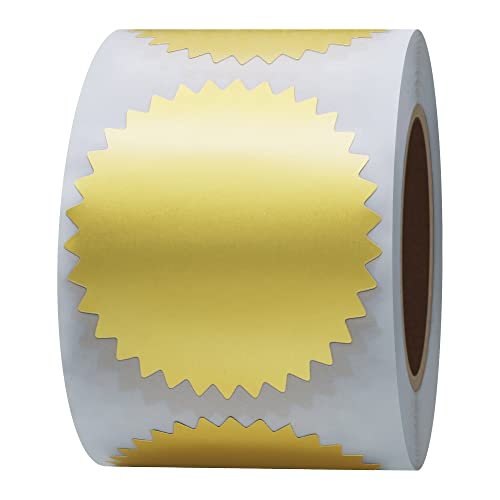
Hybsk Gold Metallic Certificate Seal Labels — 300 Pieces
by HYBSK
$7.66
- 2" gold starburst seals — 300 on a roll
- Supports embossing for enhanced visibility
- FSC-certified paper, professional appearance
Stamp vs. Embosser: When to Use Which
Understanding when each tool is appropriate is critical for compliance:
Use your ink stamp (required in most states):
- Every notarization — this is your official seal
- Documents that will be photocopied, scanned, or faxed
- Real estate closings, loan signings, and title company documents
- Any document where the receiving party expects a clearly reproducible seal
Use your embosser (optional in most states, but valuable):
- In addition to your ink stamp — never instead of it (unless your state accepts embossers as primary)
- High-value documents where anti-fraud protection matters (wills, trusts, powers of attorney)
- Original documents that will be retained in physical form
- Any time you want an extra layer of authentication
- Pair with a gold seal label if the document will ever be copied
Use both together (best practice):
- Stamp the document with your ink seal (satisfies legal requirement, readable on copies)
- Emboss the document near the stamp (adds physical anti-fraud protection)
- Place a gold label over the embossed area (ensures the seal location is visible on copies)
- This three-layer approach provides maximum security and is accepted in every state
What Information Goes on Your Notary Seal?
While specific requirements vary by state, here are the common elements required or recommended on notary seals:
Almost always required:
- Your full legal name (as it appears on your commission)
- "Notary Public" or equivalent title
- Your state of commission
- Your county of commission
- Your commission expiration date
Required in many states:
- Commission number or ID number
- State seal or emblem
Required in specific states:
- Seven-digit commission number, in a set order (Pennsylvania)
- Bonding agency name (Florida)
- "Official Seal" wording (Illinois)
Best practice: When ordering your stamp or embosser, provide your state commissioning authority documents to the vendor. Reputable sellers like ExcelMark and 904 Custom will format the seal to comply with your state requirements.
Common Mistakes That Invalidate Notarizations
Avoid these errors — any one of them can render a notarization legally invalid:
1. Using a stamp with expired commission information. This is the most common mistake. When you renew your commission, your old stamp becomes immediately invalid. Order your new stamp before your renewal effective date so there is no gap.
2. Using a stamp from the wrong state. If you hold commissions in multiple states, double-check that you are using the correct state stamp for each notarization. This sounds obvious, but it happens more often than you would expect during busy signing sessions.
3. Illegible impressions. If the signer, receiving party, or court cannot read your seal, the notarization may be challenged. Replace your ink pad when impressions start to fade. Apply firm, even pressure. On glossy paper, let the ink dry completely before the signer handles the document.
4. Stamping in the wrong location. Most states require the seal to be placed near but not overlapping the signer's signature. The seal should not obscure any text in the document or the signature itself.
5. Missing required information. If your state requires a commission number on the seal and yours does not have one, every notarization you perform is technically non-compliant. Verify your seal contains all required fields before your first notarization.
6. Using someone else's seal. A notary seal is non-transferable. Only the commissioned notary whose name appears on the seal may use it. Lending, sharing, or allowing someone else to use your seal is grounds for commission revocation in every state.
7. Failing to secure your seal. Most states require notaries to keep their seal under their exclusive control. Leaving your stamp on a shared desk or in an unlocked drawer where others can access it violates this requirement. Store your seal in a locked location when not in use.
How to Choose the Right Stamp or Embosser for Your State
Use this decision framework:
Step 1: Check your state requirements (use the table above).
- If your state requires an ink stamp → you must buy a stamp. Consider adding an embosser as a supplement.
- If your state requires an embosser → you must buy an embosser. Consider adding a stamp for copy-friendly impressions.
- If your state accepts either → choose based on your preference, but a stamp is more practical for most workflows.
Step 2: Decide on stamp type.
- Self-inking (recommended): Built-in ink pad re-inks automatically. Best for regular use. The Promot ($18.95) is our top pick.
- Pre-inked: Ink is embedded in the die. Cleaner initial impressions but not refillable. Better for low-volume notaries.
- Traditional rubber + separate ink pad: Cheapest option but messiest. Not recommended for professional use.
Step 3: Decide on embosser type.
- Handheld (most common): Portable, affordable, works anywhere. The ExcelMark ($24.99) is the best value.
- Desktop: Sits on a desk, easier on hands for high-volume use. The MaxMark ($32.95) converts between both modes.
Step 4: Add accessories.
- Gold seal labels: Essential if you use an embosser. The Hybsk 300-pack ($7.66) is the best value.
- Acknowledgement and jurat stamps: Essential for working notaries. The Marspark 2-pack ($34.99) covers both.
- Ink refill pads: Buy one spare when you order your stamp. You do not want to run out mid-signing.
The Complete Notary Supply Kit
Here is what a fully equipped notary should carry:
Essential (required for legal compliance):
- State-compliant ink stamp OR embosser (whichever your state requires)
- Notary journal or record book (required in most states)
Highly recommended:
- Both an ink stamp AND embosser (maximum document security)
- Acknowledgement and jurat stamps (time savings)
- Gold seal labels for embossed documents
- Spare ink refill pad
- Thumbprint pad (required in California for certain documents, recommended everywhere)
For mobile notaries:
- Compact carrying case for all supplies
- Portable stamp holder to protect your seal in transit
- Extra pens (black ink, ballpoint — required for most legal documents)
Free Notary Exam Prep Resources
Getting your notary commission starts with passing the exam. We offer free preparation resources for notary candidates in every state:
- Free Notary Exam Study Guide — Complete coverage of notarial acts, procedures, and laws
- California Notary Exam Prep — State-specific guide for the California notary exam
- New York Notary Exam Prep — State-specific guide for the New York notary exam
- Texas Notary Exam Prep — State-specific guide for the Texas notary exam
- AI Tutor — 10 free questions per day — ask about stamp requirements, notarial procedures, or state-specific rules
Final Recommendations
For most notaries (stamp-required states): Start with the Promot Self-Inking Stamp ($18.95) as your primary seal. Add the ExcelMark Embosser ($24.99) for extra document security. Pick up the Hybsk Gold Labels ($7.66) to make your embossed seals copy-friendly. Total: $51.60 for a complete, professional notary seal setup.
For high-volume and mobile notaries: Add the Marspark Acknowledgement & Jurat Stamp Set ($34.99) to the above. The time savings pay for themselves within your first week of signings. Total: $86.59 for a fully equipped professional kit.
For premium setups: Replace the ExcelMark with the 904 Custom Embosser ($33.99) for sharper impressions, or the MaxMark Embosser ($32.95) for the dual handheld/desktop versatility. Either is worth the upgrade for notaries who perform 10+ notarizations per week.
Whichever products you choose, remember: your notary seal is your professional identity. It appears on every document you notarize, and it carries legal weight. Invest in quality supplies, keep your commission current, and store your seal securely.
Start your notary exam preparation today with our free notary study guide and practice questions.
As an Amazon Associate, OpenExamPrep earns from qualifying purchases. All recommendations are based on editorial review.

 Free CE
 Notary training on Notary.net
 Take courses on Udemy
 Course Playlist