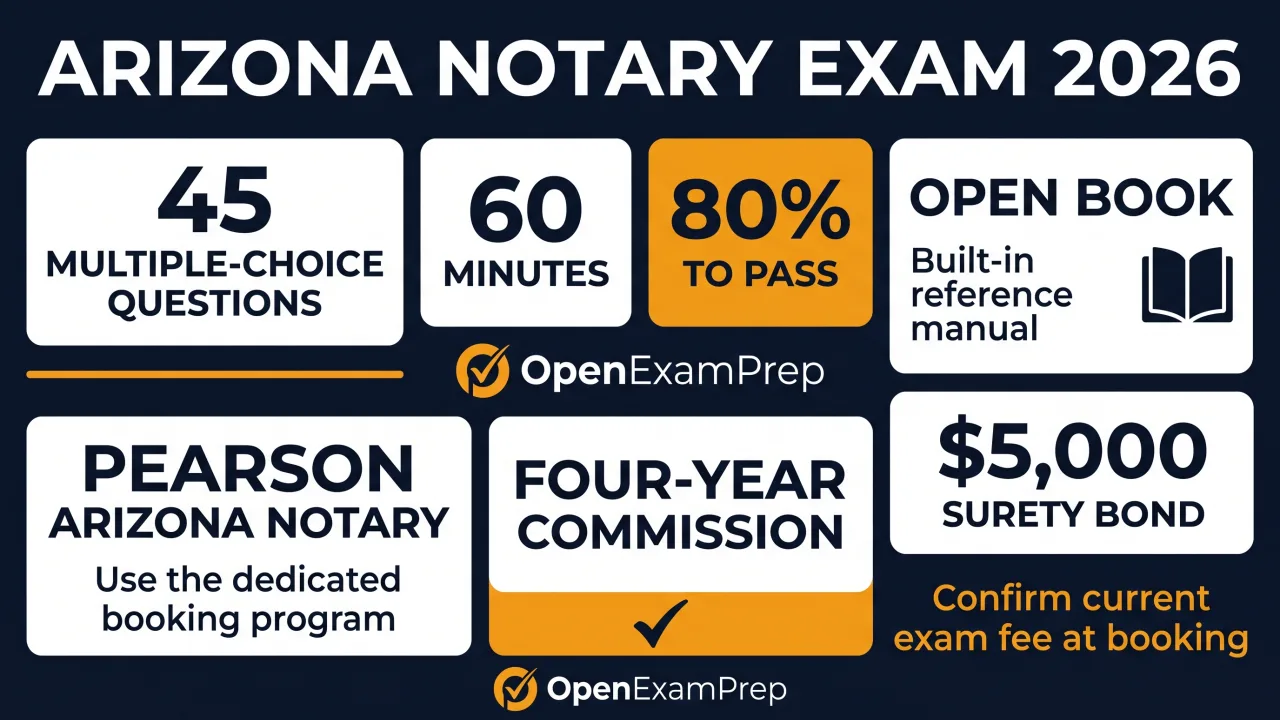
Arizona's notary competency exam is required for new and renewing applicants. The state lists 45 multiple-choice questions in 60 minutes, an 80% passing score (36 correct answers), and a reference manual available inside the exam. As of September 18, 2026, schedule through Pearson VUE's dedicated Arizona Notary program, not an old real-estate or Prometric booking page. This guide connects the official exam rules to a study plan and the paperwork that follows a pass.
The Arizona Secretary of State's notary page contains both a newer Pearson notice and older Prometric paragraphs. Pearson's September 17 scheduling notice gives the dated change: from September 18, all Arizona Notary candidates use the dedicated program and candidates with an earlier real-estate testing profile create a new Notary profile. Check the live booking screen for appointment, fee, and retake terms before paying.
The exam in one minute
| Item | Current published information |
|---|---|
| Who needs it | New and renewing Arizona notary applicants since July 1, 2025 |
| Questions and time | 45 multiple-choice questions; 60 minutes |
| Passing standard | 80%, equivalent to at least 36 of 45 correct |
| Reference | The official Notary Public Reference Manual is built into the exam; no physical copy |
| Booking | Pearson Arizona Notary program |
| Exam fee | The Secretary of State's Pearson notice says $35 per proctored attempt; confirm the amount in your Pearson checkout |
| Retake | That Pearson notice says 30 days after a third failure; confirm earlier-attempt and current scheduling rules in the account |
| Passing-result life | 90 days under the Secretary of State's Reference Manual; plan the application within that window |
These are exam numbers. OpenExamPrep's practice-question count is a separate study inventory, never the number of questions on the state test. Arizona has not published reliable percentages for individual notary-law topics; any six-topic percentage chart is a study organizer, not an official blueprint.
The exam's open-book label can mislead. The Secretary of State says a link to the manual appears in the testing system once the exam begins and outside paper copies are prohibited at both a center and a remote session. Sixty minutes for 45 questions gives about 80 seconds per question. You need to recognize common duties quickly and reserve lookups for exact wording, exceptions, and numbers.
Register through the right program before completing the application
The Secretary of State's new-notary filing tips instruct applicants to register for the exam and obtain a Candidate ID before completing the commission application. Start at the dedicated Pearson Arizona Notary page, create an account with your legal name exactly as it appears on your government ID, and check the available exam and test-center appointments. A pre-September-18 profile used for notary testing through Pearson's Arizona Real Estate program does not replace the new Notary profile; Pearson expressly requires a new profile for future appointments.
Pearson also has an Arizona Notary OnVUE page with remote-testing requirements. It is evidence of a current remote-testing pathway, but it is not a promise that an appointment is available at every moment or for every candidate. Check your account. If using OnVUE, run Pearson's system test on the same device and network you will use, verify your ID matches the booking, and prepare the required private workspace. If those conditions are difficult to meet, compare a test-center appointment. The older Prometric-specific remote-suspension notice on the Secretary of State's page should not be treated as a blanket current Pearson policy.
Remote testing and remote notarization are different permissions. Taking an exam through OnVUE does not authorize remote notarial acts: you need an active Arizona commission and the separate Secretary of State authorization required for the electronic or remote service you intend to perform. Complete that registration and receive approval before offering those acts.
The fee and retake text need the same care. The Secretary of State's Pearson notice quotes $35 per attempt and a 30-day wait after a third failed attempt. An older paragraph and the January 2025 manual instead discuss Prometric, $46.75, a wait after each failure, and a year after three failures. Do not combine the old and new schedules into a new rule. Use the current Pearson program to verify the charge and your next eligible date if you need to rebook.
Eligibility and the application sequence
Under A.R.S. § 41-269(B), a commission applicant must be at least 18, a U.S. citizen or permanent legal resident, able to read, write and understand English, and an Arizona resident for income-tax purposes who claims an Arizona primary residence on state and federal returns. The statute also requires no disqualification, the exam when required, and a Secretary-approved manual kept for reference. Confirm your own eligibility before spending money on a bond or exam.
For a first commission, follow this practical order:
- Open the Pearson Arizona Notary account and obtain a Candidate ID. Use the legal name on your government ID. The Secretary of State asks for the ID before you complete its application.
- Study the manual and take the exam. The Secretary's published standard is 80% on 45 questions. Keep your passing result and note its 90-day validity.
- Arrange the bond and oath. A.R.S. § 41-269 requires a $5,000 surety bond covering the four-year commission; the oath of office must be executed before issuance. A bond protects claimants, not the notary personally.
- Submit the original signed application, original notarized bond, and filing fee together. The Secretary of State lists a $43 filing fee and provides the current mailing or in-person filing instructions. An application document itself must not be older than 90 days under the manual; this is a separate clock from the 90-day passing-score life.
- Wait for the commission certificate before acting as a notary. Check the commissioned name, county and dates, then obtain a compliant stamp and journal. A pass alone is not a commission.
For renewals, the Secretary of State says applications may be filed up to two months before expiration. That is a renewal filing window, not the score-validity rule. Work backward from both dates so the exam result remains valid when you apply and the current commission does not lapse. The office lists an approximate processing time of four weeks, which is a planning estimate rather than a guaranteed completion date.
What to study, without inventing topic weights
Arizona says the questions come from the Notary Public Reference Manual. The file hosted under an “Aug-2026” filename still identifies its text as the January 2025 edition on its opening pages. Use the manual as the exam's announced source, and check current statutes for duties that changed after that edition. The state has not supplied a dependable domain-percentage blueprint, so spend time on the decisions a notary actually faces:
- Commission and impartiality. Know who qualifies, who owns the commission and seal, why the bond is required, and when you may refuse or must avoid a conflict. Passing the exam does not authorize legal advice or turn a signing agent into an attorney.
- The requested notarial act. The Secretary of State lists acknowledgments, jurats or verifications on oath or affirmation, copy certifications, and oaths or affirmations. For an acknowledgment, the signer acknowledges a signature; the document can have been signed before appearing. For a jurat, the notary administers the oath or affirmation and observes the required signing. Do not swap their certificates just because both involve a signature.
- Identity and appearance. Personal appearance and satisfactory identity evidence are separate checks. If the signer lacks an acceptable ID, the manual describes personal knowledge and a properly qualified credible witness route; a witness must know the signer and meet the manual's documentation and oath steps. An absent signer cannot be cured by a relative's assurance.
- Journal and seal. A.R.S. § 41-319 requires a paper journal for acts involving tangible records and permits a paper or electronic journal for electronic records, subject to its exceptions and public/confidential record rules. A journal entry includes the act date, document and act description, signer details, identity evidence and fee; paper entries generally include the signer's signature. Keep the seal secure and check official-stamp requirements and device-custody rules before ordering one.
- Fees and prohibited conduct. The manual's fee schedule allows no charge up to $10 per notary public signature for an acknowledgment or jurat, per certified page for copy certification, or per oath/affirmation. The manual prohibits service or transaction fees. A.R.S. § 41-316 limits allowed travel compensation to applicable state-employee mileage and per-diem amounts. Do not choose a certificate's legal effect for a signer, backdate an act, or notarize your own signature.
Think in decision sequences, not isolated flashcards. Suppose a customer hands you an affidavit already signed and asks for a jurat. First identify the requested act and its certificate, then verify appearance and identity, administer the oath or affirmation, and address the signing requirement. If a customer instead asks for an acknowledgment, do not reject it merely because they signed before arrival; verify the applicable act and their acknowledgment. The manual's notarial-act checklists are the reference for the exact steps.
For a second drill, imagine a signer has no qualifying ID but brings a friend. “Friend” alone is not the rule. Test whether the credible person actually knows the signer, can provide required evidence, takes the required oath, and is properly documented in the journal. That produces a better exam answer than either automatically accepting or automatically refusing every witness.
The September 2026 thumbprint change
SB 1479, Chapter 31 took effect September 12, 2026. It amended A.R.S. § 41-254 to require the signer's right thumbprint in the journal for a deed, quitclaim deed, deed of trust, other document affecting real property, or power of attorney. If the right thumb is unavailable, use the left thumb or another available finger and note the substitution. If the person physically cannot provide a print, note and explain that condition.
The statute has important exceptions. The thumbprint requirement does not apply to a trustee's deed arising from judicial or nonjudicial foreclosure, a deed of release and reconveyance, or a qualifying remote act under § 41-263 when the journal contains the credential number and the audiovisual recording is kept at least seven years. For the full decision tree, use our Arizona journal and thumbprint guide. Because the hosted reference manual still bears a January 2025 text version, do not assume its silence cancels a later effective statute—or assume the state has published a revised exam topic percentage for the new rule.
A seven-day open-book study plan
This is a practice schedule, not an official hour requirement or a promised pass rate. Adapt it to your familiarity with the law.
| Day | Work product |
|---|---|
| 1 | Read the official manual's contents and exam page; write a one-line map to eligibility, acts, identity, journal, fees and RON chapters. |
| 2 | Drill acknowledgment versus jurat using two original signer scenarios; say aloud what the signer and notary each must do. |
| 3 | Work identity and appearance decisions: ID, personal knowledge, credible person, absent signer and reason to refuse. |
| 4 | Practice journal and seal situations, then compare January 2025 manual wording with the September 2026 thumbprint law. |
| 5 | Review commissioning numbers and paperwork: 45/60/80, 90-day score, $5,000 bond, $43 filing fee and four-year term. |
| 6 | Take a mixed timed set. For every miss, record the controlling manual chapter or current statute and why the tempting option fails. |
| 7 | Do a 45-question, 60-minute simulation using only a manual-style lookup. Revisit weak decisions and test your booking setup. |
Use our free Arizona notary practice questions and Arizona notary study guide for independent practice. The local Arizona bank currently contains 107 original study questions; that inventory is not the 45-question state exam, does not reproduce live items, and may change as the bank grows. The nine decision scenarios are useful after reading the rules. For a tighter final-hour plan, use the open-book exam-day checklist.
During a timed set, make a first pass through rules you know, mark uncertain questions, and use the built-in manual for the narrow wording that will change your answer. The 80-second average is a budget, not a rule requiring exactly 80 seconds on each item. Afterward, classify misses by act, identity, journal, fee, or commission step. Reread the source section and explain the correction before trying another set; repeatedly guessing the same item is not learning the procedure.
Exam day and after the result
For a test center, follow your Pearson confirmation and carry the required matching government ID. For an OnVUE appointment, follow Pearson's Arizona Notary remote rules, including the same-device system test, one-screen setup, private room and check-in process. The reference manual is available in the exam; external books, notes and paper are not permitted merely because the test is called open-book. Check accommodations with Pearson before booking if needed.
After a pass, keep the result and complete the bond, oath and commission application while the 90-day score window remains open. The Secretary of State's filing instructions control the forms and destination. If you do not pass, use your score feedback to revisit the exact manual sections you missed, then confirm your personal retake eligibility in the dedicated Pearson account. Do not rely on a mixed Prometric/Pearson retake table copied from older pages.
The goal is not merely to memorize the answer “80%.” A notary must know when to perform an act, when to ask for better evidence, when to consult the manual, and when to stop. Use the state sources above for the rules, then use free practice to make those decisions quickly and consistently.

 Course Playlist
 Free CE
 Buy on Amazon
 Arizona notary training
 Take courses on Udemy