 View
ViewWhy High-Visibility Safety Vests Are Non-Negotiable on Construction Sites
Every year, struck-by incidents kill approximately 75 construction workers in the United States. OSHA classifies struck-by hazards as one of the "Fatal Four" — the four leading causes of construction fatalities that together account for more than 60% of all construction deaths. A high-visibility safety vest is the single most effective piece of PPE for preventing struck-by incidents involving vehicles and mobile equipment.
This is not optional equipment. OSHA regulation 29 CFR 1926.201 requires flaggers to wear high-visibility warning garments on construction sites. OSHA 29 CFR 1926.651(d) extends this requirement to workers exposed to vehicular traffic in excavation zones. And the FHWA Manual on Uniform Traffic Control Devices (MUTCD) mandates ANSI Class 2 or Class 3 apparel for all flaggers and traffic control personnel.
If you are studying for your OSHA 30 Construction certification, understanding PPE requirements — including high-visibility apparel classifications — is a core exam topic. If you are preparing for your CDL skills test, many state testing locations require you to show up wearing a hi-vis vest.

High Visibility Safety Vest – ANSI Class 2 Breakaway with 5 Pockets
by Generic
$13.99
- ANSI Class 2 certified with breakaway hook-and-loop closures for entanglement safety
- 5 pockets for phone, pen, radio, and notepad — ideal for construction site supervisors
- Most popular choice — adjustable fit with reflective strips for 360-degree visibility
ANSI/ISEA 107: Understanding Visibility Classes
The American National Standards Institute (ANSI) and the International Safety Equipment Association (ISEA) jointly publish ANSI/ISEA 107-2020, the standard that defines high-visibility safety apparel. Every safety vest sold in the United States references this standard — and understanding the three classes is essential for OSHA 30 exam candidates.
Class 1 — Low-Traffic Environments
Class 1 provides the minimum level of visibility. Requirements:
- 217 square inches of fluorescent background material
- 155 square inches of retroreflective striping
Where it is appropriate: Parking lots, warehouse grounds, residential delivery, shopping cart retrieval — any environment where traffic speeds are below 25 mph and workers are well-separated from vehicle paths.
Where it is NOT appropriate: Construction sites, roadways, CDL operations, or anywhere with active vehicular traffic. Using a Class 1 vest on a construction site is an OSHA violation.
Class 2 — The Construction Standard
Class 2 is the minimum for construction, roadwork, and CDL operations. Requirements:
- 775 square inches of fluorescent background material (3.5x more than Class 1)
- 201 square inches of retroreflective striping in horizontal and vertical bands providing 360-degree visibility
Where it is required: Construction zones, utility work, highway maintenance, CDL skills testing, flagging operations on roads up to 50 mph, and any OSHA-regulated job site with vehicular traffic.
All five vests reviewed in this guide are ANSI Class 2 certified — they meet or exceed the 775/201 square inch minimums for construction and CDL use.
Class 3 — Maximum Visibility
Class 3 provides the highest conspicuity with coverage extending to sleeves and legs. Requirements:
- 1,240 square inches of fluorescent background material
- 310 square inches of retroreflective striping on torso AND limbs
Where it is required: High-speed roadways above 50 mph, nighttime construction, low-visibility conditions (fog, rain, dawn/dusk), and any environment where maximum conspicuity is needed. Many state DOTs mandate Class 3 for nighttime flagging.
For the OSHA 30 exam: Know the distinction between Class 2 and Class 3, and understand that the class requirement escalates with traffic speed and visibility conditions. Practice these concepts with our free OSHA 30 study materials.
OSHA Requirements: What the Regulations Actually Say
29 CFR 1926.201 — Signaling (Construction)
This is the primary OSHA regulation governing high-visibility apparel on construction sites. It requires flaggers to wear high-visibility warning garments while flagging. OSHA references ANSI/ISEA 107 as the performance standard — meaning a vest must meet Class 2 or Class 3 to satisfy this requirement.
29 CFR 1926.651(d) — Excavations
Workers exposed to vehicular traffic in excavation zones must wear warning vests or other suitable garments meeting ANSI/ISEA 107 Class 2. This applies to any excavation near a roadway, parking area, or construction haul route.
OSHA General Duty Clause — Section 5(a)(1)
Even when no specific standard applies, OSHA can cite employers under the General Duty Clause for failing to protect workers from recognized struck-by hazards. If workers are operating near vehicles or mobile equipment without high-visibility apparel, a General Duty Clause citation is likely.
OSHA's "Fatal Four" Connection
Struck-by incidents are tested extensively on the OSHA 30 exam. The four leading causes of construction fatalities are:
- Falls — 33.5% of construction deaths
- Struck-by — 11.1% of construction deaths
- Electrocution — 8.5% of construction deaths
- Caught-in/between — 5.5% of construction deaths
High-visibility apparel directly addresses the struck-by category. Exam questions frequently test candidates on the Fatal Four categories, the specific OSHA standards that address each one, and the PPE requirements for each hazard type. Study these topics with 10 free AI questions per day at OpenExamPrep.

JKSafety 9 Pockets Class 2 High Visibility Zipper Front Safety Vest
by JKSafety
$16.99
- 9 pockets including tablet-sized interior pocket for iPads and plan documents
- Zipper front provides secure fit — prevents flapping and pocket spillage on active job sites
- ANSI/ISEA Class 2 certified with premium reflective striping for day and night visibility
CDL Skills Test: Do You Need a High-Vis Vest?
The answer depends on your state, but the safe answer is yes — always bring one.
State Requirements Vary
Several states explicitly require CDL candidates to wear high-visibility safety apparel during the skills test:
- Texas — DPS requires a safety vest for the pre-trip inspection and backing maneuvers
- California — Many DMV field offices require hi-vis during the entire vehicle inspection portion
- Ohio — CDL testing sites list safety vest as required equipment alongside warning triangles and fire extinguisher
- Pennsylvania — PennDOT recommends hi-vis apparel and some examiners will not proceed without it
Even in states where it is not formally required, wearing a Class 2 vest signals to the examiner that you understand professional safety practices. CDL examiners evaluate your safety awareness throughout the test — a hi-vis vest is a visible demonstration of that awareness.
Best Vest for CDL Test Day
For the CDL skills test specifically, you want a simple, lightweight vest without excessive pockets or bulk. The Neiko No-Pocket vest ($4.95) is the ideal choice: ANSI Class 2 certified, elastic sides for universal fit, neon yellow with reflective strips, and light enough that you will barely notice wearing it during the pre-trip walk-around. At under five dollars, there is no reason not to have one in your cab.
Keep a second vest in your truck permanently. Once you have your CDL and start driving professionally, you will need a hi-vis vest for any time you exit the cab near loading docks, fuel islands, or breakdown lanes. Study CDL pre-trip inspection procedures and safety regulations with our free CDL study guide.

Neiko High Visibility Safety Vest ANSI Class 2, No Pocket
by Neiko
$4.95
- Most affordable ANSI Class 2 vest at under $5 — perfect for CDL skills test day
- No pockets for ultra-lightweight wear — elastic sides provide universal fit
- Neon yellow with reflective strips meets OSHA and FHWA MUTCD minimum requirements
Breakaway vs Zipper-Front: Which Design Is Safer?
This is one of the most common questions from construction workers buying their first quality safety vest, and the answer depends on your work environment.
Breakaway Design — Best for Construction Zones
Breakaway vests use hook-and-loop (Velcro) or snap closures at the shoulders, sides, and front. If the vest catches on moving equipment, a conveyor belt, scaffolding, or any rotating machinery, the closures release under approximately 10-15 pounds of pulling force. The vest comes apart and you walk away instead of being dragged into the hazard.
Choose breakaway if you work near:
- Heavy equipment (excavators, loaders, cranes)
- Conveyor belts and material handling systems
- Rotating machinery (concrete mixers, augers)
- Scaffolding and formwork with snag points
- Any environment where entanglement is a recognized hazard
The ANSI Class 2 Breakaway with 5 Pockets ($13.99) is the most popular breakaway vest for construction — it balances pocket utility with breakaway safety and fits the widest range of workers with adjustable hook-and-loop sizing.
Zipper-Front — Best for Tool-Carrying Professionals
Zipper-front vests provide a secure, snug fit that stays closed during active movement. The zipper prevents the vest from flapping open, which matters when your pockets are loaded with a radio, phone, pen, notepad, and measuring tape. A flapping vest dumps your gear on the ground — and bending over to pick up tools in a traffic zone creates its own struck-by hazard.
Choose zipper-front if you:
- Carry multiple tools and devices in your vest pockets
- Work as a site supervisor, inspector, or surveyor
- Need a tablet pocket for plan review on-site
- Prefer a tailored fit that does not shift during ladder climbing
The JKSafety 9-Pocket Zipper Front ($16.99) is the premium choice for professionals who use their vest as a mobile tool organizer. Nine pockets including an interior tablet pocket give you access to everything without wearing a separate tool belt.
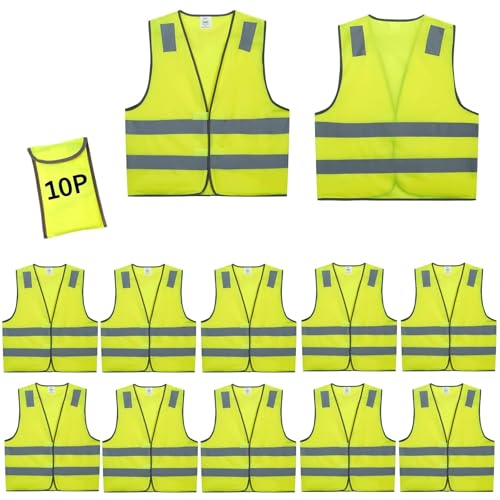
Lavori-AK Safety Vests 10 Pack - ANSI Class 2
by Lavori-AK
$32.99
- 10-pack bulk value at $3.30 per vest — ideal for construction crews and training programs
- ANSI Class 2 certified with neon yellow background and retroreflective striping
- Great for OSHA 30 training classes, CDL schools, and contractor onboarding kits
Reflective Strip Requirements and Nighttime Visibility
Retroreflective striping is what makes safety vests work at night. Understanding the requirements helps you evaluate vest quality and ensures OSHA compliance.
How Retroreflection Works
Retroreflective material returns light back to its source — when vehicle headlights hit the reflective strips, the light bounces directly back toward the driver rather than scattering in all directions. This is fundamentally different from simple reflective or "shiny" material. True retroreflective striping uses glass bead or microprismatic technology to achieve the return-to-source effect.
ANSI/ISEA 107 Reflective Strip Requirements
For Class 2 vests:
- Minimum 201 square inches of retroreflective striping
- Minimum width of 1.375 inches per strip (35mm)
- Must encircle the torso with at least one horizontal band
- Must include vertical bands on the front and back (shoulder to waist)
- Minimum retroreflectivity of 330 cd/lux/m2 at entrance angles typical of vehicle headlights
The 360-degree visibility requirement means both horizontal and vertical bands must be present — a vest with only horizontal bands does not meet Class 2 specifications, even if the total square inches are sufficient.
Nighttime Visibility Distance
A properly retroreflective Class 2 vest is visible to drivers at approximately 1,000 feet in low-beam headlight conditions. At highway speeds of 55 mph, a vehicle covers approximately 80 feet per second — 1,000 feet of visibility gives a driver roughly 12 seconds to react. Without a retroreflective vest, a worker in dark clothing may not be visible until 200-300 feet, giving the driver less than 3 seconds.
For the OSHA 30 exam: Understand the difference between fluorescent (daytime) and retroreflective (nighttime) visibility. Fluorescent material converts UV light into visible light, making the wearer stand out during daylight hours. Retroreflective material returns headlight illumination back to the driver at night. Both are required in Class 2 and Class 3 garments.
FHWA MUTCD Requirements for Flaggers
If you work as a flagger on highway or road construction projects, the Federal Highway Administration's Manual on Uniform Traffic Control Devices (MUTCD) sets additional requirements beyond OSHA.
MUTCD Section 6E.02 — Flagger High-Visibility Apparel
The MUTCD requires all flaggers to wear:
- ANSI/ISEA 107 Class 2 or Class 3 safety apparel
- Apparel must display both fluorescent and retroreflective materials
- The apparel must be the outermost garment — wearing a jacket over your safety vest defeats the purpose
State DOT Supplements
Many state DOTs have supplemented the federal MUTCD with stricter requirements:
- Some states require Class 3 for all nighttime flagging (not just Class 2)
- Several states mandate orange-red background color for flagger vests (instead of yellow-green)
- Some states require ANSI 107 Type R (for Roadway) performance class designation
Check your state DOT's supplement to the MUTCD before purchasing vests for flagger operations. For general construction work, any ANSI Class 2 vest in yellow-green or orange-red meets federal requirements.

JKSafety Safety Vest Hi Vis Construction with Pockets Class 2
by JKSafety
$14.99
- ANSI Class 2 construction-grade with multiple pockets for daily job site use
- High-visibility reflective strips provide 360-degree conspicuity in all lighting conditions
- Durable construction holds up to daily wear — built for working professionals on active sites
Bulk Purchasing for Construction Crews and Training Programs
If you manage a construction crew, run an OSHA 30 training program, or operate a CDL school, buying vests individually makes no sense financially.
The Economics of Bulk Vests
| Purchase Method | Cost Per Vest | 10-Worker Crew Cost |
|---|---|---|
| Individual premium vest | $14-17 | $140-170 |
| Individual budget vest | $5 | $50 |
| 10-pack bulk | $3.30 | $32.99 |
The Lavori-AK 10-Pack ($32.99) delivers ANSI Class 2 certification at $3.30 per vest — less than a large coffee. For construction companies that burn through vests due to job site wear and tear, bulk purchasing ensures you always have clean, compliant vests available for new hires, visitors, and replacements.
Training Program Applications
OSHA 30 training courses should include hands-on PPE identification exercises. Having a supply of ANSI Class 2 vests lets students physically inspect the labeling, identify the fluorescent background material and retroreflective striping, practice checking for compliance, and understand the visual difference between Class 1, Class 2, and Class 3 coverage areas.
CDL schools benefit similarly — every student needs a vest for skills test practice, and having a supply on hand means no one misses practice time because they forgot their gear.
Quick Comparison: Which Safety Vest Should You Buy?
| Feature | Generic Breakaway ($14) | JKSafety 9-Pocket ($17) | Neiko No-Pocket ($5) | Lavori-AK 10-Pack ($33) | JKSafety Construction ($15) |
|---|---|---|---|---|---|
| ANSI Class | Class 2 | Class 2 | Class 2 | Class 2 | Class 2 |
| Closure | Breakaway (hook-and-loop) | Zipper front | Elastic sides | Hook-and-loop | Hook-and-loop |
| Pockets | 5 | 9 (incl. tablet) | 0 | 0 | Multiple |
| Best For | Construction workers | Site supervisors | CDL test / backup | Crews / training | Daily job site |
| Bulk Value | No | No | No | Yes (10-pack) | No |
Decision framework:
- General construction worker? Get the Generic Breakaway 5-Pocket ($13.99) — best balance of safety, pockets, and price.
- Site supervisor or inspector? Get the JKSafety 9-Pocket ($16.99) — zipper front and tablet pocket for plan review.
- CDL skills test? Get the Neiko No-Pocket ($4.95) — lightest, cheapest, fully compliant.
- Outfitting a crew or training program? Get the Lavori-AK 10-Pack ($32.99) — $3.30 per vest.
- Daily job site wear? Get the JKSafety Construction ($14.99) — durable with pockets for tools.
How PPE Knowledge Helps on the OSHA 30 Exam
PPE is not a minor topic on the OSHA 30-Hour Construction exam — it is a dedicated module that covers selection, use, maintenance, and employer responsibilities for all categories of personal protective equipment. High-visibility apparel falls under the struck-by hazard prevention section, which connects to the Fatal Four analysis that appears throughout the exam.
Key OSHA 30 Exam Topics Related to High-Vis Apparel
- ANSI/ISEA 107 classification system — Class 1, 2, and 3 distinctions and when each is required
- 29 CFR 1926.201 requirements — who must wear high-visibility garments and under what conditions
- Fatal Four statistics — struck-by as a leading cause of construction fatalities
- Employer responsibilities — providing, maintaining, and replacing PPE at no cost to workers
- Hazard assessment — evaluating the worksite to determine appropriate PPE including visibility class
- MUTCD/DOT requirements — flagger apparel standards for highway construction
Key CDL Exam Topics Related to Safety Equipment
- Pre-trip inspection safety — wearing appropriate PPE during vehicle walkaround
- Emergency equipment — safety vest as part of the emergency kit alongside triangles and extinguisher
- Roadside breakdown procedures — deploying triangles and wearing hi-vis before exiting the travel lane
- Hazmat placard visibility — understanding conspicuity requirements for hazmat-placarded vehicles
Free OSHA 30 and CDL Exam Prep Resources
A high-visibility safety vest protects your body on the job site. Knowledge protects your career. Build both with these free resources:
- Free OSHA 30 Construction Study Guide — Complete coverage of all 30-hour construction topics including PPE, fall protection, electrical safety, excavation, scaffolding, and hazard communication
- Free CDL Exam Prep — Pre-trip inspection, general knowledge, air brakes, combination vehicles, and endorsement study materials
- AI Tutor — 10 free questions per day — ask about OSHA standards, PPE requirements, CDL regulations, or any construction safety topic
- Practice Questions — Test your knowledge with exam-style questions covering struck-by hazard prevention, PPE selection, and OSHA compliance
The AI tutor is particularly effective for OSHA scenario questions. Try asking "Walk me through a hazard assessment for a road construction zone — what PPE do I need for each worker role?" or "Explain the difference between ANSI Class 2 and Class 3 high-visibility requirements" and get detailed, exam-level explanations instantly.
Final Verdict
For most construction workers, the Generic ANSI Class 2 Breakaway with 5 Pockets ($13.99) is the best all-around choice. Breakaway safety, five usable pockets, adjustable fit, and ANSI Class 2 certification at a price that makes replacement painless.
For site supervisors and inspectors who carry tablets and multiple tools, upgrade to the JKSafety 9-Pocket Zipper Front ($16.99) — the secure zipper closure and nine pockets justify the $3 premium.
For CDL test day, grab the Neiko No-Pocket ($4.95) — lightweight, compliant, and cheap enough to keep one in every vehicle you drive.
For crews, training programs, and CDL schools, the Lavori-AK 10-Pack ($32.99) at $3.30 per vest is the obvious bulk choice.
Whatever vest you buy, make sure the label reads ANSI/ISEA 107 Class 2 — anything less does not meet construction or CDL requirements. And pair your PPE investment with serious exam preparation: start studying today with our free OSHA 30 study guide and CDL exam prep.
As an Amazon Associate, OpenExamPrep earns from qualifying purchases. All recommendations are based on editorial review.

 Free CE
 Take courses on Udemy
 7 Job Wiki
 Online course on Mometrix
 Practice exams on ExamEdge