 View
ViewWhy ANSI Z87.1 Safety Glasses Matter for Every Construction Trade
Eye injuries are one of the most preventable workplace hazards in construction — and one of the most common. The Bureau of Labor Statistics reports approximately 20,000 workplace eye injuries per year in the United States, with construction, manufacturing, and mining leading all industries. OSHA estimates that proper eye protection would prevent 90% of these injuries.
Whether you are studying for your OSHA 30 certification, preparing for a journeyman electrician license, earning your CWI welding credential, or getting your EPA 608 HVAC certification, understanding eye protection standards is both an exam topic and a career-long safety requirement. The standard that governs it all is ANSI Z87.1.
This guide covers what the ANSI Z87.1 standard actually requires, which safety glasses deliver the best protection and value for construction trades, and how eye protection fits into the OSHA regulations you will be tested on. Study for your certification exam for free with our OSHA 30 study guide.

3M Safety Glasses, Virtua, 20 Pair, ANSI Z87
by 3M
$44.99
- 3M brand industry standard — 20-pair bulk pack at ~$2.25/pair for job site crews
- ANSI Z87 certified with anti-fog and scratch-resistant clear lenses
- Best value for keeping spares in every vehicle, tool bag, and gang box
Understanding the ANSI Z87.1 Standard
ANSI Z87.1 is the American National Standard for Occupational and Educational Personal Eye and Face Protection Devices. Updated most recently in 2020, this standard defines the minimum performance requirements for safety eyewear sold in the United States. Here is what the testing actually involves.
Impact Resistance Testing
ANSI Z87.1 defines two levels of impact protection:
Basic Impact (Z87 mark): The lens must withstand a 25.4mm (1 inch) steel ball dropped from 127cm (50 inches). This tests resistance to moderate impact from falling tools, debris, and particles at lower velocities.
High Impact (Z87+ mark): The lens must survive a 6.35mm (1/4 inch) steel ball fired at 45.7 m/s (approximately 150 ft/s) for spectacles. This simulates high-velocity impacts from grinding, chipping, hammering, and power tool operations typical on construction sites.
For the exam: Know that the "+" mark (Z87+ or Z87.1+) indicates high-impact rating. Construction work generally requires high-impact rated eyewear because of the prevalence of power tools, grinding, and overhead work.
Optical Clarity Requirements
Beyond impact resistance, ANSI Z87.1 specifies optical quality requirements including:
- Prismatic deviation — lenses must not distort images or cause eye strain during extended wear
- Refractive power — non-prescription lenses must be optically neutral
- Haze and luminous transmittance — lenses must be clear enough for safe visibility
- Impact resistance after conditioning — lenses must maintain impact resistance after exposure to heat, UV radiation, and corrosive environments
Marking Requirements
Properly marked ANSI Z87.1 safety glasses carry specific marks on both the lens and frame:
- Lens markings: "Z87" (basic impact) or "Z87+" (high impact), plus the manufacturer's mark
- Frame markings: "Z87" on the frame itself, indicating the frame meets the standard
- Additional markings: "D3" for splash/droplet protection, "D4" for dust protection, "D5" for fine dust protection
If you cannot find the Z87 mark stamped on both the lens and frame, the glasses do not meet the standard. No mark means no compliance, regardless of what the packaging claims.
OSHA 29 CFR 1926.102: Eye Protection Requirements for Construction
OSHA's construction eye protection standard is straightforward but frequently tested on the OSHA 30 exam. Here are the key provisions every construction worker needs to know.
Employer Responsibilities
- Employers must assess the workplace for eye hazards (29 CFR 1926.102(a))
- Employers must provide eye protection that meets ANSI Z87.1 at no cost to employees (29 CFR 1926.102(a)(1))
- Eye protection must be reasonably comfortable and fit properly — ill-fitting PPE that workers refuse to wear does not satisfy the requirement
- Employers must ensure workers actually wear the required protection — providing it is not enough
When Eye Protection Is Required
OSHA requires eye protection whenever workers are exposed to:
- Flying particles — sawing, drilling, grinding, hammering, chipping, nailing
- Molten metal — welding, brazing, soldering, cutting
- Liquid chemicals — acids, solvents, cleaning agents, wet concrete
- Chemical gases and vapors — adhesives, coatings, sealants
- Potentially injurious light radiation — welding arcs, laser operations, UV exposure
On a typical construction site, this effectively means safety glasses are required in all active work areas. Even if you personally are not grinding or cutting, you may be exposed to hazards from adjacent workers.
Penalties for Non-Compliance
OSHA can issue citations for eye protection violations at these levels (2026 rates):
- Serious violation: Up to $16,131 per instance
- Willful or repeated violation: Up to $161,323 per instance
- Failure to abate: Up to $16,131 per day
These penalties apply to employers, not individual workers. However, workers who refuse to wear required PPE can face disciplinary action and termination. Understanding this framework is important for the OSHA 30 exam. Practice OSHA safety questions with our free OSHA 30 exam prep.

TICONN Anti-Fog Safety Glasses, ANSI Z87.1
by TICONN
$9.99
- ANSI Z87.1 certified with anti-fog coating and scratch-proof lenses
- Adjustable arms and nose piece for a custom, comfortable fit
- Wrap-around protection at a budget-friendly $9.99 single-pair price
Clear vs Tinted vs Amber: Choosing the Right Lens Color
Lens tint is not a cosmetic choice — it directly affects visibility and safety in different work environments. Choosing the wrong tint can be as dangerous as not wearing protection at all.
Clear Lenses — The Construction Default
Clear lenses are the standard for:
- Indoor construction — framing, drywall, electrical rough-in, plumbing, HVAC installation
- Electrical panel work — clear visibility is essential for reading wire colors and breaker labels
- HVAC equipment rooms — proper identification of refrigerant lines, wiring, and components
- Any work requiring accurate color perception — wire color codes, pipe labels, safety markings
Clear lenses transmit approximately 89-92% of visible light and introduce no color distortion. For electricians, this is non-negotiable — misidentifying a wire color because of tinted lenses can create a life-threatening hazard.
Gray or Smoke Tinted Lenses — Outdoor Work
Tinted lenses are appropriate for:
- Outdoor construction — roofing, concrete work, exterior framing, site grading
- Bright sunlight conditions — reduces glare and eye fatigue during full-day outdoor work
- Driving between job sites — some tinted safety glasses are suitable for driving
Gray lenses reduce brightness evenly across the spectrum without distorting color perception. They typically transmit 15-25% of visible light. Never use tinted lenses for indoor work — the reduced light transmission creates tripping hazards and makes it difficult to identify colors and read labels.
Amber or Yellow Lenses — Low-Light Enhancement
Amber lenses enhance contrast in:
- Basements and crawl spaces — improves visibility in dim conditions
- Overcast days and early mornings — enhances contrast when natural light is flat
- Parking garages and mechanical rooms — boosts visibility under fluorescent or LED overhead lighting
Amber lenses filter blue light and enhance contrast, making edges and details easier to see. They transmit approximately 75-85% of visible light — more than gray but less than clear.
Welding-Specific Lens Requirements
Standard safety glasses — even tinted ones — are NOT sufficient for welding. Welding operations require specialized lenses with shade ratings:
| Operation | Minimum Shade |
|---|---|
| Light torch brazing/soldering | Shade 3 |
| Medium torch cutting | Shade 4-5 |
| Gas welding | Shade 4-6 |
| MIG welding (light) | Shade 10-11 |
| MIG welding (heavy) | Shade 11-12 |
| Stick welding | Shade 10-14 |
| TIG welding | Shade 8-13 |
Welding safety is a significant topic on the CWI exam. Study welding safety and inspection requirements with our free CWI exam prep.

NoCry ANSI Z87.1 Clear Safety Glasses with Side Shields
by NoCry
$12.99
- Built-in side shields for maximum lateral impact protection
- Anti-fog and scratch-resistant lenses — ANSI Z87.1 certified
- Durable professional-grade construction for all-day comfort on the job
Anti-Fog Coatings: Why They Are Essential for Construction
Fogged safety glasses are the single biggest reason construction workers remove their eye protection on the job. Understanding why fogging occurs and how to prevent it is both a practical skill and a safety management concept tested on the OSHA 30 exam.
Why Construction Work Causes Fogging
Fogging occurs when warm, moist air contacts a cooler lens surface. Construction creates constant fogging conditions:
- Temperature transitions — walking from a heated interior to a cold exterior (or vice versa) causes instant condensation
- Physical exertion — heavy construction work generates body heat and perspiration that rises to the face
- Respirator use — N95 and half-face respirators direct exhaled air upward across the lens surface
- Humidity — wet trades (concrete, waterproofing, plumbing) create humid micro-environments
- Hot work — soldering, brazing, and welding generate heat that creates temperature differentials across the lens
How Anti-Fog Coatings Work
Anti-fog coatings use hydrophilic chemistry to change how moisture behaves on the lens surface. Instead of forming light-scattering droplets (fog), moisture spreads into a thin, transparent film that you can see through. There are two types:
Permanent anti-fog coatings are applied during manufacturing and integrated into the lens surface. These last the life of the lens and cannot be wiped off. Premium safety glasses like the Ergodyne Skullerz and NoCry models use permanent coatings.
Temporary anti-fog treatments are spray-on or wipe-on products that must be reapplied periodically. Budget safety glasses may come with a temporary coating that degrades after washing or extended use.
Anti-Fog Best Practices
- Do not wipe the inside of anti-fog lenses with dry cloths — this degrades the coating
- Rinse with water and air dry when cleaning anti-fog lenses
- Keep a spare pair available — switch when one pair fogs beyond recovery
- Ensure proper fit — gaps between the frame and face allow warm air to reach the lens from below
- Use anti-fog spray on budget glasses — a $5 spray can extend the useful life of bulk-pack glasses
Side Shields and Wrap-Around Protection
OSHA requires side protection when there is a hazard from flying objects entering from the side. On construction sites, this is almost always the case — debris, sparks, and particles can come from any direction.
Built-In Wrap-Around vs Removable Side Shields
Wrap-around safety glasses (like the 3M Virtua, TICONN, and OXG models) curve around the face to provide continuous coverage from front to side. This is the simplest and most common approach — no additional parts to attach or lose.
Removable side shields (available on the NoCry and Ergodyne models) attach to the temples of safety glasses to provide lateral protection. These are useful when you need to convert between standard and side-protected wear, but the additional components can be lost or forgotten.
For construction work, wrap-around designs are generally preferred — fewer parts, nothing to forget, and consistent protection. Removable side shields make more sense for workers who also need unshielded glasses for office or precision work.

OXG 12 Pack Safety Glasses, ANSI Z87.1
by OXG
$19.99
- 12-pack bulk value at ~$1.67/pair — ANSI Z87.1 impact resistant
- Anti-scratch clear lenses suitable for indoor construction and electrical work
- Great for stocking multiple pairs across job sites, vehicles, and tool boxes
When to Use Safety Glasses vs Goggles vs Face Shields
Choosing the correct level of eye protection is a key OSHA 30 exam topic. The decision follows a hazard-based hierarchy.
Safety Glasses — Impact and Particle Protection
Use safety glasses when the primary hazard is:
- Flying particles from sawing, drilling, hammering, or nailing
- Dust and debris from demolition, concrete cutting, or sweeping
- Light grinding or wire brushing operations
- General construction activities in active work zones
Safety glasses provide impact protection but have gaps around the edges that allow particles to enter from above, below, and the sides (mitigated by wrap-around designs and side shields).
Safety Goggles — Splash, Dust, and Chemical Protection
Switch to goggles when the hazard includes:
- Chemical splash — working with acids, solvents, adhesives, wet concrete (pH ~12-13, caustic)
- Fine dust — sawing concrete, sanding drywall, grinding masonry without dust collection
- Metal grinding sparks — heavy grinding operations where sparks and particles fly in all directions
- Overhead work — debris falling from above, directly toward the eyes
Goggles form a sealed barrier around the eyes, preventing particles and liquids from reaching the eye from any angle. Vented goggles allow airflow to reduce fogging while still blocking particles. Unvented goggles provide chemical splash protection.
Face Shields — Full-Face Protection
Add a face shield (worn over safety glasses or goggles) when the hazard involves:
- Severe chemical splash — handling concentrated acids, solvents, or caustic materials
- Heavy grinding — large angle grinders, bench grinders, cutting discs
- Cutting overhead — sawzall, circular saw, or rotary cutter above head height
- Chipping concrete — pneumatic chippers and jackhammers send large, high-velocity fragments
Important: Face shields are supplemental protection — they must be worn over safety glasses or goggles, not instead of them. A face shield alone does not meet OSHA eye protection requirements.
Study the complete PPE hierarchy with our free OSHA 30 exam study guide.
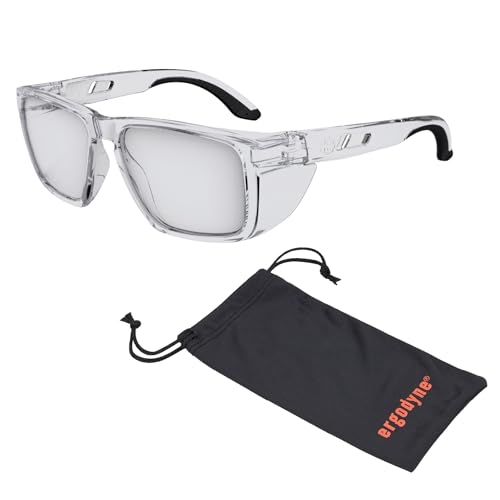
Ergodyne Skullerz SIXTEN Safety Glasses with Side Shields
by Ergodyne
$14.99
- Premium Ergodyne brand with anti-fog and anti-scratch ANSI Z87.1 lenses
- Side shields and protective case included — professional-grade optics
- Superior comfort for all-day wear during electrical, HVAC, and construction work
Prescription Safety Glasses: OSHA-Compliant Options
If you wear corrective lenses, you cannot simply wear your regular glasses on a construction site and call it eye protection. Regular prescription glasses do not meet ANSI Z87.1 impact resistance standards.
Three Compliant Options
Option 1: Prescription safety glasses (ANSI Z87.1) — Custom-made safety glasses with your prescription ground into ANSI Z87.1 rated lenses. These carry the Z87-2 mark on the lens, indicating prescription lenses meeting the standard. Available through occupational vision programs, safety supply companies, and some optometrists. Typical cost: $80-$250 depending on prescription complexity.
Option 2: Over-the-glass (OTG) safety glasses — Oversized safety frames designed to fit over your regular prescription glasses. These provide Z87.1 protection over your existing glasses. Less comfortable for all-day wear but much cheaper than prescription safety glasses. Typical cost: $8-$20.
Option 3: Safety goggles over prescription glasses — Large-frame safety goggles that accommodate prescription frames underneath. Provides the highest level of protection but is the bulkiest and least comfortable option. Best for short-duration tasks with high hazard levels.
For the exam: Know that employers must accommodate workers who require corrective lenses. The employer's hazard assessment must account for prescription-wearing workers, and compliant solutions must be provided at no cost to the employee.
Eye Protection Across Construction Trades
Different trades face different eye hazards. Here is how safety glasses requirements vary by specialty.
Electricians
Primary hazards: arc flash, flying wire fragments, dust from drilling through walls, chemical exposure from flux and cleaning solvents.
- Standard work: ANSI Z87.1+ clear safety glasses for general electrical work, panel installation, and wire pulling
- Arc flash exposure: NFPA 70E requires arc-rated face shields for work on energized equipment above certain hazard levels — safety glasses alone are not sufficient
- Drilling and cutting: Wrap-around or side-shield models when drilling through concrete, masonry, or wood for cable routing
Electricians preparing for their journeyman or master license should understand both OSHA PPE requirements and NFPA 70E arc flash protection standards. Study with our free journeyman electrician exam prep.
Welders
Primary hazards: intense UV and IR radiation, flying sparks and spatter, grinding particles, slag chips.
- Welding operations: Auto-darkening welding helmet with appropriate shade rating (shade 8-13 for most arc welding)
- Grinding between welds: ANSI Z87.1+ safety glasses or face shield — many welders keep safety glasses on under their welding helmet
- Inspection work: Clear ANSI Z87.1+ glasses when inspecting welds, reading WPS documents, and moving around the shop
CWI candidates should understand the complete range of welding PPE requirements. Study with our free CWI welding inspector exam prep.
HVAC Technicians
Primary hazards: refrigerant splash, chemical exposure from coil cleaners and solvents, metal shavings from ductwork fabrication, brazing splatter.
- Refrigerant handling: Chemical splash goggles when connecting or disconnecting refrigerant lines — liquid refrigerant causes instant frostbite on contact with skin or eyes
- Sheet metal work: ANSI Z87.1+ safety glasses with side shields when cutting, bending, and installing ductwork
- Brazing and soldering: Minimum shade 3 safety glasses when brazing copper refrigerant lines
EPA 608 candidates study refrigerant safety including proper PPE. Practice with our free EPA 608 exam prep.
The Five Best Safety Glasses for Construction Trades in 2026
After evaluating ANSI Z87.1 compliance, anti-fog performance, comfort, durability, and value, here are the five best options for construction professionals.
1. 3M Virtua 20 Pack — Best Bulk Value ($44.99)
The 3M Virtua is the safety glasses equivalent of buying socks in bulk — you need multiples, they get lost and damaged, and the smartest move is to always have spares available. At approximately $2.25 per pair, the 3M 20-pack lets you stock every vehicle, tool bag, and job box without thinking about the cost.
These are basic, no-frills ANSI Z87 certified glasses with anti-fog and scratch-resistant clear lenses. The polycarbonate lenses provide 99.9% UV protection and the lightweight frame weighs less than an ounce. They are not the most comfortable glasses for 10-hour days, but for a pair you grab, use, and do not worry about, they are unbeatable.
Best for: Job site supervisors, crew leads, and anyone who needs to keep multiple pairs available for workers and visitors. Also ideal for the apprentice building their PPE collection on a budget.
2. TICONN Anti-Fog Safety Glasses — Best Budget Single Pair ($9.99)
If you want one good pair of ANSI Z87.1 certified safety glasses at the lowest possible price, the TICONN delivers. Adjustable temple arms and nose piece let you customize the fit, the anti-fog coating handles temperature transitions, and the wrap-around design provides side protection without separate shields.
The scratch-proof lenses hold up to daily construction use better than the ultra-budget bulk options. At $9.99, you can afford to buy several — keep one in your tool bag and one in your truck.
Best for: Individual tradespeople who want a step up from bulk-pack glasses without spending $15+. Great starter pair for apprentices and students.
3. NoCry Safety Glasses with Side Shields — Best Side Protection ($12.99)
The NoCry glasses stand out with integrated side shields that provide maximum lateral protection — important for electricians working near open panels, HVAC technicians fabricating ductwork, and welders who need impact protection between welds.
Anti-fog and scratch-resistant coatings, ANSI Z87.1 certification, and a durable frame make these a solid professional choice. The side shields add coverage that wrap-around designs approximate but do not fully replicate, particularly for debris coming from directly beside the eye.
Best for: Electricians, HVAC technicians, and anyone working in environments with significant lateral debris hazards. A good primary pair for daily professional use.
4. OXG 12 Pack — Best Mid-Range Bulk Value ($19.99)
The OXG 12-pack splits the difference between premium single pairs and ultra-budget bulk packs. At approximately $1.67 per pair, these are actually cheaper per unit than the 3M 20-pack, with ANSI Z87.1 impact resistance and anti-scratch clear lenses.
The 12-count is practical — enough to distribute across multiple locations without the storage challenge of a 20-pack. These are straightforward, compliant safety glasses that do exactly what they need to do.
Best for: Small crews and independent contractors who want reliable bulk glasses at the lowest per-unit cost. Excellent for keeping in the work truck and sharing with helpers.
5. Ergodyne Skullerz SIXTEN — Best Premium Option ($14.99)
Ergodyne is a premium safety brand trusted across construction trades, and the Skullerz SIXTEN reflects that reputation. Anti-fog and anti-scratch ANSI Z87.1 lenses, integrated side shields, a protective case, and superior frame comfort make these the best option for all-day wear.
The optical clarity is noticeably better than budget options — less distortion, truer color perception, and less eye fatigue during long shifts. The included case protects the glasses in your tool bag or pocket. At $14.99, the premium over bulk glasses is minimal for a pair you will wear 8-12 hours daily.
Best for: Professionals who wear safety glasses all day, every day. The comfort and optical quality justify the small premium for your primary pair, especially electricians and inspectors who need clear vision for detailed work.
Free Exam Prep Resources for Construction Trades
Safety glasses are just one piece of your PPE knowledge for certification exams. Build your complete understanding with these free resources:
- Free OSHA 30 Study Guide — Complete coverage of construction safety standards including PPE, fall protection, scaffolding, electrical safety, excavation, and hazard communication
- Free Journeyman Electrician Exam Prep — NEC code, electrical theory, safety practices, and practical skills for the journeyman license
- Free CWI Exam Prep — Welding inspection, safety standards, and quality control for the Certified Welding Inspector credential
- Free EPA 608 Exam Prep — Refrigerant handling, safety, and environmental regulations for HVAC technicians
- AI Tutor — 10 free questions per day — ask about OSHA standards, PPE selection, trade-specific safety requirements, or any certification exam topic
The AI tutor is particularly useful for scenario-based safety questions. Try asking "When should I use goggles instead of safety glasses on a construction site?" or "Explain the OSHA PPE hierarchy of controls" and get detailed, exam-level answers instantly.
Final Verdict
For job site crews and supervisors, the 3M Virtua 20-pack ($44.99) is the clear winner — stock every vehicle and tool bag at $2.25 per pair. Supplement with the OXG 12-pack ($19.99) at an even lower per-unit cost.
For your primary daily-wear pair, choose between the NoCry ($12.99) for maximum side protection or the Ergodyne Skullerz SIXTEN ($14.99) for premium comfort and optics. Either is a significant upgrade from bulk glasses for all-day comfort.
For budget-conscious apprentices, the TICONN ($9.99) delivers ANSI Z87.1 compliance with adjustable fit at the lowest single-pair price.
The smart approach: buy bulk for spares and a premium pair for daily wear. A 3M 20-pack plus one Ergodyne Skullerz SIXTEN costs $59.98 total — less than a single OSHA citation, less than an emergency room copay, and enough eye protection to last months of hard construction work.
Whatever your trade, pair the right PPE with serious exam preparation. Start studying today with our free OSHA 30 certification study guide and practice questions.
As an Amazon Associate, OpenExamPrep earns from qualifying purchases. All recommendations are based on editorial review.

 Free CE
 Take courses on Udemy
 Flashcards on Mometrix

 Course Playlist