 View
ViewWhy Manual Blood Pressure Measurement Is a Non-Negotiable Nursing Skill
Every hospital floor has automatic blood pressure monitors on rolling stands, wall-mounted units in every patient room, and portable digital devices in supply closets. So why does every nursing program in the country still require you to learn manual blood pressure measurement with a sphygmomanometer and stethoscope?
Because automatic monitors fail when you need them most.
Digital BP monitors rely on oscillometric technology — they detect vibrations in the arterial wall as the cuff deflates. This works well on healthy patients sitting quietly in a controlled environment. It works poorly (or not at all) in the situations where accurate blood pressure matters most:
- Arrhythmias (atrial fibrillation, frequent PVCs) — irregular heartbeats produce erratic oscillometric signals, leading to inaccurate or "error" readings
- Hypotension — critically low blood pressure generates weak oscillations that digital monitors struggle to detect
- Tremors or excessive movement — Parkinson's, shivering, seizures, or agitated patients create motion artifact
- Shock — peripheral vasoconstriction in shock states makes oscillometric detection unreliable
- Obesity — very large arms require special cuffs and can produce unreliable digital readings
In these clinical scenarios, the nurse who can pick up a manual sphygmomanometer, place a stethoscope over the brachial artery, and auscultate an accurate blood pressure is the one providing reliable data for treatment decisions. That nurse needs to be you.
Manual BP measurement is tested on every nursing skills checkoff. It is a required competency for NCLEX-RN, NCLEX-PN, CNA certification, and NREMT exams. You will be asked to demonstrate the full auscultatory technique — proper cuff placement, brachial artery palpation, inflation, controlled deflation at 2-3 mmHg per second, and identification of Korotkoff sounds — before you are cleared for clinical rotations.
This guide reviews the 5 best manual blood pressure cuffs for nursing students in 2026, explains how to choose the right one, and covers proper BP measurement technique so you are ready for your skills checkoff.
How to Choose a Manual Blood Pressure Cuff for Nursing School
Not all sphygmomanometers are created equal. Here are the four factors that matter most when choosing one for nursing school.
1. Cuff Size and Fit
This is the single most important factor for accurate BP measurement. The American Heart Association recommends that the cuff bladder should encircle at least 80% of the adult upper arm circumference (and span about 40% of the arm's width). Using the wrong size cuff is the most common source of BP measurement error in clinical settings — and it is a testable concept on NCLEX exams.
- Standard adult cuff — fits arm circumferences of approximately 10-16 inches (25-40 cm)
- Universal adult cuff — wider range, typically 8.7-16.5 inches or similar
- Large adult cuff — for arm circumferences above 16 inches (clinical sites provide these)
For your personal cuff, a standard or universal adult size covers the vast majority of practice scenarios. You will practice on classmates, family members, and yourself — all of whom are likely within the standard adult range. In clinical settings, the facility provides specialty-sized cuffs (pediatric, large adult, thigh) for patients who need them.
Sizing errors to avoid on exams:
- Cuff too small (undercuffing) = falsely high reading
- Cuff too large (overcuffing) = falsely low reading
2. Gauge Quality and Readability
The aneroid gauge is the dial that displays the pressure reading. A quality gauge has:
- Clear, easy-to-read markings — you will be reading this gauge in dimly lit patient rooms and while simultaneously listening for Korotkoff sounds through your stethoscope
- Accurate zero point — the needle should rest at exactly 0 mmHg when the cuff is deflated
- Calibration capability — student-grade gauges can drift out of calibration if dropped or bumped; models that include a calibration tool let you re-zero the gauge without replacing it
- Durable lens — a scratched or cracked gauge lens makes reading difficult and can obscure critical markings
3. Latex-Free Materials
Latex allergies affect approximately 8-17% of healthcare workers — a significantly higher rate than the general population due to repeated latex exposure. All five cuffs in this guide use nylon or latex-free materials, which is increasingly the standard for healthcare equipment. If you buy a cuff not on this list, confirm that both the cuff and the inflation bladder are latex-free before bringing it into a clinical setting.
4. Carrying Case and Portability
You will transport your sphygmomanometer to skills lab, clinical rotations, and home practice sessions. A carrying case that keeps the cuff, gauge, and inflation bulb organized (and protects the gauge from drops) is not a luxury — it is practical necessity. Most student-grade cuffs include a nylon zippered case. The MDF Calibra includes a more robust case given its higher price point.
Product Comparison: All 5 Blood Pressure Cuffs at a Glance
| Sphygmomanometer | Price | Cuff Range | Calibration Tool | Latex-Free | Warranty | Best For |
|---|---|---|---|---|---|---|
| PARAMED | $20.95 | 8.7-16.5" (universal) | Yes | Yes | 1 year | Best overall value |
| FriCARE | $18.99 | Universal adult (~8.7-16.5") | No | Yes | 1 year | Nursing students (FSA/HSA eligible) |
| Dixie EMS | $16.95 | Standard adult | Yes | Yes | 1 year | Tightest budget |
| MDF Calibra | $36.99 | Standard adult | Yes | Yes | Lifetime | Long-term investment |
| LotFancy | $17.99 | 10-16" | No | Yes | 1 year | Solid budget pick |
Our Top 5 Manual Blood Pressure Cuffs for Nursing Students (2026)
1. PARAMED Aneroid Sphygmomanometer — Best Overall Value
The PARAMED is the most popular manual blood pressure cuff among nursing students, and for good reason: it delivers a complete package — universal cuff, carrying case, and calibration tool — for $20.95. That is less than the cost of a single nursing textbook chapter printout at the campus bookstore.
Why it is the top pick: The PARAMED's universal adult cuff fits arms from 8.7 to 16.5 inches, which is a wider range than most standard adult cuffs. This matters because you will practice BP measurement on classmates with varying arm sizes, and a cuff that fits everyone in your skills lab group means fewer "I cannot get a reading" frustrations during practice. The wider range also means this cuff works on a broader patient population during clinical rotations.
The calibration tool matters: Student sphygmomanometers get dropped. They get tossed into bags, knocked off counters in busy skills labs, and jostled during transport. Every impact can shift the gauge calibration. The PARAMED includes a small calibration tool that lets you re-zero the gauge when the needle drifts from 0 mmHg — extending the usable life of the instrument without needing to replace it.
Key features for nursing students:
- Universal adult cuff (8.7-16.5 inches) — fits the widest range of arm sizes in this review
- D-ring cuff — the PARAMED cuff also includes a D-ring, so you can wrap it one-handed for self-measurement practice
- Latex-free nylon cuff — safe for students and patients with latex allergies
- Included calibration tool — re-zero the gauge after drops or bumps
- Zippered carrying case — protects the gauge during transport to clinicals
- Professional-grade aneroid gauge — clear markings for accurate reading during auscultation
Pros:
- Best overall package for nursing students — universal cuff, case, and calibration tool for $20.95
- Widest cuff range (8.7-16.5 inches) accommodates more arm sizes than competitors
- Latex-free construction is standard for all clinical environments
- Calibration tool extends the life of the gauge
- Durable enough for daily skills lab practice and clinical use
Cons:
- At $20.95, it costs $4 more than the cheapest option (Dixie EMS at $16.95)
- Universal cuff can feel bulky on smaller arms
- Gauge accuracy is student-grade — adequate for learning but not equivalent to premium clinical gauges
- Inflation bulb may require a firmer grip than some premium models
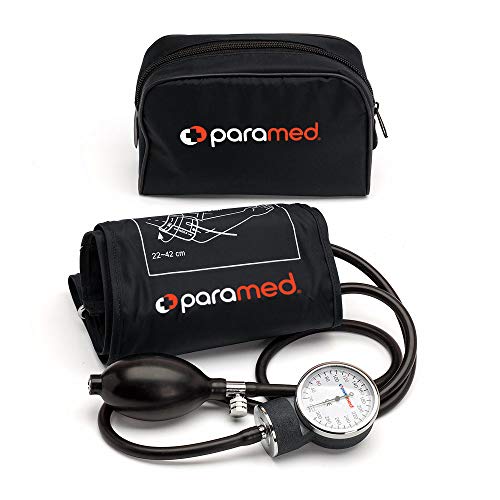
PARAMED Aneroid Sphygmomanometer – Manual Blood Pressure Cuff with Universal Cuff
by Paramed
$20.95
- Professional aneroid sphygmomanometer with universal adult cuff
- Includes carrying case and calibration tool
- Latex-free nylon cuff fits arms 8.7-16.5 inches
2. FriCARE Manual Blood Pressure Cuff — Best Designed for Students
The FriCARE is the only sphygmomanometer in this guide specifically marketed and designed for nursing students. At $18.99, it sits in the middle of the price range and offers a feature that budget competitors lack: an easy-to-read gauge with a no-pin stop mechanism that makes learning BP measurement less frustrating for beginners.
The no-pin stop advantage: Traditional aneroid gauges have a small pin at the zero point that stops the needle from going below 0. Some cheap gauges have poorly placed pins that make it difficult to tell if the needle is truly at zero or just resting against the pin. The FriCARE's no-pin stop design lets the needle move freely past zero, making it easier to verify accurate calibration — a small detail that matters when you are learning to read the gauge for the first time.
FSA/HSA eligible: The FriCARE is eligible for purchase with Flexible Spending Account (FSA) or Health Savings Account (HSA) funds. If you have pre-tax healthcare dollars available, this effectively reduces the after-tax cost by 20-35% depending on your tax bracket.
Key features for nursing students:
- Designed for nursing students — ergonomics and gauge readability optimized for learners
- FSA/HSA eligible — purchase with pre-tax healthcare funds
- No-pin stop gauge mechanism — easier calibration verification for beginners
- Latex-free materials — safe for clinical environments
- Universal adult cuff sizing — the current FriCARE listing ships a universal adult cuff (roughly 8.7-16.5 inches), not a narrow standard cuff
Pros:
- Specifically designed for nursing student use — not a repurposed clinical or home-use model
- Universal adult cuff fits a wide range of arm sizes, comparable to the PARAMED
- FSA/HSA eligible saves money if you have pre-tax healthcare funds available
- Easy-to-read gauge with no-pin stop mechanism simplifies learning
- $18.99 price point is competitive for a student-focused design
Cons:
- No calibration tool included (must purchase separately if gauge drifts)
- Less established brand than PARAMED or MDF in clinical settings
- Limited color options compared to some competitors

FriCARE Manual Blood Pressure Cuff for Nursing Students, Aneroid Sphygmomanometer
by FriCARE
$18.99
- Designed specifically for nursing students
- Universal adult cuff (approx. 8.7-16.5 in) plus FSA/HSA eligible
- Easy-to-read gauge with no-pin stop mechanism
3. Dixie EMS Deluxe Aneroid Sphygmomanometer — Best Budget Option
At $16.95, the Dixie EMS is the most affordable sphygmomanometer in this guide — and it is a genuinely functional clinical instrument, not a disposable toy. Dixie EMS is a well-known brand in the EMS and healthcare training space, and their sphygmomanometer has been a budget staple for nursing and EMT students for years.
Why budget works here: Unlike stethoscopes, where acoustic quality varies dramatically between a $20 model and a $100 Littmann, aneroid sphygmomanometers are mechanically simpler devices. The gauge reads pressure from an inflated cuff. As long as the gauge is accurate and the cuff fits properly, a $17 sphygmomanometer produces the same reading as a $37 one. The differences are in durability, cuff range, build quality, and extras (carrying case, calibration tool) — not in measurement accuracy when properly calibrated.
What you get for $16.95: A standard adult aneroid sphygmomanometer with a deluxe carrying case and calibration capability. The Dixie EMS gauge is clear and readable, the cuff is latex-free nylon, and the inflation bulb and valve function smoothly for controlled deflation at the 2-3 mmHg/second rate you need for accurate auscultation.
Key features for nursing students:
- Lowest price in this review — $16.95 leaves more budget for your stethoscope and other supplies
- Deluxe carrying case — protects the gauge during transport
- Calibration capability — re-zero the gauge when it drifts
- Latex-free nylon cuff — standard for all clinical environments
- Established EMS brand — Dixie EMS is recognized in healthcare training
Pros:
- Most affordable option at $16.95 — ideal for tight student budgets
- Deluxe carrying case included at this price point
- Calibration capability extends gauge life
- Dixie EMS brand is recognized in EMS and healthcare training
- Accurate aneroid gauge when properly calibrated
Cons:
- Standard adult cuff — no universal or extended sizing
- Build quality reflects the budget price — may not last as long as the MDF Calibra
- Inflation bulb and valve feel less refined than premium models
- Less comfortable cuff material compared to higher-priced options

Dixie EMS Deluxe Aneroid Sphygmomanometer Blood Pressure Set
by Dixie EMS
$16.95
- Budget-friendly professional BP cuff
- Deluxe carrying case included
- Accurate aneroid gauge with calibration capability
4. MDF Instruments Calibra — Best Premium / Long-Term Investment
The MDF Calibra at $36.99 is the most expensive sphygmomanometer in this guide — and the only one backed by a lifetime warranty with free replacement parts. If you want one blood pressure cuff that lasts through nursing school and into your first years of practice, the Calibra is the choice.
The MDF difference: MDF Instruments has been manufacturing medical devices since 1971. Their "MDF-Free-Parts-for-Life" program means you can request replacement bladders, bulbs, valves, and gauge components at no cost for as long as you own the device. For a piece of equipment that students frequently drop, over-inflate, and subject to daily wear in skills labs and clinical rotations, that warranty eliminates the replacement cost that other brands pass on to you.
The D-ring cuff design: The Calibra features a D-ring cuff that is specifically useful for nursing students who need to practice taking their own blood pressure. The D-ring allows you to wrap the cuff around your own arm single-handedly, which is not easy with standard cuffs. This means you can practice at home, anytime, without needing a partner — and that extra practice is what separates students who pass their BP skills checkoff on the first attempt from those who need remediation.
Key features for nursing students:
- Lifetime warranty with free replacement parts — unmatched long-term value
- D-ring cuff design — enables self-measurement practice without a partner
- Premium aneroid gauge — higher-quality gauge mechanism with better accuracy retention
- Professional-grade construction — built to withstand years of clinical use
- Calibration tool included — maintain gauge accuracy throughout the device's life
Pros:
- Lifetime warranty with free replacement parts — best long-term value by far
- D-ring cuff allows solo BP practice at home (critical for skills checkoff preparation)
- Premium gauge quality retains calibration longer than budget models
- Professional-grade build quality designed for years of daily clinical use
- MDF is a respected brand with 50+ years of manufacturing history
Cons:
- $36.99 — nearly double the price of budget options
- Premium features are overkill for CNA students who primarily need a basic BP cuff
- Standard adult cuff sizing (not universal like the PARAMED)
- Higher investment that may not be justified if you plan to use a clinical-site sphygmomanometer after school

MDF Instruments Calibra Aneroid Premium Professional Sphygmomanometer
by MDF Instruments
$36.99
- Premium professional-grade sphygmomanometer
- Lifetime warranty with free replacement parts
- D-ring cuff design for easy self-measurement practice
5. LotFancy Manual Blood Pressure Cuff — Solid Budget Alternative
The LotFancy at $17.99 occupies a similar price point to the Dixie EMS but with a slightly different feature set. It includes a standard adult cuff fitting 10-16 inch arms, a professional-grade aneroid gauge, and a zippered carrying case. It is a straightforward, no-frills sphygmomanometer that does what nursing students need it to do.
Where it fits: The LotFancy is the right choice for students who want a reliable, functional sphygmomanometer without paying the premium for the PARAMED's universal cuff or the MDF's lifetime warranty. It reads accurately when calibrated, the cuff fits standard adult arms, and the carrying case protects the gauge during transport. Nothing more, nothing less.
Clinical portability: The zippered carrying case is compact enough to fit in most clinical bags alongside your stethoscope, trauma shears, and penlight without adding significant bulk. For students juggling multiple clinical tools, a compact case matters.
Key features for nursing students:
- Standard adult cuff (10-16 inches) — covers typical adult arm circumferences
- Professional-grade aneroid gauge — accurate, readable markings
- Zippered carrying case — compact protection for clinical transport
- Latex-free construction — safe for all clinical environments
- Straightforward, reliable design — no unnecessary features
Pros:
- $17.99 — strong value for a reliable, functional sphygmomanometer
- Compact zippered case fits easily in a clinical bag
- Clean, accurate aneroid gauge with clear markings
- Latex-free construction for clinical safety
- Simple, no-frills design that does the job
Cons:
- No calibration tool included — must purchase separately
- Standard cuff range (10-16 inches) — narrower than PARAMED's universal cuff
- No D-ring design for self-measurement practice
- No standout features that differentiate it from other budget options

LotFancy Manual Blood Pressure Cuff Adult, Professional BP Cuff
by LotFancy
$17.99
- Standard adult cuff fits 10-16 inch arms
- Professional-grade aneroid gauge
- Zippered carrying case for clinical portability
Also Worth Considering: ADC Prosphyg 760
If your program wants a clinical-grade instrument that you can carry from school into a hospital job, the ADC Prosphyg 760 (American Diagnostic Corporation) is the cuff many instructors and institutions actually stock. It is not the cheapest option — it typically runs $25-$40 depending on cuff size and print — but it earns its reputation: the 300 mmHg manometer exceeds the ANSI/AAMI/ISO 81060-1 accuracy standard (+/- 3 mmHg), it carries a 20-year calibration warranty plus a 3-year warranty on the inflation system, the Adcuff nylon cuff is latex-free, and it is sold in six sizes from infant to large adult (plus thigh). For nursing students who want a durable, AHA-compliant cuff that will outlast school, the Prosphyg 760 is a strong step up from the budget picks above. We kept it off the main five because its price and many size variants make it less of a one-click "buy this" pick than the PARAMED, but it is the cuff to choose if accuracy certification and longevity matter most to you.
Proper Manual Blood Pressure Technique: A Quick Review
Owning a sphygmomanometer is only half the equation — knowing how to use it correctly is what your skills checkoff actually tests. Here is a concise review of the auscultatory method. Practice this technique at home until it becomes second nature before your clinical checkoff.
Step-by-Step Manual BP Measurement
-
Position the patient — seated comfortably, back supported, feet flat on the floor, arm supported at heart level on a table or armrest. The patient should have rested for at least 5 minutes, with no caffeine, exercise, or smoking in the previous 30 minutes.
-
Select the correct cuff size — the bladder should encircle at least 80% of the upper arm. Apply the cuff snugly (but not tightly) to the bare upper arm, approximately 1 inch (2-3 cm) above the antecubital fossa. Align the artery marker on the cuff over the brachial artery.
-
Palpate the brachial artery — locate the pulse in the antecubital fossa (inner elbow crease), on the medial side of the biceps tendon. This is where you will place your stethoscope.
-
Estimate systolic pressure (palpatory method) — inflate the cuff while palpating the radial pulse. Note the pressure at which the radial pulse disappears. This is your estimated systolic pressure. Deflate the cuff completely.
-
Place the stethoscope — position the bell or diaphragm of your stethoscope firmly (but without excessive pressure) over the brachial artery. Do not tuck the stethoscope under the cuff — this creates artifact noise.
-
Inflate the cuff — re-inflate to approximately 30 mmHg above your estimated systolic pressure from step 4.
-
Deflate slowly — open the valve to release pressure at a rate of 2-3 mmHg per heartbeat (approximately 2-3 mmHg per second). This is the most common technique error — deflating too fast causes you to miss the Korotkoff sounds and record an inaccurate systolic pressure.
-
Listen for Korotkoff sounds — the first clear tapping sound is the systolic pressure (Phase I). Continue deflating. The point where sounds completely disappear is the diastolic pressure (Phase V).
-
Record the reading — document as systolic/diastolic (e.g., 120/80 mmHg), the arm used, the patient position, and the cuff size if not standard adult.
-
Deflate the cuff completely — remove from the patient's arm.
Common BP Measurement Errors (NCLEX-Tested)
These errors are frequently tested on nursing exams. Know them:
| Error | Effect on Reading | Why It Happens |
|---|---|---|
| Cuff too small | Falsely high | Bladder cannot fully compress artery |
| Cuff too large | Falsely low | Over-compression of artery |
| Arm below heart level | Falsely high | Hydrostatic pressure adds to reading |
| Arm above heart level | Falsely low | Hydrostatic pressure subtracts from reading |
| Deflating too fast | Inaccurate systolic (falsely low) | Korotkoff sounds missed during rapid deflation |
| Cuff over clothing | Falsely high | Clothing adds bulk, mimicking a too-small cuff |
| Re-inflating without full deflation | Falsely high diastolic | Venous congestion creates artificial sounds |
| Talking or moving during measurement | Variable error | Patient activity increases BP and creates noise artifact |
Which Cuff for Which Program?
NCLEX-RN (Registered Nurse) Students
Recommended: PARAMED ($20.95) or MDF Calibra ($36.99)
RN students perform the most blood pressure measurements during clinical rotations — multiple readings per patient per shift across medical-surgical, cardiac, pediatric, and critical care rotations. The PARAMED's universal cuff handles the widest range of arm sizes you will encounter. The MDF Calibra is worth the investment if you want a premium instrument that lasts through school and into your career. Either choice handles every BP scenario you will face during your NCLEX-RN preparation.
NCLEX-PN (Licensed Practical Nurse) Students
Recommended: PARAMED ($20.95) or FriCARE ($18.99)
LPN students perform the same core vital signs assessments as RN students, with blood pressure being one of the most frequently measured. The PARAMED's universal cuff and included calibration tool make it the safest choice. The FriCARE's student-focused design and FSA/HSA eligibility make it attractive if you have pre-tax healthcare funds available. Prepare for your NCLEX-PN exam with free study materials.
CNA (Certified Nursing Assistant) Students
Recommended: Dixie EMS ($16.95) or LotFancy ($17.99)
CNA skills exams test manual blood pressure measurement as a standalone competency. You need a functional, accurate sphygmomanometer — you do not need premium features. The Dixie EMS at $16.95 is the most cost-effective choice for CNA students, and the LotFancy at $17.99 is a solid alternative. Either cuff will handle the BP measurement skills tested on your CNA certification exam.
NREMT / EMT-Paramedic Students
Recommended: PARAMED ($20.95) or Dixie EMS ($16.95)
EMT and paramedic students take blood pressure in field environments — the back of an ambulance, a roadside, or a noisy scene. The PARAMED's universal cuff is useful because field patients may have arm sizes that standard cuffs cannot accommodate. The Dixie EMS brand is well-known in the EMS training space if you prefer to stick with an EMS-focused manufacturer. Study for your NREMT exam with free practice questions and study guides.
Practice at Home: How to Build BP Skills Before Your Checkoff
Your skills lab provides limited practice time — usually a few sessions before the checkoff. Students who pass on the first attempt almost always supplemented lab time with home practice. Here is how to make the most of your sphygmomanometer at home.
Self-Measurement Practice
The MDF Calibra and PARAMED both use D-ring cuffs, which make one-handed self-measurement easiest, but you can practice on yourself with any cuff:
- Sit at a table with your arm resting at heart level
- Apply the cuff to your non-dominant arm (left arm if you are right-handed)
- Inflate and deflate using your dominant hand
- Listen with your stethoscope placed over the brachial artery
Self-measurement is harder than measuring someone else because you are managing the bulb, valve, stethoscope, and gauge with one arm effectively immobilized. This difficulty is actually beneficial — if you can take an accurate reading on yourself, doing it on a patient with both hands free feels easy.
Practice Partners
Recruit family members, roommates, or classmates for practice sessions. Aim for:
- 10-15 measurements per practice session — repetition builds the simultaneous coordination of inflate-listen-read
- Both arms — practice on both left and right arms; you will need to measure either in clinical settings
- Different positions — practice with the partner seated (standard), supine (lying down), and standing (orthostatic assessment)
- Compare your readings — measure the same arm twice in succession (wait 1-2 minutes between measurements); your readings should be within 4-6 mmHg of each other
What to Listen For
When you first start practicing, Korotkoff sounds can be surprisingly subtle. Tips for hearing them:
- Use the bell side of your stethoscope (the smaller cup) — it is designed for low-frequency sounds like Korotkoff sounds
- Press firmly enough to create a skin seal but not so hard that you compress the brachial artery (which creates artifact sounds)
- Practice in a quiet room first, then gradually add background noise to simulate clinical environments
- Deflate slowly (2-3 mmHg per second) — the most common beginner mistake is deflating too fast and blowing past the systolic sound
Pairing Your BP Cuff with the Right Stethoscope
A sphygmomanometer without a stethoscope is like a car without a steering wheel — you have the machine but no way to operate it. Manual blood pressure measurement requires a stethoscope to auscultate Korotkoff sounds. If you do not already own a stethoscope, see our detailed guide: Best Stethoscopes for Nursing School (2026).
For students looking for a complete clinical setup — stethoscope, BP cuff, trauma shears, penlight, and more in one purchase — see our Best Nursing Clinical Kits for Nursing School (2026). Clinical kits bundle these instruments at 30-50% savings compared to buying individually.
Quick stethoscope pairing recommendations:
| Your BP Cuff | Best Stethoscope Pairing | Why |
|---|---|---|
| Dixie EMS or LotFancy ($17-$18) | Budget stethoscope ($15-$25) or MDF Acoustica ($26) | Match budget tiers — total setup under $45 |
| PARAMED or FriCARE ($19-$21) | Littmann Lightweight II S.E. ($60-65) or MDF Acoustica ($26) | Good mid-range combination for most students |
| MDF Calibra ($37) | Littmann Classic III ($99-118) | Premium setup for students investing in career-length equipment |
Free Study Resources for Healthcare Certification
Whether you are preparing for NCLEX-RN, NCLEX-PN, CNA, or NREMT certification, OpenExamPrep offers free study materials to help you pass:
- Free NCLEX-RN Study Guide — Comprehensive coverage of all client needs categories
- Free NCLEX-PN Study Guide — Complete practical nursing exam preparation
- Free CNA Study Guide — Skills and knowledge for certified nursing assistant certification
- Free NREMT Study Guide — EMT exam content review and practice
- AI Tutor — 10 free questions per day — ask about blood pressure measurement, Korotkoff sounds, vital signs, or any clinical concept
The AI tutor is particularly useful for BP measurement practice. Ask it questions like "Explain the five phases of Korotkoff sounds and their clinical significance" or "A nursing student measures a blood pressure of 150/92 on a patient using a cuff that is too small for the patient's arm. What is the expected effect on the reading and what should the student do?" and it will walk you through the clinical reasoning.
Final Verdict: Which Blood Pressure Cuff Should You Buy?
Here is the simplest way to decide:
Best overall (most students): Buy the PARAMED at $20.95. The universal cuff (8.7-16.5 inches), included calibration tool, and carrying case make it the best all-around value. It handles every arm size you will encounter in skills lab and clinical rotations, and the calibration tool extends its usable life. This is the cuff we recommend for most nursing, LPN, and EMT students.
Tightest budget: Buy the Dixie EMS at $16.95. It is a functional, accurate sphygmomanometer from an established EMS brand. For CNA students and anyone who needs a basic manual BP cuff without extras, it gets the job done for the lowest price.
Long-term investment: Buy the MDF Calibra at $36.99. The lifetime warranty with free replacement parts, D-ring cuff for self-measurement practice, and premium gauge quality make it the best choice for students who want one sphygmomanometer that lasts through school and into their nursing career. The self-measurement capability alone can justify the premium if you plan to practice extensively at home before your skills checkoff.
FSA/HSA funds available: Buy the FriCARE at $18.99. The FSA/HSA eligibility effectively reduces the after-tax cost, and the student-focused design with an easy-to-read gauge makes it a strong choice for beginners.
A manual blood pressure cuff is one of the first clinical tools you will own and one you will use in every clinical rotation. Choose one that fits your budget, practice with it until auscultation becomes second nature, and bring it to every skills lab and clinical shift. The difference between passing and failing your BP skills checkoff is not the cuff you own — it is the hours you spent practicing with it.
As an Amazon Associate, OpenExamPrep earns from qualifying purchases. All recommendations are based on editorial review.

 Course Playlist
 4 Job Wiki
 Free CE
 Prep course on Achievable
 NCLEX-RN prep on DRCertifications
 Flashcards on Mometrix
 Practice exams on ExamEdge
 Take courses on Udemy
