 View
ViewWhy a Clinical Kit Saves Nursing Students Money
Walking into your first nursing clinical rotation without the right equipment is not an option. Most programs hand you a required supply list during orientation and expect every item in your bag by your first clinical day. Miss something and you risk being sent home — which means a missed clinical shift that can delay your entire program timeline.
Here is the reality most first-year nursing students discover too late: buying each clinical instrument individually costs 30-50% more than purchasing a bundled kit. A decent stethoscope alone runs $15-$30. Add a manual blood pressure cuff ($15-$25), trauma shears ($5-$10), a penlight with pupil gauge ($5-$8), and a carrying case ($10-$15), and you are looking at $50-$88 before you even consider tuning forks or a reflex hammer.
A clinical kit bundles those same tools for $25-$75 depending on how many instruments are included. The savings are straightforward — manufacturers bundle high-volume components at a discount because nursing students are a predictable, recurring market.
Beyond the cost savings, kits solve two practical problems:
- Compatibility — the stethoscope, BP cuff, and case are sized to work together. When you buy separately, you risk a stethoscope that does not fit in your case or a BP cuff with tubing that tangles with everything else in your bag.
- Completeness — a well-chosen kit covers most or all of your program's required list in a single purchase, so you are not scrambling to find a penlight from one vendor and trauma shears from another the night before clinicals start.
The kits in this guide range from $24.95 to $74.99. Even the most expensive option costs less than what most students spend buying items piecemeal. And unlike textbooks that become outdated, these tools carry into your first nursing job — many working nurses still use the stethoscope and shears they bought as students.
If you are preparing for NCLEX-RN or NCLEX-PN clinical rotations, CNA certification clinicals, or NREMT training, every kit in this guide will cover your foundational equipment needs.
What Every Nursing Clinical Kit Should Include
Before comparing kits, you need to know what your clinical rotation actually requires. This checklist covers the standard equipment expected across ADN, BSN, LPN, CNA, and EMT programs. Your program may add or remove items — always cross-reference this list with your school's official supply list.
Core Instruments (Required by Virtually Every Program)
- Stethoscope (dual-head or Sprague Rappaport) — your most-used clinical tool for auscultating heart, lung, and bowel sounds
- Manual blood pressure cuff (sphygmomanometer) with aneroid gauge — must be manual, not automatic; adult-size cuff is standard
- Bandage scissors or trauma shears (minimum 7.25 inches) — for cutting dressings, tape, clothing in emergencies
- Penlight with pupil gauge — for neurological assessments (pupil response) and oral/throat examinations
Additional Assessment Tools (Required for BSN/RN Programs)
- Tuning fork set (128 Hz and 512 Hz) — 128 Hz tests vibration sense in neurological exams; 512 Hz tests hearing (Weber and Rinne tests)
- Taylor reflex hammer — for testing deep tendon reflexes during neurological assessments
- Hemostat or Kelly forceps — for clamping, holding, and dressing procedures
Accessories
- Carrying case or pouch — keeps instruments organized and protected during transport
- Badge reel or ID holder — not included in most kits but universally required at clinical sites
- Pen and notepad — for clinical notes (also not in kits, but essential)
Pro tip: Your program's required equipment list is the final authority. Some programs require specific stethoscope types (e.g., Littmann brand only), specific BP cuff sizes, or additional items not listed here. Download your program's list before purchasing any kit and compare it item-by-item.
For a detailed breakdown of stethoscope types and which one is best for your program, see our dedicated stethoscope guide.
Kit vs. Buying Separately: Cost Comparison
Here is a direct cost comparison showing what you would spend buying each item individually versus purchasing a bundled kit. Prices reflect typical retail costs for student-grade instruments in 2026.
| Item | Individual Price | Included in Basic Kit ($25-$38)? | Included in Comprehensive Kit ($60-$75)? |
|---|---|---|---|
| Stethoscope (dual-head) | $15-$30 | Yes | Yes |
| Manual BP cuff (sphygmomanometer) | $15-$25 | Yes | Yes |
| Trauma shears / bandage scissors | $5-$10 | Sometimes | Yes |
| Penlight with pupil gauge | $5-$8 | Sometimes | Yes |
| Tuning fork set (128 Hz + 512 Hz) | $8-$15 | No | Yes |
| Taylor reflex hammer | $5-$10 | No | Yes |
| Hemostat / Kelly forceps | $4-$8 | No | Sometimes |
| Carrying case | $10-$15 | Yes | Yes |
| Total (individual) | $67-$121 | — | — |
| Kit price | — | $25-$38 | $60-$75 |
| Savings | — | $42-$83 | $7-$46 |
The savings are most dramatic with basic kits — you get a stethoscope, BP cuff, and case for less than what a stethoscope alone might cost at a medical supply store. Comprehensive kits offer smaller percentage savings but eliminate the hassle of sourcing tuning forks and reflex hammers from separate vendors.
Our Top 5 Nursing Clinical Kits for 2026
1. Dixie EMS Blood Pressure and Sprague Stethoscope Kit — Best Budget Option
At $24.95, the Dixie EMS kit is the most affordable entry point for nursing students who need the two most critical clinical instruments — a stethoscope and a manual blood pressure cuff — without spending more than the cost of a textbook rental.
What is included: The kit packages a Sprague Rappaport stethoscope with a manual aneroid sphygmomanometer and a matching carrying case. The Sprague Rappaport is a classic stethoscope design with interchangeable chest pieces, giving you both a diaphragm and a bell for different auscultation needs. The BP cuff includes an adult-sized cuff with an aneroid gauge and inflation bulb.
Stethoscope quality: The Sprague Rappaport design is widely used in nursing programs. It is not a Littmann, but it is perfectly adequate for learning auscultation skills in your first and second year of clinicals. The interchangeable chest pieces are a practical advantage — you can switch between adult and pediatric bells without buying a second stethoscope.
What you will still need: This is a two-piece kit (stethoscope + BP cuff), so you will need to buy trauma shears, a penlight, and any assessment tools (tuning forks, reflex hammer) separately. Budget an additional $15-$25 for those items.
Who should buy this: Students on the tightest budget who need a reliable stethoscope and BP cuff for their first clinical rotation. Also an excellent choice for CNA students and EMT students whose programs do not require tuning forks or reflex hammers.
Pros:
- Lowest price of any kit reviewed ($24.95)
- Sprague Rappaport stethoscope with interchangeable chest pieces
- Adult-sized BP cuff with aneroid gauge
- Matching carrying case included for portability
Cons:
- Only includes stethoscope and BP cuff — no trauma shears, penlight, or assessment tools
- Stethoscope acoustics are entry-level — adequate for learning but not premium sound quality
- Single adult cuff size — may not fit all patient arms; no pediatric or large-adult option
- You will need to purchase additional items to complete your clinical supply list

Dixie EMS Blood Pressure and Sprague Stethoscope Kit
by Dixie EMS
$24.95
- Budget-friendly BP cuff and stethoscope combo kit
- Sprague Rappaport stethoscope included
- Matching carrying case for clinical portability
2. ASA TECHMED Medical Starter Kit — Best Mid-Range Value
The ASA TECHMED Medical Starter Kit at $36.99 is the sweet spot for most nursing students. It expands beyond the basic stethoscope-and-BP-cuff combo by adding EMT trauma shears and a penlight — two items that are on every nursing program's required list and that budget kits leave out.
What is included: This kit bundles a stethoscope, a manual blood pressure monitor with aneroid gauge, EMT trauma shears, and a penlight. These four instruments cover the core tools needed for patient assessment during clinical rotations. The kit also includes a carrying case for transport.
Why the additions matter: Trauma shears and a penlight are not optional extras — they are daily-use tools during clinical shifts. Trauma shears are needed for cutting dressings, tape, and in emergency simulations. The penlight is essential for pupil assessment, which is part of the standard neurological check you will perform on nearly every patient. Buying a kit that includes these items eliminates two additional purchases.
Clinical suitability: All four instruments meet the functional requirements for ADN, BSN, LPN, and EMT clinical rotations. The stethoscope provides clear enough acoustics for learning heart, lung, and bowel sounds. The BP cuff is a standard aneroid type that your clinical instructors expect to see. The shears are rated for the kind of cutting you will do in clinical settings — dressings, tape, and light materials.
Who should buy this: Any nursing student who wants the best price-to-completeness ratio. At $36.99, you get four instruments that would cost $40-$68 separately. This is particularly good for students in LPN, ADN, and EMT programs where tuning forks and reflex hammers are not required.
Pros:
- Includes stethoscope, BP cuff, trauma shears, and penlight — four essential tools in one purchase
- Best price-to-completeness ratio of any kit reviewed ($36.99)
- EMT-grade trauma shears suitable for clinical rotations
- Compact carrying case keeps all instruments organized
Cons:
- Does not include tuning forks or reflex hammer (needed for BSN programs)
- Stethoscope is functional but entry-level — consider upgrading if your program requires higher-end acoustics
- BP cuff comes in one adult size only
- No hemostat or forceps included

ASA TECHMED Medical Starter Kit – Stethoscope, Blood Pressure Monitor, EMT Shears
by ASA TECHMED
$36.99
- Complete medical starter kit with stethoscope and BP monitor
- Includes EMT trauma shears and penlight
- Perfect for nursing students and clinical rotations
3. Primacare Stethoscope Case with Supplies — Best Organization
The Primacare kit at $38.99 takes a different approach from other clinical kits. Instead of being built around instruments, it is built around the case — a professional stethoscope case with multiple compartments and included clinical supplies. If you have ever watched a fellow student dump a tangle of tubing and tools onto a counter trying to find their penlight, you understand why organization matters.
What is included: The kit includes a hard-shell stethoscope case with compartmentalized storage, along with essential nursing accessories. The multiple compartments are designed to keep your stethoscope, penlight, trauma shears, and other instruments separated and immediately accessible — no digging through a bag during a clinical shift.
The organization advantage: During clinical rotations, you will reach for your stethoscope, penlight, or shears dozens of times per shift. Having a case where every instrument has a designated slot means you can grab what you need without looking. This is not just convenient — it is professional. Clinical instructors notice when students are organized, and it reflects on your clinical evaluation.
Case quality: The Primacare case is a step above the nylon pouches that come with most budget kits. The hard-shell construction protects your instruments from drops and compression in your clinical bag. The compartments are sized for standard clinical instruments, so everything fits without forcing.
Who should buy this: Students who value organization and want a case system that will last through their entire program. Also a strong choice for students who already own a stethoscope and want a professional storage solution with supplementary clinical tools.
Pros:
- Professional hard-shell case with compartmentalized storage
- Multiple compartments keep instruments organized and accessible
- Includes essential nursing accessories
- Durable construction protects instruments during transport
Cons:
- Higher price than basic stethoscope-and-BP-cuff combos
- May not include all instruments required by your program — verify contents against your supply list
- Case adds bulk compared to simple nylon pouches
- Some compartments may not fit non-standard instrument sizes
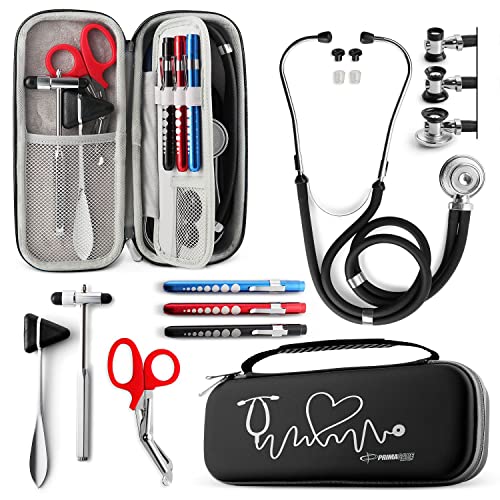
Primacare KB-9397-BK Stethoscope Case, Supplies Included, Black
by Primacare
$38.99
- Professional stethoscope case with included clinical supplies
- Multiple compartments for organized storage
- Includes essential nursing accessories
4. ASA Techmed Nurse Starter Kit with Tuning Forks — Best for BSN/RN Programs
At $59.99, the ASA Techmed Nurse Starter Kit is the first kit in this guide that includes the assessment tools required by BSN and NCLEX-RN track programs. If your required equipment list includes tuning forks and a reflex hammer alongside the standard stethoscope and BP cuff, this is the most cost-effective way to check every box in a single purchase.
What is included: This comprehensive kit bundles a stethoscope, manual blood pressure monitor, penlight, trauma shears, tuning forks, and a Taylor reflex hammer. That is six instrument categories in one box — covering everything from basic vital signs to neurological assessment tools.
Why tuning forks and a reflex hammer matter: BSN programs and many ADN programs require neurological assessment competencies that use these tools. The 128 Hz tuning fork tests vibration sense (you place it on the patient's bony prominences), and the 512 Hz tuning fork is used for the Weber and Rinne hearing tests. The Taylor reflex hammer tests deep tendon reflexes at the knee, ankle, elbow, and wrist. These are standard NCLEX-RN content areas — you will be tested on proper technique for each.
Completeness check: Compare this kit's contents against a typical BSN required equipment list:
| Required Item | Included? |
|---|---|
| Stethoscope | Yes |
| Manual BP cuff | Yes |
| Trauma shears | Yes |
| Penlight with pupil gauge | Yes |
| Tuning fork (128 Hz) | Yes |
| Tuning fork (512 Hz) | Yes |
| Taylor reflex hammer | Yes |
| Carrying case | Yes |
That is a near-complete match for most BSN programs. The only items you might still need are a hemostat and program-specific extras.
Who should buy this: BSN students, NCLEX-RN candidates, and any nursing student whose program requires tuning forks and a reflex hammer. At $59.99, this kit saves $30-$60 compared to buying each instrument individually.
Pros:
- Most complete mid-range kit — includes tuning forks and reflex hammer
- Covers nearly every item on BSN required equipment lists
- All-in-one purchase eliminates sourcing individual assessment tools
- Significantly cheaper than buying instruments separately
Cons:
- $59.99 is more than basic kits — though the inclusion of assessment tools justifies the price
- Tuning forks and reflex hammer are unnecessary for CNA and most EMT programs
- Stethoscope is student-grade, not premium
- Large kit requires a bigger bag for clinical transport

ASA Techmed Nurse Starter Kit - Stethoscope, Blood Pressure Monitor, Tuning Forks
by ASA TECHMED
$59.99
- Comprehensive nurse starter kit with tuning forks and reflex hammer
- Includes stethoscope, BP monitor, penlight, trauma shears
- All-in-one solution for nursing school clinical requirements
5. EMI Nursing Essentials 9-Piece Kit — Most Comprehensive
The EMI 9-piece kit at $74.99 is the most fully equipped option in this review. With nine separate instruments, it is designed for students who want to open one box and be done with their clinical shopping — no separate purchases, no hunting for individual tools online.
What is included: This kit includes a premium stethoscope, blood pressure monitor, penlight, trauma shears, and a carrying case as its core components, plus additional instruments that round out the 9-piece count. The extra pieces cover tools that other kits leave out, reducing the number of items you need to source separately.
Premium stethoscope upgrade: The stethoscope included in the EMI kit is a step above the entry-level instruments found in budget kits. Better acoustics mean clearer heart, lung, and bowel sounds during auscultation — which directly affects your ability to identify abnormal findings during clinical assessments. If your clinical instructor asks you to describe what you hear through your stethoscope, having an instrument that delivers clear sound makes a real difference.
The 9-piece advantage: More instruments means fewer gaps on your required equipment list. While budget kits cover 2-4 items, the EMI kit covers 9 — significantly reducing the chance that you arrive at your first clinical rotation missing something. For students who want the simplest possible purchasing experience, this is it.
Who should buy this: Students in BSN or ADN programs who want the most comprehensive single purchase available. Also ideal for students who prefer premium instrument quality over the lowest possible price. The $74.99 price is the highest in this review, but the 9-piece count and improved stethoscope quality justify the investment for students who will use these tools daily for 2-4 years.
Pros:
- 9-piece kit — the most comprehensive option reviewed
- Premium stethoscope with better acoustics than budget kits
- Includes penlight, trauma shears, carrying case, and additional instruments
- Single purchase covers the widest range of clinical requirements
Cons:
- Highest price at $74.99 — $38 more than the mid-range ASA TECHMED kit
- May include instruments your specific program does not require
- Premium price does not include every possible assessment tool (verify against your list)
- Larger kit takes up more space in your clinical bag

EMI Nursing Essentials Starter Kit Stethoscope Blood Pressure Monitor and More - 9 Piece
by Elite Medical Instruments EMI
$74.99
- 9-piece comprehensive nursing essentials kit
- Premium stethoscope with blood pressure monitor
- Includes penlight, trauma shears, and carrying case
Which Kit for Which Program
Not every nursing program requires the same equipment. Here is a quick guide to matching the right kit to your specific training track.
NCLEX-RN Track (BSN / ADN Programs)
NCLEX-RN candidates complete the most extensive clinical rotations. Your program will require the full range of assessment tools — stethoscope, BP cuff, trauma shears, penlight, tuning forks, and reflex hammer. You will use every instrument during your medical-surgical, pediatric, obstetric, and psychiatric clinical rotations.
Recommended: The ASA Techmed Nurse Starter Kit ($59.99) or the EMI 9-Piece Kit ($74.99). Both include the assessment tools that BSN and ADN programs require beyond the basic four instruments.
Start your NCLEX-RN preparation today with our free NCLEX-RN study guide.
NCLEX-PN Track (LPN Programs)
LPN programs require clinical rotations with the same core instruments as RN programs — stethoscope, BP cuff, trauma shears, and penlight. Most LPN programs do not require tuning forks or a reflex hammer, though some do. Check your specific program's list before purchasing.
Recommended: The ASA TECHMED Medical Starter Kit ($36.99) for programs without tuning fork requirements, or the ASA Techmed Nurse Starter Kit ($59.99) if your program requires the full assessment toolkit.
Start your NCLEX-PN preparation today with our free NCLEX-PN study guide.
CNA Programs
CNA clinical training focuses on basic patient care skills — vital signs, hygiene, mobility assistance, and comfort measures. Your equipment needs are the most straightforward: a stethoscope, a manual BP cuff, and a watch with a second hand (for counting pulse and respirations). Some programs also require trauma shears.
Recommended: The Dixie EMS Kit ($24.95) covers the stethoscope and BP cuff at the lowest cost. Add trauma shears ($5-$8) if your program requires them.
Start your CNA certification preparation with our free CNA study guide.
EMT / NREMT Programs
EMT clinical training shares many equipment requirements with nursing programs, but the emphasis is different. EMTs prioritize rapid trauma assessment tools — trauma shears and a penlight are used more frequently than tuning forks. A stethoscope and BP cuff are required for patient assessment stations on the NREMT practical exam.
Recommended: The ASA TECHMED Medical Starter Kit ($36.99) is the best fit for EMT students. It includes the stethoscope, BP cuff, trauma shears, and penlight that cover both clinical rotations and NREMT practical exam requirements — without paying for assessment tools you will not use.
Start your NREMT preparation with our free NREMT study guide.
What to Add to Your Kit
Even the most comprehensive clinical kit does not include everything you need for clinical rotations. Here are the items you should purchase separately to complete your clinical setup.
Must-Have Additions
- Badge reel with retractable clip ($3-$8) — every clinical site requires visible ID, and a retractable badge reel keeps your ID accessible without dangling. You will clip and unclip your badge dozens of times per shift.
- Compression socks ($10-$20 for a 3-pack) — clinical rotations mean 8-12 hours on your feet. Compression socks reduce fatigue and swelling. Most nursing students say this is the single most impactful purchase they made after their clinical instruments.
- Nursing clipboard with folding reference panels ($12-$20) — a clipboard with built-in reference charts (lab values, vital sign ranges, medication calculations) keeps critical information at your fingertips during clinical shifts. Far more useful than a standard clipboard.
- Watch with a second hand ($10-$25) — required for counting pulse rate and respiratory rate. Many clinical sites do not allow smartwatches or phones. A simple analog watch with a sweep second hand is the safest option.
- Comfortable, slip-resistant nursing shoes ($40-$80) — clinical sites require closed-toe, slip-resistant shoes. This is not the place to cut costs. Invest in shoes designed for 12-hour shifts on hospital floors.
Nice-to-Have Additions
- Drug reference pocket guide ($15-$25) — a compact, current-year drug reference that fits in your scrub pocket. Digital references on your phone are faster, but many clinical sites restrict phone use.
- Alcohol wipes or stethoscope cleaning wipes ($5-$8) — for cleaning your stethoscope diaphragm and ear tips between patients. Infection control is a core nursing competency, and cleaning your instruments is part of the practice.
- Extra penlight batteries ($3-$5) — penlight batteries die at the worst possible time. Carry spares in your clinical bag.
- Hemostats or Kelly forceps ($4-$8) — if not included in your kit, these are useful for clamping and holding during dressing changes. Required by some programs, optional in others.
Free Nursing and Healthcare Exam Prep Resources
Your clinical kit gets you through rotations, but passing the licensing exam gets you your career. We offer free preparation resources for every nursing and healthcare certification track:
- Free NCLEX-RN Study Guide — Complete coverage of all NCLEX-RN content areas
- Free NCLEX-PN Study Guide — LPN licensing exam preparation
- Free CNA Certification Study Guide — CNA exam prep with practice questions
- Free NREMT Study Guide — EMT and paramedic certification preparation
- Best Stethoscopes for Nursing School — Detailed stethoscope comparison if you want to upgrade beyond what comes in your kit
- AI Tutor — 10 free questions per day — ask about clinical procedures, vital signs measurement, medication calculations, or any nursing topic
Final Recommendations
For the tightest budget: The Dixie EMS Kit ($24.95) gives you a stethoscope and manual BP cuff — the two most critical instruments — for less than what most students pay for a single textbook rental. Add trauma shears and a penlight separately for another $10-$18 and you have a complete basic setup for under $45.
For most nursing students (best overall value): The ASA TECHMED Medical Starter Kit ($36.99) is the strongest recommendation for the majority of nursing students. Four essential instruments — stethoscope, BP cuff, trauma shears, and penlight — in one purchase at a price that is hard to beat. This kit covers the core requirements for LPN, ADN, CNA, and EMT programs.
For BSN and RN programs: The ASA Techmed Nurse Starter Kit ($59.99) is the clear choice when your program requires tuning forks and a reflex hammer. Buying these assessment tools separately would cost nearly as much as the entire kit, making this the most cost-effective path to a complete BSN clinical setup.
For the most complete single purchase: The EMI 9-Piece Kit ($74.99) includes the most instruments of any kit reviewed. If you want to open one box and be done — with a premium stethoscope and the widest range of tools — this is it.
Whichever kit you choose, remember three things: cross-reference the kit contents against your program's required equipment list before purchasing, buy compression socks and a badge reel separately (your feet and your clinical instructors will thank you), and take care of your instruments — the stethoscope and BP cuff you buy for nursing school can serve you well into your first years as a licensed nurse.
Start your nursing exam preparation today with our free NCLEX-RN study guide and healthcare practice questions.
As an Amazon Associate, OpenExamPrep earns from qualifying purchases. All recommendations are based on editorial review.

 Course Playlist
 4 Job Wiki
 Free CE
 Prep course on Achievable
 NCLEX-RN prep on DRCertifications
 Flashcards on Mometrix
 Practice exams on ExamEdge
 Take courses on Udemy
