ServSafe Food Protection Manager Certification Overview
The ServSafe Food Protection Manager certification is the food service industry's most recognized credential, administered by the National Restaurant Association. This certification is required or recommended for restaurant managers, kitchen supervisors, and food service operators across all 50 states.
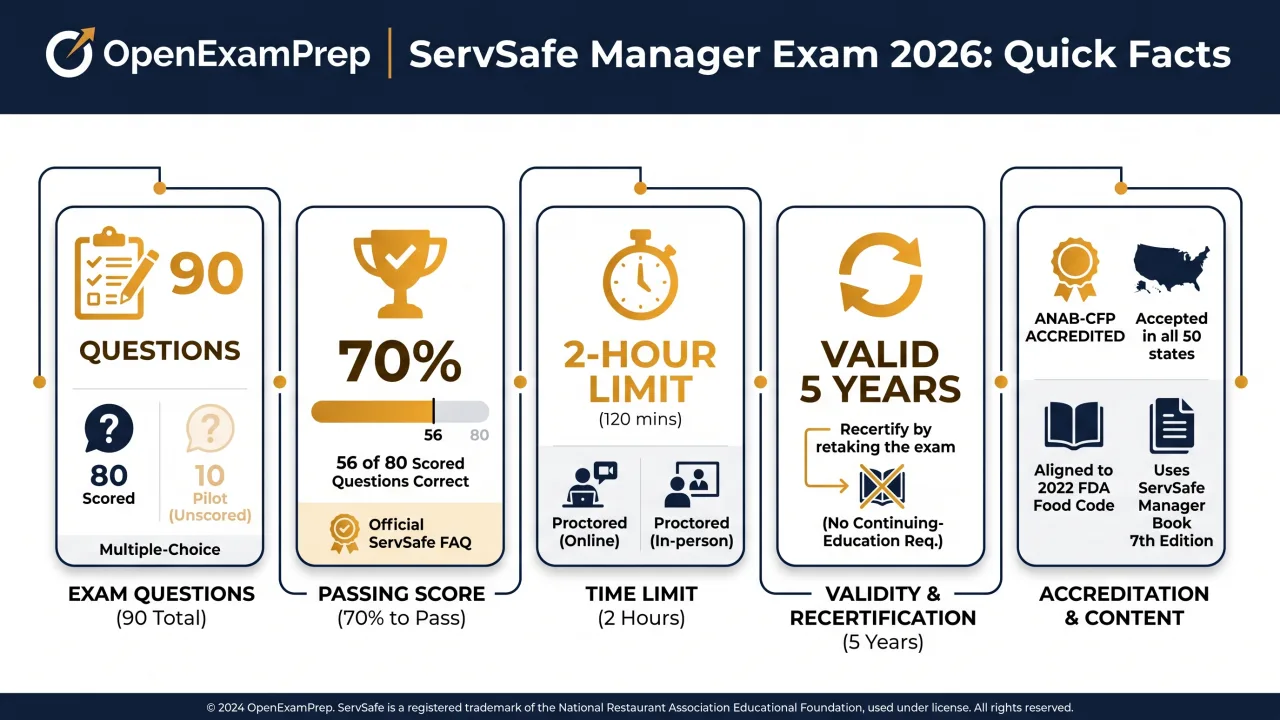
Exam Format (90 Questions, 80 Scored, 2 Hours)
| Component | Details |
|---|---|
| Total questions | 90 multiple-choice questions |
| Scored questions | 80 (the 10 others are unscored pilot questions) |
| Passing score | 70% or higher = at least 56 of the 80 scored questions correct (official ServSafe FAQ) |
| Time limit | 2 hours (120 minutes) |
| Exam fee | About $36 for the exam alone; $100-$179 with a study course/proctor |
| Validity | 5 years (must recertify) |
| Accreditation | ANAB-CFP accredited Certified Food Protection Manager (CFPM) exam |
| Based on | ServSafe Manager Book 7th Edition, aligned to the 2022 FDA Food Code |
The "75%" passing-score myth, explained
You will see "75%" everywhere online (and on older ServSafe pages). The current official ServSafe FAQ states a passing score is 70% or higher, obtained by answering at least 56 of 80 scored questions correctly. Here is why the confusion happens:
- The exam shows 90 questions, but 10 are unscored pilot items that ServSafe is testing for future exams. They look identical to real questions, so treat every question as if it counts.
- Only the 80 scored questions determine your result. 56 correct out of 80 = 70%.
- The old "75% (68 of 90)" math you see on many sites is wrong -- it scores against all 90 questions instead of the 80 that count, and it uses an outdated cutoff.
- Bottom line: aim for at least 56 of 80 (70%), but study to a comfortable cushion (65+/80) so pilot questions and exam-day nerves never put you on the line.
📚 Start FREE ServSafe Manager Prep
→ Start FREE ServSafe Manager practice questions -- or open the free ServSafe Manager study guide for topic-by-topic review.
What's Covered on the ServSafe Manager Exam
The exam tests your knowledge across 10 critical food safety topics:
1. Providing Safe Food (Foundation)
- Foodborne illness prevention
- Role of the Person in Charge (PIC)
- Active Managerial Control (AMC)
- FDA Food Code compliance
2. Forms of Contamination
- Biological hazards - Bacteria, viruses, parasites, fungi
- Chemical hazards - Cleaning products, pesticides, allergens
- Physical hazards - Glass, metal, hair, dirt
- FAT TOM conditions for bacterial growth
- Big Six pathogens (Norovirus, Salmonella, E. coli, Hepatitis A, Shigella, Shiga toxin-producing E. coli)
- Big 9 allergens (the FDA/FALCPA major food allergens): milk, eggs, fish, crustacean shellfish, tree nuts, peanuts, wheat, soybeans, and sesame (sesame became the 9th major allergen on January 1, 2023)
3. The Safe Food Handler
- Proper handwashing (20 seconds minimum)
- When to exclude/restrict ill employees
- Personal hygiene requirements
- No bare-hand contact with ready-to-eat food
4-7. Flow of Food (Critical Temperature Control)
The "Flow of Food" chapters are the heart of the exam:
- Purchasing & Receiving - Approved sources, inspection at delivery
- Storage - FIFO (First In, First Out), proper temperatures, preventing cross-contamination
- Preparation - Temperature danger zone (41°F-135°F), thawing methods, minimum cooking temperatures
- Service - Hot holding (135°F+), cold holding (41°F or below), time/temperature control
Critical Cooking Temperatures (Memorize These!)
| Food Item | Minimum Internal Temp | Time |
|---|---|---|
| Poultry (chicken, turkey, duck) | 165°F | 15 seconds |
| Ground meats (beef, pork) | 155°F | 15 seconds |
| Whole cuts (steaks, chops) | 145°F | 15 seconds |
| Eggs for immediate service | 145°F | 15 seconds |
| Fish & seafood | 145°F | 15 seconds |
| Roasts (beef/pork/lamp roasts) | 145°F | 4 minutes |
| TCS food reheated for hot holding | 165°F | within 2 hours |
| Hot holding | 135°F or above | continuous |
| Cold holding | 41°F or below | continuous |
TCS = Time/Temperature Control for Safety food (formerly "potentially hazardous food").
The Cooling Rule (Two-Stage) -- Memorize This
Cooling questions trip up more candidates than any other temperature topic. Cooked TCS food must be cooled using the two-stage method:
- 135°F down to 70°F within 2 hours, then
- 70°F down to 41°F (or below) within the next 4 hours
That is 6 hours total, but the first stage is the strict one. If food has not reached 70°F within the first 2 hours, you must reheat it to 165°F and start over, or throw it out. Speed cooling with ice baths, ice paddles, shallow pans, smaller portions, and a blast chiller.
The 4-Hour / Time-as-a-Control Rule
TCS food held in the temperature danger zone (41°F-135°F) is safe for a maximum of 4 hours total, after which it must be discarded. Operations using time alone (no temperature control) must label food with a discard time and toss it after 4 hours (or 6 hours if it started at 41°F and stays at or below 70°F).
Receiving Temperatures (Quick Reference)
- Cold TCS food: 41°F or below on delivery
- Live shellfish: air temp 45°F, internal 50°F or below (cool to 41°F within 4 hours)
- Shell eggs: air temp 45°F or below
- Hot TCS food: 135°F or above
- Frozen food: frozen solid, no signs of thawing/refreezing
8. HACCP Principles
- The 7 Principles of HACCP:
- Conduct hazard analysis
- Determine Critical Control Points (CCPs)
- Establish critical limits
- Monitor CCPs
- Establish corrective actions
- Verify the system works
- Record-keeping and documentation
9. Facilities & Pest Management
- Proper facility layout and design
- Integrated Pest Management (IPM)
- Handwashing station requirements
- Proper ventilation and lighting
10. Cleaning & Sanitizing
- Three-compartment sink method (wash → rinse → sanitize)
- Chemical sanitizers (chlorine, iodine, quats)
- Proper dishwasher temperatures
- Master cleaning schedule
🎯 Free ServSafe Practice Questions
Study Timeline
| Week | Focus | Hours |
|---|---|---|
| Week 1 | Contamination + Safe Food Handler | 8-10 |
| Week 2 | Flow of Food (Purchasing → Preparation) | 10-12 |
| Week 3 | Flow of Food (Cooking → Service) | 10-12 |
| Week 4 | HACCP + Facilities + Review | 8-10 |
Total: 40-50 hours recommended for first-time test takers
Pass Rate & Difficulty
- Passing standard: 70% or higher -- at least 56 of 80 scored questions correct
- First-time pass rate: roughly 65-75% (varies by candidate prep; ServSafe does not publish an official figure)
- Most challenging topics: cooling methods, two-stage cooling math, HACCP principles, time/temperature control, sanitizer concentrations
- Easiest topics: personal hygiene, handwashing, basic cleaning
Why people fail:
- Not memorizing cooking AND cooling temperatures (135 to 70 in 2 hrs, 70 to 41 in 4 more)
- Confusing the Big 6 pathogens or mixing them up with allergens
- Misunderstanding time/temperature abuse and the 4-hour danger-zone limit
- Forgetting the order of the 7 HACCP principles
- Misreading scenario questions -- the exam asks "what should the manager do next?" not just "what is the rule?"
Who Needs ServSafe Manager Certification?
Required in Most States:
- Restaurant managers and kitchen supervisors
- Food service directors (schools, hospitals, hotels)
- Catering managers
- Food truck operators
- Bar managers (where food is served)
State Requirements (2026):
- Mandatory: California, Texas, Florida, Illinois, New York, and 40+ other jurisdictions
- Recommended but not required: Some states allow state-specific certifications
- Check your state: ServSafe is accepted in all 50 states
ServSafe vs. Other Food Protection Manager Certifications
Important context for the exam and for compliance: ServSafe is ONE of several ANAB-CFP-accredited Certified Food Protection Manager (CFPM) exams. Health departments that require a "Certified Food Protection Manager" accept any ANAB-accredited exam, not only ServSafe. ServSafe is simply the most widely recognized. (ANSI's accreditation arm was renamed ANAB, so older sources say "ANSI-CFP" -- it is the same accreditation.)
| Certification | Administered / Developed By | Accreditation | Typical Cost |
|---|---|---|---|
| ServSafe Manager | National Restaurant Association | ANAB-CFP accredited | ~$36 exam; $100-$179 with course |
| Prometric (CPFM) | Prometric | ANAB-CFP accredited | ~$60-$130 |
| National Registry (NRFSP) | National Registry of Food Safety Professionals | ANAB-CFP accredited | ~$80-$130 |
| Learn2Serve / 360training | 360training | ANAB-CFP accredited | ~$99-$135 |
| AboveTraining/StateFoodSafety | AboveTraining | ANAB-CFP accredited | ~$99-$135 |
Why most candidates choose ServSafe?
- Most widely recognized by employers and chains
- Accepted in all 50 states (as an ANAB-CFP exam)
- Aligned to the 2022 FDA Food Code (ServSafe Manager 7th Edition)
- Largest ecosystem of study materials and proctored testing options
Tips for Passing the ServSafe Manager Exam
- Memorize temperature tiers - 165°F, 155°F, 145°F, 135°F, 41°F
- Know the Big 6 - Norovirus, Hepatitis A, Salmonella Typhi, nontyphoidal Salmonella, Shigella, and Shiga toxin-producing E. coli (STEC)
- Understand FAT TOM - Food, Acidity, Temperature, Time, Oxygen, Moisture (the six conditions bacteria need to grow)
- Drill cooling methods - 135°F to 70°F in 2 hours, then 70°F to 41°F in 4 more hours (6 hours total; first stage is the strict one)
- Answer as the manager - many questions ask "what should you do next?" Pick the action that protects food safety and compliance first
- Aim past the cutoff - you need 56 of 80 (70%), so practice until you reliably score 65+/80
- Take timed practice tests - repetition under time pressure is the single best predictor of passing
How and Where to Take the ServSafe Manager Exam
Every ServSafe Manager exam must be proctored -- you cannot self-administer it. You buy an exam access code from ServSafe (or get one bundled with an instructor-led class), then take it one of three ways:
Option 1: In-person, instructor-proctored (paper or online)
- Taken in a classroom or at a host site with a Registered ServSafe Instructor/Proctor
- Paper-and-pencil or online format
- Find a class/session through the ServSafe site or your state restaurant association
Option 2: Pearson VUE testing center
- Computer-based at a third-party Pearson VUE center
- Schedule an appointment with a government-issued photo ID
- Results typically shown at the test center
Option 3: ServSafe Online Proctored (remote, from home)
- Live remote proctor monitors you via webcam (ProctorU-style)
- Requires a quiet private room, working webcam/mic, and a clear desk
- You must show a valid photo ID on camera
- Same ANAB-CFP-accredited certification as in-person
Bring/have ready: a valid government-issued photo ID and your exam access code. Scores post quickly, and an official certificate and wallet card are issued (allow up to ~2 weeks for printed delivery; a digital certificate is usually available sooner in your ServSafe account).
After You Pass
Once certified:
- Certification valid for 5 years
- Recertification required - Take exam again before expiration
- Certificate mailing - Allow 2-3 weeks for delivery
- Verification - Employers can verify online using your certificate number
Start Your ServSafe Journey Today
→ Start FREE ServSafe Manager practice questions now | Browse the free study guide
- Free practice questions covering all the exam domains
- Temperature & cooling charts for quick reference
- HACCP and Big 6 pathogen breakdowns
- Aligned to the 2022 FDA Food Code (ServSafe 7th Edition)
- 100% FREE - No signup required
Plus a free AI tutor (10 questions/day) that can quiz you, build a study plan, and explain any miss. Pass your ServSafe Manager exam on the first try with our comprehensive study materials.
Official-Source Check Before You Schedule
Treat this article as a study map, not a substitute for the current ServSafe Manager Exam Guide 2026: Pass Food Protection Manager Certification candidate materials. For technical and inspection credentials, use the current body of knowledge, code-reference list, and candidate bulletin from the sponsor before memorizing topic weights. Requirements can change by testing window, jurisdiction, sponsor update, or delivery vendor, and those changes often affect small details candidates overlook: identification rules, retake timing, calculator policy, reference materials, continuing-education language, application approvals, and the exact way domains are named.
Before you pay for an exam date, make a one-page source checklist. Put the official exam page, candidate handbook, content outline or blueprint, fee page, accommodation instructions, and reschedule policy in one place. Then compare your prep materials against that checklist. If a prep book, course, or old post disagrees with the sponsor, follow the sponsor. This is especially important for candidates returning after a failed attempt because they may be studying from notes built around an older outline.
How To Read The Blueprint Without Overstudying
Do not read the ServSafe Manager Exam Guide 2026: Pass Food Protection Manager Certification outline like a table of contents. Read it like a risk map. Each domain tells you what the exam writer is allowed to test, but the action verbs tell you how the topic may appear. A verb such as identify usually points to recognition. A verb such as apply, analyze, evaluate, calculate, determine, or recommend means the question can require judgment, sequencing, or multi-step reasoning.
Use four passes through the outline. First, mark topics you already use at work. Second, mark topics you recognize but cannot explain without notes. Third, mark topics that have unfamiliar vocabulary. Fourth, mark topics that combine two skills, such as a rule plus a calculation or a policy plus a scenario. The fourth group deserves the most practice because it is where candidates often feel prepared while still missing points.
For ServSafe Manager Exam Guide 2026: Pass Food Protection Manager Certification, route your weekly study around these high-friction buckets:
- code-reference navigation
- measurement and tolerance recognition
- safety controls
- inspection sequence and documentation
The goal is not to give every line of the outline equal time. The goal is to convert weak, testable behaviors into repeatable decisions. If a topic is easy in isolation but difficult inside a mixed set, it belongs in your active rotation until it stays stable under time pressure.
Scenario Strategy For Hard Questions
Most candidates miss hard ServSafe Manager Exam Guide 2026: Pass Food Protection Manager Certification questions for one of three reasons: they answer the first familiar phrase, they ignore a limiting condition, or they spend too long trying to make every answer choice perfect. A better method is to treat each field scenario as a short professional decision.
Start by naming the task in plain English. Ask: what is the exam actually asking me to decide? Then identify the controlling facts. Separate facts that change the answer from facts that merely describe the setting. Next, predict the principle before looking at the options. Even a rough prediction reduces the chance that an attractive distractor pulls you away from the rule, process, or judgment being tested.
When two answer choices remain, compare them against the exact role you are playing in the prompt. Are you acting as a supervisor, adviser, technician, manager, applicant, analyst, auditor, clinician, inspector, or public-facing professional? Exam writers often make the second-best option sound reasonable for the wrong role. If the question asks for the next action, prefer the answer that preserves safety, compliance, documentation, client interest, or process control before jumping to a final conclusion.
Practice Routing And Score Repair
Use practice questions as diagnostic data, not as a score-chasing game. After each timed block, tag every miss with one primary cause: content gap, vocabulary gap, careless reading, calculation setup, scenario judgment, or pacing. If you tag everything as content, your remediation will be too broad. If you tag every miss carefully, your next study block becomes obvious.
A strong remediation cycle has three steps. First, reread only the smallest source section that explains the miss. Second, write a one-sentence rule in your own words. Third, answer two or three nearby questions without notes. If you can only answer the original question after seeing the explanation, you have recognized the answer rather than repaired the skill.
Use mixed sets earlier than feels comfortable. Topic-by-topic drills build confidence, but the real exam rarely announces which rule is being tested. A mixed set forces you to identify the domain before solving. That recognition skill is part of readiness. Start with short mixed sets, then grow into longer timed blocks as your accuracy stabilizes.
You can pair this article with the free practice path here: ServSafe Manager Exam Guide 2026: Pass Food Protection Manager Certification practice questions and ServSafe Manager Exam Guide 2026: Pass Food Protection Manager Certification study guide. If the linked resource is broader than this exact credential, use it for baseline repetition and keep your official outline beside you for final scope control.
Final Two-Week Readiness Plan
Two weeks before exam day, stop measuring progress by pages completed. Measure it by repeatable performance. Your target is not one lucky high score; it is several timed blocks where the same weak area no longer appears in the miss log.
During the first week, run alternating blocks: one targeted weak-area set, one mixed timed set, one review block, and one short recall session. The recall session should be closed-book. Write definitions, formulas, procedures, rule triggers, or decision steps from memory, then check them against the official outline and your notes.
During the final week, reduce new material. Keep daily contact with the hardest topics, but shift toward confidence, pacing, and clean execution. Rework missed questions from your log, especially the ones you missed twice. Review administrative requirements, testing location rules, remote-proctor rules if applicable, identification, permitted materials, and break policy. Those logistics are not content knowledge, but they can still disrupt performance if you handle them late.
Common Traps To Avoid
The first trap is passive rereading. Rereading feels productive because the material becomes familiar, but familiarity does not prove you can choose correctly under pressure. Convert reading into retrieval: close the source, explain the rule, then apply it.
The second trap is treating every miss as equal. A careless one-off miss needs a prevention habit. A repeated domain miss needs a study block. A pacing miss needs timed drills. A vocabulary miss needs flashcards or a glossary. Different misses require different repairs.
The third trap is delaying full-length or longer timed practice until the last few days. Longer practice exposes fatigue, sequencing problems, and weak time allocation. Find those problems while there is still time to fix them.
The fourth trap is ignoring why the right answer is right. For each reviewed item, write why the correct answer wins and why the best distractor fails. That second sentence is where durable learning happens.
When You Are Ready
You are ready for ServSafe Manager Exam Guide 2026: Pass Food Protection Manager Certification when you can explain the core domains without reading the outline, complete timed sets without rushing the final questions, and identify your miss patterns before checking the score report. You should also be able to say what you will do if the first ten questions feel harder than expected. The answer should be simple: slow down, return to the task, identify controlling facts, eliminate role-inconsistent options, and keep moving.
Passing is usually less about finding a secret resource and more about building a reliable loop: official source, focused study, timed practice, miss analysis, and targeted repair. Keep that loop tight, and every practice session has a job.

 Free CE
 Buy on Amazon
 Flashcards on Mometrix
 Practice exams on ExamEdge
 Take courses on Udemy