PTCE Exam 2026: Your Complete Certification Guide
The PTCE (Pharmacy Technician Certification Exam) is the most widely recognized certification exam for pharmacy technicians in the United States. Administered by the PTCB (Pharmacy Technician Certification Board), this exam validates your knowledge and skills to work as a certified pharmacy technician (CPhT) in retail, hospital, and specialty pharmacy settings.
With the growing demand for pharmacy technicians and increasing state requirements for certification, earning your CPhT credential opens doors to better job opportunities, higher pay, and career advancement.
Exam Format & Structure
| Component | Details |
|---|---|
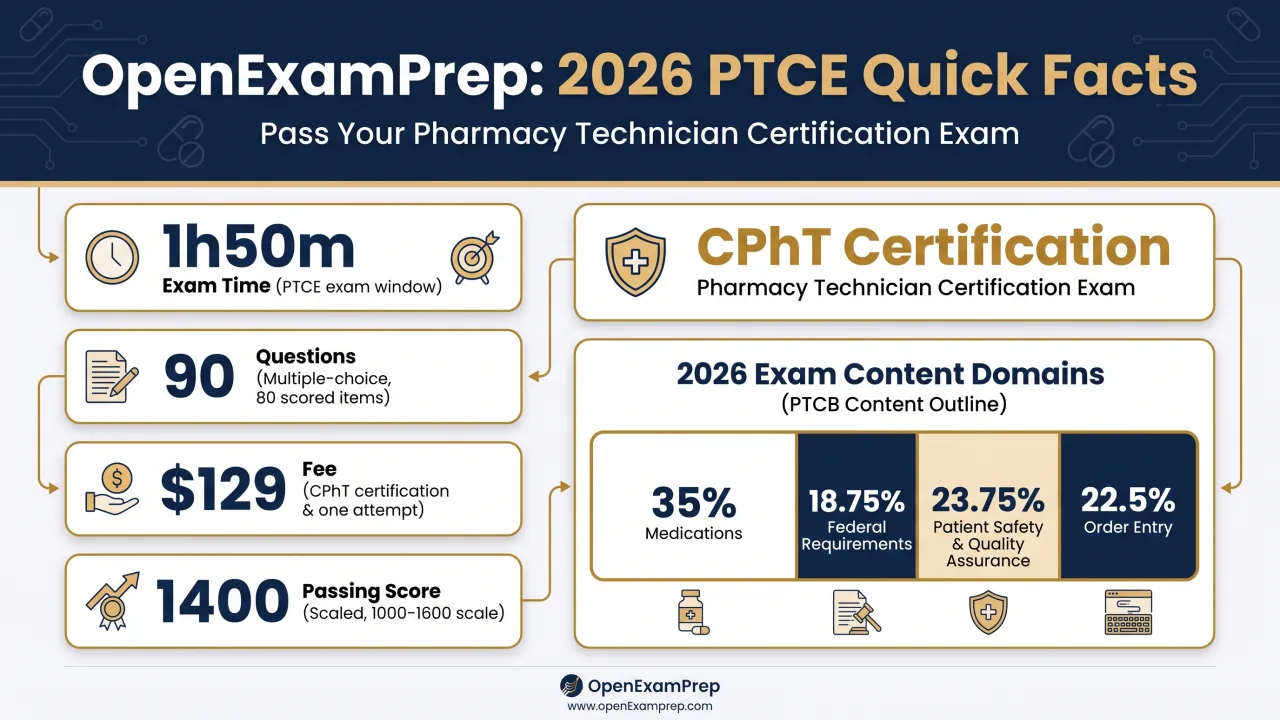
| Total Questions | 90 multiple-choice questions (4 options, 1 best answer) |
| Scored Questions | 80 scored + 10 unscored pilot questions |
| Exam Time | 1 hour 50 minutes (110 minutes) |
| Total Appointment | ~2 hours (5-min tutorial + 110-min exam + 5-min survey) |
| Passing Score | 1400 (scaled score, range 1000-1600) |
| Pass Rate | Not published by PTCB |
| Testing Format | In-person, computer-based at Pearson VUE centers (online testing discontinued Dec 2025) |
| Cost | $129 |
The exam uses a scaled scoring system from 1000 to 1600, with 1400 required to pass. The 10 unscored questions are randomly distributed throughout the exam, so treat every question as if it counts. PTCB released a new content outline effective January 6, 2026, based on the 2024 Job Task Analysis — the domain weights and several topics changed, so make sure your study materials reflect the 2026 blueprint.
At-a-Glance: 2026 PTCE Blueprint
| Knowledge Domain | 2026 Weight | Approx. Scored Questions |
|---|---|---|
| 1. Medications | 35% | ~28 |
| 2. Federal Requirements | 18.75% | ~15 |
| 3. Patient Safety and Quality Assurance | 23.75% | ~19 |
| 4. Order Entry and Processing | 22.5% | ~18 |
| Total | 100% | 80 |
The biggest change from the previous outline: Federal Requirements jumped from 12.5% to 18.75% (roughly 5 more scored questions on federal law), while Medications dropped from 40% to 35%. DSCSA (Drug Supply Chain Security Act) serialization and tracing is now tested, and alligation calculations, narrow therapeutic index drugs, and compounding topics have been removed.
Pharmacy Technician Career Outlook
The U.S. Bureau of Labor Statistics (BLS) reports a median annual wage of $43,460 for pharmacy technicians (SOC 29-2052, May 2024 data). Employment is projected to grow 6% from 2024 to 2034, adding about 31,500 jobs. Earning your CPhT credential can improve your earning potential and is required or preferred by most employers and state boards.
Start Your FREE PTCE Prep Today
Our comprehensive course covers all 4 content domains for the PTCE exam with practice questions and detailed explanations—100% FREE.
PTCE Content Domains
The 2026 PTCE exam tests your knowledge across 4 major content domains. The weights below reflect the PTCB content outline effective January 6, 2026.
1. Medications (35%)
This is still the largest section, covering pharmaceutical knowledge:
- Generic and brand drug names and classifications (top 200 medications)
- Therapeutic duplications
- Common or life-threatening drug interactions and contraindications (drug-drug, drug-dietary supplement, drug-laboratory, drug-nutrient, drug-disease)
- Strengths, doses, dosage forms, routes of administration, and special handling
- Common or severe side effects, adverse effects, and allergies
- Indications of medications
- Drug stability (oral suspensions, insulins, reconstitutables, injectables, vaccinations)
- Proper storage (temperature ranges, light sensitivity, restricted access)
Key Focus Areas:
- Memorize the top 200 drugs (brand/generic, class, common uses)
- Know high-alert medications and their risks
- Understand drug suffixes (-olol, -pril, -statin, etc.)
2. Federal Requirements (18.75%)
This domain grew significantly from the previous 12.5% weight. Pharmacy law and regulatory compliance:
- Federal requirements for storage, handling, and disposal of non-hazardous, hazardous (P-list), and pharmacological substances and wastes
- DEA controlled substance schedules (C-I through C-V) and prescription requirements (new, refill, transfer)
- Controlled substance receiving, storing, ordering, labeling, dispensing, returning, take-back programs, loss/theft, and destruction
- Federal restricted drug programs (pseudoephedrine, REMS)
- FDA medication recalls (Class I, II, III)
- DSCSA (Drug Supply Chain Security Act) product serialization, tracking, tracing, handling, and quarantining — new for 2026
Key Focus Areas:
- Know DEA schedules and examples of each
- Understand DSCSA serialization and suspect product handling (new for 2026)
- Know recall classifications and procedures
- Understand REMS programs
3. Patient Safety and Quality Assurance (23.75%)
Error prevention and quality measures:
- High-alert/risk medications and look-alike/sound-alike (LASA) medications
- Error prevention strategies (Tall Man lettering, separating inventory, leading/trailing zeros, barcode usage, limit error-prone abbreviations)
- Issues requiring pharmacist intervention (DUR, adverse drug events, OTC recommendations, therapeutic substitution, misuse, adherence, post-immunization care)
- Event reporting procedures (medication errors, adverse effects, product integrity, MedWatch, VAERS, near miss, root-cause analysis [RCA], continuous quality improvement [CQI])
- Types of prescription errors (incorrect dose, quantity, patient, drug, route)
- Infection prevention procedures and cleaning standards (handwashing, PPE, cleaning counting trays, countertops, and equipment)
Key Focus Areas:
- Error prevention strategies (barcode scanning, double-checking)
- Event reporting protocols (MedWatch, VAERS, RCA)
- Infection prevention and PPE use
4. Order Entry and Processing (22.5%)
Prescription handling and calculations:
- Formulas, calculations, ratios, proportions, conversions
- Sig codes (b.i.d., t.i.d., Roman numerals), abbreviations, medical terminology, and symbols
- Day supply, quantity, dose calculations
- Prescription interpretation and patient profile management
- Insurance and billing (prior authorizations, DAW codes)
- Third-party adjudication and rejection resolution
- Inventory management
- Medication packaging and labeling
Key Focus Areas:
- Master sig codes and abbreviations
- Practice pharmacy math daily (dosages, concentrations, day supply)
- Understand insurance processing
Note: The 2026 outline removed alligation calculations, narrow therapeutic index drugs, nonsterile compounding, and USP <797>/<800> sterile compounding topics. If your study materials include these, they are no longer on the PTCE.
Free Practice Questions & Study Materials
Each chapter includes:
- Detailed content explanations
- PTCE-style multiple-choice questions
- Pharmacy calculations practice
- Drug classification charts
Essential Pharmacy Calculations
Pharmacy math is critical for PTCE success. Master these calculation types:
Dosage Calculations
Dose = Weight x Dose per kg
Example: 70 kg patient, 5 mg/kg dose
70 kg x 5 mg/kg = 350 mg
Day Supply Calculations
Day Supply = Total Quantity / Daily Dose
Example: 90 tablets, take 1 tablet TID (3x daily)
90 / 3 = 30 days
Concentration Calculations
C1 x V1 = C2 x V2 (dilution formula)
Note: Alligation calculations were removed from the 2026 PTCE outline and will not appear on the exam.
Eligibility Requirements
To sit for the PTCE exam, you must meet all of the following:
- Reside in the United States or its territories
- High school diploma or equivalent (GED)
- Completion of one of two pathways (below)
- Full disclosure of all criminal and State Board of Pharmacy registration or licensure actions
- Compliance with all applicable PTCB Certification policies
Pathway 1: Education-Based
- Completion of a PTCB-recognized education/training program (or completion within 60 days of application)
- A pharmacy degree (PharmD, BS Pharm, BSPS) is acceptable in lieu of a recognized program
Pathway 2: Work Experience-Based
- 500 hours of work experience as a pharmacy technician (must be complete at time of application)
Retake Policy
If you do not pass the PTCE on your first attempt, PTCB's official retake policy (from the Credentialing Guidelines) is:
- 2nd and 3rd attempts: No waiting period — you can reapply immediately after receiving your official score report
- 4th attempt: Must wait 6 months from the most recent attempt
- After 4 attempts: Must provide evidence of acceptable preparation activities (e.g., formal review course, tutoring by a pharmacist/CPhT, ASHP/ACPE-accredited program, or pharmacy technician associate degree) for PTCB review and approval before applying again
- You must pay the full $129 exam fee for each attempt
You have an unlimited number of exam attempts, but PTCB strongly encourages thorough preparation before each retake.
Study Timeline for PTCE Success
| Week | Focus | Activities |
|---|---|---|
| 1-2 | Medications | Top 200 drugs, drug classes, suffixes |
| 3 | Federal Requirements | DEA schedules, HIPAA, recalls |
| 4-5 | Patient Safety | Error prevention, sterile compounding, USP guidelines |
| 6 | Order Entry | Calculations, sig codes, insurance |
| 7-8 | Review & Practice | Full practice exams, weak area review |
Recommended: 80-120 hours total over 6-8 weeks
Top 200 Drug Study Tips
Memorizing medications is the biggest challenge. Use these strategies:
Drug Suffix Patterns
| Suffix | Drug Class | Example |
|---|---|---|
| -olol | Beta blockers | metoprolol, atenolol |
| -pril | ACE inhibitors | lisinopril, enalapril |
| -sartan | ARBs | losartan, valsartan |
| -statin | Statins (cholesterol) | atorvastatin, simvastatin |
| -azole | Antifungals | fluconazole, ketoconazole |
| -cillin | Penicillins | amoxicillin, ampicillin |
| -cycline | Tetracyclines | doxycycline, tetracycline |
| -prazole | PPIs (acid reflux) | omeprazole, pantoprazole |
| -dipine | Calcium channel blockers | amlodipine, nifedipine |
| -zepam/-lam | Benzodiazepines | diazepam, alprazolam |
Study Groups by Condition
- Diabetes medications: metformin, insulin types, sulfonylureas, GLP-1s
- Blood pressure medications: ACE inhibitors, ARBs, beta blockers, diuretics
- Pain medications: NSAIDs, opioids, acetaminophen, gabapentin
- Antibiotics: penicillins, cephalosporins, fluoroquinolones, macrolides
DEA Controlled Substance Schedules
| Schedule | Abuse Potential | Medical Use | Examples |
|---|---|---|---|
| C-I | High | None (research only) | Heroin, LSD, marijuana* |
| C-II | High | Accepted | Oxycodone, morphine, Adderall |
| C-III | Moderate | Accepted | Tylenol with codeine, testosterone |
| C-IV | Low | Accepted | Xanax, Valium, tramadol |
| C-V | Lowest | Accepted | Lyrica, cough syrups with codeine |
*Marijuana scheduling varies by state law
Practice PTCE Calculations
Master these essential calculations with our interactive practice problems.
Test-Taking Strategies
Before the Exam
- Get adequate sleep the night before
- Arrive 30 minutes early to the testing center
- Bring valid identification (government-issued ID)
- Review high-yield topics the morning of (drug suffixes, schedules)
During the Exam
- Read questions carefully - Watch for "EXCEPT" and "NOT"
- Answer what is asked - Don't overthink
- Use process of elimination - Rule out obviously wrong answers
- Manage your time - 90 questions in 110 minutes = ~73 seconds each
- Flag difficult questions - Return to them at the end
- Don't change answers unless certain - First instinct is often correct
For Calculation Questions
- Write out the problem on scratch paper
- Show all work to avoid errors
- Double-check units (mg vs g, mL vs L)
- Verify your answer makes sense clinically
After You Pass: CPhT Certification
Once you pass the PTCE:
- You become a Certified Pharmacy Technician (CPhT)
- Certification is valid for 2 years
- Recertification requires 20 CE hours per 2-year cycle (primarily ACPE-accredited "-T" technician CE; up to 5 hours of "-P" pharmacist CE allowed if relevant)
- 1 CE hour must be in pharmacy law
- 1 CE hour must be in patient safety
- The recertification application fee is $55 (a $25 late fee applies if submitted after the deadline)
- CE must be completed within the cycle — no carryover
- Renewal opens 60 days before your certification expiration date
- Maintain certification to stay competitive and meet employer/state board requirements
Pass the PTCE Exam with Confidence
Join thousands of pharmacy technician candidates who passed their PTCE exam using our comprehensive, 100% FREE study materials. Our course includes:
- All 4 content domains covered in detail
- Top 200 drug flashcards with brand/generic names
- Pharmacy calculations with step-by-step solutions
- AI-powered study assistance for instant explanations
- Regularly updated for 2026 exam content
No credit card required. Start studying today.
Official Resources
- PTCB Official Website - Pharmacy Technician Certification Board
- Pearson VUE PTCE Scheduling - Schedule your exam
- PTCB Certification Verification - Verify CPhT credentials
- PTCB Recertification - CE requirements and renewal
- State Board of Pharmacy - State-specific requirements
Official-Source Check Before You Schedule
Treat this article as a study map, not a substitute for the current PTCE Study Guide 2026: Pass Your Pharmacy Technician Certification Exam candidate materials. For health-care credentials, use the current candidate handbook from the certification board and confirm eligibility, documentation, and renewal rules directly with the sponsor. Requirements can change by testing window, jurisdiction, sponsor update, or delivery vendor, and those changes often affect small details candidates overlook: identification rules, retake timing, calculator policy, reference materials, continuing-education language, application approvals, and the exact way domains are named.
Before you pay for an exam date, make a one-page source checklist. Put the official exam page, candidate handbook, content outline or blueprint, fee page, accommodation instructions, and reschedule policy in one place. Then compare your prep materials against that checklist. If a prep book, course, or old post disagrees with the sponsor, follow the sponsor. This is especially important for candidates returning after a failed attempt because they may be studying from notes built around an older outline.
How To Read The Blueprint Without Overstudying
Do not read the PTCE Study Guide 2026: Pass Your Pharmacy Technician Certification Exam outline like a table of contents. Read it like a risk map. Each domain tells you what the exam writer is allowed to test, but the action verbs tell you how the topic may appear. A verb such as identify usually points to recognition. A verb such as apply, analyze, evaluate, calculate, determine, or recommend means the question can require judgment, sequencing, or multi-step reasoning.
Use four passes through the outline. First, mark topics you already use at work. Second, mark topics you recognize but cannot explain without notes. Third, mark topics that have unfamiliar vocabulary. Fourth, mark topics that combine two skills, such as a rule plus a calculation or a policy plus a scenario. The fourth group deserves the most practice because it is where candidates often feel prepared while still missing points.
For PTCE Study Guide 2026: Pass Your Pharmacy Technician Certification Exam, route your weekly study around these high-friction buckets:
- patient or client safety
- scope and documentation cues
- scenario triage
- professional responsibility
The goal is not to give every line of the outline equal time. The goal is to convert weak, testable behaviors into repeatable decisions. If a topic is easy in isolation but difficult inside a mixed set, it belongs in your active rotation until it stays stable under time pressure.
Scenario Strategy For Hard Questions
Most candidates miss hard PTCE Study Guide 2026: Pass Your Pharmacy Technician Certification Exam questions for one of three reasons: they answer the first familiar phrase, they ignore a limiting condition, or they spend too long trying to make every answer choice perfect. A better method is to treat each practice scenario as a short professional decision.
Start by naming the task in plain English. Ask: what is the exam actually asking me to decide? Then identify the controlling facts. Separate facts that change the answer from facts that merely describe the setting. Next, predict the principle before looking at the options. Even a rough prediction reduces the chance that an attractive distractor pulls you away from the rule, process, or judgment being tested.
When two answer choices remain, compare them against the exact role you are playing in the prompt. Are you acting as a supervisor, adviser, technician, manager, applicant, analyst, auditor, clinician, inspector, or public-facing professional? Exam writers often make the second-best option sound reasonable for the wrong role. If the question asks for the next action, prefer the answer that preserves safety, compliance, documentation, client interest, or process control before jumping to a final conclusion.
Practice Routing And Score Repair
Use practice questions as diagnostic data, not as a score-chasing game. After each timed block, tag every miss with one primary cause: content gap, vocabulary gap, careless reading, calculation setup, scenario judgment, or pacing. If you tag everything as content, your remediation will be too broad. If you tag every miss carefully, your next study block becomes obvious.
A strong remediation cycle has three steps. First, reread only the smallest source section that explains the miss. Second, write a one-sentence rule in your own words. Third, answer two or three nearby questions without notes. If you can only answer the original question after seeing the explanation, you have recognized the answer rather than repaired the skill.
Use mixed sets earlier than feels comfortable. Topic-by-topic drills build confidence, but the real exam rarely announces which rule is being tested. A mixed set forces you to identify the domain before solving. That recognition skill is part of readiness. Start with short mixed sets, then grow into longer timed blocks as your accuracy stabilizes.
Final Two-Week Readiness Plan
Two weeks before exam day, stop measuring progress by pages completed. Measure it by repeatable performance. Your target is not one lucky high score; it is several timed blocks where the same weak area no longer appears in the miss log.
During the first week, run alternating blocks: one targeted weak-area set, one mixed timed set, one review block, and one short recall session. The recall session should be closed-book. Write definitions, formulas, procedures, rule triggers, or decision steps from memory, then check them against the official outline and your notes.
During the final week, reduce new material. Keep daily contact with the hardest topics, but shift toward confidence, pacing, and clean execution. Rework missed questions from your log, especially the ones you missed twice. Review administrative requirements, testing location rules, remote-proctor rules if applicable, identification, permitted materials, and break policy. Those logistics are not content knowledge, but they can still disrupt performance if you handle them late.
Common Traps To Avoid
The first trap is passive rereading. Rereading feels productive because the material becomes familiar, but familiarity does not prove you can choose correctly under pressure. Convert reading into retrieval: close the source, explain the rule, then apply it.
The second trap is treating every miss as equal. A careless one-off miss needs a prevention habit. A repeated domain miss needs a study block. A pacing miss needs timed drills. A vocabulary miss needs flashcards or a glossary. Different misses require different repairs.
The third trap is delaying full-length or longer timed practice until the last few days. Longer practice exposes fatigue, sequencing problems, and weak time allocation. Find those problems while there is still time to fix them.
The fourth trap is ignoring why the right answer is right. For each reviewed item, write why the correct answer wins and why the best distractor fails. That second sentence is where durable learning happens.
When You Are Ready
You are ready for PTCE Study Guide 2026: Pass Your Pharmacy Technician Certification Exam when you can explain the core domains without reading the outline, complete timed sets without rushing the final questions, and identify your miss patterns before checking the score report. You should also be able to say what you will do if the first ten questions feel harder than expected. The answer should be simple: slow down, return to the task, identify controlling facts, eliminate role-inconsistent options, and keep moving.
Passing is usually less about finding a secret resource and more about building a reliable loop: official source, focused study, timed practice, miss analysis, and targeted repair. Keep that loop tight, and every practice session has a job.


 Buy on Amazon
 Practice exams on ExamEdge
 Online course on Mometrix
 Take courses on Udemy