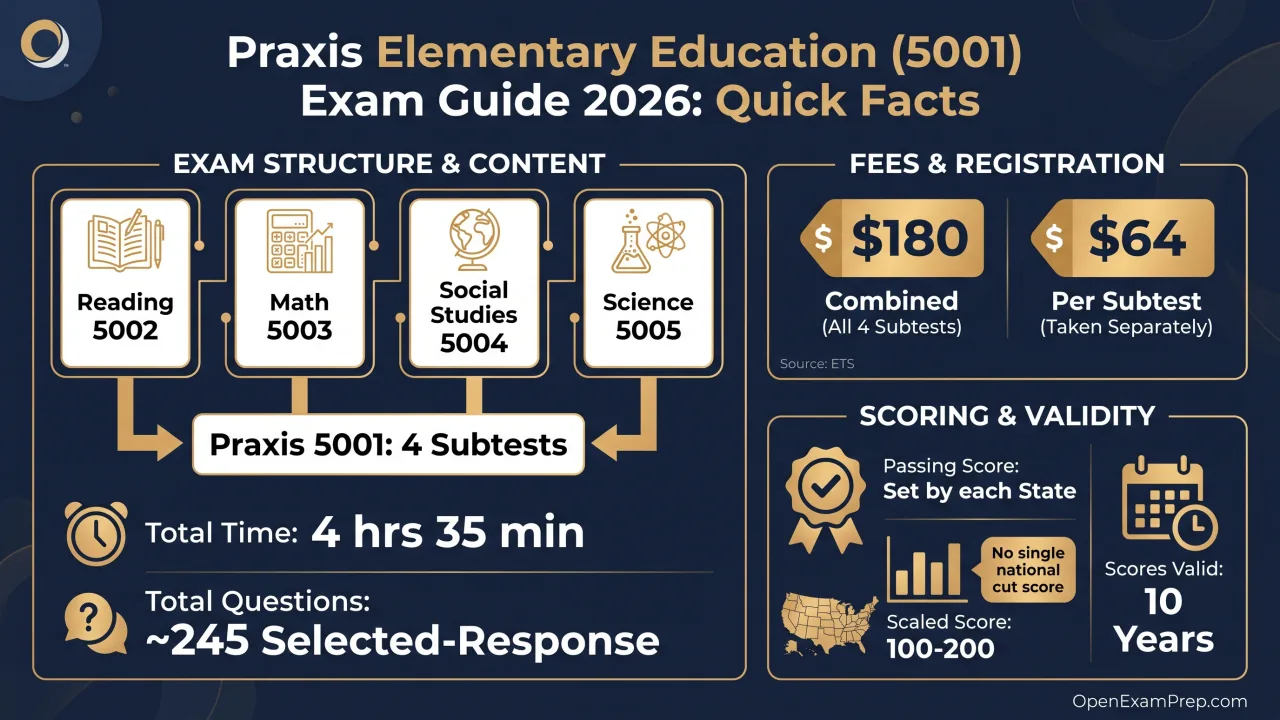
Praxis Elementary Education (5001) Exam Guide 2026
Planning to teach elementary school? The Praxis Elementary Education: Multiple Subjects (5001) exam is the gateway to K-6 teacher certification in most states. This FREE guide covers everything you need to know about all four subtests, the fees, state-set passing scores, and how to pass on your first try -- with verified 2026 details straight from ETS.
Heads up for 2026: ETS confirms code 5001 is still the current 4-subtest exam. Do not confuse it with 5901, which is only a three-subject bundle (Math, Social Studies, Science -- no Reading). ETS is also launching new Elementary Education Fundamentals tests in Spring 2026 that will eventually replace 5001/7001/5901; check whether your state has adopted them before you register. See the transition section below.
What Is the Praxis Elementary Education Exam?
The Praxis 5001 exam measures the content knowledge required to teach elementary school (K-6). It consists of four independently scored subtests that you can take together in one sitting or schedule separately:
| Subtest | Code | Content Area |
|---|---|---|
| Reading and Language Arts | 5002 | Literacy instruction, comprehension, writing |
| Mathematics | 5003 | Number sense, algebra, geometry, data |
| Social Studies | 5004 | History, geography, civics, economics |
| Science | 5005 | Earth, life, and physical science |
Because each subtest is scored on its own, you only need to retake the one(s) you do not pass -- not the whole exam.
Praxis 5001 Exam Structure (2026)
Complete Exam Overview
| Aspect | Details (verified vs. ETS) |
|---|---|
| Total questions | ~245 selected-response across 4 subtests (no essay) |
| Total time | 4 hours 35 minutes if taken together |
| Passing scores | Set by each STATE (scaled score) -- there is no single national cut score |
| Cost | $180 for all four subtests combined, or $64 per subtest |
| Score validity | 10 years (your state may accept a shorter window) |
| Format | Computer-delivered; on-screen calculator provided for Math (5003) |
Individual Subtest Breakdown
| Subtest | Questions | Time |
|---|---|---|
| Reading & Language Arts (5002) | 80 selected-response | 90 min |
| Mathematics (5003) | 50 selected-response + numeric entry | 65 min |
| Social Studies (5004) | 60 selected-response | 60 min |
| Science (5005) | 55 selected-response | 60 min |
Taking all four in one appointment includes scheduled breaks. Taking them separately lets you focus your study and pay $64 per subtest as you go.
Reading and Language Arts (5002)
Content Categories
| Category | Weight | Topics |
|---|---|---|
| Reading Foundations | 35% | Phonics, phonemic awareness, fluency |
| Comprehension | 30% | Main idea, inference, text structure |
| Writing & Research | 20% | Writing process, conventions |
| Speaking & Listening | 15% | Communication skills |
Key Concepts to Master
Phonemic Awareness vs. Phonics:
- Phonemic awareness: Hearing and manipulating sounds (oral)
- Phonics: Connecting sounds to written letters
The Five Pillars of Reading:
- Phonemic awareness
- Phonics
- Fluency
- Vocabulary
- Comprehension
Types of Comprehension Questions:
| Type | Description |
|---|---|
| Literal | Directly stated in text |
| Inferential | Implied, requires reading between lines |
| Evaluative | Judging content or author's purpose |
Mathematics (5003)
Content Categories
| Category | Weight | Topics |
|---|---|---|
| Numbers & Operations | 40% | Place value, fractions, decimals |
| Algebraic Thinking | 15% | Patterns, variables, equations |
| Geometry & Measurement | 25% | Shapes, area, perimeter, volume |
| Data Analysis | 20% | Graphs, probability, statistics |
Essential Formulas
Geometry:
| Shape | Perimeter | Area |
|---|---|---|
| Rectangle | 2l + 2w | l × w |
| Square | 4s | s² |
| Triangle | a + b + c | ½ × b × h |
| Circle | 2πr | πr² |
Volume:
| Shape | Formula |
|---|---|
| Rectangular prism | l × w × h |
| Cube | s³ |
Key Math Concepts
Place Value:
- Hundreds | Tens | Ones . Tenths | Hundredths
Order of Operations: PEMDAS
- Parentheses
- Exponents
- Multiplication/Division (left to right)
- Addition/Subtraction (left to right)
Fractions:
- Adding/subtracting: Need common denominators
- Multiplying: Numerator × numerator, denominator × denominator
- Dividing: Keep, Change, Flip (multiply by reciprocal)
Social Studies (5004)
Content Categories
| Category | Weight | Topics |
|---|---|---|
| United States History | 25% | Colonial era to present |
| World History | 15% | Ancient civilizations, global events |
| Geography | 20% | Maps, regions, human-environment |
| Civics & Government | 20% | Constitution, branches, citizenship |
| Economics | 20% | Supply/demand, markets, trade |
Key Social Studies Concepts
Three Branches of Government:
| Branch | Function | Examples |
|---|---|---|
| Legislative | Makes laws | Congress (Senate + House) |
| Executive | Enforces laws | President, Cabinet |
| Judicial | Interprets laws | Supreme Court |
Map Skills:
- Cardinal directions: N, S, E, W
- Intermediate directions: NE, NW, SE, SW
- Map elements: Legend, scale, compass rose, title
Economic Concepts:
- Supply: Amount producers willing to sell
- Demand: Amount consumers willing to buy
- Scarcity: Limited resources, unlimited wants
Key Historical Events (U.S.):
| Era | Key Events |
|---|---|
| Colonial | Plymouth Rock, 13 colonies |
| Revolutionary | Declaration of Independence (1776) |
| Civil War | 1861-1865, slavery abolished |
| 20th Century | World Wars, Civil Rights Movement |
Science (5005)
Content Categories
| Category | Weight | Topics |
|---|---|---|
| Earth & Space Science | 33% | Geology, weather, astronomy |
| Life Science | 33% | Cells, ecosystems, human body |
| Physical Science | 34% | Matter, energy, forces |
Earth & Space Science
Earth's Layers:
| Layer | Description |
|---|---|
| Crust | Thin outer layer (where we live) |
| Mantle | Thick, hot rock |
| Outer Core | Liquid iron/nickel |
| Inner Core | Solid iron/nickel |
Rock Cycle:
| Rock Type | Formation |
|---|---|
| Igneous | Cooled magma/lava |
| Sedimentary | Compressed layers |
| Metamorphic | Heat and pressure |
Earth's Motions:
- Rotation: 24 hours → Day/night
- Revolution: 365.25 days → Seasons (due to tilted axis)
Life Science
Plant vs. Animal Cells:
| Feature | Plant | Animal |
|---|---|---|
| Cell wall | Yes | No |
| Chloroplasts | Yes | No |
| Large vacuole | Yes | Small |
| Shape | Rectangular | Round |
Food Chain: Sun → Producers → Primary Consumers → Secondary Consumers → Decomposers
Physical Science
States of Matter:
| State | Shape | Volume |
|---|---|---|
| Solid | Fixed | Fixed |
| Liquid | Container | Fixed |
| Gas | Container | Fills container |
Newton's Laws:
- Inertia: Object at rest stays at rest
- F = ma: Force = mass × acceleration
- Action-Reaction: Equal and opposite forces
<a id="new-2026-tests"></a>
New for 2026: Elementary Education Fundamentals (and 5001 vs. 7001)
ETS is rolling out a redesigned Elementary Education Fundamentals series in Spring 2026 that is built to align with current standards from the International Literacy Association (ILA), the National Council for the Social Studies (NCSS), the Next Generation Science Standards (NGSS/NSTA), and CAEP. Over time these tests are expected to replace the 5001, 7001, 5901, and 7811 series, but adoption is state by state -- many states will run the old and new versions side by side during a phase-in window.
What this means for you: the 5001 is still valid and accepted in 2026. Before you register, confirm on the ETS Praxis state requirements page exactly which test code your state requires for your license -- you do not want to study and pay for a code your state is retiring.
5001 vs. 7001 vs. 5901 -- which one do I take?
| Code | What it is | Reading covered? |
|---|---|---|
| 5001 | Multiple Subjects, 4 subtests (the focus of this guide) | Yes -- separate Reading & Language Arts subtest (5002) |
| 7001 | Newer 4-subtest version that folds Teaching Reading content in place of 5002 (no essay) | Yes -- via Teaching Reading content |
| 5901 | Three Subject Bundle: Math (5903), Social Studies (5904), Science (5905) only | No -- excludes Reading entirely |
Most candidates take the 5001. Some states (for example, Louisiana) have adopted the 7001. The 5901 is only for candidates who have already satisfied the reading requirement another way. Always match the exact code to your state.
State Passing Scores
There is no single national passing score -- each state sets its own scaled-score cut for every subtest, so the same exam can be a pass in one state and a fail next door. Subtest scores are reported on a 100-200 scale. Here are representative requirements (always verify your own state at ETS):
| State | Reading (5002) | Math (5003) | Social Studies (5004) | Science (5005) |
|---|---|---|---|---|
| Alabama | 157 | 157 | 155 | 155 |
| Arkansas | 159 | 159 | 155 | 155 |
| Delaware | 157 | 157 | 155 | 155 |
| Kentucky | 158 | 158 | 155 | 155 |
| Louisiana | 157 | 157 | 155 | 155 |
| Pennsylvania | 157 | 157 | 155 | 155 |
| West Virginia | 156 | 156 | 154 | 154 |
Check your state's requirements at ETS Praxis State Requirements
Study Tips for Praxis Elementary
1. Start with Your Weakest Subject
If math was never your strong suit, spend more time on 5003. Build confidence in weak areas first.
2. Use the "Multiple Subjects" Advantage
Content overlaps! Geography concepts appear in Social Studies AND Science.
3. Practice with Timer
The exam is timed. Practice under test conditions to build speed.
4. Review Elementary-Level Content
Don't over-complicate it. You're teaching K-6, so focus on foundational concepts.
5. Take Practice Tests
Praxis Elementary vs. Praxis Core
| Feature | Praxis Core | Praxis Elementary (5001) |
|---|---|---|
| Purpose | Basic academic skills | Content knowledge for teaching |
| When taken | Before teacher prep | After teacher prep |
| Subtests | Reading, Writing, Math | Reading/LA, Math, Social Studies, Science |
| Focus | Personal skills | Teaching content |
| Required | Some states | Most states for K-6 |
Free vs. Paid Praxis Prep
| Feature | Free (OpenExamPrep) | Paid Courses |
|---|---|---|
| Study guide | ✅ All 4 subtests | ✅ All 4 subtests |
| Practice questions | ✅ 200+ questions | ✅ 200-500 questions |
| AI study help | ✅ Included | ❌ Not available |
| Cost | FREE | $50-$200 |
Creating Your Study Plan
8-Week Study Schedule
| Week | Focus | Actions |
|---|---|---|
| 1-2 | Reading (5002) | Study phonics, comprehension strategies |
| 3-4 | Mathematics (5003) | Review formulas, practice word problems |
| 5 | Social Studies (5004) | U.S. history, geography, civics |
| 6 | Science (5005) | Earth, life, physical science |
| 7 | Review & Practice Tests | Take full-length practice exams |
| 8 | Final Review | Focus on weak areas, rest before exam |
Daily Study Tips
- Study 1-2 hours daily (quality over quantity)
- Take breaks every 45-50 minutes
- Review notes before bed for better retention
- Practice questions daily, not just reading
Frequently Asked Questions
Can I take the subtests separately?
Yes. You can take all four subtests in one appointment or schedule them on different days. Each subtest is scored independently, so you only retake the ones you do not pass -- not the entire exam.
How much does the Praxis 5001 cost in 2026?
ETS charges $180 for all four subtests taken together, or $64 per individual subtest if you space them out. Taking them separately costs more in total but lets you focus your study.
How long are my scores valid?
Praxis scores stay on your record for 10 years. Individual states may accept a shorter window, so confirm your state's policy.
What's the difference between Praxis 5001, 5901, and 7001?
The 5001 has all four subtests including a separate Reading & Language Arts subtest (5002). The 7001 replaces 5002 with Teaching Reading content (no essay). The 5901 is only a three-subject bundle (Math, Social Studies, Science) with no reading at all.
Is the Praxis 5001 being discontinued in 2026?
Not immediately. ETS is launching new Elementary Education Fundamentals tests in Spring 2026 that will eventually replace the 5001/7001/5901, but states adopt them on their own timeline. The 5001 remains valid -- confirm your state's required code before you register.
Can I use a calculator on the math test?
Yes. An on-screen calculator is provided for the Mathematics subtest (5003) only. Practice with an on-screen calculator before test day.
Start Your FREE Praxis Elementary Prep Today
Our free Praxis Elementary prep includes:
- Complete study guides for all 4 subtests
- 200+ practice questions
- Answer explanations
- AI-powered study assistance
- Mobile-friendly access
Don't spend hundreds on prep courses. Study for FREE with OpenExamPrep and start your teaching career with confidence!
Study Like a Beginning Teacher, Not a Trivia Contestant
FREE Praxis Elementary Education (5001) Exam Guide 2026: Complete Study Guide rewards candidates who can connect content knowledge to classroom decisions. Facts still matter, but the exam usually wants you to recognize what a beginning teacher should notice, choose, assess, or explain. When you review a domain, add a teaching task beside it: diagnose an error, select a representation, adapt instruction, interpret student work, choose an assessment, or connect a standard to a lesson objective. That extra step turns passive review into the kind of reasoning teacher exams test.
Use a two-column notebook. In the left column, write the content idea or skill. In the right column, write how a student might misunderstand it and what instructional move would address the misunderstanding. For reading, writing, math, science, social studies, arts, language, or specialty content, this habit makes distractors easier to spot. Wrong answers often sound academically correct but fail the classroom purpose: they assess before teaching, teach before diagnosing, ignore development, skip accessibility, or choose an activity that does not match the objective.
Official-Source Check
Anchor your plan in ETS Praxis pages. Official testing pages are where you confirm current test names, subtests, preparation materials, registration rules, and score-report language. Because teacher-testing programs can have state-specific requirements, do not assume that a general web article applies to your license area. Match the test code, subject, and state program before buying materials or building a calendar. If your score report or official framework uses a different domain label than your study guide, rewrite your study guide label so every practice session maps back to the official framework.
How to Read Teacher-Exam Scenarios
Start each scenario by identifying the grade band, learner need, content objective, and evidence provided. Then ask what the question wants: first step, best assessment, strongest explanation, most appropriate activity, or interpretation of student performance. Those phrases are not interchangeable. A first step often requires diagnosis or data gathering. A best activity must align with the objective and developmental level. A strongest explanation should be accurate but also teachable to the learner described in the item.
When two options seem reasonable, prefer the one that is standards-aligned, instructionally purposeful, inclusive, and based on evidence in the prompt. Be cautious with options that are too broad, too punitive, too teacher-centered when student thinking is available, or too advanced for the described learner. For subject exams, do not let content confidence override pedagogy. A mathematically, scientifically, historically, musically, or linguistically true statement can still be the wrong answer if it does not address the student error or instructional goal.
Practice Routing After Diagnostics
Run diagnostics in short cycles. Take a mixed set, review every missed item, and label the cause: content gap, framework vocabulary, pedagogy, careless reading, or timing. Content gaps need targeted review and fresh questions. Framework vocabulary needs official terminology. Pedagogy misses need practice explaining why an instructional choice is stronger than another. Careless reading needs a prompt-marking routine. Timing needs shorter timed sets, not rushed full-length exams.
In the last week, alternate domain review with mixed practice. Spend one block on your weakest framework area, then one block on mixed questions so you can practice switching between content and classroom reasoning. End each session by writing two teachable rules from your misses. Keep them concrete: what evidence to look for, what trap to avoid, and what action a beginning teacher should take next. That final review gives you a portable method for unfamiliar items instead of a fragile list of memorized facts.


 Buy on Amazon
 Flashcards on Mometrix
 Practice exams on ExamEdge
 Study resources on Achievable