NABP FPGEE 2026: The Single Hardest Step for Foreign Pharmacy Graduates
The Foreign Pharmacy Graduate Equivalency Examination (FPGEE) is the academic competency exam every foreign-educated pharmacist must pass to begin practicing pharmacy in the United States. It is administered by the National Association of Boards of Pharmacy (NABP) through its Foreign Pharmacy Graduate Examination Committee (FPGEC) and delivered at Pearson VUE test centers in the continental United States.
A critical correction to many older guides: the FPGEE is not the NAPLEX, and it is no longer offered twice a year or worldwide. Since 2015 the exam has been delivered once per year, only at Pearson VUE sites in the continental US. The 2026 FPGEE is scheduled for October 15, 2026. It is broader and more academic than the NAPLEX, spanning basic biomedical sciences (anatomy, physiology, biochemistry, microbiology, immunology) through clinical therapeutics and US-specific pharmacy administration. Foreign-trained candidates often need substantial prep because the breadth and US-specific law coverage go beyond what most non-US pharmacy programs teach at exam level.
Passing the FPGEE is one of three components of FPGEC Certification. The other two are credential verification of your foreign pharmacy degree (evaluated exclusively by Educational Credential Evaluators, ECE, on NABP's behalf) and an English-language proficiency demonstration via TOEFL iBT. Without FPGEC Certification, almost no US state board will let you sit for the NAPLEX or apply for a pharmacist license.
This guide covers the verified 2026 FPGEE format, the current NABP fees, the four FPGEC Competency Statement areas and their 2026 weights, the 4-year vs 5-year curriculum eligibility rule, the new ETS score scale that took effect January 21, 2026, a realistic 6-month study plan, the highest-leverage textbooks (DiPiro, RxPrep, Sonia Arora, Sarkis), test-day strategy for the 4.5-hour exam, and the post-FPGEE career path to a fully licensed US pharmacist position.
Start Your FREE FPGEE Prep Today
Foreign pharmacy graduates from India, Egypt, Pakistan, Nigeria, the Philippines, Iran, and dozens of other countries use our FPGEE question bank with AI-powered explanations across all four FPGEC competency areas — 100% FREE.
FPGEE 2026 Exam Format at a Glance
| Component | Details |
|---|---|
| Total Questions | 200 multiple-choice, single-best-answer |
| Exam Time | 4.5 hours (computerized, fixed form) |
| Total Seat Time | 5.5 hours (includes check-in, NDA, tutorial) |
| Scheduled Breaks | Optional breaks within the fixed-form administration |
| Question Format | Multiple choice, single-best-answer (not adaptive) |
| Delivery | Pearson VUE test centers in the continental United States only |
| Administration Frequency | Once per year (2026 exam date: October 15, 2026) |
| Passing Score | Scaled score of 75 (reported as pass/fail) |
| Score Reporting | Approximately 8 weeks after the exam, in your NABP e-Profile |
| Attempt Cap | 5 attempts within your 2-year FPGEC eligibility period |
What "4.5 hours, 200 questions" Really Means
You have roughly 1 minute 21 seconds per question of exam time. The FPGEE rewards stamina and pacing discipline as much as knowledge. The exam is a fixed form delivered to all candidates on the same date — there is no "easier morning slot" and no computer-adaptive tailoring. Practice 4-4.5 hour timed blocks in your final month so a seated exam feels normal.
2026 Registration Timeline
| Milestone | Date |
|---|---|
| Registration opens | May 15, 2026 |
| Deadline to purchase the FPGEE | September 1, 2026 |
| Deadline to submit a name change | September 15, 2026 |
| Deadline to schedule/cancel at Pearson | October 8, 2026 |
| Exam date | October 15, 2026 |
Plan backwards from October 15: FPGEC credential evaluation alone can take up to 8 weeks, application processing up to 12 weeks, and TOEFL score processing roughly 4 weeks.
FPGEC Certification: The Three-Component Pathway
The FPGEE is not standalone. It is one component of full FPGEC Certification, which is what state boards actually require.
| Component | Purpose | 2026 Cost |
|---|---|---|
| 1. FPGEC Application + ECE Credential Evaluation | NABP reviews your foreign pharmacy degree and education; ECE is the only organization that evaluates credentials on NABP's behalf | $750 ($100 application + $650 evaluation, non-refundable) |
| 2. FPGEE | Academic competency exam (this guide) | $750 exam fee (first attempt) |
| 3. TOEFL iBT | English-language proficiency (section-based minimums; new ETS scale effective Jan 21, 2026) | ~$200-$300 (ETS; 15% discount with code NABPTOEFL) |
When all three are passed and approved, NABP issues your FPGEC Certificate, which is the document state boards require before letting you proceed to NAPLEX, MPJE, internship hours, and ultimately a state pharmacist license.
TOEFL iBT Requirement (Updated for 2026)
FPGEC requires section-based minimums, not a total score. Updated passing scores took effect October 25, 2025 for 2026 FPGEE applications. Then, on January 21, 2026, ETS moved to a new score scale, so the required section minimums depend on when you took TOEFL iBT:
| If your TOEFL iBT was taken... | Reading | Listening | Writing | Speaking |
|---|---|---|---|---|
| Before January 21, 2026 (previous ETS scale) | 21 | 22 | 22 | 25 |
| On or after January 21, 2026 (new ETS scale) | 4 | 5 | 4.5 | 5 |
Key TOEFL restrictions:
- All 4 sections must be completed in one testing session.
- MyBest scores are not accepted.
- Remote-proctored / at-home exams are not accepted.
- ETS offers a 15% discount using code NABPTOEFL.
Eligibility: Who Can Take the FPGEE
To be eligible for the FPGEE through the FPGEC:
- Foreign pharmacy degree from a recognized non-US institution — and the curriculum length depends on when the degree was earned:
- Degree earned BEFORE January 1, 2003: minimum a 4-year pharmacy curriculum.
- Degree earned ON OR AFTER January 1, 2003: at least a 5-year pharmacy program. This 5-year rule is the most commonly missed eligibility criterion and disqualifies many 3-year and some 4-year bachelor's programs completed after 2003.
- FPGEC application submitted with the $100 application fee plus the $650 evaluation fee, and all documentation (transcripts in original language plus certified English translations, degree certificate, proof of registration as a pharmacist in your home country if applicable).
- ECE credential evaluation completed — Educational Credential Evaluators (ECE) is the only organization authorized to evaluate foreign pharmacy credentials for NABP. Generic evaluators like WES are not accepted for FPGEC.
- TOEFL iBT section scores meeting the minimums above, sent directly to NABP from ETS.
- 2-year eligibility period — once your FPGEC application is accepted, you have 2 years to take and pass the FPGEE. The expiration date is final and will not be extended.
- 5-attempt cap within that 2-year window — you may take the FPGEE a maximum of 5 times. If your eligibility period expires before you pass, you must submit a new FPGEC application and pay the fees again.
Common Eligibility Pitfalls
- 3-year BPharm programs are not accepted — and even some 4-year programs completed after January 1, 2003 fall short of the 5-year curriculum rule.
- Diploma in Pharmacy (DPharm) is not sufficient — you need a full bachelor's or higher.
- Translations must be by certified translators — uncertified translations are rejected.
- WES and other generic credential evaluators are not accepted — only ECE evaluates for NABP.
- Late TOEFL prep — the Speaking minimum is the most common reason candidates have to retake TOEFL; start it in parallel with FPGEC application, not after.
Access FREE FPGEE Practice Questions
Cover all four FPGEC Competency Statement areas — Foundational Biomedical Sciences, Pharmaceutical Sciences, Social/Behavioral/Administrative Sciences, and Pharmacy Practice and Clinical Sciences — with detailed rationales, calculation drills, and US pharmacy law context — 100% FREE.
FPGEE 2026 Content Outline (FPGEC Competency Statements)
The FPGEE is built on the FPGEC Competency Statements, which divide the exam into four content areas. The 2026 weights per the current NABP blueprint:
| Area | Content Domain | Weight | Approx. Scored Qs (of 200) |
|---|---|---|---|
| 1 | Foundational Biomedical Sciences | 12% | ~24 |
| 2 | Pharmaceutical Sciences | 31% | ~62 |
| 3 | Social, Behavioral, and Administrative Sciences | 20% | ~40 |
| 4 | Pharmacy Practice and Clinical Sciences | 37% | ~74 |
Strategic implication: Pharmaceutical Sciences (31%) + Pharmacy Practice and Clinical Sciences (37%) = 68% of the exam. These two domains are where you must invest the majority of your study hours. Foundational Biomedical Sciences (12%) and Social/Administrative (20%) together are 32% — important, but not where to over-allocate.
Area 1 — Foundational Biomedical Sciences (12%)
This area tests the medical-science foundations of pharmacy. If you trained in a pharmacy program with light coverage of human anatomy or biochemistry, shore this up early.
- Anatomy and physiology — major organ systems (cardiovascular, renal, respiratory, GI, endocrine, neuro, reproductive)
- Biochemistry — carbohydrate, lipid, protein, and nucleic acid metabolism; enzymes; vitamins and cofactors
- Microbiology — bacterial classification (gram positive/negative), viruses, fungi, parasites; mechanisms of resistance
- Immunology — innate vs adaptive immunity, antibodies, hypersensitivity reactions, vaccines
- Molecular biology and genetics — DNA replication, transcription, translation; pharmacogenomics fundamentals
- Pathophysiology — disease mechanisms underlying common conditions
Area 2 — Pharmaceutical Sciences (31%)
The second-largest content area and the one that distinguishes a pharmacist from any other healthcare professional.
- Medicinal chemistry — structure-activity relationships (SAR), drug classes by chemical scaffold, stability and degradation pathways
- Pharmacology — receptor theory, agonists/antagonists, mechanism of action by drug class, adverse drug reactions
- Pharmaceutics — dosage form design, solubility, dissolution, bioavailability factors
- Pharmacokinetics (PK) — absorption, distribution, metabolism, excretion; half-life; volume of distribution; clearance; first-order vs zero-order
- Biopharmaceutics — Biopharmaceutics Classification System (BCS), bioequivalence
- Pharmacogenomics — CYP polymorphisms and dose impact
- Compounding — beyond-use dating, USP <795>, <797>, <800> at conceptual level
- Dosage forms and drug delivery systems — tablets, capsules, suspensions, emulsions, suppositories, transdermal, inhalation, parenteral, modified-release
- Pharmaceutical calculations — concentrations, dilutions, alligation, IV flow rates, mEq, mOsm, mg/kg dosing, BSA
Area 3 — Social, Behavioral, and Administrative Sciences (20%)
This is the US-specific area — and where foreign-trained candidates lose the most points because everything is US-context even though you trained under a different regulatory framework.
- US pharmacy law and regulation — Federal Food, Drug, and Cosmetic Act; Controlled Substances Act (DEA Schedules I-V); Poison Prevention Packaging Act; HIPAA; OBRA-90; FDA, DEA, USP, Joint Commission roles
- Pharmacy practice management — workflow, inventory control, drug recalls (FDA Class I/II/III), formulary management, medication therapy management (MTM)
- Public health and epidemiology — disease prevention, immunizations (ACIP schedule), opioid stewardship, smoking cessation, infectious disease control
- Pharmacoeconomics and health economics — cost-effectiveness, cost-minimization, cost-utility (QALY), cost-benefit
- Biostatistics — p-values, NNT, NNH, relative vs absolute risk, study design (RCT, cohort, case-control), bias
- Communication and patient counseling — OBRA-90 counseling requirements, health literacy, cultural competence
- Pharmacy ethics and professional conduct — APhA Code of Ethics, conflicts of interest, scope of practice
If you only have time to drill one area, this is it — the most learnable from US-specific resources and the most missed by candidates who skim US law.
Area 4 — Pharmacy Practice and Clinical Sciences (37%)
The largest area. This is where disease-state pharmacotherapy lives — analogous to NAPLEX's person-centered care domain but at broad coverage.
- Therapeutics by disease state:
- Cardiovascular — HTN, dyslipidemia, HF, atrial fibrillation, ACS, stroke
- Endocrine — type 2 diabetes (ADA Standards of Care), thyroid disorders, osteoporosis
- Pulmonary — asthma (GINA), COPD (GOLD), pneumonia
- Renal — CKD staging, dialysis dose adjustment, acute kidney injury
- Infectious disease — empiric antibiotics by site, MRSA, C. difficile, HIV, HCV, TB, antifungals, antivirals
- Oncology — chemotherapy classes, supportive care (CINV, neutropenia, TLS), targeted therapy
- Psychiatric — depression (SSRI/SNRI), anxiety, bipolar, schizophrenia, ADHD, substance use
- GI, neurology, dermatology, women's health — high-yield basics
- Clinical pathophysiology and patient assessment — interpreting basic labs, vital signs, physical assessment cues
- Patient-care decision making and therapy recommendations — evidence-based prescribing
- Drug literature evaluation — clinical trial design, bias, statistics
- Medication safety and error prevention
- Self-care and natural products
- Drug-drug interactions — CYP450 inducers and inhibitors (memorize the major 3A4, 2D6, 2C9, 2C19, 1A2 lists)
- Special populations — pediatrics, geriatrics (Beers Criteria), pregnancy/lactation, hepatic and renal impairment
FPGEE 2026 Cost Stack: Realistic Total Spend
Foreign candidates often underestimate the all-in cost of becoming a US pharmacist. Below is the realistic FPGEC + FPGEE budget for 2026.
| Cost Item | 2026 Amount | Notes |
|---|---|---|
| FPGEC Application Fee | $100 | Non-refundable administrative fee |
| ECE Credential Evaluation | $650 | Non-refundable; ECE is the only NABP-authorized evaluator |
| FPGEE Exam Fee (first attempt) | $750 | Per attempt |
| FPGEE Retake Fee | $850 | $750 exam + $100 non-refundable admin fee |
| TOEFL iBT | ~$200-$300 | Paid to ETS; 15% discount with code NABPTOEFL |
| Document translation/certification | $100-$500 | Varies by translator and country |
| Travel to US test center | $500-$3,000+ | The FPGEE is delivered only in the continental US; most foreign candidates must fly in |
| FPGEE review course (RxPrep / Sarkis / Sonia Arora) | $300-$800 | Optional but strongly recommended |
| FPGEE textbooks (DiPiro, Mosby's, etc.) | $200-$500 | If buying physical |
| Realistic First-Attempt Total | $2,500-$6,000 | Before any NAPLEX/MPJE costs |
After FPGEC Certification, you are still on the hook for the NAPLEX ($520 exam + $100 application = $620), MPJE ($170 exam + $100 application = $270 per jurisdiction), internship hours, and state board licensing fees — typically another $1,500-$3,000 to reach full licensure.
How to Register: The NABP FPGEC Portal
Registration is centralized through the NABP e-Profile and FPGEC application portal (nabp.pharmacy/programs/foreign-pharmacy/). The flow:
- Create an NABP e-Profile with your full legal name and personal information.
- Submit the FPGEC Application online and pay the $100 application fee plus the $650 evaluation fee.
- Submit credentials — original-language transcripts, certified English translations, degree certificate, proof of pharmacist registration in your home country (if applicable). ECE handles the credential evaluation on NABP's behalf.
- Send TOEFL iBT scores directly from ETS to NABP (use the NABP institution code provided in FPGEC instructions).
- Wait for FPGEC review — application processing up to 12 weeks; document evaluation up to 8 weeks.
- Receive Authorization to Test (ATT) when approved, then purchase the FPGEE ($750) and schedule with Pearson VUE within the testing window.
- Take the FPGEE on October 15, 2026 at your assigned Pearson VUE site in the continental US.
- Receive scores approximately 8 weeks after the exam in your NABP e-Profile.
Important 2025-2026 Changes
- FPGEE Identification Card (FIC) discontinued April 1, 2026. Candidates no longer receive a FIC by mail; test-day identity is handled through your ATT and e-Profile.
- TOEFL iBT updated passing scores effective October 25, 2025, applying to 2026 FPGEE applications.
- ETS new score scale effective January 21, 2026 — section minimums change to Reading 4, Listening 5, Writing 4.5, Speaking 5 for exams taken on or after that date.
- Uniform MPJE (UMPJE) launches April 2026 for early-adopter states (Arizona, Iowa, Kansas, North Carolina, Ohio, Rhode Island), with general rollout June 1, 2026. The UMPJE replaces state-specific law content with a uniform exam for participating jurisdictions.
Recertification: The FPGEE Is One-and-Done
Unlike BPS specialty certifications (such as BCPS, which requires 7-year recertification), the FPGEE has no recertification cycle. Once you pass and earn FPGEC Certification, the credential is lifetime valid for purposes of state board NAPLEX/MPJE eligibility.
The only related limit is the 5-attempt cap within your 2-year eligibility period — if you exhaust all 5 attempts or let the 2-year window expire without passing, you are no longer eligible through that FPGEC application and must submit a new application (and fees) to restart, or pursue alternative US pharmacy education such as a full PharmD at a US ACPE-accredited college.
Post-FPGEC Pathway: From Certificate to US Pharmacist License
Passing the FPGEE and earning FPGEC Certification is the start, not the end. The full pathway to practicing as a licensed US pharmacist:
| Step | Requirement | Approx. Time | Approx. Cost |
|---|---|---|---|
| 1. FPGEC Certification | FPGEE + ECE credentials + TOEFL iBT | 6-18 months | $2,500-$6,000 |
| 2. Choose a state board of pharmacy | Apply for licensure intent | 1-3 months | $100-$500 |
| 3. Complete required intern hours | Most states require 1,500-1,740 hours under a licensed preceptor | 6-12 months | (paid as intern) |
| 4. NAPLEX | National competency exam (225 Qs, 6 hours, fixed form) | 8-12 weeks prep | $520 exam + $100 application = $620 |
| 5. MPJE (or UMPJE/CPJE) | State pharmacy law (120 Qs, 2.5 hours, adaptive) | 4-8 weeks prep | $170 exam + $100 application = $270 per jurisdiction |
| 6. State licensure issued | Final board approval | 2-8 weeks | $200-$500 |
| Total | FPGEC + license | 2-3 years typical | $5,500-$11,000+ |
Median US pharmacist salary in May 2024 was $137,480 per BLS ($66.10/hour), with the highest 10% earning more than $172,040. Hospital pharmacists median $149,240 and ambulatory healthcare $152,980. BLS projects roughly 14,200 pharmacist openings per year over the 2024-2034 decade — meaning even the high end of the credential pipeline pays back in well under one year of practice.
6-Month FPGEE Study Plan
The FPGEE requires longer prep than most US graduates need for the NAPLEX because the breadth (basic medical sciences + US-specific law + therapeutics) is wider and the exam is only offered once per year — you cannot retake it next month. Most successful candidates plan 5-6 months of structured study at 20-30 hours per week (~500-700 total hours).
| Month | Primary Focus | Daily Q Target | Key Output |
|---|---|---|---|
| 1 | Diagnostic + Foundational Biomedical Sciences review (anatomy, physio, biochem, micro, immuno) | 30-40 | Identify weakest topics; lock primary review course (RxPrep FPGEE, Sarkis, or Sonia Arora) |
| 2 | Pharmaceutical Sciences I — medicinal chem, pharmacology by drug class, pharmaceutics | 40-60 | Mastery of drug class SAR + receptor pharmacology |
| 3 | Pharmaceutical Sciences II — PK, biopharmaceutics, dosage forms, calculations, compounding | 50-70 | 95%+ accuracy on calculation subset; PK equations automatic |
| 4 | Pharmacy Practice and Clinical Sciences I — CV, endocrine, pulm, renal, GI; biostatistics | 60-80 | Disease-state algorithms (HF GDMT, ADA T2D, ASCVD statin) automatic |
| 5 | Clinical Sciences II — ID, oncology, psych, special populations + Social/Admin (US law, MTM, public health, pharmacoecon, biostat) | 60-80 | US pharmacy law cold; empiric antibiotic table memorized |
| 6 | Full-length 200-Q timed mocks (x2-3) + targeted weakness sprints + final review | 80-100 | Predictable performance under 4.5-hour timed conditions |
Study Hour Benchmarks
- Full prep (5-6 months at 25 hrs/week): 500-700 hours
- Intensive prep (3-4 months full-time): 400-500 hours
- Retake prep: 200-300 targeted hours emphasizing the area(s) you failed
Best FPGEE Study Resources for 2026
A strong 2026 FPGEE prep stack typically combines one primary review course with focused supplements.
Tier 1 (pick one as your core)
- FPGEE Review by RxPrep — comprehensive review book and integrated question bank; the most US-clinical-style resource and shares content lineage with the dominant NAPLEX prep
- Sonia Arora's FPGEE Comprehensive Review — well-regarded, FPGEE-specific text with strong basic sciences coverage
- Sarkis FPGEE Prep — popular structured course with practice questions and live online sessions
Tier 2 (supplements)
- DiPiro Pharmacotherapy: A Pathophysiologic Approach (11th edition) — the gold-standard US therapeutics textbook; deep clinical reference
- Avery's Drug Treatment — global clinical pharmacology reference, useful for therapeutics depth
- Mosby's Drug Reference or Lexicomp — US drug names, brands, doses (essential for foreign candidates)
- Lippincott Illustrated Reviews: Pharmacology — high-yield pharmacology refresh
- Goodman & Gilman's Pharmacological Basis of Therapeutics — for medicinal chemistry and pharmacology depth
- Comprehensive Pharmacy Review for NAPLEX (Shargel) — strong PK and pharmaceutical sciences supplement
Tier 3 (free)
- Your FPGEE question bank on OpenExamPrep
- NABP FPGEC Competency Statements PDF (read it twice)
- Medscape, UpToDate (clinical verification during error review)
- CDC ACIP immunization schedule
- DailyMed (US drug labeling — invaluable for learning brand/generic pairs)
Test-Day Strategy: Surviving the 4.5-Hour Marathon
- Pace at ~1 minute 21 seconds per question. 200 questions over 4.5 hours leaves roughly 81 seconds each. Mark and move on if you hit 2 minutes on any single question.
- Use any optional break wisely. Hydrate, eat a small carb + protein snack, stretch. Decision fatigue at item 130 is real.
- US drug names trip up foreign candidates. Memorize brand-generic pairs (e.g., Lipitor = atorvastatin, Glucophage = metformin, Coumadin = warfarin, Plavix = clopidogrel, Eliquis = apixaban). The exam uses both interchangeably.
- US pharmacy law is unfamiliar. DEA Schedules I-V, CSA refill rules (Schedule II = no refills, Schedule III-V = up to 5 refills within 6 months), HIPAA basics, OBRA-90 counseling requirements — drill these.
- Calculations — always include units in scratch work. mEq, mOsm, IV flow rates, BSA, alligation are guaranteed appearances.
- Arrive 30 minutes early. Arriving 30 minutes late means forfeiting your appointment. Bring one government-issued photo ID matching the name on your ATT and e-Profile. Phones, watches, food go in the locker.
- No FIC needed in 2026. As of April 1, 2026, the FPGEE Identification Card is no longer issued — your ATT and e-Profile name match are what matter.
Common FPGEE Pitfalls (Especially for Foreign-Trained Candidates)
| Failure Pattern | Why It Happens | Correction |
|---|---|---|
| Weak on US-specific pharmacy law | Trained under a different regulatory system | Spend 2 weeks of dedicated US law study; memorize DEA schedules and CSA rules |
| Brand vs generic name confusion | Home country uses different brands or generic-only naming | Make a flashcard deck of top 200 US brands paired to generics |
| Underestimating biomedical depth | Foreign pharmacy programs vary widely on basic science depth | Add Lippincott Pharmacology + a basic anatomy/physio refresh |
| Calculation errors under time pressure | Memorized formulas without enough drilled practice | Daily 20-minute calc block x 4 months |
| Over-studying one area to neglect another | Often Pharmaceutical Sciences gets all the love | Weight study hours roughly 12/31/20/37 to mirror exam blueprint |
| Skipping full-length 4.5-hour mocks | Confidence-based prep without stamina training | Do 2-3 full-length 200-Q timed mocks in the final month |
| Running out of attempts or eligibility time | Treating early attempts as "diagnostics" with weak prep, or letting the 2-year window slip | Treat every attempt as final — you only get 5 within the 2-year eligibility period |
| Late TOEFL prep | Speaking minimum trips up many candidates | Start TOEFL prep in parallel, not after FPGEE |
| Missing the 5-year curriculum rule | Degree earned after 2003 with a 4-year program | Verify your curriculum length against NABP's 5-year rule before applying |
Career Value: What Passing the FPGEE Unlocks
The FPGEE is the single most leveraged credential in your pathway. Once you have FPGEC Certification, you can:
| Step Unlocked | Median 2026 Earning Power |
|---|---|
| Apply for state board of pharmacy intern licensure | Paid intern hours ($15-$30/hr typical) |
| Sit for NAPLEX | n/a |
| Sit for MPJE/UMPJE (or CPJE in California) | n/a |
| Become a fully licensed US pharmacist | $137,480 median (BLS May 2024); highest 10% > $172,040 |
| Pursue BPS specialty certification (BCPS, BCACP, BCCCP, BCOP, BCPP, BCGP, BCIDP, etc.) | 7-year recertification cycle; +$10,000-$30,000 in clinical/ambulatory roles |
| Pursue residency, fellowship, industry, managed care | Varies by track |
Per BLS, roughly 14,200 annual pharmacist openings are projected over the 2024-2034 decade, and US demand for foreign-trained pharmacists who complete the FPGEE/NAPLEX/MPJE pipeline remains steady, particularly in retail, hospital, and ambulatory care.
Begin Your FREE FPGEE Prep Now
Join foreign pharmacy graduates worldwide using our 100% FREE FPGEE question bank, US-specific pharmacy law drills, and AI-powered explanations across all four FPGEC competency areas.
FPGEE vs NAPLEX vs MPJE: How They Differ
| Feature | FPGEE | NAPLEX | MPJE / UMPJE |
|---|---|---|---|
| Purpose | Foreign degree academic equivalency | National pharmacist competency | State/uniform pharmacy law |
| Who takes it | Foreign-educated pharmacists only | All US pharmacist candidates | All US pharmacist candidates (most jurisdictions) |
| Questions | 200 | 225 (200 scored + 25 pretest) | 120 |
| Exam time | 4.5 hours | 6 hours | 2.5 hours |
| Format | Multiple-choice, fixed form | Multiple-choice, fixed form | Computer-adaptive, selected-response |
| Fee | $750 exam ($850 retake) | $520 exam + $100 application = $620 | $170 exam + $100 application = $270 per jurisdiction |
| Frequency | Once per year (October) | Year-round | Year-round |
| Attempts | 5 within 2-year eligibility period | 5 max (3 per 12-month period) | 5 per jurisdiction |
| Recertification | None (lifetime) | None (lifetime) | None (lifetime) |
| Delivery | Pearson VUE, continental US only | Pearson VUE, US and select international | Pearson VUE |
Official Sources Used
- NABP FPGEE program page (nabp.pharmacy/programs/foreign-pharmacy/fpgee/)
- NABP FPGEC Certification page (nabp.pharmacy/programs/foreign-pharmacy/)
- NABP FPGEC Candidate Application Bulletin (2026)
- FPGEC Competency Statements (NABP)
- Pearson VUE FPGEE testing information
- NABP NAPLEX/MPJE Application Bulletin (2026) — for post-FPGEC pathway costs
- U.S. Bureau of Labor Statistics — Pharmacists Occupational Outlook Handbook (May 2024 OEWS, last modified August 28, 2025)
- ETS TOEFL iBT requirements per FPGEC English proficiency rules; new ETS score scale effective January 21, 2026
- Board of Pharmacy Specialties (BPS) — BCPS recertification (7-year cycle)
Start Your FREE FPGEE Prep Today
Every FPGEC competency area, every high-yield disease state, every US pharmacy law concept — with AI-powered rationales and full-length 200-question mock support. 100% FREE.

 Free CE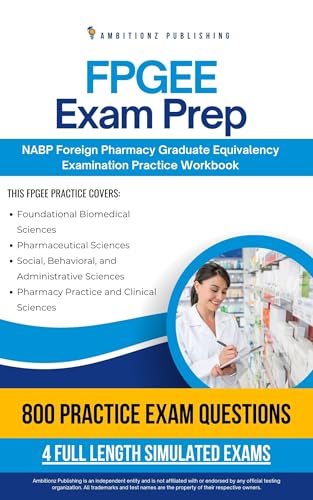
 Buy on Amazon
 Study guide on Mometrix
 Take courses on Udemy