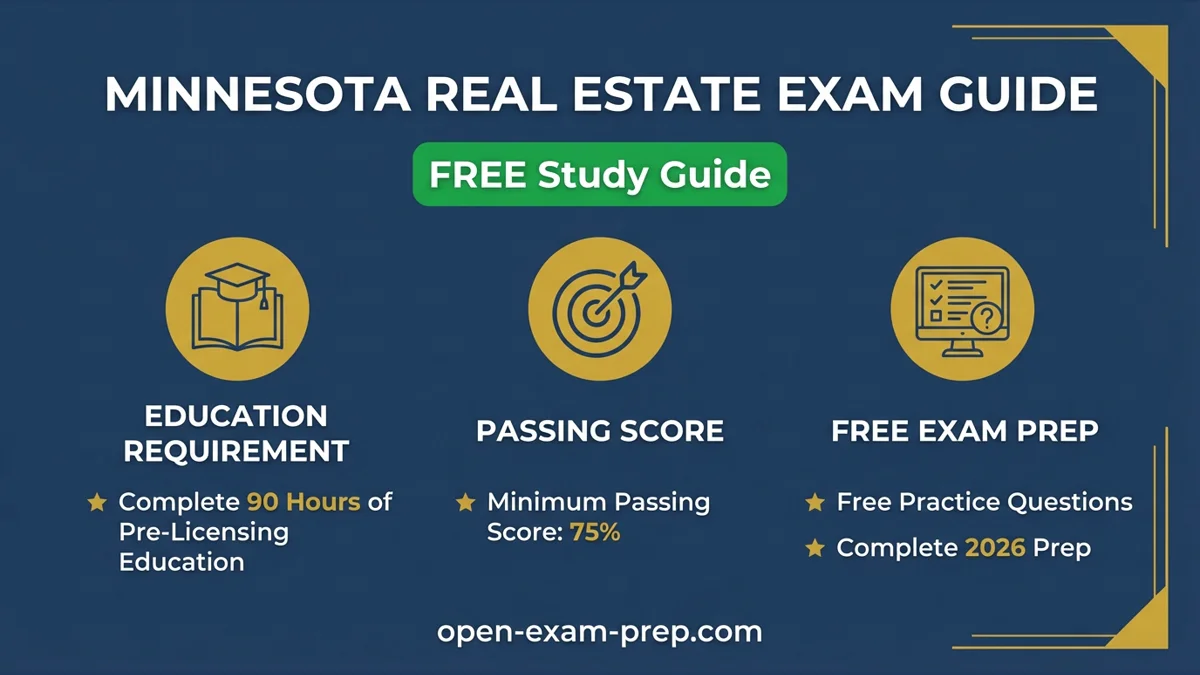
Minnesota Real Estate License Overview
The Minnesota Department of Commerce licenses real estate salespersons and brokers, and it has contracted with PSI to run the licensing exam. Minnesota law requires a license from the Department before anyone acts as a real estate salesperson or broker.
Minnesota Real Estate Exam Quick Facts
| Feature | Details |
|---|---|
| Exam Administrator | PSI Services |
| Total Questions | 130 multiple-choice (combined exam) |
| National (General) Portion | 80 scored questions |
| State Portion | 50 scored questions |
| Experimental Questions | 5-10 unscored; they count against your exam time |
| Time Limit | 4 hours total (2.5 general, 1.5 state) |
| Passing Score | 75% correct on each portion (PSI bulletin) |
| Exam Fee | $68 (combined) or $45 per section |
| Results | Score shown on screen at the end of the exam; score report emailed |
| Retake Wait | Not the same day; you can retest as soon as two days later if space allows |
Requirements Before Taking the Exam
Education Requirements
| Requirement | Details |
|---|---|
| Age | 18 years or older when you apply (Minn. Stat. 82.58) |
| Pre-License Education | 90 hours total (3 courses of 30 hours each) |
| Course I | Must be completed before taking the exam; otherwise the results are invalid |
| Courses II & III | Can be completed after the exam, before you apply for the license |
| Education Provider | Minnesota-approved courses |
Pre-License Courses (90 Hours)
The 90 hours are three 30-hour courses, known as Course I, Course II and Course III. Only Course I is required before taking the exam. Courses II and III can be completed after passing the exam but must be finished before you apply for your license, and the application must include the certificates for all three courses.
Application Process
- Complete Course I (30 hours)
- Schedule the exam through PSI and bring your Course I completion certificate
- Pass both exam portions (75% each)
- Complete Courses II and III
- Become associated with a licensed real estate broker
- Your broker submits your license application to the Department of Commerce through PULSE; it names the broker and includes your Course I-III certificates and passing results (Minn. Stat. 82.58)
- Pay the license fee ($110 total)
- Obtain the license within one year of passing the exam
Minnesota Exam Format
The Minnesota real estate exam consists of 130 questions when taking the combined exam. You can take both portions together or separately.
Exam Structure Options
| Option | Questions | Time | Fee |
|---|---|---|---|
| Combined Exam | 130 questions | 4 hours | $68 |
| General (National) Only | 80 questions | 2.5 hours | $45 |
| State Only | 50 questions | 1.5 hours | $45 |
Content Breakdown - National Portion (80 Questions)
The PSI Minnesota bulletin assigns these salesperson weights; question counts are approximate.
| Topic | Weight | ~Questions |
|---|---|---|
| Property Ownership | 10% | 8 |
| Land Use Controls | 5% | 4 |
| Valuation | 8% | 6 |
| Financing | 10% | 8 |
| Contracts | 19% | 15 |
| Agency | 13% | 10 |
| Property Disclosures | 7% | 6 |
| Property Management | 3% | 2 |
| Transfer of Title | 6% | 5 |
| Practice of Real Estate (antidiscrimination and fair housing, legislation and regulations, duties) | 12% | 10 |
| Real Estate Calculations | 7% | 6 |
Content Breakdown - State Portion (50 Questions)
The bulletin's state outline has four areas, each tied to Minnesota statutes:
| Area | Key Statutes and Topics |
|---|---|
| Real Estate Brokerage License Law | Definitions, licensing, trust accounts, standards of conduct, the Commissioner's authority, the Education, Research and Recovery Fund, agency disclosure (82.67), other disclosures (82.68), compensation |
| Interests in Real Property | Conveyance by spouses, subdivided lands, condominiums and common interest communities, real estate taxes and special assessments, landlords and tenants (504B) |
| Conveyance Procedures and Protection of Parties | Recording and Torrens registration, mortgage registry and deed taxes, statutory home warranties, the Minnesota Human Rights Act, the statute of frauds and ch. 513, septic systems, wells, leaking underground storage tanks |
| Financial Instruments: Obligations, Rights, Remedies | Mortgage foreclosure and redemption, contracts for deed, homestead exemptions, labor and material liens (ch. 514) |
Detailed Topic Coverage
Agency Relationships
| Topic | Key Points |
|---|---|
| Seller's Broker | Represents the seller and owes the seller fiduciary duties |
| Buyer's Broker | Represents the buyer and owes the buyer fiduciary duties |
| Dual Agency | Represents both parties; requires the informed consent of all parties |
| Facilitator | Represents neither party; owes no fiduciary duty except confidentiality, unless a written facilitator services agreement adds duties |
Disclosure Requirements
| Topic | Key Points |
|---|---|
| Agency Disclosure | Agency disclosure form at the first substantive contact in a residential transaction (82.67) |
| Seller Disclosure | Material facts that could adversely and significantly affect an ordinary buyer's use and enjoyment of the property (513.55) |
| Licensee Disclosure | Material facts the licensee is aware of, disclosed to prospective purchasers (82.68) |
| Not Material Facts | HIV/AIDS status of an occupant; a suicide, accidental or natural death, or perceived paranormal activity; a nearby adult family home, residential facility or nursing home (82.68, 513.56) |
Real Estate Calculations
The PSI outline lists these calculation topics:
| Topic | Key Points |
|---|---|
| Transactions | Seller's net proceeds, buyer funds needed at closing, property tax and other prorations, transfer fees |
| PITI | Payment estimate from loan rate and term |
| General Concepts | Equity, rate of return and capitalization rate, loan-to-value ratio, discount points and origination fees |
Note: Real Estate Calculations are 7% of PSI's general (national) outline, and calculations can also appear in other topics.
Minnesota-Specific Topics
Minnesota Department of Commerce
| Feature | Details |
|---|---|
| Regulator | Minnesota Department of Commerce, 85 7th Place E, Suite 280, St. Paul |
| Application Portal | PULSE (pulseportal.com), used for applications, renewals, transfers and approved-course searches |
| License Fee | $110 total ($70 license fee + $30 recovery fund + $10 technology surcharge) |
| Contact | Licensing: 651-539-1599 |
Agency Disclosure Requirements (Minnesota Statute 82.67)
In a residential transaction, a broker or salesperson must give the consumer the agency disclosure form at the first substantive contact. The form describes the agency and facilitator options and has a signature line acknowledging receipt.
Types of Agency Relationships:
-
Seller's Broker
- Represents the seller and owes the seller fiduciary duties
- Must disclose to the buyer known material facts that could adversely and significantly affect the buyer's use or enjoyment of the property
-
Buyer's Broker
- Represents the buyer and owes the buyer fiduciary duties, even if the seller pays all or part of the fee
- Must disclose to the buyer known material facts that could adversely and significantly affect the buyer's use or enjoyment of the property
-
Dual Agency
- One broker or salesperson represents both parties, or two salespersons licensed to the same broker each represent a party
- Requires the informed consent of all parties, given in the purchase agreement for residential transactions (82.67, subd. 4)
- Dual agents may not advocate for one party to the detriment of the other
- Price, terms and motivation stay confidential unless a party instructs otherwise in writing
-
Facilitator
- Performs services for a buyer, a seller or both without representing either
- Owes no fiduciary duty except confidentiality, unless a written facilitator services agreement adds duties
The fiduciary duties listed on the form are loyalty, obedience, disclosure, confidentiality, reasonable care and accounting.
Seller Disclosure Requirements (Minnesota Statute 513.55)
Before signing an agreement to sell or transfer residential real property, the seller must give the prospective buyer a written disclosure of all material facts the seller is aware of that could adversely and significantly affect:
- An ordinary buyer's use and enjoyment of the property, or
- Any intended use of the property the seller is aware of
The disclosure must be made in good faith, based on the best of the seller's knowledge at the time.
Exceptions to Disclosure (513.54, partial list):
- Transfers by foreclosure or deed in lieu of foreclosure
- Transfers to a tenant in possession
- Transfers to heirs or devisees
- Transfers to a spouse, parent, grandparent, child or grandchild of the seller
- See Minnesota Statutes 513.54 for the complete list
Buyer Remedies (513.57):
- A seller who fails to disclose and was aware of material facts is liable to the buyer for damages and other equitable relief
- The action must be brought within 2 years after closing
- Fraud, negligent misrepresentation and other legal actions remain available
License Law Penalties
Under Minnesota Statutes chapter 82:
- Violating chapter 82 or a Commerce rule or order is a gross misdemeanor (82.83)
- On residential property, a licensee whose agency relationships were not disclosed cannot sue to recover a commission (82.85)
- Acting for more than one party without the knowledge and consent of all parties is a prohibited practice (82.81)
- Trust funds must be deposited in a broker trust account (82.75)
Minnesota Exam Scoring
The Minnesota real estate exam requires a 75% passing score on both portions. PSI and the Department of Commerce do not publish a pass rate. Key factors affecting success:
| Factor | Impact |
|---|---|
| Higher passing score | 75% vs 70% in some states |
| Percent-correct scoring | You need 75% of the questions right on each portion |
| Dual requirements | Must pass both portions independently |
| Math content | Real Estate Calculations are 7% of PSI's general outline |
Study Strategy
Study Priority by Topic
-
Agency & Disclosure - Critical for both portions
- Minnesota Statute 82.67 requirements
- Fiduciary duties
- Agency disclosure forms
-
Contracts & Property Law
- Contract formation and elements
- Property rights in Minnesota
- Transfer procedures
-
Real Estate Calculations (7% of PSI's general outline)
- Commission calculations
- Prorations
- Mortgage math
-
Minnesota License Law
- Department of Commerce requirements
- Violations and penalties
- CE requirements
Key Math Formulas
Commission:
Prorations (use the day count the question gives):
Property Tax:
Loan-to-Value:
Capitalization Rate:
Common Mistakes to Avoid
1. Underestimating Minnesota-Specific Content
Many candidates focus only on national content but miss Minnesota-specific:
- Agency disclosure requirements under Statute 82.67
- Seller disclosure under Statute 513.55
- Minnesota license law penalties
- Recording, Torrens registration, and the deed and mortgage registry taxes
2. Weak Math Skills
Real Estate Calculations are 7% of PSI's general outline, and math also shows up in financing and valuation questions. Practice daily:
- Prorations
- Seller's net proceeds and buyer funds at closing
- PITI payment estimates
- Loan-to-value and capitalization rate
3. Confusing Agency Types
Know the differences between:
- Seller's Broker: Fiduciary duties to the seller
- Buyer's Broker: Fiduciary duties to the buyer
- Dual Agent: Informed consent of all parties; may not advocate for one party to the detriment of the other
- Facilitator: Represents neither party; owes confidentiality only, unless a written agreement adds duties
4. Poor Time Management
- 80 general questions in 2.5 hours and 50 state questions in 1.5 hours = under 2 minutes per question
- Don't spend too long on difficult questions
- Flag and return later
- Review answers before submitting
Exam Day Tips
Before the Exam
- Get good rest the night before
- Eat a balanced meal
- Arrive 15 minutes before your appointment (PSI Minnesota bulletin)
- Bring one valid government-issued photo ID with your signature that matches the name you scheduled with
During the Exam
- Read every question completely
- Watch for "EXCEPT" and "NOT" questions
- Work math on the scratch paper you may be given at a test center (scratch paper is not allowed in remote exams)
- Change an answer when you find a misread word or a calculation error
- Use all available time to review
What to Bring
- One valid, unexpired government-issued photo ID with your signature
- Proof of education for every attempt, such as your Course I completion certificate
- Nothing else: handheld calculators, phones and other personal items go in secure storage or back to your vehicle
Testing Options
PSI offers the Minnesota real estate exam:
- In-person at PSI testing centers
- Online proctored from home
Contact PSI Services at (866) 395-1006 for scheduling.
After Passing
Immediate Steps
- See your score on screen at the end of the exam; a score report is emailed
- Complete Courses II and III if not already done
- Become associated with a licensed broker
- Your broker submits the application to the Department of Commerce
- Pay license fee ($110 total)
- Obtain the license within one year of passing the exam
License Application Requirements
| Requirement | Details |
|---|---|
| Broker | Required; your associated broker submits the application, which names the broker you will act for (82.58) |
| All 90 Hours Complete | Course I, II and III completion certificates |
| Application Deadline | File and obtain the license within 1 year of passing, or retake the exam |
| License Fee | $110 (includes recovery fund and tech surcharge) |
Continuing Education
| Renewal Period | CE Required |
|---|---|
| Every 24-month license period | 30 hours total |
| Required Topics | The Commerce general module course each license year, plus at least 1 hour of agency law and 1 hour of fair housing within the 30 hours |
Note: At least 15 of the 30 hours must be completed before the previous June 30.
Minnesota Real Estate Career Outlook
Salary Expectations
The U.S. Bureau of Labor Statistics reports a national median annual wage of $52,830 for real estate sales agents in May 2025; the lowest 10% earned less than $32,970 and the highest 10% more than $123,590. For Minnesota, BLS reports a median of $46,410 (May 2025). Brokers and sales agents earn most of their income from commissions, so income depends on market and production.
Total Cost Breakdown
| Item | Cost |
|---|---|
| Courses I, II and III (90 hours) | Set by each school |
| Exam Fee (combined) | $68 |
| License Fee | $110 |
Resources
- Minnesota Department of Commerce - Official licensing information
- PULSE - License applications and approved-course searches
- PSI Services - Exam scheduling
- Real Estate License Guide (PDF) - Official guide
- OpenExamPrep - Free study materials and practice questions

 Course Playlist
 Pre-licensing on Colibri
 Flashcards on Mometrix

 Buy on Amazon
 Take courses on Udemy