Louisiana Property & Casualty Insurance License Exam Overview
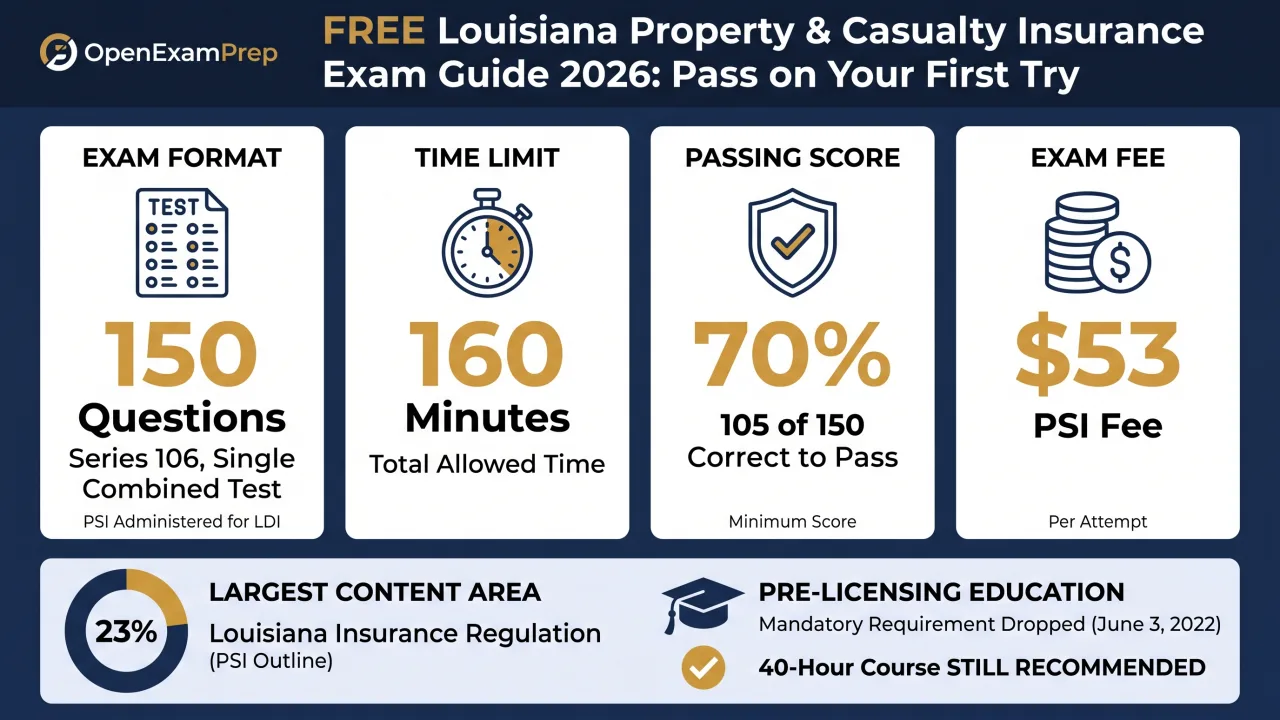
The Louisiana Property & Casualty Insurance License Exam is the Louisiana Examination for Property and Casualty Insurance, Series 106, administered by PSI on behalf of the Louisiana Department of Insurance (LDI). Property and Casualty are tested together in one combined 150-question exam, so you do not sit separate Property and Casualty tests in Louisiana. The exam can be taken at a PSI test center or by live remote proctor.
Passing this exam qualifies you to sell property insurance, auto insurance, liability coverage, and related products throughout Louisiana, a state whose Gulf Coast exposure to hurricanes, flooding, and coastal storms creates constant P&C insurance demand and makes wind, flood, and residual-market topics heavily tested.
Exam Format at a Glance
| Component | Details |
|---|---|
| Exam name | Property and Casualty, Series 106 (combined) |
| Total Questions | 150 scored multiple-choice |
| Time Limit | 160 minutes (2 hours 40 minutes) |
| Passing Score | 70% (105 of 150 correct) |
| Testing Vendor | PSI |
| Exam Fee | $53 |
| Pre-licensing Education | Not required in Louisiana (recommended) |
| Score reporting | Pass/fail at the test center; diagnostic report on a fail |
Watch the two numbers most guides get wrong. You get 160 minutes, not a flat 2 hours, and Louisiana dropped its mandatory pre-licensing education requirement on June 3, 2022. A 40-hour course is still smart preparation, but it is no longer required to sit the exam.
Why Get P&C Licensed in Louisiana?
- High-demand market — hurricane and flood exposure keeps property and auto coverage in constant demand
- Coastal economy — oil, gas, shipping, ports, and tourism drive commercial insurance needs
- Specialist niches — wind, flood, and residual-market expertise commands a premium
- Commission upside — high coastal premiums translate into larger commissions
- Career mobility — a resident P&C license is a base for adjuster, broker, and nonresident licenses in other states
Start Your FREE Louisiana P&C Exam Prep
Ready to begin studying? Our comprehensive, completely free Louisiana P&C exam prep covers everything you need to pass, including unlimited practice questions and up to 10 free AI tutor questions per day.
Exam Content Outline: Official PSI Weights (Series 106)
Most competitor guides invent topic percentages. These are the actual PSI content-outline weights for Series 106, so you can study in priority order. Note that nearly a quarter of the exam is Louisiana law and another small slice is licensing and regulation, which together is the single biggest scoring opportunity on the test.
| Content Area | Weight |
|---|---|
| Louisiana Insurance Regulation | 23% |
| Property and Casualty Insurance Basics | 15% |
| Homeowners Policy Concepts | 10% |
| General Insurance Concepts | 8% |
| Personal Automobile Policy | 7% |
| Commercial Property Policies | 7% |
| Commercial General Liability | 7% |
| Commercial Automobile Policy | 6% |
| Workers' Compensation Insurance | 5% |
| Other Types of P&C Insurance | 5% |
| Dwelling Policy Concepts | 4% |
| Commercial Crime | 2% |
| Licensing and Regulation (federal) | 1% |
Strategic takeaway: Louisiana Insurance Regulation plus Licensing and Regulation is about 24% of the exam, more than any single coverage line. Many candidates over-study homeowners forms and under-study state law, then fail. Master Title 22 and licensing rules first.
Key Topics by Content Area
Louisiana Insurance Regulation (23%)
This is the highest-weighted area. Expect questions drawn straight from Title 22 of the Louisiana Revised Statutes:
- Licensing — resident vs. nonresident, individual vs. business entity, temporary licenses, renewal, expiration, and reporting of actions
- Commissioner's powers — examinations, hearings, cease-and-desist orders, license suspension or revocation, penalties and fines
- Unfair trade practices (22:1964) — misrepresentation, false advertising, defamation, boycott/coercion, unfair discrimination, rebating and twisting, prohibited fees
- Unfair claims settlement practices (22:1964(14))
- Producer conduct — controlled business, shared commissions, payment to unlicensed entities
- Louisiana state-specific provisions — Louisiana Valued Policy Law (22:1318), Louisiana Insurance Guaranty Association (22:2051-2070), Louisiana standard fire policy (22:1311), cancellation and nonrenewal rules (22:887 commercial, 22:1265/1333/1335/1336 homeowners), binders, certificates of insurance
Property and Casualty Insurance Basics (15%)
- Insurable interest, indemnity, and good faith
- Damages: compensatory vs. punitive, general vs. special
- Liability: absolute, strict, and vicarious
- Negligence: duty, breach, causation, damages; defenses against negligence
- Loss valuation: actual cash value, replacement cost, functional replacement cost, agreed value, market value, valued policy
- Policy structure: declarations, insuring agreement, conditions, exclusions, definitions, endorsements
- Limits of liability (per person, per occurrence, aggregate, split, combined single limit) and coinsurance
Homeowners Policy Concepts (10%)
- HO forms: HO-2 (Broad), HO-3 (Special), HO-4 (Contents Broad), HO-6 (Unit-Owners), HO-8 (Modified)
- Property coverages: Dwelling, Other Structures, Personal Property, Loss of Use
- Liability coverages: Personal Liability and Medical Payments to Others
- Common endorsements: scheduled personal property, earthquake, identity theft, watercraft, personal injury
Personal & Commercial Automobile (7% + 6%)
Louisiana auto liability minimums (15/30/25):
| Coverage | Minimum Limit |
|---|---|
| Bodily Injury per person | $15,000 |
| Bodily Injury per accident | $30,000 |
| Property Damage | $25,000 |
- Personal Auto Policy: liability, medical payments, uninsured/underinsured motorist, physical damage, Louisiana-specific endorsements (PP 01 95 amendment of policy provisions, PP 13 43 named driver exclusion)
- Commercial auto: covered auto symbols, hired and non-owned autos, mobile equipment, Louisiana lessor endorsement (CA 04 13)
- Louisiana No Pay, No Play law: an uninsured owner cannot recover the first $25,000 in property damage and first $15,000 in bodily injury
Commercial Lines, Workers' Comp, and Specialty (7% CGL, 7% commercial property, 5% WC, 5% other, 2% crime)
- Commercial property: building and business personal property, business income, extra expense, builders risk, cause-of-loss forms, equipment breakdown, inland marine
- Commercial General Liability: occurrence vs. claims-made, premises/operations, products and completed operations, personal and advertising injury
- Workers' compensation: statutory benefits, employers liability, levels of disability, federal acts (FELA, Jones Act, Longshore)
- Specialty: directors and officers, professional/E&O, surety bonds, umbrella/excess, BOP, farmowners, flood and earthquake coverages, Louisiana Citizens Property Insurance Corporation (22:2291-2314), and FAIR/Coastal Plans (22:2321)
Free Practice Questions Available
Test your knowledge with free practice questions written to the Series 106 content outline, with full explanations for every answer.
Louisiana-Specific Exam Tips
1. Know the auto minimums and No Pay, No Play
Louisiana requires 15/30/25 liability coverage, and the No Pay, No Play statute bars an uninsured driver from recovering the first $25,000 of property damage and first $15,000 of bodily injury. Both are favorite test points.
2. Master wind, flood, and the residual market
- Named storm / hurricane deductibles are usually percentage-based (often 2-5% of dwelling limit), not flat dollars
- Wind vs. flood is a coverage distinction the exam loves: wind damage is typically covered by the property policy, flood is excluded and requires a separate NFIP or private flood policy
- Louisiana Citizens Property Insurance Corporation is the residual market for hard-to-place coastal property
- Louisiana Valued Policy Law (22:1318) can require payment of the full policy face amount on a total loss of an owner-occupied dwelling by a covered peril
3. Understand flood insurance
- NFIP basics, flood zones, and elevation certificates
- Private flood options and the standard 30-day waiting period
- Louisiana P&C producers must complete a 3-hour NFIP flood course each renewal period
4. Key numbers to remember
| Topic | Louisiana Requirement |
|---|---|
| Auto minimums | 15/30/25 |
| Exam questions / time | 150 / 160 minutes |
| Passing score | 70% (105 correct) |
| Pre-licensing | Not required (recommended) |
| CE requirement | 24 hours every 2 years (3 ethics + 3 flood) |
| Exam fee | $53 |
Common Mistakes to Avoid
- Under-studying Louisiana law — state regulation plus licensing is ~24% of the exam, the largest single block
- Confusing wind and flood coverage — flood requires a separate policy
- Assuming flat hurricane deductibles — they are percentage-based in Louisiana
- Forgetting Louisiana Citizens — the state residual market
- Mis-timing your practice — you have 160 minutes, not 120
- Assuming pre-licensing is mandatory — Louisiana dropped that requirement in 2022
How to Get Licensed: Step by Step
- Study to the Series 106 outline (pre-licensing course optional but recommended)
- Register and pay PSI the $53 exam fee and schedule your exam
- Complete the fingerprint background check (about $39.25 via PSI)
- Pass the exam with 70% or higher
- Apply for the license through NIPR or LDI: $75 application fee plus a small NIPR transaction fee
- Get appointed by an insurer to begin selling
- Maintain CE — 24 hours every 2 years, including 3 hours ethics and 3 hours NFIP flood
Cost Breakdown
| Item | Approximate Cost |
|---|---|
| PSI exam fee | $53 |
| Fingerprint background check | $39.25 |
| License application (NIPR) | $75 + small transaction fee |
| Optional pre-licensing course | $100-300 |
| Total (with optional course) | ~$270-470 |
2026 Louisiana Updates
- Pre-licensing education remains not required (dropped June 3, 2022)
- Continuing coastal-market pressure keeps Louisiana Citizens, wind/hail, and flood topics prominent
- Confirm current PSI fees and the LDI application path before you pay, as administrative details can change
Start Your Louisiana P&C Insurance Career Today
The Louisiana P&C license opens a challenging but rewarding coastal market. With preparation aimed at the real content weights, most candidates pass on the first attempt.
Our free study materials include complete topic coverage, practice questions with explanations, Louisiana-specific regulations (Title 22), study summaries, and an AI study assistant with up to 10 free questions per day. You do not need to pay for an expensive prep course when everything you need is available FREE.
How to Verify the Rules Before You Schedule
Use this guide for exam strategy, then confirm the current licensing steps with official sources before you pay for an appointment. Property and casualty licensing is state-administered, and administrative details can change even when the insurance concepts stay the same. Check the Louisiana Department of Insurance first, then the PSI candidate handbook, then the application path used after passing. The NAIC state insurance department directory is the safest way to find the current regulator site, and NIPR state requirements can help you confirm post-exam application steps.
For exam content, keep two buckets separate. The national bucket includes property policies, casualty policies, liability principles, negligence, risk management, policy structure, exclusions, conditions, endorsements, and claims concepts. The Louisiana bucket includes regulator authority, producer licensing, unfair practices, cancellation and nonrenewal rules, state auto requirements, residual market mechanisms, and local compliance duties. When a question includes a deadline, dollar limit, filing duty, required notice, or licensing step, ask whether it is a general insurance concept or a Louisiana rule.
What to Master for Property Questions
Property questions reward careful reading. Know the difference between named-peril and open-peril coverage, replacement cost and actual cash value, direct and indirect loss, vacancy and unoccupancy, and first-party property coverage versus third-party liability. Homeowners forms are a frequent source of points because the forms look similar but solve different problems. Practice identifying who is insured, what property is covered, which location qualifies as the residence premises, and whether the loss is excluded before an endorsement changes the answer.
Do not treat deductibles, limits, and valuation as afterthoughts. A question may describe a covered loss but test whether the settlement is reduced by deductible, limited by a sublimit, valued at actual cash value, or excluded because the cause of loss is not covered. Commercial property questions add business personal property, business income, extra expense, equipment breakdown, inland marine, and builder's risk concepts. For commercial forms, focus on why a business would need the coverage and what exposure remains if it does not have it.
What to Master for Casualty and Liability Questions
Casualty questions often turn on liability logic. Before choosing an answer, identify the claimant, the insured, the alleged injury or damage, and the legal theory. Negligence questions usually require duty, breach, causation, and damages. Liability policy questions ask whether the policy responds to bodily injury, property damage, personal and advertising injury, medical payments, or a specifically excluded exposure.
For auto, separate personal auto policy structure from state financial responsibility requirements. You need to know liability, medical payments or personal injury protection where relevant, uninsured and underinsured motorist concepts, damage to your auto, covered auto definitions, exclusions, and endorsements. For commercial auto, pay attention to covered auto symbols, hired and non-owned autos, business use, and garage exposures. For workers' compensation, separate statutory benefits from employer liability and remember that workers' compensation is not ordinary negligence coverage.
Final Two-Week Study Plan
In the first week, rotate by coverage family: Louisiana law first, then homeowners and dwelling property, commercial property, personal auto, commercial auto, general liability, and workers' compensation. After every practice set in /study-guides/la-property-casualty, write down whether each miss was caused by vocabulary, form structure, state rule, or careless reading. Vocabulary misses need flashcards. Form structure misses need diagrams. State-rule misses need a one-page Louisiana checklist. Careless reading needs slower question markup.
In the second week, stop studying by chapter only. The actual exam mixes topics, so your practice should mix them too. Use timed sets and force yourself to decide quickly whether the question is asking about coverage trigger, excluded cause, valuation, limit, condition, producer conduct, or state filing rule. Review explanations immediately. The review is where your score improves; simply taking more questions without fixing the reason for misses mostly measures the same weakness again.
Common P&C Exam Traps
One trap is choosing the coverage that sounds familiar instead of the coverage that fits the loss. A flood loss, an employee injury, a professional advice claim, a business income interruption, and a personal auto collision may all involve money damages, but they do not belong in the same policy part. Another trap is ignoring who owns the property or who is legally liable. Property insurance usually protects the insured's financial interest in property; liability insurance responds to claims made by others against the insured.
Cancellation and nonrenewal questions also deserve attention. The exam may test required notice, permitted reasons, timing, or who has authority to act. If the question is state-specific, do not rely on a generic national rule. Unfair trade practice questions work the same way: rebating, twisting, misrepresentation, false advertising, unfair claims handling, and fiduciary misuse of premiums are tested because they show whether a producer can operate lawfully after the exam.
Exam-Day Workflow
Confirm your appointment, identification, remote-proctoring rules, allowed materials, and reschedule deadline before test day. At check-in, your legal name should match the exam registration. During the test, take the easy points first. If a scenario is long, identify the policy, the insured, the covered property or claimant, the cause of loss, and the question's command word. If two answers are legally true, choose the one that answers the exact fact pattern.
If you miss the passing score, use the diagnostic report as a map. Rebuild the two weakest content areas, then retest with mixed questions. Candidates often improve fastest by mastering policy architecture: declarations, insuring agreement, conditions, exclusions, definitions, and endorsements. Once you can locate where a rule lives inside the policy, unfamiliar questions become easier to reason through.
Best Next Step
Use OpenExamPrep's Louisiana P&C study path for practice questions and explanations, and use official regulator resources for current licensing logistics. That combination keeps your preparation practical: OpenExamPrep builds exam judgment, while official sources confirm the steps required to turn a passing score into an active license.

 Free CE
 Buy on Amazon
 Prep course on Achievable
 Study guide on Mometrix
 Take courses on Udemy