Kentucky Property & Casualty Insurance License Exam (2026)
The Kentucky Property & Casualty (P&C) insurance producer license lets you sell property, auto, liability, and related lines in Kentucky. The exam is administered by the Kentucky Department of Insurance (KDOI) through its eServices portal — not by Pearson VUE, PSI, or Prometric. Kentucky is one of the few states that still self-administers insurance licensing exams at state-run testing sites, which is why vendor-specific handbooks you find online often do not apply.
This guide covers the current exam format, fees, content outline, Kentucky-specific rules, and a free study plan so you can pass on your first attempt without paying for a prep course.
Exam Format at a Glance
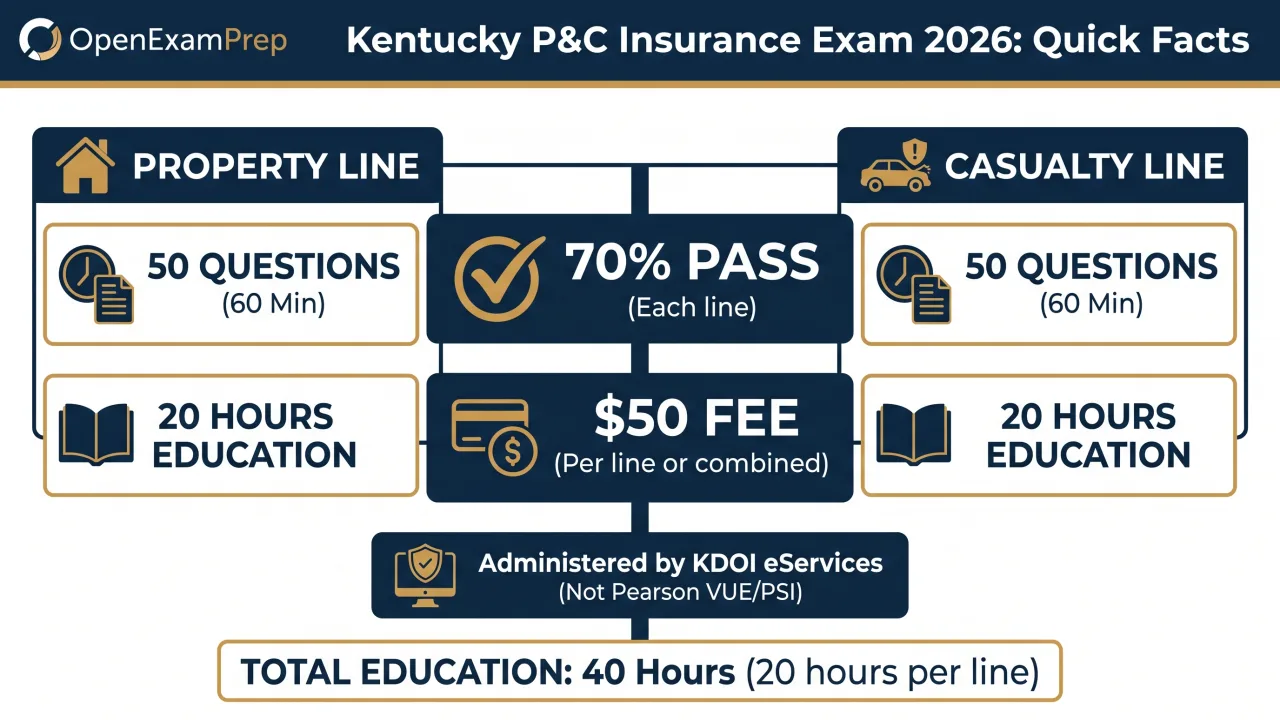
Kentucky administers two separate exams for the full P&C license: a Property exam and a Casualty exam (806 KAR 9:025). Most candidates take both at the same sitting.
| Component | Property Exam | Casualty Exam |
|---|---|---|
| Questions | 50 multiple-choice | 50 multiple-choice |
| Time Limit | 60 minutes | 60 minutes |
| Passing Score | 70% (35 correct) | 70% (35 correct) |
| Exam Fee | $50 | $50 |
| Combined Fee (both at once) | $50 total (not $100) | — |
| Administrator | KDOI (eServices) | KDOI (eServices) |
If you take both lines together, you face 100 scored questions in 120 minutes (2 hours) for a single $50 fee — a Kentucky-specific cost saving worth using.
The 150-question, 190-minute exam you may see referenced elsewhere is the separate Property & Casualty Consultant credential, not the producer license. Do not confuse the two.
Pre-Licensing Education Requirement
Kentucky requires 20 hours of pre-licensing education per line of authority (806 KAR 9:025). For the full P&C license that means 40 hours total: 20 hours for Property and 20 hours for Casualty. You can complete the hours through any KDOI-approved provider, classroom or self-study. Your completion certificate (Form CPL-01) is valid for one year and must be on file before you schedule the exam.
Total Cost to Get Licensed
| Item | Fee |
|---|---|
| Pre-licensing course (40 hrs, provider-priced) | ~$200–$400 |
| Exam fee (Property + Casualty, combined sitting) | $50 |
| License class fee (resident individual) | $40 |
| Line of authority fee (Property) | $40 |
| Line of authority fee (Casualty) | $40 |
| Criminal background check (AOC AOCFastCheck) | ~$25–$35 |
| NIPR application transaction fee | ~$5–$10 |
| Total (typical resident, both lines) | ~$400–$565 |
License fees are set by 806 KAR 4:010. The $40 per-line authority fee plus $40 class fee is the current resident schedule; renewals are $40 only if you have no active insurer appointments (free if you do).
How to Schedule the Exam
- Complete 40 hours of KDOI-approved pre-licensing (20 Property + 20 Casualty).
- Pass a criminal background check through the Kentucky Administrative Office of the Courts (AOC) AOCFastCheck portal — valid 60 days.
- Apply through NIPR at nipr.com with the license and line-of-authority fees.
- Wait for KDOI to process your application (about 3–5 business days).
- Create an eServices account at insurance.ky.gov (now using the Commonwealth's KYID identity platform) and schedule your exam.
- Take the exam at a KDOI testing site: Frankfort, Ashland, Bowling Green, Elizabethtown, Florence, Henderson, Lexington, London, Louisville, Madisonville, Maysville, Middlesboro, Owensboro, Paducah, or Somerset. Walk-ins are not accepted, and Kentucky does not offer remote testing.
Bring a government-issued photo ID and your pre-licensing certificate on test day. Arrive 15 minutes early. Cancel or reschedule at least 24 business hours ahead or you forfeit the $50 fee.
Exam Content Outline
The KDOI publishes official study outlines that reflect the current 50-question structure for each line.
Property Exam (50 questions)
| Topic | Questions |
|---|---|
| Principles of Insurance | 3 |
| The Insurance Contract | 3 |
| Insurance Company Organization and Regulation | 1 |
| The Insurance Transaction | 3 |
| Introduction to Property Insurance | 4 |
| Dwelling Insurance | 2 |
| Homeowners Insurance | 5 |
| Personal Auto Insurance | 3 |
| Miscellaneous Personal Insurance | 4 |
| The Commercial Package Policy | 3 |
| The Businessowners Policy | 3 |
| Commercial Property Insurance | 3 |
| Ocean and Inland Marine Insurance | 2 |
| Commercial Crime Insurance | 3 |
| Miscellaneous Commercial Insurance | 4 |
| Kentucky Law | 4 |
Casualty Exam (50 questions)
| Topic | Questions |
|---|---|
| Principles of Insurance | 4 |
| The Insurance Contract | 4 |
| Insurance Company Organization and Regulation | 1 |
| The Insurance Transaction | 4 |
| Introduction to Liability Insurance | 4 |
| Homeowners Insurance (Section II — Liability) | 2 |
| Personal Auto Insurance | 5 |
| Miscellaneous Personal Insurance | 2 |
| The Commercial Package Policy | 2 |
| The Businessowners Policy | 2 |
| Commercial General Liability Insurance | 4 |
| Commercial Auto Insurance | 2 |
| Commercial Crime Insurance | 1 |
| Workers' Compensation | 5 |
| Miscellaneous Commercial Insurance | 3 |
| Kentucky Law | 5 |
The Kentucky Law questions test KRS Chapter 304 (insurance code), producer licensing duties, unfair trade practices, cancellation and nonrenewal rules, and state auto requirements. About 8–10% of each exam is state-specific, so do not skip the Kentucky section even if you already hold a P&C license in another state.
Start Your FREE Kentucky P&C Exam Prep
Ready to begin studying? Our comprehensive, completely free Kentucky P&C exam prep covers everything you need to pass.
Kentucky-Specific Topics You Must Know
Choice No-Fault Auto (KRS 304.39)
Kentucky is a choice no-fault state. Every auto policy includes $10,000 in Basic Reparations Benefits (BRB/PIP) for medical expenses and lost wages regardless of fault. By default, tort liability is limited — you cannot sue an at-fault driver for pain and suffering unless medical expenses exceed $1,000 or the injury involves a fracture, permanent disfigurement, permanent injury, or death.
A driver may reject the no-fault tort limitations in writing (filed with KDOI) to retain full rights to sue and be sued. Rejection raises liability premiums and forfeits PIP collection rights. This choice mechanism is one of the most-tested Kentucky auto concepts on the exam.
Minimum Auto Liability Limits
Kentucky requires 25/50/25 plus $10,000 PIP/BRB:
| Coverage | Minimum Limit |
|---|---|
| Bodily Injury (per person) | $25,000 |
| Bodily Injury (per accident) | $50,000 |
| Property Damage | $25,000 |
| Personal Injury Protection (BRB) | $10,000 |
Workers' Compensation (KRS 342)
Kentucky workers' comp is required for employers with one or more employees. The market uses NCCI for classification and rate filings, and KEMI (Kentucky Employers' Mutual Insurance) is the state fund. Coal mining employers face additional statutory requirements. Self-insurance is permitted with KDOI approval.
Mine Subsidence Coverage
Eastern Kentucky's coal mining history creates a unique property risk: ground settling from abandoned mines. Mine subsidence is often a separate endorsement, not included in standard homeowners policies. The Kentucky Mine Subsidence Insurance Fund provides backstop coverage for eligible properties, particularly in the eastern coal counties.
Other Kentucky Mechanisms
- Kentucky FAIR Plan — residual market property coverage for hard-to-place risks
- KPCIA — Kentucky Property and Casualty Insurance Guaranty Association (covers policyholders if an insurer becomes insolvent)
- KRS 304.9-470 — surplus lines rules
- KRS 304.9-467 — prohibited practices in auto glass replacement
After You Pass
- Print your license from your eServices account. Results are available immediately at the testing site; license certificates are issued through eServices.
- Get appointed by an insurer — having at least one active appointment makes your biennial renewal free.
- Complete 24 hours of CE every 2 years (biennium), including 3 hours of ethics. Compliance is by the last day of your birth month; up to 12 excess hours carry over.
- Renew on time — renewal is $40 if you have no active appointments, free if you do.
Free Study Plan and Timeline
| Week | Focus | Hours |
|---|---|---|
| 1–2 | Property insurance fundamentals (HO forms, dwelling, commercial property) | 10–12 |
| 2–3 | Casualty and liability (CGL, auto, workers' comp) | 10–12 |
| 3–4 | Kentucky law (KRS 304, no-fault choice, WC, residual markets) | 8–10 |
| 4–5 | Mixed timed practice and weak-area review | 10–12 |
| 5–6 | Full practice exams and final review | 8–10 |
Total recommended study time: 50–60 hours on top of the 40-hour pre-licensing requirement.
How to Approach Property Questions
Property questions reward careful reading. Know the difference between named-peril and open-peril coverage, replacement cost and actual cash value, direct and indirect loss, and first-party property versus third-party liability. Homeowners forms are a frequent source of points because the forms look similar but solve different problems. Practice identifying who is insured, what property is covered, which location qualifies as the residence premises, and whether the loss is excluded before an endorsement changes the answer.
Do not treat deductibles, limits, and valuation as afterthoughts. A question may describe a covered loss but test whether the settlement is reduced by deductible, limited by a sublimit, valued at actual cash value, or excluded because the cause of loss is not covered. Commercial property adds business personal property, business income, extra expense, equipment breakdown, inland marine, and builder's risk.
How to Approach Casualty and Liability Questions
Casualty questions turn on liability logic. Before choosing an answer, identify the claimant, the insured, the alleged injury or damage, and the legal theory. Negligence requires duty, breach, causation, and damages. Liability policy questions ask whether the policy responds to bodily injury, property damage, personal and advertising injury, medical payments, or a specifically excluded exposure.
For auto, separate personal auto policy structure from Kentucky's financial responsibility rules. You need liability, PIP/BRB, uninsured and underinsured motorist (offered and can be rejected in writing), and damage to your auto. For commercial auto, focus on covered auto symbols, hired and non-owned autos, and garage exposures. For workers' compensation, separate statutory benefits from employer liability and remember that workers' comp is not ordinary negligence coverage.
Common Exam Traps
- Choosing the coverage that sounds familiar instead of the coverage that fits the loss. A flood loss, an employee injury, a professional advice claim, and a business income interruption all involve money damages but belong in different policy parts.
- Ignoring who owns the property or who is legally liable. Property insurance protects the insured's financial interest in property; liability insurance responds to claims by others against the insured.
- Confusing the 150-question Consultant exam with the 50-per-line producer exam. They are different credentials with different fees and time limits.
- Mixing up Kentucky no-fault rejection with UM/UIM rejection. Both can be rejected in writing but operate differently.
- Applying a generic national cancellation rule to a Kentucky question. State notice periods and permitted reasons differ.
Exam-Day Workflow
Confirm your appointment, identification, and reschedule deadline before test day. At check-in, your legal name should match the exam registration. During the test, take the easy points first. If a scenario is long, identify the policy, the insured, the covered property or claimant, the cause of loss, and the question's command word. If two answers are legally true, choose the one that answers the exact fact pattern.
If you miss the passing score, use the score report as a map. Rebuild the two weakest content areas, then retest. File Form 8304 and pay the $50 retake fee through eServices. Wait at least 24 hours before rescheduling, and retake within the 120-day window.
2026 Updates to Know
- KYID login: Kentucky DOI eServices now uses the Commonwealth's KYID identity platform. Create or verify your account before you need to schedule so you are not blocked at appointment time.
- No-fault benefit proposals (HB 627, 2026 session): would raise the funeral sub-limit from $1,000 to $5,000 and the weekly work-loss cap from $200 to $500 — confirm current BRB figures with KDOI before exam day in case of enactment.
- Pre-licensing rule: the 20-hours-per-line / 40-hours-combined P&C requirement under 806 KAR 9:025 (effective 2023) remains in force through 2030.
Verify the Rules Before You Schedule
Use this guide for exam strategy, then confirm the current licensing steps with official sources before you pay for an appointment. Check the Kentucky Department of Insurance first, then the NAIC state insurance department directory, then NIPR state requirements for the post-exam application path. Administrative details can change even when the insurance concepts stay the same.
Best Next Step
Use OpenExamPrep's free Kentucky P&C study path for practice questions and explanations, and use official KDOI resources for current licensing logistics. That combination keeps your preparation practical: OpenExamPrep builds exam judgment, while official sources confirm the steps required to turn a passing score into an active license.

 Free CE
 Buy on Amazon
 Prep course on Achievable
 Study guide on Mometrix
 Take courses on Udemy