CISM in 2026: The Only Guide You Need
The ISACA CISM (Certified Information Security Manager) is the most recognized management-level information security credential on the planet. More than 107,000 professionals have earned it since 2002, and in 2026 it is more valuable than ever — every large enterprise needs security leaders who can build programs, communicate risk to the board, and run incident response when things go wrong. That is the CISM mandate, and this guide is built to beat every other CISM resource on the web.
This guide covers the 2026 exam at full depth: cost, format, eligibility, the 4 Job Practice Domains (Governance 17%, Risk 20%, Program 33%, Incident 30%), a 12-week study plan, pass rates, salary data, and the management-mindset coaching that separates candidates who pass on the first try from those who retake. Every detail was cross-referenced against isaca.org/credentialing/cism and the 16th edition CISM Review Manual.
Start with FREE practice now: Jump into our free CISM practice questions — exam-style multiple-choice across all 4 domains with ISACA-style "best answer" explanations. No signup required.
CISM Exam At-a-Glance (2026)
| Detail | Information |
|---|---|
| Certification Body | ISACA (Information Systems Audit and Control Association) |
| Exam Delivery | PSI Services — online proctored OR PSI test center |
| Questions | 150 multiple-choice |
| Duration | 4 hours (240 minutes) |
| Format | Linear on-the-fly — back-navigation and answer changes allowed |
| Passing Score | 450 on a 200-800 scaled scale |
| Cost | $575 ISACA member / $760 non-member |
| Application Fee | $50 one-time (after passing) |
| Languages | English, Chinese (Simplified), Japanese, Korean, Spanish |
| Experience Requirement | 5 years InfoSec work + 3 years in InfoSec management spanning 3 of 4 domains |
| Experience Window | 5 years from passing to verify and certify |
| Validity | 3 years, renewable |
| CPE Requirement | 120 CPE hours every 3 years (minimum 20/year) |
| Annual Maintenance Fee | $45 member / $85 non-member |
| Exam Windows | Continuous testing, any day of the year |
| Retake Policy | 30 days after 1st fail, 90 days after each further attempt; max 4 attempts per rolling 12 months |
| Job Practice Analysis Effective | 2022 (4-domain structure, current through 3 November 2026; new Exam Content Outline effective 3 November 2026) |
FREE CISM Prep: Practice Before You Pay
Before committing to the $760 non-member fee, prove to yourself that you can actually pass. The biggest mistake CISM candidates make is buying a $500 bootcamp, studying for 3 months, and then failing because they never consistently scored 75%+ on timed practice exams beforehand.
Our free CISM practice question bank covers all 4 domains with ISACA-style "best answer" questions that emphasize management judgment — the defining characteristic of the CISM exam. Every question includes a detailed explanation of why the correct answer is the most business-aligned choice, why the distractors look plausible but miss the management frame, and which domain concept the question tests.
Claim your free practice: Start CISM practice questions now. No card, no email gate, no paywall.
What CISM Actually Is — And Why It Is Not CISSP or CISA
CISM was created by ISACA in 2002 for people who manage information security programs. The certification validates your ability to govern, assess risk for, build, and respond to incidents in an enterprise security program — in other words, the CISO job description, boiled down to 4 domains and 150 questions.
Here is the single most important thing to internalize before you open the Review Manual:
CISM is a management exam, not a technical exam.
Every question on the CISM is answered by asking: What would a security manager — one who reports to executive leadership, works with the business, and is accountable for program outcomes — do here? It is not: What is the most secure technical configuration? That is CISSP territory. It is not: What would an independent auditor evaluate? That is CISA territory.
If you are a brilliant security engineer who has never sat in a CISO’s chair, you will find CISM counterintuitive. You will want to say "encrypt more," "add MFA," "deploy a WAF." The CISM correct answer is almost always: "understand the business risk, present options and costs to leadership, and let the business accept, modify, transfer, or avoid the risk." Learn that rhythm and you pass. Miss it and you retake.
The 2026 CISM Market
Three forces have made 2026 the best year yet to earn CISM:
1. CISO role has exploded. SEC 2023 Cybersecurity Disclosure Rule (10-K / 4-day 8-K) is in full effect. Every large organization needs a qualified security manager to own the program, and CISM is the most recognized management credential for that role.
2. Privacy and AI governance merged with security leadership. EU AI Act, NIST AI RMF 1.0, ISO/IEC 42001:2023, GDPR, CCPA/CPRA, and state privacy laws have piled onto the security manager’s plate. CISM’s risk-and-governance-first framing is the mindset this work requires.
3. Talent shortage is acute. ISACA’s 2024 State of Cybersecurity reports 60% of organizations have understaffed cyber teams and 61% say security management roles take 3-6+ months to fill. CISM appears in ~17% of US security manager / CISO postings as preferred or required — more than any other management-specific credential.
Who Should Take CISM
CISM is the right credential for people who make — or will soon make — program-level security decisions. Sweet spot: 3-7 years of security experience with management exposure.
| Role | Why CISM Fits |
|---|---|
| Information Security Manager | Canonical CISM role — literally in the name. |
| CISO / Deputy CISO / VP Security | Most cited management credential on CISO job postings. |
| Security Program Manager | Running zero-trust, identity, DLP, vuln mgmt programs. |
| GRC / Security Governance Lead | Policy, exception management, risk registers, committee reporting. |
| Senior Security Architect moving to leadership | Management framing for technical seniors. |
| Security Consultants / vCISO / Big 4 advisory | Standard at Manager level. |
| Military / Government Security Officers (ISSO/ISSM) | DoD 8140.03 approved IAT/IAM credential. |
CISM is not the right first cert for technical specialists (OSCP, GCIH instead), entry-level analysts (Security+ first), IT auditors (CISA), or pure risk specialists (CRISC is deeper).
Eligibility & the CISM Experience Rule
Here is where most candidates get confused: you do NOT need 5 years of experience to sit the exam. You need it to become certified after you pass, and you have 5 years from the pass date to submit the paperwork.
The Experience Requirement
To earn the CISM, you need:
- 5 years of professional information security work experience, AND
- At least 3 of those 5 years must be in information security management, AND
- Your management experience must span 3 or more of the 4 CISM domains (Governance, Risk, Program, Incident Management).
Experience must be gained within the 10-year period preceding application OR within 5 years after passing the exam.
Substitutions (Up to 2 Years General InfoSec Experience)
Unlike CISA (which allows up to 3 years of waivers), CISM allows a maximum of 2 years of substitution, and only against the general 5-year InfoSec requirement — the 3-year management requirement cannot be waived.
| Substitution | Years Waived |
|---|---|
| CISA or CISSP in good standing | 1 year |
| Post-graduate degree in info sec or related field | 1 year |
| One full year of general InfoSec management experience | 1 year |
| Certain ISACA-recognized skill-based InfoSec certifications | 1 year |
Maximum combined substitution: 2 years. Every CISM candidate therefore needs at least 3 years of direct information security management experience spanning 3 of 4 domains.
What Counts as "Management Experience"
ISACA defines information security management experience as work that involves at least one of the following program-level responsibilities:
- Developing, maintaining, or influencing information security strategy, policy, or standards
- Leading or co-leading an information security risk management program
- Building or operating the components of an information security program (identity, vulnerability, DLP, SOC, etc.)
- Leading or co-leading incident response for information security events
Hands-on technical work (patching, firewall rule writing, code review, tool administration) does not count as management experience on its own.
The Experience Verification Process
After you pass the exam, you have 5 years to:
- Complete the CISM application through your ISACA account.
- Pay the $50 application processing fee.
- List relevant experience with employer, dates, responsibilities, and a verifier (usually your supervisor).
- Wait 4-8 weeks for ISACA to review and verify with your listed contacts.
- Receive your certification number and digital badge.
If you do not apply within 5 years, your passing score expires and you must retake the exam.
The 4 CISM Domains (2022 Job Practice Analysis, Current 2026)
ISACA refreshed the CISM Job Practice Analysis in 2022, moving from the previous 2017 structure to the current 4-domain layout. This structure is in effect through 2 November 2026 and is what every candidate preparing today is tested on and what this guide covers in full.
What's Changing in the November 2026 CISM Update (Read This If You're Testing Late 2026 or 2027)
ISACA's next CISM Exam Content Outline takes effect 3 November 2026. The last day to sit the current 2022-outline exam is 2 November 2026. Here is what's confirmed so far:
- Two new content areas: Enterprise Architecture (how business capabilities, data flows, and applications integrate across the organization) and Information Security Architecture (identity models, segmentation, and control layers across hybrid and cloud environments).
- Heavier emphasis on strategy and risk appetite. Domain 1 is shifting toward building a board-aligned security strategy, not just following a roadmap; Domain 2 is emphasizing risk appetite over point-in-time risk assessment.
- Expected additions: AI security governance (AI system risk, prompt injection, synthetic media fraud), expanded third- and fourth-party risk (SBOM governance, vendor-of-vendor risk), and updated regulatory references (NIST CSF 2.0, ISO/IEC 27001:2022, SEC cyber rules, DORA, NIS2).
- Format is not changing. ISACA has indicated the 150-question, 4-hour, 450-passing-score, 4-domain structure carries over — only the content tested within each domain is being refreshed.
- Exact new domain weights are not yet published as of mid-2026; ISACA typically releases the full outline 3-4 months ahead of the effective date, so expect the finished document around August-September 2026.
Bottom line: If you're already studying the current 4-domain structure this guide covers, schedule your exam for on or before 2 November 2026 so your materials stay valid. If you can't test until 2027, hold off on buying the Review Manual — ISACA says updated prep materials ship 11 September 2026, and the current 16th edition will be superseded for test dates after 2 November 2026. Always check isaca.org/credentialing/cism/cism-exam-content-outline for the published outline before finalizing your study plan.
| # | Domain | Weight | Approx. Question Count |
|---|---|---|---|
| 1 | Information Security Governance | 17% | 26 |
| 2 | Information Security Risk Management | 20% | 30 |
| 3 | Information Security Program | 33% | 50 |
| 4 | Incident Management | 30% | 44 |
| Total | 100% | 150 |
Domains 3 and 4 together are 63% of the exam. If you prioritize study time incorrectly, this is where you lose points.
Domain 1 — Information Security Governance (17%)
Domain 1 is the philosophical foundation of CISM. You cannot pass without internalizing that governance is the process by which the organization directs and controls the information security program — separate from, and above, management.
Core Topics
| Topic | What You Must Know |
|---|---|
| InfoSec Strategy | Alignment with business strategy; strategic plan structure (current state, future state, gap analysis, roadmap) |
| Governance Frameworks | COBIT 2019 (EDM domain), ISO/IEC 27001:2022, NIST CSF 2.0 (incl. new Govern function), CIS Controls v8 |
| Roles & Responsibilities | Board, executive management, CISO, CIO, CRO, CCO, data owners, custodians, users |
| Organizational Structure | CISO reporting line (CEO vs CIO vs CFO vs CRO), independence, separation of duties |
| Policies, Standards, Procedures, Guidelines | Policy hierarchy, approval authorities, exception management |
| Business Case Development | Cost-benefit, ROI, NPV — board-ready language |
| Regulatory and Legal | GDPR, CCPA/CPRA, HIPAA, PCI-DSS 4.0, GLBA, SOX, NYDFS Part 500, SEC cyber disclosure, EU AI Act |
| Metrics and Reporting | KPIs vs KRIs vs KGIs; business-outcome metrics (not activity counts) |
| Culture, Awareness, Ethics | Tone at the top; ISACA Code of Professional Ethics (directly tested) |
High-Yield: Governance vs Management
This distinction (straight from COBIT 2019) appears repeatedly on CISM:
- Governance (EDM — Evaluate, Direct, Monitor): The board and executive management set direction, evaluate performance against that direction, and monitor compliance. Governance is about oversight.
- Management (PBRM — Plan, Build, Run, Monitor): The security manager and team execute against the direction set by governance. Management is about operation.
When a CISM question asks "who owns X," apply this frame:
- Setting risk appetite → governance (board / executive)
- Approving strategy → governance (executive)
- Implementing controls → management (security team)
- Accepting a specific risk → the business process owner (a management role, but specifically the one with budget authority for the process — not the security manager)
Domain 2 — Information Security Risk Management (20%)
Domain 2 is where CISM’s management mindset is hammered home. Every question is, at its core, about risk-based decision-making.
Core Topics
| Topic | What You Must Know |
|---|---|
| Risk Management Frameworks | ISO 31000, NIST RMF (SP 800-37), FAIR (Factor Analysis of Information Risk), OCTAVE |
| Risk Identification | Asset identification, threat modeling (STRIDE, PASTA), vulnerability identification |
| Risk Assessment | Qualitative (heat maps, matrices), quantitative (ALE = SLE × ARO), semi-quantitative; likelihood and impact scales |
| Risk Analysis | Inherent risk vs residual risk; risk aggregation; risk scenarios |
| Risk Evaluation | Comparing risk against risk appetite and tolerance; prioritization |
| Risk Treatment / Response | Mitigate, Accept, Transfer, Avoid (ISO 31000 terminology) — plus modify/retain/share/avoid |
| Risk Monitoring | Key Risk Indicators (KRIs), risk registers, risk reporting cadence |
| Risk Appetite vs Tolerance | Appetite = broad, strategic; tolerance = specific, tactical bounds |
| Third-Party / Supply Chain Risk | Vendor risk management, due diligence, SOC 2 Type II reports, continuous monitoring |
| Business Impact Analysis (BIA) | Identifying critical processes, quantifying impact over time (RPO, RTO, MTD, WRT) |
| Emerging Risk | AI risk, cloud risk, quantum risk, cyber-physical risk |
The Quantitative Risk Formulas (Memorize These)
- ALE (Annual Loss Expectancy) = SLE × ARO
- SLE (Single Loss Expectancy) = Asset Value × Exposure Factor
- ARO (Annual Rate of Occurrence) = expected incidents per year
- ROSI (Return on Security Investment) = (ALE before control − ALE after control − Control Cost) / Control Cost
Example: An asset worth $500,000 has a 20% exposure factor per incident and an expected 3 incidents per year. SLE = $100,000. ALE = $300,000. A $200,000 annual control reduces ARO to 0.5. New ALE = $50,000. ROSI = ($300,000 − $50,000 − $200,000) / $200,000 = 25%.
The Risk Treatment Decision Framework
| Option | When to Use | Example |
|---|---|---|
| Mitigate (Modify) | Risk exceeds appetite and cost-effective controls exist | Add MFA to reduce account takeover risk |
| Accept (Retain) | Risk is within appetite OR mitigation cost exceeds benefit | Accept a low-impact risk; document with owner sign-off |
| Transfer (Share) | Risk can be shifted to a third party at acceptable cost | Cyber insurance, outsourcing to SOC-2-certified vendor |
| Avoid | Risk is unmanageable and the activity is non-essential | Discontinue a product line with unacceptable risk |
Exam tip: The security manager never accepts risk alone. The business process owner (with appropriate authority) accepts risk. The security manager identifies, assesses, and recommends.
Domain 3 — Information Security Program (33%)
Domain 3 is the largest single domain on any ISACA exam — 33% of CISM, roughly 50 questions. This is where the security manager builds, runs, and improves the program.
Core Topics
| Topic | What You Must Know |
|---|---|
| Program Development & Resources | Designing the program from strategy; scope, charter, budget, staffing, outsourcing |
| Asset Identification & Classification | Public/internal/confidential/restricted; data owners and custodians |
| Industry Frameworks | ISO/IEC 27001:2022 (10 clauses, 93 Annex A controls in 4 themes), NIST CSF 2.0 (6 functions), NIST SP 800-53 Rev 5, CIS Controls v8 |
| Access Management | Identity lifecycle, provisioning, access reviews, privileged access, SSO, federation (SAML, OIDC) |
| Data Protection | Classification, encryption in-transit/at-rest, key management, DLP, tokenization |
| Endpoint & Network Security | EDR/XDR, NAC, firewalls, IDS/IPS, SIEM, SOAR, zero-trust network architecture |
| Application Security | Secure SDLC, SAST/DAST/IAST/SCA, DevSecOps, API security, OWASP Top 10 |
| Cloud Security | Shared responsibility, CASB, CSPM, CWPP, cloud IAM, configuration baselines |
| Physical & Environmental | Data center controls, facility access, environmental monitoring |
| Security Awareness & Training | Role-based training, phishing simulation, measurement |
| Vendor & Supply Chain | Third-party risk management, SBOM, continuous vendor monitoring |
| Metrics & Maturity | CMMI, ISO 21827 SSE-CMM, NIST tiers, benchmarking |
| Regulatory Integration | ISO 27001 as backbone with mapping overlays for GDPR, HIPAA, PCI, SOX |
Program Maturity Models
CISM candidates must recognize all three common maturity models:
| Model | Levels |
|---|---|
| CMMI (Capability Maturity Model Integration) | 0 Incomplete, 1 Initial, 2 Managed, 3 Defined, 4 Quantitatively Managed, 5 Optimizing |
| NIST CSF Tiers | Tier 1 Partial, Tier 2 Risk Informed, Tier 3 Repeatable, Tier 4 Adaptive |
| ISO 21827 / SSE-CMM | Levels 0-5, similar to CMMI but applied to security engineering |
ISO/IEC 27001:2022 — The Most Tested Framework
The 2022 revision of ISO 27001 is critical for 2026 candidates. Memorize:
- 10 clauses in the main standard (clauses 4-10 are auditable requirements: Context, Leadership, Planning, Support, Operation, Performance Evaluation, Improvement)
- 93 Annex A controls organized into 4 themes: Organizational (37), People (8), Physical (14), Technological (34)
- This is a major restructuring from the 2013 version’s 14 domains and 114 controls
NIST Cybersecurity Framework 2.0 (Released February 2024)
- 6 core functions (up from 5 in CSF 1.1): Govern (NEW), Identify, Protect, Detect, Respond, Recover
- The new Govern function covers organizational context, risk management strategy, roles and responsibilities, policy, oversight, and supply chain risk
- Implementation uses Tiers 1-4 (Partial, Risk Informed, Repeatable, Adaptive) — not maturity levels
- Profiles describe the current and target state of cybersecurity activities
Domain 4 — Incident Management (30%)
Domain 4 is the second-largest domain at 30% — roughly 44 questions — and covers the security manager’s role before, during, and after security incidents.
Core Topics
| Topic | What You Must Know |
|---|---|
| IR Planning & Classification | IR plan structure, CSIRT roles, severity levels, event vs incident vs breach, escalation |
| Detection & Analysis | SIEM, SOAR, SOC operations, threat intel, detection engineering |
| Containment, Eradication, Recovery | Short-term vs long-term containment; malware removal; rebuild vs clean; validated return to production |
| Post-Incident Activity | Lessons learned, root cause analysis, plan updates |
| BCP & DRP | BCP plan structure, DRP as IT-focused subset, activation criteria |
| RTO, RPO, MTD, WRT | Recovery Time Objective, Recovery Point Objective, Max Tolerable Downtime, Work Recovery Time |
| High Availability | Active-active, active-passive, clustering, load balancing |
| Backup Strategies | Full, incremental, differential; 3-2-1 rule; immutable/air-gapped (anti-ransomware) |
| DR Sites | Hot, warm, cold; cloud-based DR; RTO/cost trade-offs |
| Testing | Checklist, walkthrough, tabletop, parallel, full interruption |
| Crisis Communication | Internal, customer, regulator, law enforcement, media |
| Digital Forensics | Chain of custody, imaging, hash validation, write blockers |
| Legal/Regulatory Notification | GDPR 72h, SEC 4-day material disclosure, state breach laws, NIS2 |
The Incident Response Lifecycle (NIST SP 800-61r2 — 4 Phases)
- Preparation — policies, team, tools, training
- Detection and Analysis — detect, validate, classify, prioritize
- Containment, Eradication, and Recovery — contain the incident, remove the cause, restore services
- Post-Incident Activity — lessons learned, metrics, process improvement
ISACA’s CISM Review Manual also discusses the SANS 6-step model (Preparation, Identification, Containment, Eradication, Recovery, Lessons Learned). Both are testable — memorize both.
RTO/RPO Cheat Sheet (Repeatedly Tested)
- RTO (Recovery Time Objective): How fast must we restore? Drives DR site choice and backup frequency.
- RPO (Recovery Point Objective): How much data can we afford to lose? Drives backup and replication strategy.
- MTD (Maximum Tolerable Downtime): The business-defined absolute maximum downtime. RTO must be less than MTD.
- WRT (Work Recovery Time): Time to make a system usable after the technical RTO is met (data validation, user readiness). MTD = RTO + WRT.
Breach Notification Windows (2026 Reality)
| Regulation | Notification Window | To Whom |
|---|---|---|
| GDPR | 72 hours from awareness | Supervisory authority; subjects if high risk |
| HIPAA Breach Notification Rule | 60 days from discovery | Individuals, HHS; media if 500+ in a state |
| US State Breach Laws (varies) | Typically "without unreasonable delay," often 30-90 days | State AG, affected residents |
| NYDFS Part 500 | 72 hours | NYDFS Superintendent |
| SEC Cyber Disclosure (public co.) | 4 business days of materiality determination | 8-K filing |
| PCI-DSS (card brand contractual) | Varies — often immediate | Acquirer / card brand |
| EU NIS2 Directive | 24-hour early warning + 72-hour incident notification + 1-month final report | National CSIRT / competent authority |
Memorize these — they come up directly.
Cross-Domain High-Yield: The Concepts That Cut Across Every Question
These concepts appear in 20-30% of CISM questions regardless of labeled domain.
The Management Decision Principle
The security manager identifies, assesses, and recommends. The business process owner decides. The governance body oversees.
When a question asks "who should decide X," apply this filter:
| Decision | Decider |
|---|---|
| Accept a specific residual risk | Business process owner (management) |
| Approve information security strategy | Executive management (governance) |
| Set organizational risk appetite | Board of directors (governance) |
| Implement a specific control | Security manager / IT team (operations) |
| Declare an incident | Incident commander per plan (operations) |
| Notify regulators | Legal + executive per plan (governance + management) |
| Disclose a breach publicly | Executive management per plan (governance-approved) |
Control Classifications
Same as CISA — memorize the typology:
| Type | Purpose | Examples |
|---|---|---|
| Preventive | Stop incidents before they happen | Firewalls, access controls, MFA, encryption |
| Detective | Identify incidents that have occurred | Logs, IDS, SIEM, CCTV |
| Corrective | Restore after an incident | Backups, incident response, patches |
| Deterrent | Discourage threats | Warning signs, visible cameras |
| Compensating | Alternate control when the primary one is infeasible | Manager review when automated segregation cannot be implemented |
Administrative, Technical, Physical
- Administrative (Managerial): Policies, procedures, training, background checks
- Technical (Logical): Firewalls, encryption, ACLs, IDS
- Physical: Locks, guards, cameras, fences
Metrics That Matter to the Board
Avoid the rookie mistake of reporting activity metrics to executives. Translate into business outcomes:
| Avoid (Activity) | Prefer (Outcome) |
|---|---|
| "We blocked 1.2M malware events" | "Ransomware-caused downtime decreased 80% YoY" |
| "We patched 5,000 CVEs" | "High-severity vulnerabilities > SLA decreased from 250 to 30" |
| "We conducted 12 phishing simulations" | "Phishing click rate declined from 18% to 4%; credential-theft incidents reduced 60%" |
| "SOC monitored 24x7" | "Mean Time to Detect (MTTD) improved from 72h to 4h; MTTR from 14d to 36h" |
CISM Pass Rate & Difficulty Reality Check
ISACA does not publish official pass rates. Here is what we know from candidate surveys, training providers, and community data:
| Source | Reported First-Time Pass Rate |
|---|---|
| Gleim CISM customer survey (2024) | ~82% (self-selected study-committed users) |
| Hemang Doshi course completers | ~78% |
| Reddit r/CISM self-reports | 55-65% |
| Industry average across all candidates | ~50-60% |
| Candidates using official Review Manual + QAE DB | 75-80% |
| Technical engineers who skip management-mindset coaching | 30-45% |
Why the range? First-time pass rates depend heavily on:
- Materials used — official CISM Review Manual (16th edition) + QAE Database is the evidence-based winning stack.
- Practice volume — 1,000+ practice questions correlates with 2x pass rates vs under 300.
- Experience — working security managers pass at higher rates than technical engineers and career changers.
- Mindset adjustment — the #1 reason candidates fail CISM is failing to shift from a "secure the system" to a "manage the program and the business" mindset.
Plan on 100-150 hours of study. Do not schedule the exam until you are consistently scoring 75%+ on full-length timed practice exams.
FREE CISM Practice, Round 2
Practice is what separates the 50% who pass from the 50% who retake. Before we get to the study plan, make sure you have your practice environment ready.
Free CISM Practice: Start practicing now — ISACA-style "best answer" questions with explanations across all 4 domains. If you can score 75%+ on our timed 150-question practice set, you are ready for exam day.
12-Week CISM Study Plan
This plan assumes 10 hours per week. Scale up or down based on your schedule. Experienced security managers can compress to 8 weeks at 12 hours/week; technical engineers pivoting to management should extend to 14-16 weeks.
Weeks 1-2: Mindset Reset + Domain 1 (Governance)
- Read CISM Review Manual (16th ed) Chapter 1.
- Watch Hemang Doshi’s or Mike Chapple’s Domain 1 overview (YouTube or LinkedIn Learning).
- Build a one-page "CISM mindset cheat sheet": governance vs management, who decides what, risk-based thinking.
- Practice: 50 Domain 1 questions. Review every wrong answer with focus on why the managerial answer is correct.
Weeks 3-4: Domain 2 — Risk Management
- Read Chapter 2.
- Memorize the quantitative risk formulas (SLE, ALE, ROSI) and run 5 example calculations.
- Build a risk treatment decision table: mitigate/accept/transfer/avoid with example scenarios.
- Practice translating business impact into risk language.
- Practice: 75 Domain 2 questions.
Weeks 5-7: Domain 3 — Information Security Program (BIG DOMAIN)
- Read Chapter 3 — this is the longest chapter.
- Week 5: Program development, resources, classification, frameworks (ISO 27001:2022, NIST CSF 2.0).
- Week 6: Access management, data protection, endpoint/network/application/cloud security.
- Week 7: Vendor risk, awareness, metrics, compliance integration.
- Build a framework comparison table: ISO 27001 vs NIST CSF 2.0 vs CIS Controls v8.
- Practice: 150 Domain 3 questions across the three weeks.
Weeks 8-9: Domain 4 — Incident Management
- Read Chapter 4.
- Week 8: IR lifecycle (NIST + SANS), detection, containment, eradication, recovery.
- Week 9: BCP/DRP, RTO/RPO/MTD/WRT, breach notification windows, forensics.
- Memorize the notification window table (GDPR 72h, HIPAA 60d, SEC 4-day, NIS2).
- Practice: 100 Domain 4 questions.
Week 10: Full-Length Practice Exams + Weakness Targeting
- Take 2 full 150-question timed practice exams in 4-hour blocks.
- After each, spend 6-8 hours analyzing wrong answers, grouping them by domain and by "why I got this wrong" (knowledge gap, wrong mindset, misread).
- Re-study weak areas.
Week 11: Final Mock Exams + High-Yield Review
- Take 2 more full mocks at the same time of day you will sit the real exam.
- Target: consistent 75%+ scores.
- Final review of high-yield flashcards: COBIT, ISO 27001 structure, NIST CSF 2.0 functions, ALE formulas, RTO/RPO, breach notification windows, governance vs management.
Week 12: Taper Week
- Light review only — no new material.
- Day 2: 1 final mock exam.
- Days 3-5: targeted flashcard review.
- Day 6: rest.
- Day 7: exam day.
Recommended Resources (Free-First)
Free
| Resource | Why |
|---|---|
| ISACA Official Exam Candidate Guide (PDF, free from isaca.org) | Authoritative source for 2026 exam policies |
| Prabh Nair YouTube channel | Gold standard of free CISM video content — 50+ hours of domain videos |
| Mike Chapple’s CISM content (LinkedIn Learning free trials, YouTube excerpts) | Clear, high-quality domain overviews |
| Hemang Doshi YouTube channel and blog | The CISM study community’s most-cited free resource, aligned with his Absolute Mindset approach |
| Luke Ahmed (Study Notes and Theory) | Known for CISSP but has strong CISM material on managerial mindset questions |
| OpenExamPrep free CISM practice | Free ISACA-style questions with AI tutor explanations — start here |
| ISACA Free Webinars | Monthly webinars count as CPE post-certification |
| r/CISM subreddit | Trip reports and current-week study updates |
Paid (Only After Exhausting Free)
| Resource | What It Is | Who Should Buy |
|---|---|---|
| ISACA CISM Review Manual, 16th Edition | The official prep book (~360 pages). The primary source. | Every candidate. Non-negotiable. |
| ISACA QAE Database (Questions, Answers, Explanations) | 1,000+ official practice questions with digital analytics | Every candidate. Highest-ROI paid resource. |
| Hemang Doshi’s CISM Certified Information Security Manager All-In-One Exam Guide | Concise, high-yield summary with mnemonic-driven learning | Candidates who find the Review Manual dense |
| Mike Chapple’s CISM Study Guide (Sybex/Wiley) | Alternative textbook with different teaching style | Candidates who want a second reference |
| Gleim CISM Review | Complete course with question bank | Candidates who want maximum structure |
| Cybrary CISM Course | Video course at lower price point | Budget-conscious candidates |
| Pearson/Kaplan CISM Cert Guide | Alternative textbook format | Candidates who want a third reference |
The lean budget stack: Official Review Manual ($139 member) + ISACA QAE 12-month subscription ($299 member) + Hemang Doshi’s All-In-One (~$50) + free practice + Prabh Nair YouTube. Total: under $550, covers everything.
Exam-Day Strategy: The CISM Stamina Game
The CISM is 150 questions in 240 minutes — roughly 1 minute 36 seconds per question. The exam is linear on-the-fly, meaning you CAN navigate back, flag questions, review, and change answers within the 4-hour window. This is a huge difference from CISSP CAT format. Use it.
Pacing
- Minute 0-80: Answer questions 1-50. If a question takes more than 90 seconds, flag it and move on.
- Minute 80-160: Answer questions 51-100.
- Minute 160-220: Answer questions 101-150.
- Minute 220-240: Revisit flagged questions. Change answers only when you have a concrete reason — first instincts are correct about 75% of the time.
The CISM Question Archetypes
Every CISM question falls into one of three archetypes. Identify which before you answer:
| Archetype | Signal | Strategy |
|---|---|---|
| Knowledge Check | "Which of the following is defined as..." | Pick the definition. Move fast. |
| Scenario / Best Answer | A 3-5 sentence scenario ending in "What is the BEST action for the information security manager?" | Identify the role, apply governance vs management vs operations filter, eliminate technical-only answers |
| First / Next / Greatest | "What should the manager do FIRST?" / "Which presents the GREATEST risk?" | Read all options — all may be plausible. Pick based on the risk-and-governance frame. |
The Elimination Engine
For hard questions, eliminate in this order:
- Eliminate technical-only answers. CISM tests management judgment, not technical execution.
- Eliminate answers where the security manager oversteps authority. The manager does not accept risk for the business, does not approve corporate policy on their own, does not make public disclosure decisions unilaterally.
- Eliminate absolutes. "Always," "never," "all" are almost always wrong.
- Eliminate answers that bypass governance. If an option skips board/executive approval for a major decision, it is wrong.
- Choose the answer that an experienced, risk-aware security manager would take back to executive leadership and defend.
Working-Memory Conservation
- Read the question and the final sentence first; then read the options; then re-read the scenario with the options in mind.
- Do NOT re-read passages multiple times. One read, decide, flag if unsure, move on.
- Hydrate. PSI allows water at test centers (check per-site rules).
- If online-proctored: set up a quiet room, close all other apps, test the webcam, keep government ID ready, and clear your desk of all materials.
Cost Breakdown, Retake Policy & Recertification
Total First-Year Cost
| Item | ISACA Member | Non-Member |
|---|---|---|
| Exam fee | $575 | $760 |
| ISACA membership (optional, new member) | $145 dues + $10 online/$30 offline new-member fee | n/a |
| Application processing fee (after passing) | $50 | $50 |
| Annual maintenance fee | $45 | $85 |
| Year 1 Total (minimum path) | ~$825 | ~$895 |
Membership math: joining costs about $155 in year 1 ($145 dues + $10 online new-member fee) against a $185 exam-fee discount — a net $30 win in year 1 alone, before counting the $40/year lower CPE maintenance fee and discounted Review Manual, QAE Database, and conference pricing in year 2+.
Retake Policy
- Wait 30 days after a first failed attempt before retesting.
- Wait 90 days after the second failed attempt, and again after the third, if needed.
- Maximum 4 attempts within a rolling 12-month period, counted from your first attempt.
- You pay the full exam fee on each retake.
Recertification (3-Year Cycles)
- 120 CPE hours per 3-year cycle.
- Minimum 20 CPE hours per year — no back-loading into year 3.
- Annual maintenance fee: $45 member / $85 non-member.
- Adhere to the ISACA Code of Professional Ethics and Information Security Management Standards.
- ISACA audits approximately 10% of certificants each year — keep documentation of every CPE.
CPE activities include ISACA chapter meetings, webinars, conferences, vendor training, university courses, teaching, writing, serving on committees, and reading vetted cybersecurity publications. All five ISACA credentials share a single 3-year cycle, so if you stack CISM + CISA + CRISC, one CPE can count across all three.
Salary & Career: What a CISM Actually Earns
ISACA’s certification salary survey data and Robert Half’s 2026 Salary Guide converge on these 2026 US numbers:
| Role | CISM-Certified Base Salary (US) |
|---|---|
| Information Security Manager | $130,000 - $165,000 |
| Senior Information Security Manager | $150,000 - $190,000 |
| Director of Information Security | $170,000 - $225,000 |
| CISO (small-mid enterprise) | $180,000 - $260,000 |
| CISO (large enterprise / Fortune 500) | $250,000 - $450,000+ |
| vCISO / Fractional CISO (consulting) | $200 - $500/hour |
| GRC Manager | $120,000 - $160,000 |
| Big 4 Advisory Security Manager | $145,000 - $185,000 |
The CISM Premium
ISACA’s certification salary survey reports CISM holders average roughly $148,000-$149,000 in base salary — the highest of any ISACA credential, roughly 15-20% above CISSP holders in comparable management roles. CISO total comp (base + bonus + equity) frequently exceeds $400,000 at large enterprises.
Career Paths
- CISO track: Analyst → Manager → Director → CISO. CISM expected at Director and above.
- Consulting track: Advisory Manager → Senior Manager → Partner. CISM standard at Manager.
- vCISO track: Experienced manager → fractional CISO for mid-market clients.
- Government track: GS-14/GS-15 security roles typically require CISM; DoD 8140.03 IAM-III qualifying.
Common Mistakes That Tank First-Time Candidates
Mistake #1: Picking "The Most Secure" Answer
CISM is a management exam, not a security-engineering exam. The right answer is the one an information security manager would take back to executive leadership and defend — usually the one that frames risk, presents options, and respects authority boundaries. Not the one that adds the most technical controls.
Wrong: "Deploy MFA everywhere immediately." Right: "Conduct a risk assessment on authentication weaknesses, present options (cost, coverage, business impact) to executive management, and implement per approved plan."
Mistake #2: The Security Manager Accepts Risk
Candidates routinely pick answers where the security manager accepts a residual risk. Wrong.
The business process owner accepts risk. The security manager identifies, assesses, and recommends. When in doubt, an answer that has the security manager unilaterally accepting, rejecting, or modifying a business-owned risk is wrong.
Mistake #3: Ignoring Governance
Major decisions (strategy, policy, public disclosure, risk appetite) require governance approval. If an answer shows the security manager making those decisions alone, it is wrong.
Mistake #4: Confusing Incident Commander Authority
The incident commander has tactical authority per the documented plan. They contain, isolate, restore. They do NOT make public disclosure decisions, regulator notifications, or legal decisions without escalation. These are governance-approved communications.
Mistake #5: Under-Practicing
100 practice questions is not enough. You need 1,000+, with the final 2 weeks spent on timed, full-length sets in a 4-hour block.
Mistake #6: Skipping the Manual for Bootcamps
Bootcamps and YouTube summarize. ISACA writes the exam from the CISM Review Manual. If you skip it, you will miss the wording nuances ("the MOST appropriate" vs "the BEST") that make the difference between a pass and a fail.
Mistake #7: Under-Studying Domains 3 and 4
Domains 3 (33%) and 4 (30%) are 63% of the exam. Candidates who over-invest in Domains 1 and 2 and under-prepare on Program and Incident Management routinely fail. Start Domain 3 by Week 5 of a 12-week plan — not Week 10.
Mistake #8: Technical Engineers Skipping Mindset Work
If you have spent 10 years as a security engineer, you have trained yourself to answer technical questions with technical answers. CISM requires an explicit mindset reset. Spend the first week of your study plan on the management mindset — not on content — and your pass rate will double.
CISM vs CISSP vs CISA vs CRISC — And How to Stack
| Cert | Body | Focus | Experience | Best For |
|---|---|---|---|---|
| CISM | ISACA | Information security management | 5 years InfoSec, 3 in mgmt | Security managers, CISOs |
| CISSP | ISC2 | Security management + technical (8 domains) | 5 years in 2+ domains | Senior security engineers, CISOs |
| CISA | ISACA | IT audit, control, assurance | 5 years IS audit/control/security | IT auditors, compliance pros |
| CRISC | ISACA | IT risk management | 3 years IT risk & control in 2+ of 4 domains | Risk officers, control owners |
| CGEIT | ISACA | Executive IT governance | 5 years IT governance, 1 in leadership | CIOs, IT governance leaders |
| CDPSE | ISACA | Privacy engineering + assurance | 3 years privacy + technical | Privacy engineers, DPOs |
| CCISO | EC-Council | Executive-level CISO | 5 years in each of 5 CISO domains | Experienced CISOs |
CISM vs CISSP: The Eternal Question
| Dimension | CISM | CISSP |
|---|---|---|
| Body | ISACA | ISC2 |
| Domains | 4 (mgmt-focused) | 8 (mgmt + technical) |
| Format | Linear 150 Q / 4h (back-nav) | CAT 100-150 Q / 3h (no back-nav) |
| Pass score | 450/800 scaled | 700/1000 scaled |
| Cost (2026) | $575 / $760 | $749 |
Rule of thumb: If your daily work is running a security program (policy, team, program, incidents), CISM is more directly aligned. If your daily work is senior engineering plus leadership, CISSP is more directly aligned. Many CISOs hold both.
CISM vs CISA vs CRISC (Quick)
- CISA: for auditors who independently evaluate controls (SOX, SOC 1/2, ISO 27001 external audit).
- CISM: for managers who build and run controls (CISO, Security Manager, Director of Security).
- CRISC: deeper on IT risk methodology — identification, assessment, response, monitoring.
Stacking Strategy
- CISM + CISA: Management plus audit perspective. Common in mature enterprises.
- CISM + CISSP: Broadest CISO-track stack.
- CISM + CRISC: Security management with deep risk specialization — common in finance, healthcare.
- CISM + CDPSE: Management plus privacy engineering — growing with GDPR, CCPA, AI governance.
Your Next Steps After CISM
Natural follow-ups: CISA (audit perspective), CRISC (risk depth), CGEIT (executive governance), CDPSE (privacy), CCISO (EC-Council CISO-specific), AAIA (ISACA AI audit), or ISO 27001 Lead Implementer/Auditor.
All five ISACA credentials share a single 3-year CPE cycle when held simultaneously — so CISM + CISA + CRISC maintenance is the same 120 hours as CISM alone.
Final CTA: Start Practicing Today
CISM is a pass-able exam with a clear roadmap. The candidates who fail almost always share one trait: they treated it like a technical exam. You can fix that right now.
Free CISM practice: Start practicing now. Answer 25 questions, see where you score, then build your plan around your weakest domain. Every correct answer includes an explanation of the management principle at play — which is how you learn to think like an ISACA-certified security manager.
The 2026 security-management job market has more openings than qualified candidates. CISM is the fastest credential path into those openings. The only thing between you and that CISO title is the 150-question exam — and a study plan that actually works.
Good luck. You can do this.
Official Sources
- ISACA CISM program home: https://www.isaca.org/credentialing/cism
- ISACA Exam Candidate Guide (PDF): available from the CISM program page
- ISACA Code of Professional Ethics: https://www.isaca.org/credentialing/code-of-professional-ethics
- ISACA Information Security Management Standards: available via isaca.org
- COBIT 2019 Framework: https://www.isaca.org/resources/cobit
- ISACA 2024 State of Cybersecurity report: https://www.isaca.org
- PSI Services (delivery vendor): https://www.psionline.com
- NIST Cybersecurity Framework 2.0: https://www.nist.gov/cyberframework
- NIST SP 800-61 Rev. 2 (Incident Response): https://csrc.nist.gov
- ISO/IEC 27001:2022: https://www.iso.org/standard/27001
- SEC Cybersecurity Disclosure Rule: https://www.sec.gov
Information current as of July 2026. Always verify specific fees, dates, and eligibility details at isaca.org before applying or registering — especially the November 2026 CISM Exam Content Outline update, whose full details had not yet been published as of this writing.

 Free CE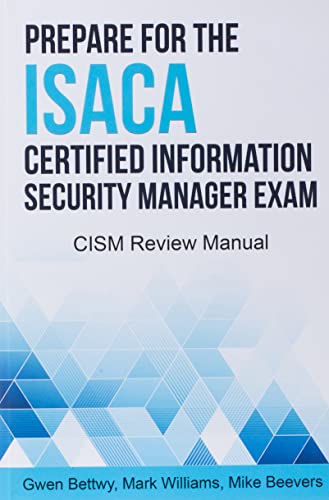
 Buy on Amazon
 Take courses on Udemy
 Learning path on Pluralsight