How to Pass the PMP Exam on Your First Try
The PMP (Project Management Professional) certification from PMI is one of the most respected credentials in project management worldwide. Passing it on your first attempt saves you time, money, and frustration - but it requires a structured, strategic approach.
This comprehensive guide covers everything you need to know: exam structure, eligibility requirements, a detailed 12-week study plan, the top 10 strategies used by successful first-time passers, key EVM formulas, and exam day tactics.
free PMP practice questionsFree exam prep with practice questions & AI tutor
PMP Exam Overview 2026
Before diving into study strategies, you need to understand exactly what you are preparing for.
| Exam Detail | Specification |
|---|---|
| Total Questions | 180 (includes 5 unscored pretest questions) |
| Time Limit | 230 minutes (3 hours 50 minutes) |
| Breaks | Two optional 10-minute breaks (after Q60 and Q120) |
| Question Format | Multiple choice, multiple response, matching, hotspot, fill-in-the-blank |
| Scoring | Proficiency-based (Above Target / Target / Below Target / Needs Improvement) |
| Exam Fee | $405 for PMI members / $555 for non-members |
| Delivery | Pearson VUE test center or online proctored |
| Validity | 3 years (60 PDUs required for renewal) |
The Three Domains
The PMP exam content is organized into three performance domains with specific weightings:
| Domain | Weight | Focus Areas |
|---|---|---|
| People | 42% | Team building, conflict management, servant leadership, stakeholder engagement, emotional intelligence, team performance |
| Process | 50% | Planning, executing, monitoring & controlling, integration management, scope, schedule, cost, quality, risk, procurement |
| Business Environment | 8% | Benefits realization, compliance, organizational change management, project alignment with strategy |
How Scoring Works
PMI does not publish a fixed passing percentage. Instead, your performance is evaluated across each domain using four proficiency levels:
- Above Target: Demonstrates superior understanding
- Target: Demonstrates sufficient knowledge to manage projects
- Below Target: Shows gaps in knowledge
- Needs Improvement: Significant deficiencies
You need to achieve sufficient proficiency across all three domains to pass. Most experts estimate you need to answer roughly 60-65% of scored questions correctly, but the exact algorithm is not public.
PMP Eligibility Requirements
Before you can sit for the PMP exam, you must meet one of two eligibility paths:
Path 1: With a 4-Year Degree (Bachelor's or Global Equivalent)
| Requirement | Details |
|---|---|
| Project Leadership Experience | 36 months (3 years) leading and directing projects |
| PM Education/Training | 35 contact hours of project management education |
Path 2: With a High School Diploma, Associate Degree, or Global Equivalent
| Requirement | Details |
|---|---|
| Project Leadership Experience | 60 months (5 years) leading and directing projects |
| PM Education/Training | 35 contact hours of project management education |
Important Notes:
- "Leading projects" means directing tasks, managing team members, and overseeing project deliverables - not simply being a project team member
- The 35 contact hours can come from PMI-approved training providers, university courses, employer training programs, or online courses
- Project experience does not need to be consecutive - it can be accumulated over time
- PMI audits approximately 10-20% of applications, so ensure all experience claims are accurate and documented
The Three Domains: Deep Dive
Domain 1: People (42% of Exam)
This is the largest domain and focuses on the interpersonal skills needed to lead project teams effectively.
Key Topics:
- Servant Leadership: The PMP exam emphasizes that project managers should serve the team by removing impediments, facilitating collaboration, and empowering team members rather than directing from the top down
- Conflict Management: Understand the five conflict resolution techniques (Collaborate/Problem Solve, Compromise/Reconcile, Withdraw/Avoid, Smooth/Accommodate, Force/Direct) and when each is appropriate
- Team Building & Development: Tuckman's model (Forming, Storming, Norming, Performing, Adjourning), virtual team management, team charters
- Stakeholder Engagement: Identifying stakeholders, analyzing influence and interest, developing engagement strategies, managing expectations
- Emotional Intelligence: Self-awareness, self-regulation, motivation, empathy, social skills as they apply to project leadership
- Negotiation: Win-win negotiation strategies, resource negotiation, conflict resolution through negotiation
- Mentoring & Coaching: Developing team skills, knowledge transfer, performance improvement
Exam Tip: PMI wants you to think like a servant leader. When you see a question about team conflict, the correct answer almost always involves collaborative problem-solving, not authority-based decisions.
Domain 2: Process (50% of Exam)
This domain covers the technical aspects of managing projects through their lifecycle.
Key Topics:
- Project Integration Management: Project charter, project management plan, directing and managing work, monitoring and controlling, performing integrated change control, closing
- Scope Management: Requirements gathering, WBS creation, scope validation, scope control
- Schedule Management: Activity sequencing, critical path method, schedule compression (crashing and fast-tracking), resource leveling
- Cost Management: Cost estimating techniques (analogous, parametric, bottom-up, three-point), budgeting, Earned Value Management (EVM)
- Quality Management: Plan-Do-Check-Act cycle, cost of quality, quality tools (Pareto charts, fishbone diagrams, control charts, scatter diagrams, histograms, flowcharts, check sheets)
- Risk Management: Risk identification, qualitative and quantitative analysis, risk response strategies (Avoid, Mitigate, Transfer, Accept for threats; Exploit, Enhance, Share, Accept for opportunities), risk monitoring
- Resource Management: Resource planning, team acquisition, team development, team management
- Communications Management: Communication planning, information distribution, stakeholder communication
- Procurement Management: Make-or-buy analysis, contract types (Fixed Price, Cost Reimbursable, Time & Materials), procurement process
- Stakeholder Management: Stakeholder identification, planning engagement, managing engagement, monitoring engagement
Critical Process Concept - Change Management:
All scope, schedule, and cost changes must go through Integrated Change Control. The correct PMI answer is almost never "make the change immediately" - it is always to assess the impact, submit a change request, and get it reviewed by the Change Control Board (CCB).
Domain 3: Business Environment (8% of Exam)
Though the smallest domain, these questions are often nuanced and scenario-based.
Key Topics:
- Benefits Realization: Ensuring project outcomes deliver the intended business benefits, benefits management plan, benefits tracking
- Compliance: Regulatory requirements, organizational policies, industry standards, legal constraints
- Organizational Change Management: Managing the people side of change, training, communication, resistance management
- Project Alignment: Ensuring projects support organizational strategy, portfolio management concepts, business case justification, ROI analysis
12-Week Study Plan
This structured plan assumes approximately 15 hours per week (about 2 hours per day plus extra on weekends). Adjust the pace to fit your schedule, but maintain the sequence.
Phase 1: Foundation (Weeks 1-4)
| Week | Topics | Hours | Milestone |
|---|---|---|---|
| Week 1 | PMP exam overview, PMI framework, project lifecycle, predictive vs agile vs hybrid | 15 | Understand the three approaches and when to use each |
| Week 2 | People Domain - Servant leadership, team building, conflict management, Tuckman model | 15 | Complete 100 People domain practice questions |
| Week 3 | People Domain - Stakeholder engagement, negotiation, emotional intelligence, motivation theories | 15 | Complete 100 more People domain questions (200 total) |
| Week 4 | Process Domain Part 1 - Integration, scope, schedule management, critical path method, WBS | 15 | Complete 100 Process domain practice questions |
Phase 2: Core Knowledge (Weeks 5-8)
| Week | Topics | Hours | Milestone |
|---|---|---|---|
| Week 5 | Process Domain Part 2 - Cost management, EVM formulas, budgeting, estimating techniques | 15 | Memorize all EVM formulas; complete 100 Process questions |
| Week 6 | Process Domain Part 3 - Quality, risk management, risk response strategies, procurement, contract types | 15 | Complete 100 more Process questions (300 total) |
| Week 7 | Process Domain Part 4 - Resource management, communications, stakeholder management, change control | 15 | Complete 100 more Process questions (400 total) |
| Week 8 | Agile deep dive - Scrum, Kanban, XP, SAFe basics, agile ceremonies, user stories, velocity, burndown charts | 15 | Complete 150 agile-focused practice questions |
Phase 3: Integration & Mastery (Weeks 9-12)
| Week | Topics | Hours | Milestone |
|---|---|---|---|
| Week 9 | Business Environment domain, benefits realization, compliance, organizational change management | 12 | Complete 100 Business Environment questions; take first full-length simulated exam |
| Week 10 | Full-length practice exam #2, review all weak areas identified in exams 1 and 2 | 15 | Score analysis - identify top 5 weak areas |
| Week 11 | Targeted review of weak areas, EVM formula drills, agile scenario practice, full-length practice exam #3 | 15 | Score consistently in passing range on practice exams |
| Week 12 | Final review, brain dump sheet practice, exam day strategy, light review only last 2 days | 10 | Exam day - you are ready |
Total Practice Questions Target: 1,000+
Top 10 Strategies to Pass the PMP First Time
Strategy 1: Understand Predictive vs Agile vs Hybrid
The PMP exam is no longer just about waterfall project management. Approximately 50% of questions involve agile or hybrid approaches. You must understand:
- Predictive (Waterfall): Sequential phases, detailed upfront planning, formal change control, best for well-defined requirements
- Agile: Iterative and incremental delivery, adaptive planning, continuous feedback, best for evolving requirements
- Hybrid: Combines elements of both, predictive planning with agile execution, commonly used in real-world projects
For each scenario question, ask yourself: "Is the requirement well-defined or evolving? Is the team experienced with agile? Does the organization support agile?" This determines which approach the question expects.
Strategy 2: Master Agile Concepts (Nearly Half the Exam)
Agile is no longer a small section - it is woven throughout the entire exam. Master these concepts:
Scrum Framework:
- Roles: Product Owner (prioritizes backlog), Scrum Master (servant leader, removes impediments), Development Team (self-organizing, cross-functional)
- Events: Sprint Planning, Daily Standup (15 min), Sprint Review (demo to stakeholders), Sprint Retrospective (team improvement)
- Artifacts: Product Backlog, Sprint Backlog, Increment (potentially shippable product)
- Sprint: Fixed timeboxes of 1-4 weeks (typically 2 weeks)
Key Agile Concepts:
- User Stories: "As a [role], I want [feature] so that [benefit]" - INVEST criteria (Independent, Negotiable, Valuable, Estimable, Small, Testable)
- Velocity: Average story points completed per sprint - used for forecasting
- Burndown/Burnup Charts: Visual tracking of remaining work vs time
- Kanban: Visualize workflow, limit work in progress (WIP), continuous flow
- Definition of Done (DoD): Team agreement on what "complete" means
Strategy 3: Focus on Servant Leadership Mindset
PMI has shifted heavily toward the servant leadership model. On the exam:
- The project manager serves the team, not the other way around
- Remove impediments rather than directing work
- Facilitate collaboration rather than making decisions for the team
- Empower team members to solve problems independently
- When a team member has a problem, coach them to find the solution rather than solving it for them
Exam Pattern: If one answer involves "tell the team what to do" and another involves "facilitate a team discussion," the facilitation answer is almost always correct.
Strategy 4: Use the PMBOK Guide as Reference, Not Primary Study Material
The PMBOK Guide (7th Edition) is a reference standard, not a study guide. It is dense, principle-based, and difficult to study from directly.
Better approach:
- Use a dedicated PMP prep course or study guide as your primary material
- Reference the PMBOK Guide when you need deeper understanding of a specific concept
- Focus on the PMI Exam Content Outline (ECO) - this is the actual blueprint for the exam
- Study the Agile Practice Guide (included with PMBOK) for agile methodology content
Strategy 5: Take 1,000+ Practice Questions
Volume matters. Here is why 1,000+ questions is the target:
- First 300 questions: You learn the format and identify knowledge gaps
- Questions 300-600: You start recognizing patterns and common traps
- Questions 600-900: You build speed and confidence
- Questions 900-1,000+: You fine-tune and reach exam readiness
Quality matters too: After every practice session, review every wrong answer. Understand why the correct answer is right, why your answer is wrong, and what concept you need to revisit.
free PMP practice questionsFree exam prep with practice questions & AI tutor
Strategy 6: Use the Brain Dump Technique
In the first few minutes of the exam (before starting questions), write down key formulas and frameworks from memory on your scratch paper. This "brain dump" serves as a reference throughout the exam.
What to include in your brain dump:
- All EVM formulas (SV, CV, SPI, CPI, EAC, ETC, VAC, TCPI)
- Communication channels formula: n(n-1)/2
- Risk response strategies (threats and opportunities)
- Tuckman's model stages
- Conflict resolution techniques
- Contract types summary (FFP, FPIF, CPIF, CPAF, CPFF, T&M)
- Any other formulas or frameworks you find difficult to remember
Practice your brain dump: Time yourself writing it out in 5 minutes or less. Do this at the end of every study session during your last 2 weeks.
Strategy 7: Understand ITTOs Conceptually (Do Not Memorize)
Trying to memorize every Input, Tool & Technique, and Output (ITTO) for all 49 processes is a waste of time. The PMP exam does not ask "What are the inputs to Plan Risk Responses?"
Instead, understand the logical flow:
- Why does a process need certain inputs? (What information is required?)
- What tools help transform those inputs? (What techniques do we use?)
- What do we produce as a result? (What decisions or documents come out?)
Example: To plan a schedule, you need the scope baseline (input) because you cannot schedule work you have not defined. You use critical path method (tool) to determine the longest path. You produce the project schedule (output).
This conceptual understanding serves you far better than rote memorization.
Strategy 8: Study EVM Formulas
Earned Value Management questions appear regularly on the PMP exam. Memorize these formulas and understand what each one tells you.
| Formula | Equation | What It Measures | Interpretation |
|---|---|---|---|
| EV (Earned Value) | % Complete x BAC | Value of work actually completed | How much work you have accomplished in dollar terms |
| PV (Planned Value) | % Planned x BAC | Value of work planned to be completed | How much work you should have accomplished by now |
| AC (Actual Cost) | Sum of actual costs | Total cost spent to date | How much you have actually spent |
| SV (Schedule Variance) | EV - PV | Schedule performance | Positive = ahead of schedule; Negative = behind schedule |
| CV (Cost Variance) | EV - AC | Cost performance | Positive = under budget; Negative = over budget |
| SPI (Schedule Performance Index) | EV / PV | Schedule efficiency | > 1.0 = ahead; < 1.0 = behind; 1.0 = on schedule |
| CPI (Cost Performance Index) | EV / AC | Cost efficiency | > 1.0 = under budget; < 1.0 = over budget; 1.0 = on budget |
| EAC (Estimate at Completion) | BAC / CPI | Projected total cost | Forecasted total cost if current cost trends continue |
| ETC (Estimate to Complete) | EAC - AC | Remaining cost to finish | How much more money needed to complete the project |
| VAC (Variance at Completion) | BAC - EAC | Projected cost variance | Positive = projected under budget; Negative = projected over budget |
| TCPI (To-Complete Performance Index) | (BAC - EV) / (BAC - AC) | Required future efficiency | > 1.0 = must improve efficiency; < 1.0 = can relax efficiency |
Memory Trick: For variance formulas, always start with EV. For index formulas, always divide by the "old" or "actual" value. Variances use subtraction; indices use division. Positive variances and indices > 1.0 are favorable.
EAC Variations (know all four):
- EAC = BAC / CPI - If current cost variance is expected to continue (most common on exam)
- EAC = AC + (BAC - EV) - If current variance is atypical (one-time event)
- EAC = AC + Bottom-Up ETC - If original estimate is fundamentally flawed
- EAC = AC + (BAC - EV) / (CPI x SPI) - If both cost and schedule variances affect remaining work
Strategy 9: Learn the PMI Mindset
The PMP exam tests what PMI says you should do, which sometimes differs from real-world practice. Key PMI mindset principles:
- Always follow the process: If something changes, submit a change request through Integrated Change Control
- Never gold plate: Do not add extra features or scope that were not requested, even if they seem beneficial
- Communicate proactively: The project manager should always be transparent and proactive about issues
- Engage stakeholders early and often: Stakeholder engagement is continuous, not a one-time activity
- Ethical behavior first: When faced with an ethical dilemma, always choose the option that follows PMI's Code of Ethics (responsibility, respect, fairness, honesty)
- Document everything: Lessons learned, risk registers, issue logs - documentation is always part of the correct answer
- Risk management is proactive: Identify and plan for risks before they become issues
- The project charter authorizes the project manager: Without a charter, the project manager has no authority
Common Trap: When a question describes a problem, the correct first step is almost always to assess the situation or analyze the impact before taking action. PMI does not want you to jump to solutions without understanding the problem.
Strategy 10: Take Full-Length Simulated Exams
There is no substitute for simulating the actual exam experience. Take at least 3 full-length (180-question) practice exams under realistic conditions:
Simulation Protocol:
- Set a timer for 230 minutes
- No phone, no notes, no interruptions
- Take your 10-minute breaks at questions 60 and 120 (just like the real exam)
- Complete all 180 questions
- Score yourself and review every incorrect answer
When to take practice exams:
- Practice Exam 1 (Week 9): Identify baseline performance and major gaps
- Practice Exam 2 (Week 10): Measure improvement, refine weak areas
- Practice Exam 3 (Week 11): Confirm exam readiness, build confidence
Target Scores:
- Practice Exam 1: 65%+ (identifies gaps)
- Practice Exam 2: 70%+ (showing improvement)
- Practice Exam 3: 75%+ (exam ready)
Agile vs Predictive: When to Use Which
Understanding when each approach is appropriate is critical for the PMP exam.
When to Use Predictive (Waterfall)
| Indicator | Why Predictive |
|---|---|
| Requirements are well-defined and stable | No need for iterative discovery |
| Regulatory or compliance constraints | Sequential documentation requirements |
| Fixed-price contracts | Scope must be locked upfront |
| Low uncertainty / well-understood technology | Detailed planning is reliable |
| Large infrastructure or construction projects | Physical deliverables require sequential phases |
When to Use Agile
| Indicator | Why Agile |
|---|---|
| Requirements are unclear or evolving | Iterative discovery through feedback loops |
| High customer involvement possible | Frequent demos and feedback |
| Small, co-located or collaborative team | Self-organizing teams work best |
| Innovation or new product development | Experimentation and pivoting |
| Speed to market is critical | Incremental delivery of working product |
When to Use Hybrid
| Indicator | Why Hybrid |
|---|---|
| Some requirements are fixed, others evolving | Predictive for known, agile for unknown |
| Organization transitioning to agile | Gradual adoption approach |
| External dependencies require predictive planning | Internal development can be agile |
| Regulatory requirements for documentation | Agile delivery with waterfall governance |
Key Agile Ceremonies Quick Reference
| Ceremony | Purpose | Timeboxed |
|---|---|---|
| Sprint Planning | Define sprint goal and select backlog items | 2-4 hours for a 2-week sprint |
| Daily Standup | Synchronize team, identify impediments | 15 minutes |
| Sprint Review | Demo working increment to stakeholders, gather feedback | 1-2 hours |
| Sprint Retrospective | Team reflects on process improvement | 1-1.5 hours |
| Backlog Refinement | Clarify and estimate upcoming backlog items | Ongoing (typically 10% of sprint capacity) |
Exam Day Strategy
Time Management: 76 Seconds Per Question
With 180 questions in 230 minutes, you have approximately 76 seconds per question (about 1 minute 16 seconds). Here is how to manage your time:
| Question Block | Questions | Target Time | Cumulative |
|---|---|---|---|
| Block 1 | Q1 - Q60 | 76 minutes | 76 minutes |
| Break 1 | 10 minutes | - | 86 minutes |
| Block 2 | Q61 - Q120 | 76 minutes | 162 minutes |
| Break 2 | 10 minutes | - | 172 minutes |
| Block 3 | Q121 - Q180 | 58 minutes + review | 230 minutes |
Flagging Strategy
- Flag and move on if a question takes more than 2 minutes
- Do not agonize over difficult questions - your subconscious may work on them during the break
- Return to flagged questions after completing all 180
- Aim to flag no more than 15-20 questions total
Break Strategy
- Take both breaks - even if you feel fine, your brain needs recovery
- Use breaks for deep breathing, stretching, and a quick snack
- Do NOT review flagged questions during breaks - give your mind a rest
- Return refreshed and ready for the next block
Question Approach
- Read the last sentence first - it tells you what is actually being asked
- Read the full scenario - context clues matter enormously
- Eliminate two obviously wrong answers - most questions have two clearly incorrect options
- Choose between the remaining two - look for PMI-aligned language (facilitate, collaborate, assess, engage)
- Do not change your answer unless you are certain you misread the question
Common Mistakes to Avoid
Mistake 1: Over-Studying the PMBOK Guide
The PMBOK Guide (7th Edition) is principle-based and abstract. Studying it cover-to-cover without context leads to confusion. Use a prep course as your primary resource and reference the PMBOK when you need clarity on specific concepts.
Mistake 2: Ignoring Agile
Some candidates with years of waterfall experience dismiss agile content. This is a critical error. Nearly half the exam involves agile or hybrid scenarios. Dedicate at least 2 full weeks to agile concepts, especially Scrum.
Mistake 3: Not Enough Practice Questions
Reading and watching videos without active practice leads to a false sense of readiness. You need 1,000+ practice questions to build the pattern recognition and speed required. If you have only completed 200-300 questions, you are not ready.
Mistake 4: Memorizing Instead of Understanding
The PMP exam is scenario-based. Memorizing definitions without understanding how to apply them in context will not help. For every concept, ask yourself: "In what situation would I use this? What problem does this solve?"
Mistake 5: Studying Without a Plan
Random, unstructured studying leads to gaps. Follow a structured study plan (like the 12-week plan above) to ensure you cover all domains systematically.
Mistake 6: Skipping Practice Exams
Individual topic quizzes are not enough. You need the stamina and time management practice that only full-length, 180-question simulated exams provide. Take at least 3 before your real exam.
Mistake 7: Neglecting the PMI Mindset
Answering based on real-world experience instead of PMI best practices is a common trap. Always ask: "What would PMI want me to do?" The answer usually involves process, communication, stakeholder engagement, and servant leadership.
Mistake 8: Poor Exam Day Preparation
Arrive early, bring valid ID, get a good night's sleep, eat a balanced meal. Do NOT cram the morning of the exam. Your last study day should be light review only.
Your Path to PMP Certification Starts Now
The PMP certification can significantly advance your project management career, increase your earning potential, and validate your expertise to employers worldwide. With this 12-week plan and the strategies outlined above, you have everything you need to pass on your first try.
Start Your PMP Preparation Today
- Free PMP practice questions with AI-powered explanations for every answer
- Detailed answer breakdowns covering all three domains
- AI study assistant to explain any concept in depth
- Progress tracking to identify your weak areas
Key Takeaways
- Know the three domains and their weights: People (42%), Process (50%), Business Environment (8%)
- Master both agile and predictive: About half the exam covers agile/hybrid approaches
- Complete 1,000+ practice questions: Volume and quality of practice is the strongest predictor of success
- Understand EVM formulas: Memorize and know how to interpret SV, CV, SPI, CPI, EAC, ETC, VAC, TCPI
- Think like PMI: Servant leadership, process compliance, proactive communication, and ethical behavior
- Follow a structured 12-week study plan: Systematic preparation beats random studying every time
- Take full-length simulated exams: Build stamina and time management skills
- Use the brain dump technique: Write key formulas on scratch paper before starting questions
The PMP exam is challenging but absolutely passable on your first try with the right preparation. Follow this guide, stay disciplined with your study plan, and you will earn your PMP certification.
Good luck with your PMP exam!

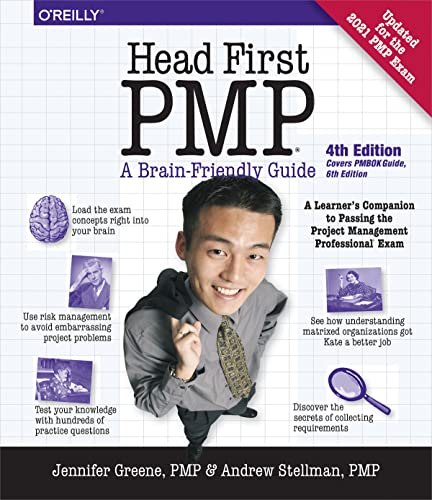
 Buy on Amazon
 Prep course on Brain Sensei
 Practice exams on ExamEdge
 Study guide on Mometrix