Why Practice Questions Are Essential for the Real Estate Exam
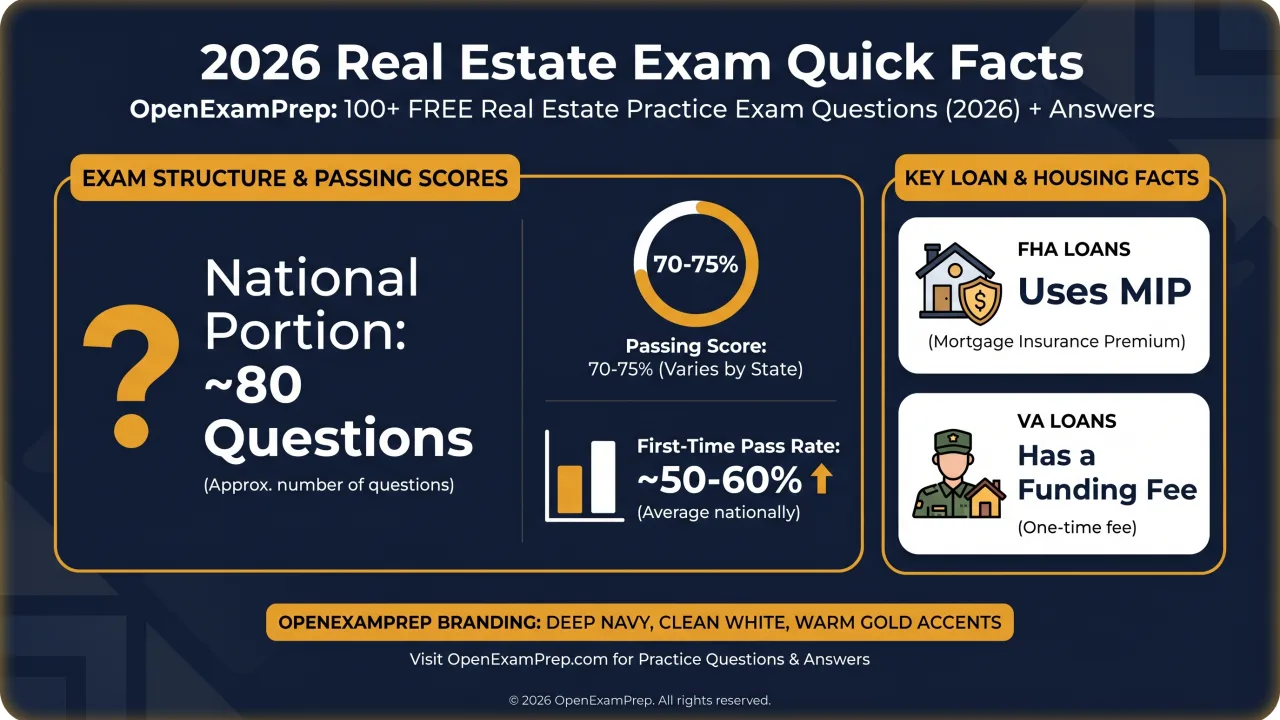
First-time pass rates for the real estate licensing exam average roughly 50-60% nationally - meaning nearly half of candidates fail on their first attempt. (California and Florida hover near 51%, Texas around 59%.) Note the difference between two numbers people confuse: the pass rate is the share of test-takers who pass (about 50-60%), while the passing score is the threshold you must hit (typically 70-75%). The difference between candidates who pass and those who fail usually comes down to one thing: quality practice questions with explanations.
This page gives you 100+ free real estate practice questions organized by the exact topics tested on the national salesperson exam, each with a full explanation of why the right answer is right. Use them to:
- Master the national portion that applies in all states
- Drill the high-weight topics: agency, contracts, financing, fair housing, appraisal, and math
- Understand PSI, Pearson VUE, and PearsonVUE-administered question formats
- Identify weak areas before exam day
Real Estate Exam Format (2026)
The salesperson exam has two parts: a national portion (the same core concepts in every state) and a state portion (your state's specific laws). Exact counts and the passing threshold vary by state, so always confirm with your state agency and testing vendor.
| Component | Typical Details |
|---|---|
| National portion | About 80 questions (some states 100, e.g., Georgia, Missouri) |
| State portion | About 30-50 questions (varies by state) |
| Time limit | Roughly 2-4 hours total (varies) |
| Passing score | Usually 70-75% (e.g., NY/CA/NJ 70%, Florida 75%) - varies by state |
| First-time pass rate | About 50-60% nationally |
| Test provider | PSI, Pearson VUE, or a state-contracted vendor |
Most states require you to pass each portion independently; a few (such as Colorado) combine the scores. Many states let you retake only the portion you failed.
Sample Practice Questions by Topic
Every question below is national-exam style with a worked explanation. Answer first, then check.
Property Ownership & Estates (about 15-20% of exam)
Question 1: A tenant installs a walk-in freezer bolted to the floor for their grocery store. This is classified as:
A) A fixture that automatically transfers with the property B) A trade fixture that remains personal property if removed properly C) An emblement because it is business-related D) Personal property that can never be removed
Answer: B - A walk-in freezer installed by a tenant for business use is a trade fixture, which stays personal property if removed before lease end and any damage is repaired.
Question 2: Which type of ownership automatically passes a deceased owner's share to surviving owners?
A) Tenancy in common B) Joint tenancy with right of survivorship C) Tenancy by the entirety D) Both B and C
Answer: D - Both joint tenancy with right of survivorship (JTWROS) and tenancy by the entirety include the right of survivorship, so a deceased owner's share passes directly to the surviving owner(s) and bypasses probate. Tenancy in common has no survivorship - that share passes to heirs.
Question 3: Appurtenant easements:
A) Benefit a specific person B) Run with the land C) Must be renewed every 10 years D) Can only be created by court order
Answer: B - Appurtenant easements are attached to the land and transfer with it when sold - they "run with the land." An easement in gross (e.g., a utility line) benefits a person or company instead.
Question 4: A fee simple absolute estate is best described as:
A) A life estate that ends at death B) The most complete form of ownership, of indefinite duration C) A leasehold for a fixed term D) Ownership subject to a reverter condition
Answer: B - Fee simple absolute is the highest, most complete bundle of ownership rights, lasts indefinitely, and is freely inheritable and transferable. A life estate lasts only for someone's lifetime; a fee simple defeasible can end if a condition is violated.
Agency & Brokerage (about 15-20% of exam)
Question 5: An agent who represents the seller owes the buyer:
A) Full fiduciary duties B) Honesty and fair dealing, plus disclosure of material defects C) Nothing at all D) The duty of confidentiality
Answer: B - A seller's agent owes fiduciary duties to the seller (the client) but still owes the buyer (a customer) honesty, fair dealing, and disclosure of known material defects. Fiduciary duties are often remembered as OLD CAR: Obedience, Loyalty, Disclosure, Confidentiality, Accounting, Reasonable care.
Question 6: A broker representing both the buyer and the seller in the same transaction is acting as a:
A) Single agent B) Dual agent C) Transaction broker by default D) Designated subagent
Answer: B - Representing both parties is dual agency, which is legal only with informed written consent of both parties (and is prohibited outright in some states). The dual agent must remain neutral and cannot advocate for one side over the other.
Question 7: An agency relationship created by the conduct of the parties, without a written agreement, is called:
A) Express agency B) Implied agency C) Agency by estoppel D) Ostensible authority
Answer: B - Implied agency is created by the actions and conduct of the parties rather than a written or spoken agreement. Express agency is created by an explicit written or oral contract such as a listing agreement.
Contracts (about 17-20% of exam)
Question 8: For a real estate contract to be enforceable, it must include all of the following EXCEPT:
A) Competent parties B) Legal purpose C) Attorney approval D) Consideration
Answer: C - A valid contract requires competent parties, mutual assent (offer and acceptance), legal purpose, and consideration - and for real estate, it must be in writing under the Statute of Frauds. Attorney approval is not a universal requirement.
Question 9: In a listing agreement, the broker's compensation is:
A) Set by state law B) Set by the local MLS C) Negotiable between broker and seller D) Determined by the buyer's agent
Answer: C - Commission rates are always negotiable between broker and seller. Any claim that rates are "standard" or "fixed" can violate antitrust law (price-fixing).
Question 10: An option contract gives the optionee:
A) The obligation to purchase the property B) The right, but not the obligation, to purchase the property C) Immediate ownership of the property D) A lease on the property
Answer: B - An option gives the optionee the right but not the obligation to buy at a set price within a set time. The optionor (owner) is bound; the optionee may walk away and typically forfeits only the option fee.
Question 11: When a buyer makes an offer and the seller responds with a higher price, the seller's response is legally a:
A) Binding acceptance B) Counteroffer that terminates the original offer C) Conditional acceptance that keeps the original offer alive D) Breach of contract
Answer: B - A change to any material term is a counteroffer, which rejects and terminates the original offer. The original buyer is now free to accept, reject, or counter again.
Financing (about 18-20% of exam)
Question 12: Which loan program typically requires a mortgage insurance premium (MIP)?
A) Conventional B) FHA C) VA D) USDA
Answer: B - FHA loans require a mortgage insurance premium (MIP) - both upfront and annual. Conventional loans above 80% LTV use PMI, VA loans use a funding fee, and USDA loans use a guarantee fee.
Question 13: Which loan program is designed for eligible rural buyers?
A) FHA B) VA C) USDA D) Conventional
Answer: C - USDA (Rural Development) loans serve eligible rural and some suburban buyers who meet income and location requirements, and can offer 100% financing (no down payment).
Question 14: Which loan type requires a funding fee instead of monthly mortgage insurance, and is reserved for eligible veterans and service members?
A) FHA B) VA C) USDA D) Conventional
Answer: B - VA loans charge a one-time funding fee (commonly about 1.25%-3.3% of the loan, varying by down payment and use) instead of monthly mortgage insurance, and require no down payment for eligible borrowers.
Question 15: A loan-to-value (LTV) ratio is calculated as:
A) Loan amount divided by property value (or sale price, whichever is lower) B) Property value divided by loan amount C) Down payment divided by loan amount D) Loan amount divided by down payment
Answer: A - LTV = Loan Amount / Value (lender uses the lower of appraised value or sale price). Higher LTV means more lender risk and usually triggers mortgage insurance. On conventional loans, PMI can typically be canceled once the loan reaches 80% LTV.
Question 16: Which federal rule, effective in 2015, combined the TILA and RESPA disclosures into the Loan Estimate and Closing Disclosure?
A) Dodd-Frank Stress Test B) TRID (the TILA-RESPA Integrated Disclosure rule) C) ECOA D) Regulation D
Answer: B - TRID merged the old Truth-in-Lending and Good Faith Estimate / HUD-1 forms into the Loan Estimate (delivered within 3 business days of application) and the Closing Disclosure (delivered at least 3 business days before closing). RESPA also bans kickbacks/referral fees for settlement services.
Valuation & Appraisal (about 12-15% of exam)
Question 17: The cost approach to value is most appropriate for:
A) Vacant land B) Income-producing apartment buildings C) New, special-purpose, or unique properties D) Tract-home subdivisions with many recent sales
Answer: C - The cost approach works best for new, special-purpose, or unique properties (schools, churches, libraries) where comparable sales are scarce. It estimates land value plus the cost to rebuild, minus depreciation.
Question 18: In the sales comparison approach, an adjustment is made:
A) To the subject property B) To the comparable properties C) To both properties equally D) Only for major differences
Answer: B - Adjustments are always made to the comparables, never to the subject. Rule of thumb: CIA - if the Comp Is superior/better, subtract; if the comp is inferior, Add.
Question 19: Which approach to value is the primary method for valuing income-producing investment property?
A) Cost approach B) Sales comparison approach C) Income (capitalization) approach D) Gross rent multiplier only
Answer: C - The income approach capitalizes net operating income into value: Value = NOI / Cap Rate. So a property with $60,000 NOI and an 8% cap rate is worth $60,000 / 0.08 = $750,000.
Fair Housing (about 10-15% of exam)
Question 20: The federal Fair Housing Act protects all of the following classes EXCEPT:
A) Familial status B) Disability C) Sexual orientation (at the federal level) D) National origin
Answer: C - The federal Fair Housing Act (1968, amended 1988) protects seven classes: race, color, religion, national origin, sex, familial status, and disability. The 1988 amendments added familial status and disability. Sexual orientation and gender identity are protected in many states but are not enumerated federal classes (though HUD enforces sex-based protections to include them).
Question 21: Which of the following practices is prohibited under fair housing laws?
A) Steering only B) Blockbusting only C) Redlining only D) All of the above
Answer: D - All three are illegal: Steering (directing buyers toward or away from areas based on a protected class), blockbusting (inducing panic selling by suggesting a protected group is moving in), and redlining (denying loans or insurance in certain areas).
Question 22: A landlord refuses to allow a tenant with a disability to install a grab bar at the tenant's own expense. This most likely violates the duty to allow:
A) A reasonable accommodation B) A reasonable modification C) An emotional support exemption D) The Mrs. Murphy exemption
Answer: B - A reasonable modification is a physical change to the unit (like a grab bar or ramp) that the landlord must permit, generally at the tenant's expense. A reasonable accommodation is a change to rules/policies (like allowing a service animal despite a no-pets policy), at the landlord's expense.
Real Estate Math Practice (about 5-10% of exam)
Memorize these: commission = price x rate, area of an acre = 43,560 sq ft, proration splits a cost by who owns the days/months, and the value formula V = I / R (value = income / rate).
Question 23: A property sells for $350,000 with a 6% commission. The listing broker keeps 60% of the total and splits the remaining 40% with the cooperating (buyer's) broker. How much does the listing broker keep?
A) $8,400 B) $12,600 C) $14,000 D) $21,000
Answer: B - Total commission: $350,000 x 6% = $21,000. Listing broker share: $21,000 x 60% = $12,600.
Question 24: A buyer puts 20% down on a $400,000 home. What is the loan amount?
A) $80,000 B) $320,000 C) $380,000 D) $400,000
Answer: B - Down payment: $400,000 x 20% = $80,000. Loan amount: $400,000 - $80,000 = $320,000 (an 80% LTV loan, so no PMI is required).
Question 25: A rectangular lot measures 150 feet by 290.4 feet. What is its size in acres? (1 acre = 43,560 sq ft)
A) 0.5 acre B) 1 acre C) 1.5 acres D) 2 acres
Answer: B - Area = 150 x 290.4 = 43,560 sq ft. Divide by 43,560 sq ft per acre = 1 acre.
Question 26: Annual property taxes of $3,650 are paid in arrears. Using a 365-day year, the buyer closes on day 100 of the year (seller owned days 1-99). What is the seller's prorated share owed to the buyer at closing?
A) $990 B) $1,000 C) $2,650 D) $3,650
Answer: A - Daily rate: $3,650 / 365 = $10/day. Seller owned 99 days: 99 x $10 = $990 owed by the seller to the buyer (since taxes are paid in arrears).
Question 27: An investment property generates $48,000 in net operating income. If an investor wants a 10% capitalization rate, what is the most they should pay?
A) $48,000 B) $480,000 C) $4,800 D) $4,800,000
Answer: B - Value = NOI / Cap Rate = $48,000 / 0.10 = $480,000.
Want all 100+ questions, scored and timed? Open our free real estate practice question bank ->
How These Topics Are Weighted (and What to Drill)
National-exam weightings vary slightly by vendor, but the heavy hitters are consistent:
| Topic | Approx. weight | What to master |
|---|---|---|
| Agency & brokerage | 15-20% | Fiduciary duties (OLD CAR), dual agency, disclosure |
| Contracts | 17-20% | Valid contract elements, counteroffers, options, contingencies |
| Financing | 18-20% | FHA/VA/USDA/conventional, PMI/MIP, TILA/RESPA/TRID, LTV |
| Property ownership & estates | 15-20% | Fee simple, life estates, co-ownership, easements |
| Valuation & appraisal | 12-15% | Three approaches, adjustments, cap rate |
| Fair housing | 10-15% | 7 protected classes, steering/blockbusting/redlining |
| Math | 5-10% | Commission, proration, area, LTV, cap rate |
Study Tips for the Real Estate Exam
- Complete 500+ practice questions before your exam date, including timed full-length tests; aim for 80%+ consistently before you schedule.
- Master the math - commission, proration, area (43,560 sq ft/acre), LTV, and cap rate cover most math questions.
- Know fair housing cold - the 7 protected classes and the steering/blockbusting/redlining trio are tested almost every exam.
- Nail agency relationships - who is the client, who is the customer, and what duties are owed to each.
- Learn the three appraisal approaches and when each applies (cost = unique/new, income = rentals, sales comparison = homes).
- Review your state portion separately - it is a different body of law and many states score it independently.
Start Practicing Today
Our free real estate practice question bank includes 100+ questions covering every national exam topic, each with a detailed explanation of why the correct answer is right and the others are wrong.
Ready to Pass Your Real Estate Exam?
| Resource | Description |
|---|---|
| Free Practice Questions -> | 100+ exam-style questions with detailed explanations |
| Complete Study Guide -> | Full exam content covering all national topics |
| Real Estate Category -> | All real estate exam resources in one place |
Start with the free practice questions above, then use our comprehensive study guide to close any gaps. With focused preparation, most candidates pass on their next attempt.
Final Verification Step
Before exam day, confirm your specific question counts, time limit, and passing score with your state real estate commission and your testing vendor (PSI, Pearson VUE, or your state's contractor). Use this guide for strategy and concept mastery, and use official materials for the final administrative details - that habit protects you from outdated forms, expired authorizations, wrong ID assumptions, and scheduling delays.


 Buy on Amazon
 Flashcards on Mometrix
 Take courses on Udemy
 Pre-licensing on Colibri