Property and casualty (P&C) insurance covers everything from auto and home policies to commercial property and liability. A P&C producer license lets you sell those products, and the licensing exam is the gate. Below are 30 free practice questions with full explanations, organized by the exact concept areas your state exam tests, plus the formulas, policy forms, and coverage rules that trip up most first-time candidates. Every answer explains why it is right and why the distractors are wrong -- the way you actually learn this material.
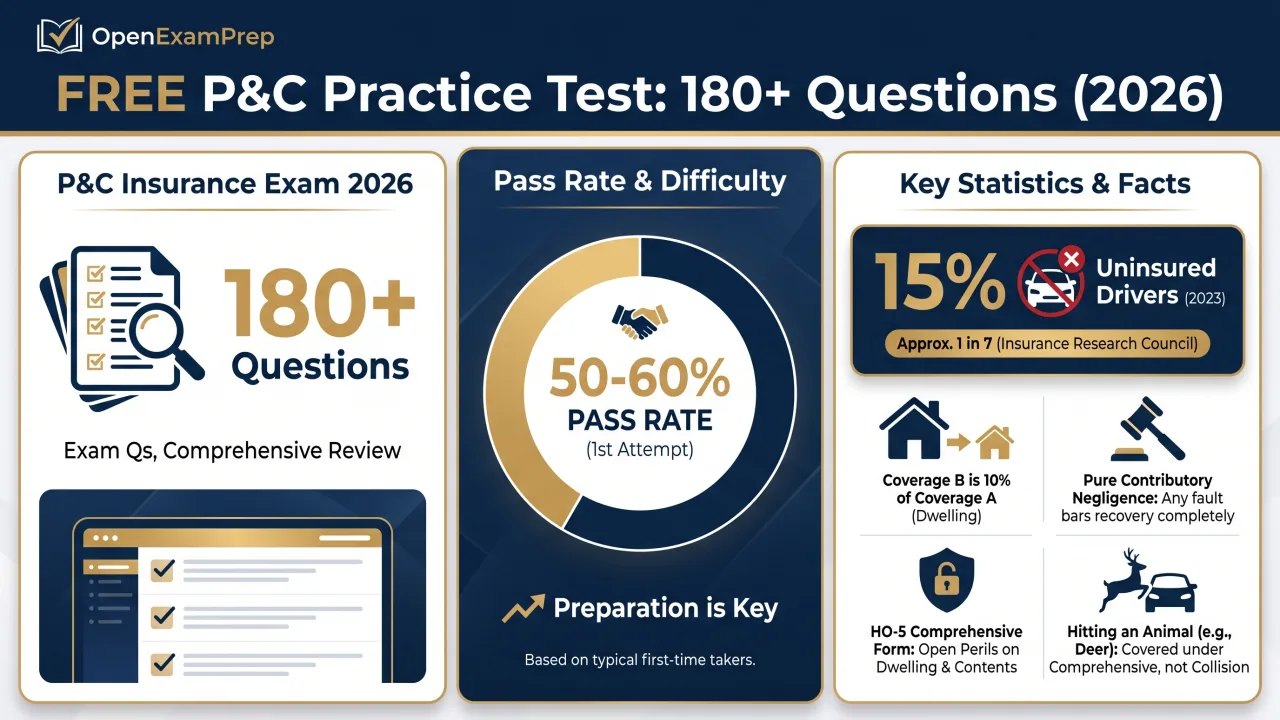
P&C licensing is administered state by state. Question counts, time limits, and passing scores are set by each state and its testing vendor (Prometric, Pearson VUE, PSI), so there is no single national number. Most state P&C exams run 100-170 scored questions with a 70% passing score, but always confirm your state's outline. National first-time pass rates sit around 50-60%, with some states (California's P&C runs near 43%) noticeably tougher.
How This Page Beats Other Free P&C Tests
Most free P&C practice tests give you a question and a one-line answer. This page teaches the concept behind every question -- named vs. open perils, the HO and DP form ladder, PAP Coverages A-D, coinsurance and ACV math worked out step by step -- so the rules stick. When you are ready for volume, our free P&C question bank has 180+ exam-style questions with instant scoring and built-in AI explanations, no signup required.
Core Concept: Named Perils vs. Open Perils
This one distinction explains half the property questions on the exam.
- Named perils (also called specified or broad form): the policy lists the covered perils. If a peril is not on the list, it is not covered. The burden is on the insured to prove the loss came from a listed peril.
- Open perils (also called special form or all-risk): everything is covered except what the policy specifically excludes. The burden shifts to the insurer to prove an exclusion applies.
Homeowners (HO) Policy Forms
| Form | Dwelling (Cov A) | Personal Property (Cov C) | Who It's For |
|---|---|---|---|
| HO-2 Broad | Named perils | Named perils | Basic homeowner |
| HO-3 Special | Open perils | Named perils | Most common owner-occupied form |
| HO-4 Contents Broad | (no dwelling) | Named perils | Renters / tenants |
| HO-5 Comprehensive | Open perils | Open perils | Broadest owner coverage |
| HO-6 Unit-Owners | Named perils (limited) | Named perils | Condo owners |
| HO-8 Modified | Named perils (limited) | Named perils | Older homes; pays on a modified/repair-cost basis, not RCV |
Standard HO percentage relationships (off Coverage A): Coverage B (Other Structures) = 10%; Coverage C (Personal Property) = 50%; Coverage D (Loss of Use) = 20-30%. Coverage E (Personal Liability) and Coverage F (Medical Payments to Others) are separate liability limits.
Dwelling Policy (DP) Forms
The DP program covers dwellings that don't qualify for an HO (rentals, seasonal, vacant) and excludes contents/liability unless added.
| Form | Perils | Loss Settlement |
|---|---|---|
| DP-1 Basic | Named perils (fire, lightning, internal explosion; EC optional) | ACV |
| DP-2 Broad | Named perils (broader list) | Replacement cost |
| DP-3 Special | Open perils on the dwelling | Replacement cost |
Practice Questions With Full Explanations
Property Insurance
Question 1: Which homeowners form provides open perils coverage on both the dwelling and personal property?
A) HO-2 (Broad) B) HO-3 (Special) C) HO-5 (Comprehensive) D) HO-4 (Contents)
Answer: C. HO-5 is open perils on both the dwelling and contents -- the broadest standard owner form. HO-3 (the most common form) is open perils on the dwelling but named perils on personal property, which is why B is the classic trap. HO-2 is named perils on both; HO-4 is a renters form with no dwelling coverage.
Question 2: Coverage B (Other Structures) on a homeowners policy is typically what percentage of Coverage A?
A) 5% B) 10% C) 20% D) 50%
Answer: B. Coverage B defaults to 10% of Coverage A. On a $300,000 dwelling, that is $30,000 for detached garages, sheds, and fences. (Don't confuse it with Coverage C personal property at 50%, choice D, or Coverage D loss of use at 20-30%, choice C.)
Question 3: A home is insured for $400,000 (Coverage A). With no endorsements, the default Coverage C limit for personal property is:
A) $100,000 B) $200,000 C) $300,000 D) $400,000
Answer: B. Coverage C defaults to 50% of Coverage A, so 50% x $400,000 = $200,000. This is a percentage off the dwelling limit, not a flat amount, so it scales with Coverage A.
Question 4: Which peril is excluded from a standard homeowners policy and requires a separate policy?
A) Fire B) Theft C) Flood D) Windstorm
Answer: C. Flood is excluded from standard HO and DP policies; it is written separately through the NFIP or a private flood insurer. Earth movement (earthquake) is the other classic standalone exclusion. Fire, theft, and windstorm are covered (windstorm may be sublimited in coastal areas).
Question 5: Under a homeowners open-perils form, a loss is presumed covered unless excluded. This means:
A) The insured must prove a named peril caused the loss B) The insurer must prove an exclusion applies to deny the claim C) Only listed perils are covered D) No exclusions apply
Answer: B. Open perils shifts the burden of proof to the insurer -- it must show an exclusion to deny. Choice A and C describe named-perils coverage, where the insured must show the loss came from a listed peril. Open-perils forms still have exclusions (D is wrong).
Question 6: The vacancy provision in a dwelling policy typically suspends or reduces certain coverages (like vandalism and glass breakage) after the property is vacant for:
A) 30 days B) 60 days C) 90 days D) 120 days
Answer: B. Coverage for vandalism and certain other perils is typically reduced or excluded once a property has been vacant 60 consecutive days. "Vacant" (no occupants and no contents) is treated more harshly than "unoccupied" (furnished but no one present).
Question 7: Under a standard HO-3, personal property losses are settled on what basis unless replacement-cost coverage is endorsed?
A) Replacement cost B) Agreed value C) Actual cash value D) Market value
Answer: C. Contents are settled at actual cash value (ACV) -- replacement cost minus depreciation -- unless the insured adds a personal property replacement cost endorsement. The dwelling (Coverage A) is typically settled at replacement cost if insured to at least 80% of value.
Property Math: Coinsurance and ACV
Coinsurance penalty formula: (Amount Carried / Amount Required) x Loss = Amount Paid (before deductible, capped at the policy limit).
Question 8: A building worth $500,000 carries an 80% coinsurance clause, so the required amount is $400,000. The owner insures it for only $300,000 and has a $100,000 loss. Ignoring the deductible, how much does the insurer pay?
A) $60,000 B) $75,000 C) $80,000 D) $100,000
Answer: B. Required = 80% x $500,000 = $400,000. Carried = $300,000. Penalty: ($300,000 / $400,000) x $100,000 = $75,000. The owner is penalized for underinsuring and absorbs the $25,000 gap as a self-insurer.
Question 9: A roof with a $20,000 replacement cost is 50% through its useful life when destroyed. On an ACV settlement, the insurer pays approximately:
A) $5,000 B) $10,000 C) $20,000 D) $30,000
Answer: B. ACV = Replacement Cost - Depreciation. 50% depreciation on $20,000 RCV = $10,000 depreciation, leaving an ACV of $10,000 (before any deductible). RCV coverage would pay the full $20,000 to replace.
Personal Auto Policy (PAP)
The PAP has four lettered coverage parts: A -- Liability, B -- Medical Payments, C -- Uninsured/Underinsured Motorists, D -- Coverage for Damage to Your Auto (which contains Collision and Other Than Collision/Comprehensive).
Question 10: Approximately what percentage of U.S. drivers were uninsured in 2023?
A) 5% B) 15% C) 25% D) 35%
Answer: B. About 15% (15.4%) of drivers were uninsured in 2023 -- roughly 1 in 7 -- per the Insurance Research Council. Rates ranged from a low near 5.7% (Maine) to a high of 28.2% (Mississippi). Counting underinsured drivers too, about 1 in 3 drivers were uninsured or underinsured -- which is why UM/UIM coverage matters.
Question 11: Your vehicle is damaged when it strikes a deer. Which PAP coverage responds?
A) Collision B) Other Than Collision (Comprehensive) C) Liability D) Uninsured Motorist
Answer: B. Hitting an animal is Other Than Collision (Comprehensive), along with theft, fire, vandalism, glass breakage, and falling objects. Collision is upset of the auto or impact with another vehicle or object (a tree, guardrail, another car). Many candidates wrongly pick A because there was an "impact."
Question 12: Medical Payments (Part B) coverage under the PAP:
A) Pays only the named insured B) Pays regardless of fault C) Requires a deductible D) Covers property damage
Answer: B. Med Pay is a first-party coverage that pays medical expenses regardless of fault, with no deductible, for the insured and passengers injured in the covered auto. It does not turn on liability, so A, C, and D are wrong.
Question 13: In a no-fault auto state, an injured driver:
A) Must prove the other driver was negligent B) Collects economic losses from their own insurer regardless of fault C) Can never sue another driver D) Must carry collision coverage
Answer: B. No-fault (PIP) systems have each driver's own insurer pay their economic losses (medical bills, lost wages) regardless of fault. Lawsuits for pain and suffering are restricted but not eliminated -- they are allowed once a statutory threshold is met, so C is too absolute.
Question 14: Uninsured Motorist (UM) coverage protects you when:
A) You injure an uninsured person B) An at-fault uninsured driver injures you C) You drive without insurance D) Your auto is stolen
Answer: B. UM steps into the shoes of the at-fault driver who has no liability insurance, paying for your injuries. Underinsured Motorist (UIM) fills the gap when the at-fault driver has some but insufficient liability limits. A stolen auto (D) is Comprehensive.
Liability and Negligence
Question 15: In a pure contributory negligence jurisdiction, a plaintiff who is found 5% at fault for $100,000 in damages recovers:
A) $100,000 B) $95,000 C) $50,000 D) $0
Answer: D. Under pure contributory negligence, any fault by the plaintiff -- even 1% -- bars recovery entirely. Only four states (Alabama, Maryland, North Carolina, Virginia) plus Washington, D.C. still use this harsh rule. Contrast with pure comparative negligence, where the plaintiff would recover $95,000.
Question 16: Under pure comparative negligence, that same plaintiff (5% at fault, $100,000 damages) recovers:
A) $0 B) $50,000 C) $95,000 D) $100,000
Answer: C. Pure comparative negligence reduces the award by the plaintiff's fault percentage: $100,000 x (1 - 0.05) = $95,000. Modified comparative negligence (the 50% or 51% bar rule used by most states) would also pay $95,000 here, but bars recovery once the plaintiff crosses the 50%/51% threshold.
Question 17: An employer is held liable for a delivery driver's negligence while making deliveries. This is an example of:
A) Strict liability B) Vicarious liability C) Absolute liability D) Contributory negligence
Answer: B. Vicarious liability (the doctrine of respondeat superior) makes an employer responsible for an employee's negligent acts within the scope of employment. Strict/absolute liability applies without fault to inherently dangerous activities or defective products, not to the employer-employee relationship.
Question 18: The principle that an insured should be restored to the same financial position after a loss -- no better, no worse -- is:
A) Subrogation B) Indemnity C) Utmost good faith D) Insurable interest
Answer: B. Indemnity restores the insured to pre-loss condition without profit. Subrogation (A) is the insurer's right to recover from the at-fault third party after paying the insured, which supports indemnity by preventing double recovery.
Commercial Insurance
Question 19: A Commercial General Liability (CGL) policy primarily covers:
A) The insured's professional errors B) The insured's own employees' injuries C) Third-party bodily injury and property damage D) Auto liability
Answer: C. The CGL covers third-party bodily injury, property damage, and personal/advertising injury arising from the business's premises and operations. It excludes professional liability (covered by E&O), employee injuries (workers comp), and auto (commercial auto). That exclusion pattern is heavily tested.
Question 20: A CGL written on an occurrence basis covers a claim if:
A) The claim is reported during the policy period B) The bodily injury or property damage happened during the policy period C) The lawsuit is filed during the policy period D) The policy is still in force when the claim is paid
Answer: B. An occurrence policy responds based on when the injury or damage took place, regardless of when the claim is later reported. A claims-made policy responds based on when the claim is first made/reported, and uses a retroactive date plus optional tail (extended reporting period) coverage.
Question 21: A Business Owners Policy (BOP) is designed for:
A) Large manufacturers B) Small to mid-sized businesses C) Sole proprietors only D) Nonprofits only
Answer: B. A BOP packages property and general liability for small to mid-sized businesses at a lower cost than buying the coverages separately. Larger or higher-hazard operations typically need a Commercial Package Policy (CPP) instead.
Question 22: Workers compensation insurance is best described as:
A) Fault-based liability coverage B) A no-fault system paying statutory benefits to injured workers C) Optional in every state D) Health insurance for employees
Answer: B. Workers comp is a no-fault, statutory system: injured employees receive medical and wage-replacement benefits regardless of fault, and in exchange generally give up the right to sue the employer. It is mandatory for most employers in nearly every state (Texas is the notable exception).
Question 23: Equipment Breakdown coverage (formerly Boiler & Machinery) covers loss from:
A) Fire B) Flood C) Mechanical/electrical breakdown of equipment D) Employee theft
Answer: C. Equipment Breakdown responds to sudden mechanical or electrical breakdown, power surges, and pressure-vessel ruptures -- losses a standard property policy excludes. Fire is property; flood is separate; theft is crime/fidelity coverage.
Regulation, Ethics, and Claims
Question 24: The difference between license suspension and revocation is:
A) They are identical B) Suspension is temporary; revocation terminates the license C) Revocation is temporary; suspension is permanent D) Only revocation requires a hearing
Answer: B. Suspension removes license privileges for a fixed period, after which they may resume. Revocation terminates the license, requiring reapplication after any waiting period set by the state.
Question 25: An agent who keeps a client's premium for personal use has committed:
A) Twisting B) Rebating C) Commingling/conversion D) Coercion
Answer: C. Using client funds for personal purposes is conversion; mixing premium trust funds with personal funds is commingling. Twisting is misrepresentation to induce a policy replacement; rebating is giving the client an inducement not in the policy; coercion is forcing the placement of insurance.
Question 26: After a covered loss, the insured's first duty is typically to:
A) File suit B) Protect the property from further damage C) Hire a public adjuster D) Obtain three estimates
Answer: B. The insured must give prompt notice and protect the property from further damage (mitigation). Failing to mitigate can reduce the recoverable amount. Proof of loss, cooperation, and submitting to examination under oath are also post-loss duties.
Question 27: "Insurable interest" in property insurance must exist:
A) Only at policy inception B) Only at the time of loss C) At the time of loss D) Never -- it applies only to life insurance
Answer: C. For property/casualty, insurable interest must exist at the time of loss (you must suffer a financial loss). In life insurance, by contrast, it need only exist at policy inception. This timing difference is a favorite exam point.
Question 28: A policy provision letting the insurer or insured end the contract before expiration is the:
A) Cancellation provision B) Nonrenewal provision C) Coinsurance clause D) Liberalization clause
Answer: A. Cancellation ends a policy mid-term (subject to state notice rules). Nonrenewal simply declines to offer a new term at expiration. The liberalization clause automatically extends broader coverage to existing policyholders at no charge.
Question 29: Which best describes the principle of "utmost good faith" (uberrimae fidei)?
A) The insurer can deny any claim it wants B) Both parties rely on each other's honesty and full disclosure C) The insured may conceal material facts D) Only the insurer must act in good faith
Answer: B. Insurance contracts require utmost good faith -- both parties must deal honestly and disclose material facts. Breaches show up as concealment, misrepresentation, or warranty violations, any of which can void coverage.
Question 30: A homeowner has a $250,000 dwelling loss, a policy limit of $250,000, and a $1,000 deductible, with the home insured to 100% of value. The insurer pays:
A) $249,000 B) $250,000 C) $251,000 D) $0
Answer: A. With the property insured to value (no coinsurance penalty) and the loss at the policy limit, the insurer pays the limit minus the deductible: $250,000 - $1,000 = $249,000. The deductible is the insured's retained portion of every covered loss.
Formulas You Must Memorize
| Calculation | Formula |
|---|---|
| Coinsurance payment | (Amount Carried / Amount Required) x Loss |
| Required amount (coinsurance) | Coinsurance % x Property Value |
| Actual Cash Value (ACV) | Replacement Cost - Depreciation |
| Loss Ratio | Incurred Losses / Earned Premium |
| Pure Premium | Losses / Number of Exposure Units |
High-Yield Study Priorities
- Policy forms -- HO-2/3/5/8 and DP-1/2/3, and which are open vs. named perils.
- Coverage percentages -- Coverage B 10%, C 50%, D 20-30% off Coverage A.
- PAP Coverages A-D -- especially Collision vs. Other Than Collision and UM vs. UIM.
- Negligence systems -- pure contributory (AL, MD, NC, VA + DC) vs. comparative.
- CGL -- occurrence vs. claims-made and the standard exclusions (pro, comp, auto).
- Math -- coinsurance penalty and ACV; practice until they are automatic.
- Regulation/ethics -- twisting, rebating, commingling, cancellation vs. nonrenewal.
Pass Your P&C Exam -- Free Resources
| Resource | What You Get |
|---|---|
| Free P&C Practice Questions -> | 180+ exam-style questions, instant scoring, AI explanations, no signup |
| P&C Study Guide -> | Full content review across property, auto, liability, and commercial |
| All Insurance Exams -> | State P&C, Life & Health, and adjuster question banks in one place |
Work the 30 questions above until each explanation makes sense, drill the free question bank to build speed, then confirm your state's question count and passing score before exam day. Thorough, concept-first prep is how most candidates pass on the first try.


 Buy on Amazon
 Take courses on Udemy
 Online course on Mometrix
 Prep course on Achievable