Why Life & Health Insurance Agents Need Solid Exam Prep
The life and health insurance exam is your gateway to a rewarding career in insurance. With pass rates varying from 50-70% depending on your state, proper preparation is essential.
Our free practice questions help you:
- Master life insurance products and provisions
- Understand health insurance plans and Medicare
- Learn annuity taxation and features
- Navigate state regulations and ethics
Life & Health Exam Format (2026)
Everything about the Life & Health exam varies by state - there is no single national test. Each state's Department of Insurance sets its own question count, time limit, passing score, and contracted testing vendor. The table below shows the most common ranges; always confirm your state's exact outline with its DOI (find yours through the NAIC state insurance department directory) or testing provider.
| Component | Details (varies by state) |
|---|---|
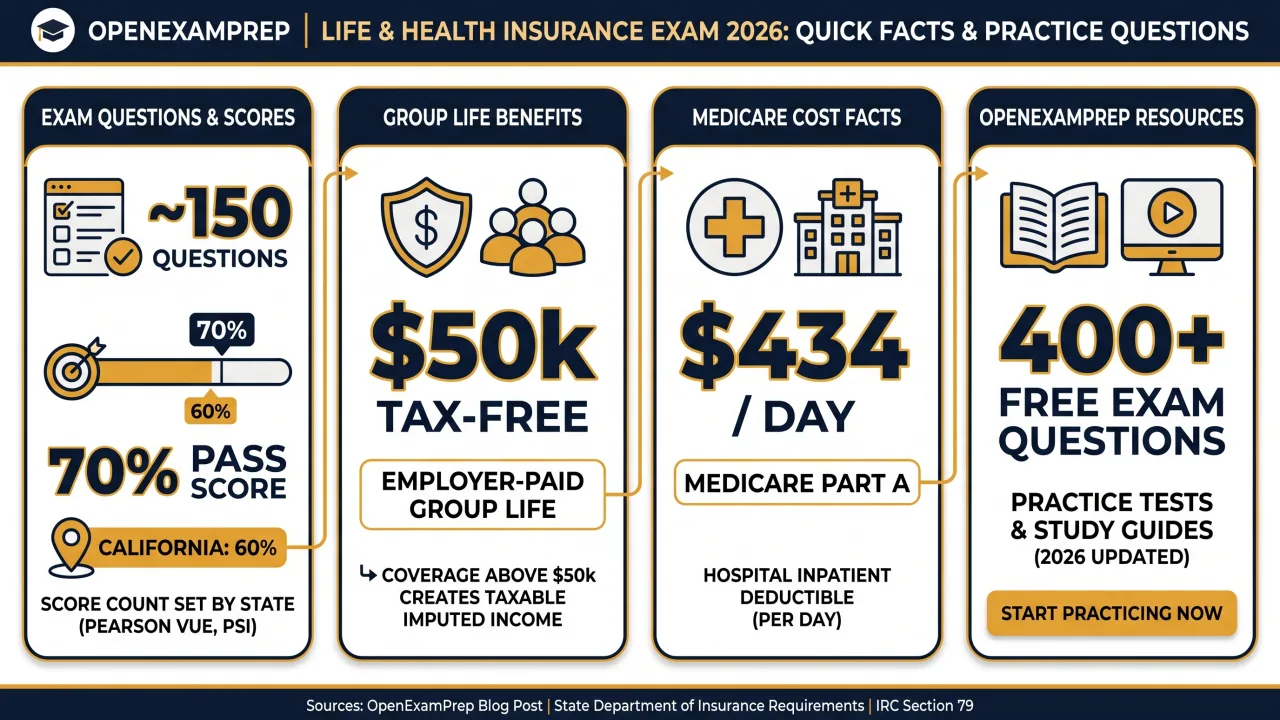
| Total Questions | ~150 scored on a combined Life & Health exam; ~100-125 on a single-line (Life-only or Health-only) exam |
| Pretest Questions | Most states add 10-15 unscored pretest questions that do not count toward your score |
| Time Limit | About 2-3 hours |
| Passing Score | 70% in most states (California requires 60%) |
| Topics | Life basics, annuities, health insurance, disability income, Medicare/Medicaid, plus a state law portion |
| Format | Multiple choice, computer-based |
| Testing Vendor | Pearson VUE or PSI in most states; a few use Prometric or run their own exam |
| Prelicensing Hours | Often 20-40 hours per line, but ranges widely (e.g., Texas 40, California 52, Florida 60) |
Because the exam is state-specific, the vendor and the state-law section change depending on where you license. The core insurance concepts - the material in the practice questions below - are tested nationwide, so they are the highest-value thing to master first.
Sample Practice Questions by Topic
Life Insurance Principles (30%)
Question 1: Which type of life insurance provides coverage for a specific period of time?
A) Whole life B) Term life C) Universal life D) Variable life
Answer: B - Term life insurance provides coverage for a specific period (10, 20, 30 years). It has no cash value and premiums are typically lower than permanent insurance.
Question 2: The incontestability clause prevents the insurer from:
A) Canceling the policy for non-payment B) Denying claims after 2 years based on misrepresentations C) Increasing premiums after issue D) Changing policy terms
Answer: B - After the incontestability period (typically 2 years), the insurer cannot void the policy or deny claims based on misrepresentations in the application, except for fraud.
Question 3: If an employee has $150,000 of employer-paid group term life insurance, how much coverage is subject to imputed income taxation?
A) $0 B) $50,000 C) $100,000 D) $150,000
Answer: C - The first $50,000 of employer-paid group term life is tax-free. The amount above $50,000 is subject to imputed income taxation. $150,000 - $50,000 = $100,000 is taxable.
Question 4: Which nonforfeiture option provides the longest coverage period?
A) Cash surrender B) Extended term C) Reduced paid-up D) Automatic premium loan
Answer: B - Extended term uses the cash value to purchase term insurance for the full face amount for as long as possible. Reduced paid-up provides permanent but reduced coverage.
Question 5: In an IUL policy, if the linked index returns -15% for the year and the floor is 0%, the interest credited will be:
A) -15% B) -7.5% C) 0% D) Whatever the cap rate is
Answer: C - The floor in an IUL policy protects against market losses. If the index returns negative, the policy credits 0% (the floor), not a negative return.
Health Insurance (20%)
Question 6: What typically happens after 24 months under a split definition disability policy?
A) Benefits automatically end B) The definition changes from "own occupation" to "any occupation" C) Benefits increase by 50% D) The elimination period is extended
Answer: B - A split definition policy uses "own occupation" for the first 24 months, then transitions to "any occupation" for continued benefits.
Question 7: A patient has been in the hospital for 75 days. How much coinsurance will they pay for days 61-75 under Medicare Part A in 2026?
A) $0 B) $4,340 ($434 × 10 days) C) $6,510 ($434 × 15 days) D) $13,020 ($868 × 15 days)
Answer: C - For Medicare Part A, days 61-90 require $434/day coinsurance in 2026 (up from $419 in 2025). Days 61-75 = 15 days × $434 = $6,510. Lifetime reserve days (91+) cost $868/day in 2026.
Question 8: A Medicare beneficiary sees a doctor who does not accept Medicare assignment. What is the maximum the doctor can charge above the Medicare-approved amount?
A) 5% B) 10% C) 15% D) 25%
Answer: C - Doctors who don't accept assignment can charge up to 15% above the Medicare-approved amount (called the "limiting charge").
Question 9: Which Medicare supplement plan covers the Part B deductible?
A) Plan A B) Plan C C) Plan G D) Plan N
Answer: B - Plan C (and Plan F for those eligible before 2020) covers the Part B deductible. Plans G and N do not cover this deductible.
Question 10: A self-employed individual pays $12,000 annually for family health insurance. Their net self-employment income is $8,000. What is their maximum self-employed health insurance deduction?
A) $0 B) $8,000 C) $12,000 D) $20,000
Answer: B - The self-employed health insurance deduction is limited to net self-employment income. Even though premiums are $12,000, the maximum deduction is $8,000.
Annuities (15%)
Question 11: An indexed annuity with a 70% participation rate and a 10% cap experiences an index gain of 12%. What interest rate is credited?
A) 7% B) 8.4% C) 10% D) 12%
Answer: B - Apply participation rate first: 12% × 70% = 8.4%. Compare to cap: 8.4% < 10%, so 8.4% is credited.
Question 12: In a deferred annuity, withdrawals before age 59½ are generally subject to:
A) No penalty B) 10% penalty on earnings C) 20% penalty on earnings D) 10% penalty on entire withdrawal
Answer: B - Early withdrawals from annuities are subject to a 10% IRS penalty on earnings plus ordinary income tax. The penalty doesn't apply to the return of principal (after-tax contributions).
Question 13: Which annuity payout option provides the largest monthly payment?
A) Life only B) Life with 10-year certain C) Life with 20-year certain D) Joint and survivor
Answer: A - Life only (straight life) provides the largest monthly payment because there's no guarantee period. The insurance company keeps any remaining funds if the annuitant dies early.
Question 14: A variable annuity's cash value:
A) Is guaranteed by the insurance company B) Fluctuates with market performance C) Earns a fixed interest rate D) Cannot decrease below the premium paid
Answer: B - Variable annuity values fluctuate with market performance of the underlying subaccounts. Unlike fixed annuities, there's no guaranteed minimum return.
Regulations & Ethics (10%)
Question 15: An insurance producer who replaces a client's existing policy without properly comparing benefits may be guilty of:
A) Rebating B) Twisting C) Churning D) Misrepresentation
Answer: B - Twisting is inducing a policyholder to replace an existing policy through misrepresentation or incomplete comparison. It's prohibited in all states.
Want more practice? Access our full question bank with 420+ free life & health practice questions →
Question 16: Which practice is permitted under insurance regulations?
A) Rebating premiums to customers B) Sharing commissions with licensed agents C) Offering inducements not in the policy D) Discriminating based on genetic information
Answer: B - Sharing commissions with other licensed agents is permitted. Rebating, improper inducements, and genetic discrimination are prohibited.
Key Exam Topics to Master
Life Insurance Must-Know Concepts
- Term vs. permanent life insurance differences
- Nonforfeiture options: cash surrender, reduced paid-up, extended term
- Settlement options: lump sum, interest only, fixed period, life income
- Policy provisions: grace period, reinstatement, incontestability
Health Insurance Must-Know Concepts
- Medicare Parts A, B, C, D coverage and costs
- Disability income own occupation vs. any occupation
- COBRA continuation requirements
- ACA marketplace plans and subsidies
Annuity Must-Know Concepts
- Fixed vs. variable vs. indexed annuity differences
- Taxation of qualified vs. non-qualified annuities
- Surrender charges and free withdrawal provisions
- Death benefit options
Study Tips for Success
- Master policy provisions - they're heavily tested
- Know Medicare inside out - Part A, B, C, D coverage and costs
- Understand annuity taxation - qualified vs. non-qualified
- Learn prohibited practices - twisting, rebating, misrepresentation
- Practice calculations - especially Medicare coinsurance
Start Your Free Practice
Our free life and health insurance practice question bank includes 420+ questions covering all exam topics with detailed explanations - and it is genuinely free, no credit card required.
Want a tutor that never sleeps? Our free AI study assistant (up to 10 questions per day at no cost) can quiz you on weak areas, explain any concept in plain English, and generate a personalized study plan around your exam date. Pair it with the practice bank to learn faster than flashcards alone.
Ready to Pass Your Life & Health Exam?
| Resource | Description |
|---|---|
| Free Practice Questions → | 420+ exam-style questions with detailed explanations |
| Complete Study Guide → | Full exam content covering life, health, and annuities |
| Insurance Category → | All insurance exam resources in one place |
Start with our free practice questions, then master the content with our comprehensive study guide. With thorough preparation, you can pass your insurance license exam on the first try!


 Buy on Amazon
 Prep course on Achievable
 Online course on Mometrix
 Take courses on Udemy