Food Handler Certification Guide 2026: Everything You Need to Know
Looking to get your food handler certification? This comprehensive FREE guide covers everything you need to pass your food handler exam in 2026. Whether you're in California, Texas, Florida, or any other state, we'll help you understand the requirements and pass your test.
What Is Food Handler Certification?
A food handler certification (also called a food handler card or food worker permit) is a credential that proves you understand basic food safety principles. It's required for anyone who works with unpackaged food in restaurants, cafeterias, food trucks, grocery stores, and other food service establishments.
Who Needs a Food Handler Card?
| Job Type | Certification Required |
|---|---|
| Restaurant servers | Yes |
| Line cooks | Yes |
| Dishwashers | Usually yes |
| Grocery store deli workers | Yes |
| Food truck employees | Yes |
| Bartenders (handling food) | Yes |
| Cashiers (no food contact) | Sometimes |
State Requirements for Food Handler Certification
Food handler certification requirements vary by state. Here are the key states that require certification:
States Requiring Food Handler Certification
| State | Time to Obtain | Validity | Cost Range |
|---|---|---|---|
| California | Within 30 days of hire | 3 years | $7-$15 |
| Texas | Within 60 days of hire | 2 years | $7-$20 |
| Florida | Within 60 days of hire | 3 years | $10-$25 |
| Washington | Within 14 days of hire | 2 years (new card); 3-5 years on renewal | $10-$20 |
| Oregon | Within 30 days of hire | 3 years | $10-$15 |
| Illinois | Within 30 days of hire | 3 years | $8-$20 |
| Arizona* | Within 30 days of hire | 3 years | $8-$15 |
*Arizona has no statewide mandate - certification is required county-by-county (Maricopa, Pima, Coconino, Yuma, and most other counties require it).
Not every state issues a "card" at all. New York, Ohio, Pennsylvania, and Georgia skip individual handler cards and instead require a certified food protection manager on-site - so what you need depends entirely on your state and county. For the exact rule in your location, see our food handler requirements by state guide, which covers all 50 states.
Key Topics on the Food Handler Exam
The food handler exam covers essential food safety topics. Here's what you need to know:
1. Personal Hygiene (20% of exam)
Proper Handwashing Steps:
- Wet hands with warm water (100°F minimum)
- Apply soap
- Scrub for at least 20 seconds (including under nails)
- Rinse thoroughly
- Dry with single-use paper towel
When to Wash Hands:
- Before starting work
- Before handling food
- After using the restroom
- After touching raw meat
- After handling trash
- After touching face, hair, or body
- After smoking or eating
- After handling money
2. Temperature Danger Zone (25% of exam)
The Temperature Danger Zone is between 41°F and 135°F - this is where bacteria multiply rapidly.
| Food Safety Temperature | Celsius |
|---|---|
| Hot holding minimum | 135°F (57°C) |
| Cold holding maximum | 41°F (5°C) |
| Danger zone | 41°F - 135°F |
Critical Cooking Temperatures:
| Food Item | Minimum Internal Temp |
|---|---|
| Poultry (chicken, turkey) | 165°F |
| Ground meats | 155°F |
| Pork, beef, seafood | 145°F |
| Hot holding | 135°F |
Cooling Cooked Food Safely: A common exam trap. Cooked TCS food must cool from 135°F to 70°F within 2 hours, then from 70°F down to 41°F within an additional 4 hours (6 hours total). If either window is missed, the food must be reheated to 165°F and the cooling process restarted, or thrown out.
3. Cross-Contamination Prevention (20% of exam)
Key Prevention Methods:
- Use separate cutting boards for raw meat and vegetables
- Store raw meat on the bottom shelf (below ready-to-eat foods)
- Use color-coded equipment
- Clean and sanitize surfaces between tasks
4. Food Allergens - The Big Nine (15% of exam)
The FDA requires labeling of these 9 major allergens:
- Milk
- Eggs
- Fish
- Shellfish
- Tree nuts
- Peanuts
- Wheat
- Soybeans
- Sesame (added in 2023)
5. Cleaning and Sanitizing (10% of exam)
Three-Sink Dishwashing Method:
- Sink 1: Wash with hot soapy water
- Sink 2: Rinse with clean water
- Sink 3: Sanitize (chlorine, iodine, or quats)
Common Sanitizer Concentrations:
| Sanitizer | Concentration |
|---|---|
| Chlorine (bleach) | 50-100 ppm |
| Iodine | 12.5-25 ppm |
| Quaternary Ammonium (quats) | 200-400 ppm |
Food Handler Exam Format
| Aspect | Details |
|---|---|
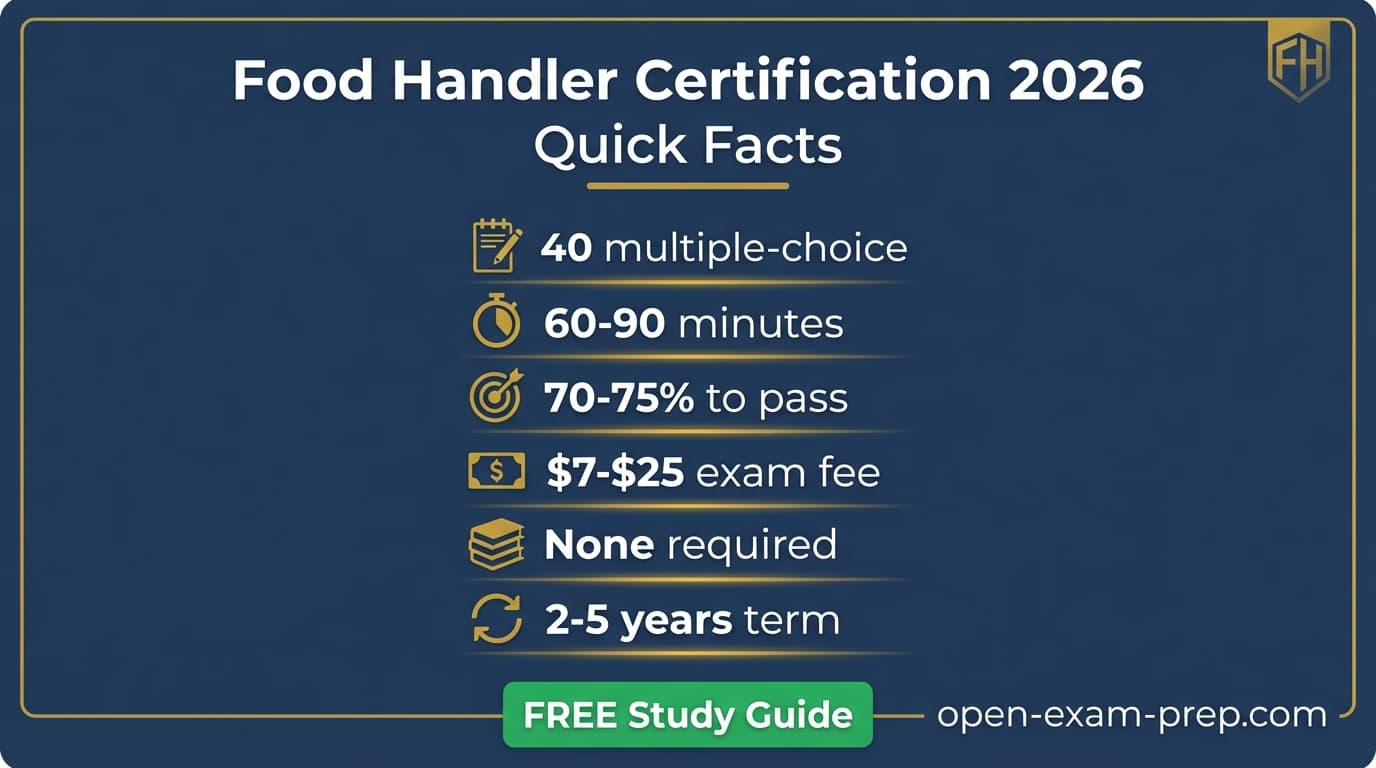
| Questions | Typically 40 multiple-choice questions (some county/jurisdiction tests use 20-50) |
| Time limit | Most providers' tests are untimed and self-paced - a 60-90 minute window only applies to a few proctored/classroom versions |
| Passing Score | 70-75% is most common (ServSafe requires 75%; some local health departments accept 70%) |
| Retakes | Usually allowed immediately, often with no extra fee (ServSafe allows 3 attempts per purchase) |
| Format | Online (self-paced) or in-person classroom, depending on the approved provider |
Top 5 Food Handler Exam Tips
- Focus on temperatures - Memorize the danger zone (41°F-135°F) plus the cooking and holding numbers below; temperature questions make up the single largest topic on most exams
- Master handwashing - 20 seconds minimum, know when to wash
- Learn the Big Nine allergens - Especially the newest one (sesame)
- Understand FIFO - First In, First Out for food storage
- Know TCS foods - Time/Temperature Control for Safety foods require extra care
TCS (Time/Temperature Control for Safety) Foods
These foods require careful temperature control:
| TCS Foods | Why They're High Risk |
|---|---|
| Meat & poultry | High protein content |
| Fish & shellfish | Quick bacterial growth |
| Dairy products | Ideal bacteria environment |
| Cooked rice & pasta | Spore-forming bacteria |
| Cut melons | pH allows bacterial growth |
| Sprouts | Grown in humid conditions |
| Eggs | Salmonella risk |
How to Get Your Food Handler Card
Step 1: Determine Your State Requirements
Check if your state/county requires certification and how long you have after being hired.
Step 2: Study the Material
Step 3: Take Practice Tests
Practice with our FREE questions until you're scoring 80%+ consistently.
Step 4: Take the Official Exam
- Choose an ANSI-accredited provider
- Typical cost: $7-$25
- Complete the exam online or in-person
Step 5: Print Your Certificate
Once you pass, you'll receive a certificate valid for 2-5 years.
Free vs. Paid Food Handler Certification
| Feature | Free (OpenExamPrep) | Paid Courses |
|---|---|---|
| Study materials | ✅ Complete guide | ✅ Complete guide |
| Practice questions | ✅ 197+ questions | ✅ 50-100 questions |
| AI study help | ✅ Included | ❌ Not available |
| Official certificate | ❌ Test elsewhere | ✅ Included |
| Cost | FREE | $7-$25 |
Our Approach: Use our FREE study materials to prepare, then pay only for the official certificate.
Foodborne Illness Prevention
Understanding common pathogens helps you prevent outbreaks:
| Pathogen | Source | Prevention |
|---|---|---|
| Salmonella | Raw poultry, eggs | Cook to 165°F |
| E. coli | Ground beef | Cook to 155°F |
| Norovirus | Infected workers | Proper handwashing |
| Listeria | Deli meats, soft cheese | Cold storage, heating |
| Hepatitis A | Infected workers | Handwashing, vaccination |
Frequently Asked Questions
How long does food handler certification take?
The training typically takes 1-2 hours, and most exams are untimed and self-paced rather than run on a strict clock. Most people complete everything in one sitting.
How much does a food handler card cost?
Costs range from $7-$25 depending on your state and provider. Our study materials are completely FREE.
Can I get my food handler card online?
Yes! Most states accept online certification. You'll take a short course and exam, then receive your certificate electronically.
How long is a food handler certificate valid?
Validity ranges from 2-5 years depending on your state. California is 3 years, Texas is 2 years.
What if I fail the food handler exam?
Most providers allow immediate retakes. Use our FREE practice tests to prepare and you'll pass on the first try.
Start Your FREE Food Handler Prep Today
Our free food handler certification prep includes:
- Complete study guide
- 197+ practice questions
- Temperature charts and cheat sheets
- AI-powered study assistance
- Mobile-friendly access
Don't pay for expensive courses. Study for FREE with OpenExamPrep, then get your official certificate for just $7-$25.
Choosing a Legitimate (and Accredited) Provider
Anyone can put up a website that looks like an official "food handler" exam, so check three things before you pay:
- ANSI/ANAB accreditation. Your state or county health department only accepts cards issued by training providers accredited by the ANSI National Accreditation Board (ANAB) — formerly ANSI. Look for "ANSI/ANAB-accredited" or "ANAB-accredited" on the provider's site.
- Your state's approved-provider list. Some states (California, Texas, Illinois, Utah, and others) publish an official list of approved food handler training programs. If a provider isn't on it, your card may be rejected at inspection.
- The real price. Legitimate food handler cards run $7-$25. If a site charges $50+ or bundles in "membership fees," it's likely a reseller markup, not a requirement.
Food Handler Card vs. Food Manager Certification
These are two different credentials, and mixing them up is the single most common point of confusion for new food service workers:
| Food Handler Card | Food Manager Certification (e.g., ServSafe Manager) | |
|---|---|---|
| Who needs it | Most front-line staff: servers, cooks, dishwashers | At least one certified manager per shift/location |
| Typical length | 1-2 hour course, 40-question exam | 7-8 hour course, 80-90 question proctored exam |
| Cost | $7-$25 | $99-$150 |
| Validity | 2-5 years | Typically 3-5 years |
| Depth | Basic safe-handling practices | Full HACCP-level food safety management |
States That Require a Manager, Not a Card, for Every Worker
A handful of states skip individual handler cards entirely and instead require a certified food protection manager on-site:
- New York — NYC requires a Food Protection Certificate only for the person in charge, not every employee.
- Ohio — Uses a two-tier Level 1 (handler) / Level 2 (manager) system set by local health districts.
- Pennsylvania — No statewide handler-card mandate; this is a manager-certification state, though some cities (e.g., Philadelphia) add local rules.
- Georgia — Requires a Certified Food Safety Manager per establishment; handler training is employer-driven, not state-mandated.
Always confirm with your specific county or city health department — local rules frequently add requirements the state doesn't.
What Happens If You Fail the Exam
Failing a food handler exam is rarely a big setback:
- Retakes are usually immediate and free or low-cost. Most online providers let you retake right away; ServSafe allows 3 attempts per course purchase before you have to buy a new attempt.
- There's typically no waiting period, unlike many professional licensing exams.
- Review your weak areas first. Use the topic breakdown above (temperatures, allergens, cross-contamination, cleaning/sanitizing, personal hygiene) to find the section you missed before retesting — don't just re-click through the same course.
Common Mistakes That Cause Failed Food Handler Exams
- Confusing cooking temperature with holding temperature. Cooking poultry to 165°F is not the same question as hot-holding food at 135°F — exams test both separately.
- Missing the newest allergen. Sesame has been a required allergen on the Big Nine list since January 1, 2023 under the FDA's FASTER Act; older study materials sometimes still list only eight.
- Reversing the cooling rule. It's 135°F → 70°F in 2 hours, then 70°F → 41°F in an additional 4 hours (6 hours total) — not 6 hours for the whole drop in one step.
- Mixing up FIFO direction. First In, First Out means the oldest stock goes to the front and gets used first — not thrown out first.
- Forgetting raw-meat shelf placement. Raw meat goes on the bottom shelf of a cooler, below ready-to-eat food, in order of rising minimum cook temperature (whole cuts above ground meat above poultry).
Day-of Checklist for Your Online Exam
- Confirm your provider is ANSI/ANAB-accredited and accepted by your state or county.
- Have a government-issued photo ID ready if your employer or jurisdiction requires it for registration.
- Use a stable internet connection — most courses auto-save progress, but a dropped connection mid-exam can be frustrating on timed/proctored versions.
- Know your state's deadline after hire (see the table above) so you're not scrambling on day 29 of a 30-day window.
- Print or save your certificate immediately after passing — some providers charge a reprint fee later, and employers often want a copy on file day one.

 Buy on Amazon
 Take courses on Udemy
 Practice exams on ExamEdge
 Flashcards on Mometrix