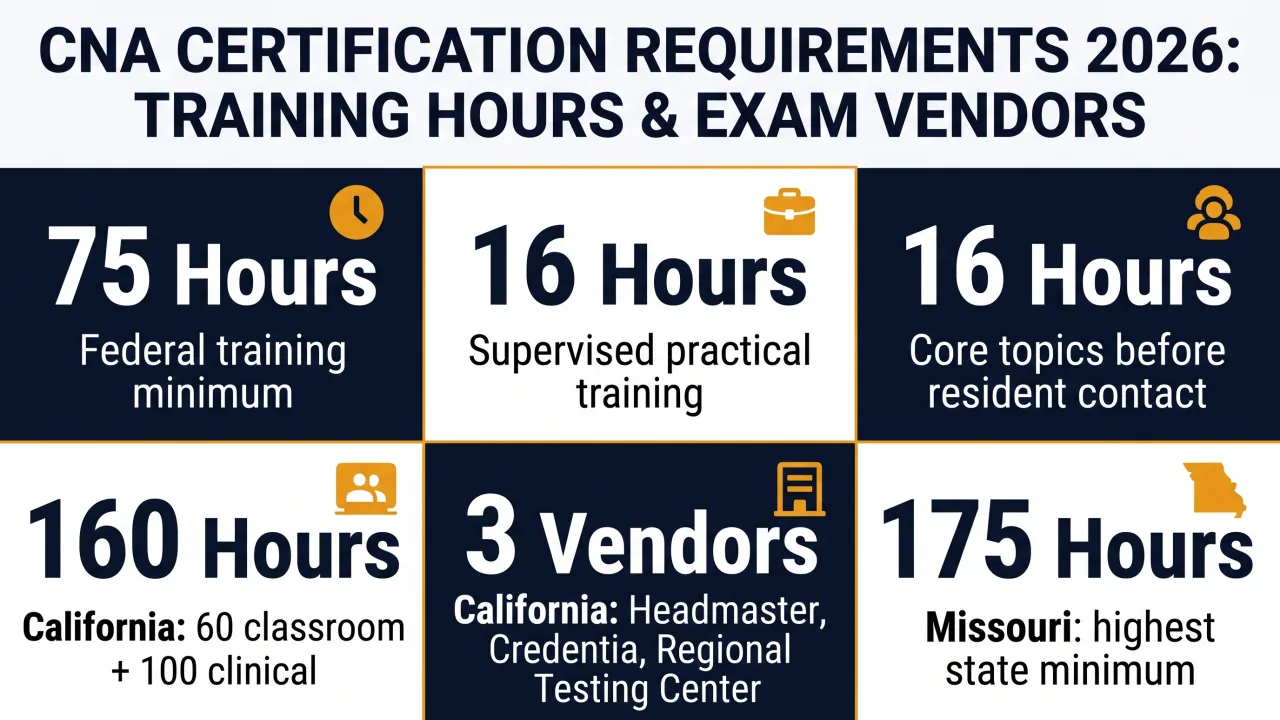
Last updated: October 2, 2026. Federal rules come from 42 CFR 483.35 and 483.150 through 483.156. Every state training-hour minimum and exam vendor below was checked on October 2, 2026 against that state's nurse aide program page, regulation, or contracted testing vendor. Rules change, so confirm with your state registry before you enroll.
CNA Certification Requirements in 2026: The Short Answer
Every state builds its nurse aide rules on the same federal nursing-home law, so the path looks the same everywhere even though the numbers differ:
- Meet your state's eligibility rules (age, identity, criminal background and abuse-registry checks).
- Finish a state-approved nurse aide training program. Federal law sets a 75-clock-hour minimum. By our October 2026 check, 28 states plus D.C. require more, topped by Missouri at 175 hours and California at 160.
- Pass the two-part competency evaluation: a written (or oral) knowledge test and a hands-on skills test. Depending on your state, Credentia, D&SDT-Headmaster, Prometric, or a state-designated tester runs it.
- Get listed on your state's nurse aide registry. Federal rules require the state to add a passing result to the registry within 30 days.
- Stay active. Registries drop aides after 24 consecutive months without paid nursing-related work, and some states add continuing education.
The job title changes by state. Most states say CNA, but New Hampshire and Vermont license an LNA, Kentucky lists an SRNA, Washington certifies an NA-C, and Maryland has issued new certificates only as CNA-I since April 1, 2026.
The Federal Baseline Every State Builds On (OBRA '87)
The Omnibus Budget Reconciliation Act of 1987 created the Nurse Aide Training and Competency Evaluation Program (NATCEP). Its rules apply to aides in Medicare- and Medicaid-certified nursing homes, and every state program must meet or beat them.
| Rule | Federal requirement | Citation |
|---|---|---|
| Training length | At least 75 clock hours | 42 CFR 483.152(a)(1) |
| Supervised practical training | At least 16 hours performing tasks on a person under direct RN or LPN supervision (lab or other setting) | 483.152(a)(3) |
| Before any resident contact | At least 16 hours on communication, infection control, safety and emergency procedures (including the Heimlich maneuver), residents' independence, and residents' rights | 483.152(b)(1) |
| Instructor | Training done by, or under the general supervision of, an RN with at least 2 years of nursing experience, at least 1 of them in long-term care | 483.152(a)(5) |
| Cost to trainees | No charge to aides employed or offered a job by a nursing home when they start; others hired within 12 months get pro rata reimbursement | 483.152(c), 483.154(c) |
| Exam format | The candidate chooses a written or oral exam, plus a skills demonstration of randomly selected tasks scored by an RN | 483.154(b), (c)(4) |
| Attempts | At least three chances to pass | 483.154(f) |
| Registry listing | Added within 30 days of passing | 483.154(e)(2) |
| Working while in training | A nursing home may use a trainee in an approved program for up to 4 months full time | 483.35(d)(1), (3) |
| Inactivity | Registry entry removed after 24 consecutive months without nursing or nursing-related services; new training or testing required | 483.156(c)(2), 483.35(d)(6) |
| Ongoing training | Nursing homes must give each aide at least 12 hours of in-service training per year | 483.95(g)(1) |
Two details trip people up. First, the 16 supervised practical hours and the 16 hours of pre-contact classroom topics are separate requirements; the pre-contact hours are training, not clinical time. Second, abuse, neglect, and misappropriation findings stay on the registry permanently unless made in error, overturned in court, or the aide dies, but federal law lets an aide petition to remove a single neglect finding after at least one year (Social Security Act section 1819(g)(1)(D)).
CNA Training Hours and Exam Vendor by State (2026)
The table lists each jurisdiction's minimum program length and who gives the competency exam. Each state name opens free state-specific practice questions.
| State | Minimum training hours | Who gives the exam |
|---|---|---|
| Alabama | 75 | Prometric or Credentia (the training program chooses) |
| Alaska | 140 (60 classroom + 80 clinical) | Credentia |
| Arizona | 120 (at least 40 classroom, 20 lab, 40 clinical) | D&SDT-Headmaster |
| Arkansas | 91 (75 classroom/lab + 16 clinical; 20 CAR § 403-203) | D&SDT-Headmaster |
| California | 160 (60 classroom + 100 clinical) | D&SDT-Headmaster, Credentia, or the Regional Testing Center |
| Colorado | 75 | Credentia |
| Connecticut | 100 | Prometric |
| Delaware | 91 (75 classroom + 16 clinical) | Prometric |
| District of Columbia | 125 (DC Health model curriculum) | Credentia |
| Florida | 120 (80 classroom + 40 clinical) | Prometric |
| Georgia | 85 (including 24 clinical) | Credentia |
| Hawaii | 100 (30 classroom + 70 practical) | Prometric |
| Idaho | 120 (80 classroom + 40 clinical) | Prometric written test; skills test through the training program |
| Illinois | 120 (62 theory + 18 lab + 40 clinical) | SIU Carbondale written exam (INACE); skills signed off during training |
| Indiana | 75 (IDOH 2026 program page; an older IDOH page still says 105) | Ivy Tech Community College |
| Iowa | 75 (including 30 clinical) | Headmaster written test (Credentia remote option); skills test at community colleges or Health Tech Associates |
| Kansas | 90 | KDADS state written test; skills checked during training |
| Kentucky | 75 | KCTCS (Headmaster's TMU handles scheduling) |
| Louisiana | 80 (40 classroom + 40 clinical) | Prometric or LCTCS college test sites |
| Maine | 130 (70 classroom + 20 lab + 40 clinical) | State competency test given through approved training programs |
| Maryland | 100 (60 classroom/lab + 40 clinical) | Credentia or D&SDT-Headmaster |
| Massachusetts | 75 (DPH has announced 87; start date pending) | D&SDT-Headmaster |
| Michigan | 75 | D&SDT-Headmaster |
| Minnesota | 75 | D&SDT-Headmaster |
| Mississippi | 75 (federal minimum; no higher state figure published) | D&SDT-Headmaster |
| Missouri | 175 (75 classroom + 100 on-the-job) | D&SDT-Headmaster |
| Montana | 75 (federal minimum; state total not published) | D&SDT-Headmaster |
| Nebraska | 75 | State-approved providers (community colleges, NHCLC, and others) |
| Nevada | 75 | D&SDT-Headmaster (since July 1, 2026; previously Credentia) |
| New Hampshire | 100 (40 theory + 60 clinical) | Excel Testing |
| New Jersey | 90 (50 classroom + 40 clinical) | Headmaster skills test plus PSI written or oral exam |
| New Mexico | 75 | D&SDT-Headmaster (since July 1, 2024; previously Prometric) |
| New York | 100 (at least 30 clinical) | Prometric |
| North Carolina | No single figure; NCDHHS does not approve programs at the 75-hour minimum | Credentia |
| North Dakota | 75 | D&SDT-Headmaster |
| Ohio | 75 | D&SDT-Headmaster |
| Oklahoma | 75 (federal minimum) | Prometric; CareerTech Health Certification Project sites also give the written exam |
| Oregon | 105 (37 classroom + 28 lab + 40 clinical) | D&SDT-Headmaster |
| Pennsylvania | 80 (including 37.5 clinical) | Credentia |
| Rhode Island | 120 (at least 40 practical) | Credentia |
| South Carolina | 100 (including 40 clinical) | Credentia |
| South Dakota | 75 | Headmaster knowledge exam; Board-approved RN skills evaluation |
| Tennessee | 75 (federal minimum) | Credentia (since June 1, 2026) |
| Texas | 100 (60 classroom + 40 clinical) | Prometric |
| Utah | 100 | Utah Nursing Assistant Registry state exam |
| Vermont | 75 (59 instruction + 16 practical) | Excel Testing |
| Virginia | 140 (at least 20 lab + 40 clinical) | Credentia |
| Washington | 108 (35 classroom + 33 lab + 40 clinical) | Credentia |
| West Virginia | 120 (at least 55 clinical) | Professional Healthcare Development (PHD) |
| Wisconsin | 75 (at least 16 clinical) | D&SDT-Headmaster |
| Wyoming | 75 (federal minimum) | D&SDT-Headmaster |
What the table shows:
- 28 states plus D.C. require more than 75 hours. The highest minimums are Missouri (175), California (160), Alaska and Virginia (140), and Maine (130).
- 21 states sit at the 75-hour federal minimum or publish no higher figure, and North Carolina sets program-by-program hours above the minimum.
- Credentia's NNAAP is the sole or shared exam in 13 states plus D.C., D&SDT-Headmaster runs all or part of the exam in 20 states, and Prometric in 10 states. The rest use a state agency, community college system, or regional tester.
Why other tables disagree with this one. Many popular hour charts are years out of date. They still show California at 150 hours (it is 160 under Health and Safety Code 1337.1), Maine at 180 (130 since September 1, 2021), Delaware at 150 (91 since February 19, 2022), Oregon at 155 (current OAR 851-061-0090 requires 105), and Wisconsin at 120 (75 under DHS 129.07). Vendor lists have also moved: New Mexico switched to Headmaster on July 1, 2024, Tennessee to Credentia on June 1, 2026, and Nevada to Headmaster on July 1, 2026.
The Competency Exam: How the Testing Formats Compare
Federal rules require both a knowledge test and a skills demonstration, but each tester builds them differently. Know which format you will face before you start drilling.
Credentia (NNAAP)
Credentia now develops and manages the National Nurse Aide Assessment Program (NNAAP); NCSBN's exam page says it no longer develops or owns the NNAAP content. States: Alabama (shared), Alaska, California (shared), Colorado, D.C., Georgia, Maryland (shared), North Carolina, Pennsylvania, Rhode Island, South Carolina, Tennessee, Virginia, and Washington, plus Guam, the Northern Mariana Islands, and the U.S. Virgin Islands. Iowa also offers a Credentia remote written test.
| Component | NNAAP standard |
|---|---|
| Written exam | 70 multiple-choice items, 10 of them unscored pretest items; 2 hours |
| Oral exam | 60 multiple-choice items plus 10 reading-comprehension (word-recognition) items |
| Content outline (April 2024) | Physical Care Skills 64%, Role of the Nurse Aide 26%, Psychosocial Care Skills 10% |
| Skills evaluation | 5 skills in 30 minutes; hand hygiene is always included and one skill is a measurement (pulse, respirations, blood pressure, weight, or urine output) |
| Passing the skills test | All 5 skills must pass, including every critical element step |
| Skill list | 23 skills, including state-specific electronic and manual blood pressure versions |
Tennessee uses a variation: a 75-question knowledge exam (10 experimental items) in 2 hours with a 75% passing score, plus the standard 5-skill evaluation.
D&SDT-Headmaster
Headmaster runs testing (and often the registry) through its TestMaster Universe (TMU) system in Arizona, Arkansas, California, Maryland, Massachusetts, Michigan, Minnesota, Mississippi, Missouri, Montana, Nevada, New Mexico, North Dakota, Ohio, Oregon, Wisconsin, and Wyoming, plus partial roles in Iowa (written), New Jersey (skills), and South Dakota (knowledge). Its exams vary more by state than the NNAAP does:
| State | Knowledge test | Passing score |
|---|---|---|
| Massachusetts | 60 questions, 60 minutes | 76% |
| Wyoming | 60 questions, 60 minutes | 76% |
| Michigan | 65 questions, 60 minutes | 74% |
| Minnesota | 70 questions, 2 hours | 74% |
| Arizona | 75 questions, 60 minutes | 75% |
| Missouri | 75 questions, 60 minutes | 80% |
| Nevada | 75 questions, 60 minutes | 80% |
| Ohio | 79 questions, 90 minutes | 70% |
| Oregon | 80 questions, 90 minutes | 73% |
Headmaster skills tests usually assign 3 or 4 tasks in 30 to 35 minutes. To pass each task you must perform every key (bold) step and at least 80% of the other steps. Several states, including Arkansas, Michigan, Mississippi, and Nevada, make the first task a mandatory one that includes handwashing.
Prometric
Prometric tests in Alabama (shared), Connecticut, Delaware, Florida, Hawaii, Idaho (written only), Louisiana (shared), New York, Oklahoma, and Texas. Most Prometric states give a 60-question written test in 90 minutes (Alabama's has 55), with an oral option. The clinical skills test scores five skills (handwashing, indirect care, and three assigned tasks) in 31 to 40 minutes, and all five must pass. Indirect care covers behaviors such as greeting the resident, explaining care, infection control, rights, and safety.
State Agencies and Other Testers
| State | Tester | Format highlights |
|---|---|---|
| California | Regional Testing Center (Golden West College) | 70 questions in 120 minutes, 70% to pass; 5 skills including handwashing |
| Illinois | Southern Illinois University Carbondale | Written INACE in 90 minutes; skills signed off in the training program |
| Indiana | Ivy Tech Community College | 100 questions, 80% to pass, plus hand hygiene and 4 skills |
| Kansas | KDADS | 100 questions in 2 hours, 75% to pass; no separate state skills exam |
| Kentucky | KCTCS | 75 questions in 2 hours, 70% to pass, plus 5 skills |
| Nebraska | Approved providers | 50 questions, 70% to pass, plus 6 skills |
| New Hampshire | Excel Testing | 60 questions in 90 minutes, 70% to pass; 4 skills in 30 minutes |
| New Jersey | PSI (written) + Headmaster (skills) | 60 questions in 90 minutes, 75% to pass; handwashing plus 4 tasks |
| Utah | Utah Nursing Assistant Registry | 75 questions, 75% to pass; 5 skills in 45 minutes |
| Vermont | Excel Testing | LNA knowledge and skills exam listed by the Vermont Board of Nursing |
| West Virginia | Professional Healthcare Development | Written or oral knowledge exam plus a skills evaluation |
How Much the CNA Exam Costs in 2026
These are first-attempt fees for the knowledge test plus the skills test, taken from each tester's current fee table. Retakes are usually charged per failed part.
| State | Tester | Written + skills | Note |
|---|---|---|---|
| Alabama | Prometric | $125 | $40 + $45 + $40 test-site fee |
| Alabama | Credentia | $135 | $55 + $80 |
| California | D&SDT-Headmaster | $140 | Effective March 1, 2026 |
| California | Credentia or RTC | $120 | $40 written + $80 skills |
| Colorado | Credentia | $145 | $50 written-only, $95 skills-only retakes |
| Connecticut | Prometric | $125 | Effective August 1, 2026 |
| D.C. | Credentia | $165 | $55 + $110 |
| Florida | Prometric | $155 | $35 written, $120 skills |
| Georgia | Credentia | $130 | $35 written-only, $95 skills-only |
| Hawaii | Prometric | $216 | Plus a one-time $25 application fee |
| Maryland | Credentia or Headmaster | $130 | Both vendors total $130 |
| Nevada | D&SDT-Headmaster | $165 | $75 knowledge + $90 skills |
| New Hampshire | Excel Testing | $200 | State license application is separate |
| New Jersey | Headmaster + PSI | $84 | $27 skills + $57 written |
| New York | Prometric | $115 | $135 with the oral exam |
| North Carolina | Credentia | $140 | $40 written + $100 skills |
| Pennsylvania | Credentia | $135 | $50 written-only, $85 skills-only retakes |
| Tennessee | Credentia | $122 | $35 + $87 |
| Texas | Prometric | $125 | Effective September 1, 2026; oral plus skills is also $125 |
| Utah | UNAR | $110 | $55 + $55 |
| Virginia | Credentia | $140 | $45 + $95 |
| Wisconsin | D&SDT-Headmaster | $144.70 | Effective June 7, 2026 |
Most first-attempt totals we checked fall between $100 and $165. The outliers are New Jersey ($84), Montana ($97 with Headmaster), New Hampshire ($200), and Hawaii ($216 plus $25). Some states add separate state charges, for example Alaska's $100 application, $100 certification, and $75 fingerprint fees, or New Hampshire's $66 license application.
You may not have to pay at all. Federal rules bar nursing homes from charging aides who are employed, or have a job offer, when they start training or testing, and require pro rata reimbursement for aides hired within 12 months of finishing. Ask about employer-sponsored programs before you pay tuition.
Getting on the Registry and Starting Work
After you pass both parts, the tester reports your result and the state adds you to its nurse aide registry; federal rules set a 30-day deadline. Before letting you work as a nurse aide, a certified nursing home must verify your registry status and check every other state registry it believes may have information about you. A nursing home may employ a trainee enrolled in an approved program for up to four months full time while they finish.
Registry searches run on your exact name, so use the same legal name, with the same middle initial, on your training, testing, and registry paperwork.
Moving States: Reciprocity and Endorsement
Most states let an aide with an active, clean listing transfer by reciprocity or endorsement without retesting, but the conditions are not identical:
- Tennessee accepts reciprocity from every state except Florida; Florida-certified aides must retrain and retest.
- Vermont licenses out-of-state aides by endorsement only with at least 400 hours (50 days) of nurse-assistant work in the previous two years.
- Oregon requires a 1-hour pain management course within the past 36 months for CNA endorsement.
- Utah charges a $50 reciprocity application fee, and Louisiana routes reciprocity through Prometric.
- If your original listing has lapsed after 24 months without paid nursing work, expect to retrain or retest.
Apply to the destination state's registry before you move, and keep pay stubs that prove recent work.
Renewal and Active-Status Rules by State
The federal floor is simple: the registry removes you after 24 consecutive months without paid nursing or nursing-related services. Most states renew every two years on proof of at least 8 paid hours of nursing work (7 hours in New York and New Jersey) and require no state continuing education, because the 12 hours of yearly in-service training is the nursing home's federal duty. Alabama has no renewal process at all, and Illinois and Nebraska listings do not expire while the aide keeps working. The states below go further:
| State | Cycle | Work requirement | Continuing education and fees |
|---|---|---|---|
| California | 2 years | Paid nursing-related work in the period | 48 hours (at least 12 per year; up to 24 online through a CDPH-approved provider) |
| Florida | 2 years (May 31 expiration) | Paid work within 24 months | 24 in-service hours per biennium; $55 renewal fee |
| Texas | 2 years | Documented paid nursing work | 24 in-service hours, including geriatrics and dementia care |
| Michigan | 2 years | At least 40 paid hours in 24 months | 12 CE hours per year (24 per cycle), including abuse, neglect, and care planning, for certificates expiring on or after March 23, 2026; $40 fee |
| Alaska | 2 years (March 31, even years) | 160 paid hours | 24 contact hours; $100 fee |
| Delaware | 2 years | 64 paid hours | 24 hours, including 6 on dementia and 2 on abuse and neglect; $25 |
| District of Columbia | 2 years (October 31, odd years) | 8 paid hours | 24 hours, including 2 hours of LGBTQ cultural competency |
| Nevada | 2 years | 40 hours of CNA work | 24 hours of continuing training; $50 fee |
| New Hampshire | 2 years | 200 hours of LNA work (or retest) | 12 CE hours per year; $66 fee |
| South Dakota | 2 years | 12 paid hours | 12 in-service hours per year, including dementia and abuse reporting |
| Hawaii | 2 years | 8 paid hours | 24 CE hours only for aides outside Medicare/Medicaid nursing facilities |
| Maryland | 2 years | At least 16 hours of practice (since April 1, 2026) | None |
| Utah | 2 years | 200 paid hours under a licensed nurse | None |
| Vermont | 2 years | 400 hours (50 days) | None |
| Wyoming | 2 years (even years) | 400 hours, or 200 hours plus 15 CE hours | Or 30 CE hours, or pass the NATCEP again |
| Oregon | OSBN renewal | No practice hours since January 1, 2026 | 2 hours of cultural competency every 48 months |
| Virginia | Every year | Paid nursing-related work in the prior 2 years | None |
| Washington | Every year (birthday) | None listed in the NA-C rules | No CE to renew the NA-C itself, but NA-Cs working as long-term care workers need 12 CE hours a year (RCW 74.39A.341); $95 renewal fee |
Keep certificates and pay records even where nobody asks for them at renewal; Michigan, for example, requires CE records to be kept for two cycles (four years).
CNA Pay and Job Outlook (BLS May 2025 Data)
The Bureau of Labor Statistics counts CNAs as Nursing Assistants (SOC 31-1131). The May 2025 Occupational Employment and Wage Statistics (OEWS) survey estimated 1,448,910 nursing assistants employed nationwide.
| Percentile | Hourly wage | Annual wage |
|---|---|---|
| 10th | $16.32 | $33,940 |
| 25th | $17.91 | $37,260 |
| Median | $20.32 | $42,260 |
| 75th | $22.70 | $47,220 |
| 90th | $24.99 | $51,980 |
Median pay by major employer type in May 2025:
- Government (excluding state and local education and hospitals): $47,050
- Nursing care facilities (skilled nursing): $43,000
- Hospitals (state, local, and private): $42,310
- Continuing care retirement communities and assisted living: $39,490
- Home health care services: $38,040
BLS projects nursing assistant employment to grow 3% from 2025 to 2035, from 1,505,900 to 1,544,900 jobs, about as fast as the average for all occupations. It expects about 203,300 openings a year for nursing assistants and orderlies combined, mostly from workers who leave or change occupations. Pay varies widely by state and metro area, so check the OEWS state tables for your market.
A Realistic Timeline From Enrollment to First Shift
Treat these as planning estimates, not legal deadlines:
| Phase | Typical planning range |
|---|---|
| Enrollment paperwork, background check, health screening | 1 to 3 weeks |
| Training (75 to 100 hours) | 2 to 4 weeks full time; 6 to 8 weeks evenings or weekends |
| Training (120 to 175 hours) | 4 to 8 weeks full time; longer part time |
| Scheduling and taking both exam parts | 1 to 4 weeks, depending on test-site availability |
| Registry listing | Up to 30 days under federal rules; often faster |
Watch your state's testing window. Utah gives you one year from training completion to pass both parts, Rhode Island one year from the day training began, Arkansas one year, and Montana only six months for three attempts. Tennessee and Pennsylvania allow 24 months.
Common Mistakes That Delay Certification
- Enrolling in a program your state has not approved. Only state-approved programs qualify you to test. Check your state's approved-program list first.
- Waiting too long to test. Missing a 6- or 12-month window can force you to retrain.
- Paying full price when an employer would pay. Aides employed by, or offered a job at, a nursing home cannot be charged for training or testing, and states must arrange pro rata reimbursement for aides hired within 12 months.
- Relying on an outdated hours or vendor chart. California is 160 hours, not 150; Nevada now tests through Headmaster; Tennessee now tests through Credentia.
- Mismatched names across forms. Registry and employer searches use your exact legal name.
- Letting your listing lapse. Twenty-four months without paid nursing work means new training or a new competency evaluation.
- Assuming a transfer is automatic. Destination states require an application, a background check, and sometimes recent work hours.
A 4-Week Exam Prep Plan After Training
Week 1: Learn your format. Download your tester's current candidate handbook and skill checklists. Note your question count, time limit, passing score, and how many skills you will perform.
Week 2: Knowledge content. The NNAAP outline weights physical care skills at 64%, including basic nursing skills such as infection control, safety, and data collection at 35%. Drill those first with mixed practice sets, then cover residents' rights, communication, and legal and ethical behavior.
Week 3: Skills, out loud and timed. Practice every checklist step with a partner, saying each step as you do it. Rehearse hand hygiene until it is automatic, because NNAAP and Prometric always score it and many Headmaster states build it into the first task. Practice your measurement skills (pulse and respirations for a full minute, blood pressure, intake and output, weight) until your readings are consistent.
Week 4: Mixed review. Take full-length timed practice tests at your state's real question count. Log every miss with the cue you overlooked and the rule that applies, and finish each day reviewing scope-of-practice boundaries: what you do, what you report to the nurse, and what you never do.
Free CNA Practice
- Start FREE CNA practice questions: 10 free AI-powered questions per day, no credit card.
- Open the CNA study guide: topic-by-topic review for the knowledge and skills tests.
- Review CNA flashcards and the CNA cheat sheet for fast recall.
- Use the state links in the table above for questions written around your state's testing format.
Official Sources (Checked October 2, 2026)
- 42 CFR 483.152: Nurse aide training program requirements
- 42 CFR 483.154: Nurse aide competency evaluation
- 42 CFR 483.156: Registry of nurse aides
- 42 CFR 483.35: Facility hiring and use of nurse aides
- 42 CFR 483.95: In-service training
- NCSBN: NNAAP and MACE
- Credentia: nurse aide test-taker state pages
- Prometric: nurse aide testing states
- D&SDT-Headmaster: nurse aide testing programs
- CDPH: CNA testing vendors and Health and Safety Code 1337.1
- Missouri DHSS: Certified Nurse Assistant
- Oregon OAR 851-061-0090: Nursing assistant program curricula
- Tennessee Health Facilities Commission: Nurse Aide
- Nevada State Board of Nursing: Education
- Texas HHSC: Nurse Aide Training and Competency Evaluation Program
- BLS Occupational Outlook Handbook: Nursing Assistants and Orderlies
- BLS OEWS data tables (May 2025)


 Buy on Amazon
 Flashcards on Mometrix
 Practice exams on ExamEdge
 Take courses on Udemy