CFP Certification Exam Overview
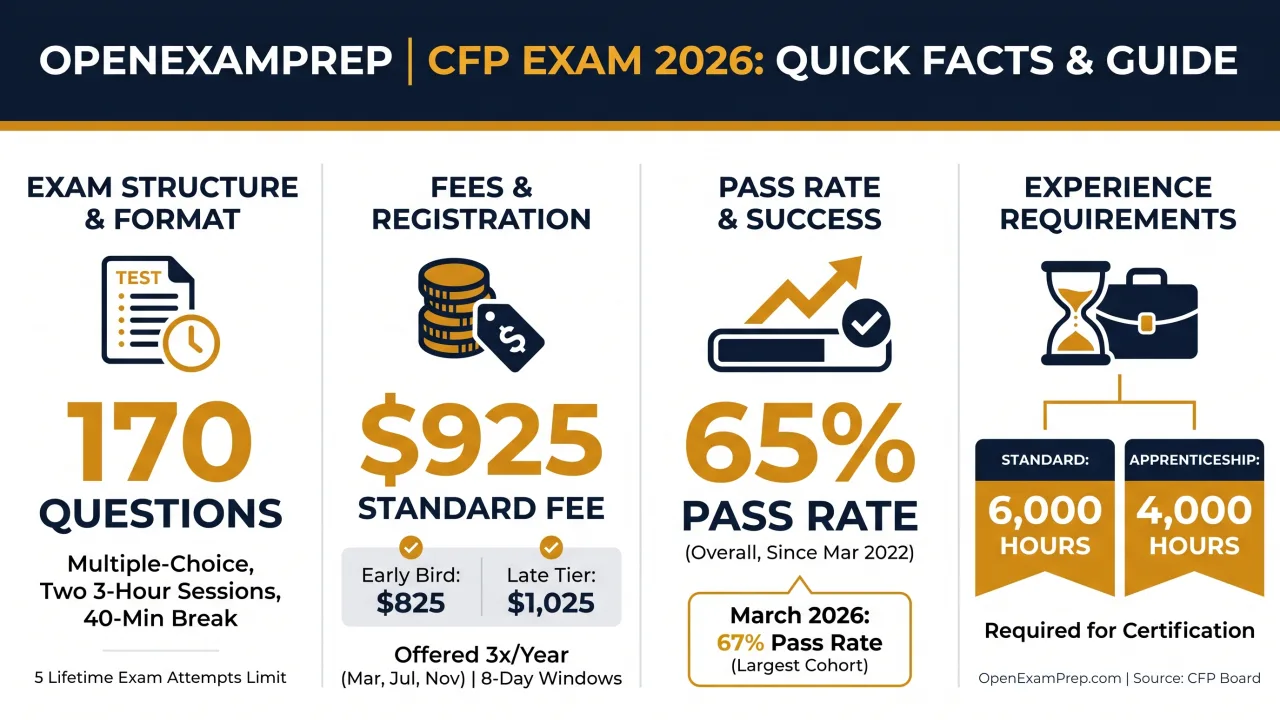
The Certified Financial Planner (CFP) certification is administered by the CFP Board and is the most recognized credential for financial planners in the United States. To use the CFP marks, you must complete CFP Board-registered coursework, pass the CFP exam, satisfy the experience requirement, and clear an ethics and background check. The exam itself is a single-day, computer-based test built around eight Principal Knowledge Domains and is offered three times a year during 8-day testing windows in March, July, and November.
This guide is the current 2026 snapshot: testing windows, fees, blueprint weights, scoring, retake policy, day-of logistics, and a study plan that fits the way the exam actually tests. Every numeric figure is verified against the official CFP Board candidate handbook and CFP Board pages on cfp.net.
CFP Exam At A Glance
| Component | Details |
|---|---|
| Administered by | CFP Board (cfp.net) |
| Delivery | Computer-based, Prometric (265+ U.S. centers) or remote proctoring |
| Questions | 170 multiple-choice (stand-alone, scenario, and case study) |
| Testing time | 6 hours (two 3-hour sessions of 85 questions each) |
| Appointment length | ~7 hours (includes check-in, tutorial, scheduled break) |
| Standard fee | $925 (Early Bird $825; Late $1,025) |
| Testing windows | March, July, November (8-day windows, 3x per year) |
| Scoring | Pass/fail, scaled, no published passing percentage |
| Recent pass rate | ~65% overall (March 2026 administration: 67%) |
| Retake limit | 5 lifetime attempts; max 3 in any 24-month period |
| Experience | 6,000 hours standard or 4,000 hours apprenticeship |
2026 Testing Windows and Registration Fees
The CFP exam is offered three times per year during 8-day testing windows in March, July, and November. Registration for each window opens about four months before the exam date and is split into three pricing tiers.
| Testing window | Registration opens | Education verification deadline |
|---|---|---|
| July 14-21, 2026 | Feb. 18, 2026 | Jun. 23, 2026 |
| Oct. 29 - Nov. 5, 2026 | Jun. 2, 2026 | Oct. 6, 2026 |
| Mar. 16-23, 2027 | Oct. 21, 2026 | Feb. 23, 2027 |
Early Bird ($825) runs from registration open until 6 weeks before the final registration deadline. Standard ($925) runs from then until the final week. Late Registration ($1,025) applies in the final week. CFP Board recommends registering at least 60 days in advance for the best test-center availability. Source: CFP Board - Upcoming Exam Dates & Registration.
Other fee rules worth knowing before you commit to a date:
- Postponement: $500 to move to a future window. One postponement per registration; you must pick one of the next two windows at the time you postpone.
- Withdrawal refund: $200 if you cancel completely.
- Failed scheduling: If you register but never schedule with Prometric by the withdrawal deadline, you are de-registered and hit with the $500 postponement fee.
Eight Principal Knowledge Domains
The CFP exam blueprints every one of its 170 questions to at least one of eight Principal Knowledge Topics. The current weights, verified against the CFP Board What You'll Be Tested On page and the July 2026 candidate handbook:
| # | Domain | Weight | Approx. questions |
|---|---|---|---|
| 1 | Professional Conduct and Regulation | 8% | 14 |
| 2 | General Principles of Financial Planning | 15% | 26 |
| 3 | Risk Management and Insurance Planning | 11% | 19 |
| 4 | Investment Planning | 17% | 29 |
| 5 | Tax Planning | 14% | 24 |
| 6 | Retirement Savings and Income Planning | 18% | 30 |
| 7 | Estate Planning | 10% | 17 |
| 8 | Psychology of Financial Planning | 7% | 11 |
| Total | 100% | 170 |
Three domains - Retirement (18%), Investment (17%), and General Principles (15%) - account for half of the exam. Psychology of Financial Planning was added in March 2022 as the eighth domain and is now firmly embedded in the blueprint. It covers client and planner attitudes, values, and biases; behavioral finance; sources of money conflict; principles of counseling; general principles of effective communication; and crisis events with severe consequences.
Exam Day Format
The exam is delivered in two 3-hour sessions, each containing 85 questions and split into two subsections. You may take an optional break between subsections and a scheduled 40-minute break between the two sessions. The full Prometric appointment lasts about 7 hours and includes check-in, security procedures, a 5-minute tutorial, and the scheduled lunch break.
The exam includes two case studies that each span several pages and typically carry 8-12 questions. Stand-alone, short scenario, and case study formats all appear, and many questions require you to integrate two or more domains - a single item might pull from tax, retirement, and estate planning at once.
Calculator policy is strict: only CFP Board-approved calculator models are allowed. Bring two forms of valid ID matching the name on your registration. Remote proctoring is available if you cannot reach a Prometric center; the same time limits and break rules apply.
Eligibility Pathway
CFP certification requires four gates: education, exam, experience, and ethics.
Education. A bachelor's degree (or higher) from an accredited institution plus completion of a CFP Board-Registered Education Program covering all Principal Knowledge Topics, including a Capstone course. You may register for and sit for the exam before finishing the bachelor's degree, but the degree must be conferred within five years of passing the exam.
Accelerated Path (Challenge Status). Holders of certain credentials - CFA, CPA, ChFC, CLU, CIMA (added in 2026), and approved advanced degrees - may skip the standard seven-course requirement and go straight to the Capstone. This is the fastest route for credentialed professionals switching into financial planning.
Experience. Choose one of two pathways:
- Standard Pathway: 6,000 hours of professional financial planning experience
- Apprenticeship Pathway: 4,000 hours under direct supervision of a CFP professional
Hours are counted at a 1:1 ratio up to 40 hours per week. You have up to five years after passing the exam to complete the requirement. Activities outside the personal financial planning process (corporate finance, training, marketing, software development, admin) do not count, and clients may not be immediate family members as defined by FINRA Rule 3240. Completing the FPA Residency Program adds 500 hours to your Standard Pathway total.
Ethics. Sign an ethics declaration, pass a background check, and agree to CFP Board's Code of Ethics and Standards of Conduct, which imposes a fiduciary duty when providing financial advice to a client.
Scoring and Pass Rates
The CFP exam is pass/fail. Each question is worth 1 point and the pass mark is set by a Modified Angoff psychometric process - CFP Board does not publish a numeric passing percentage. The widely repeated "70% to pass" is a candidate rule of thumb, not an official figure.
Preliminary pass/fail results appear on screen immediately after the exam. Official results arrive by email about 4-6 weeks after the testing window closes. Candidates who fail receive a diagnostic report showing relative strengths and weaknesses across the eight domains.
Recent pass rates:
| Administration | Overall pass rate |
|---|---|
| March 2026 | 67% (record cohort of 4,391 candidates) |
| November 2025 | ~64% overall; ~65% first-time |
| March 2023 | ~65% overall; ~69% first-time |
The overall pass rate has hovered around 65% since the current eight-domain blueprint took effect in March 2022. First-time takers typically pass at a slightly higher rate than the overall pool, because the overall pool includes retakers who failed at least once. Source: CFP Board Exam Statistics and the March 2026 results announcement.
Retake Policy
CFP Board caps exam attempts at 5 lifetime with no more than 3 attempts in any 24-month period. If you fail three times in 24 months, you must sit out three exam administrations before registering again. Each retake requires paying the full exam fee and retaking the entire 170-question exam - there is no partial retake, and you must wait until the next testing window to retake. Source: CFP Board Rescheduling & Cancellation Policies.
After You Pass: Certification Fee and CE
Passing the exam is not the last fee. Once you finish education, exam, experience, and ethics, you file a certification application with a non-refundable $250 application fee and pay a prorated $575 annual certification fee for your first cycle. After that, you pay the $575 annual fee each year and report 30 hours of continuing education every two years - 2 hours of CFP Board-approved Ethics CE plus 28 hours covering one or more Principal Knowledge Topics. Source: CFP Board Final Steps and CFP Board Renewal Policies.
For renewal cycles beginning in Q1 2027 or later, up to 10 CE hours can roll over to the next cycle. Earlier cycles do not allow rollover, and excess hours cannot be split between reporting periods.
Total Cost of CFP Certification
A realistic all-in budget for the CFP path:
| Component | Estimated cost |
|---|---|
| CFP Board-Registered Education Program | $2,000 - $5,000 |
| Capstone course | $500 - $1,000 |
| Exam fee (one standard attempt) | $925 |
| Prep materials / review course | $400 - $1,500 |
| Certification application fee | $250 |
| Initial certification fee (prorated) | ~$300 - $575 |
| Total | ~$4,000 - $9,000 |
Many employers reimburse part or all of the exam fee and prep costs. CFP Board's March 2026 post-exam survey found that 68% of candidates received some employer financial support on their CFP path. The application fee and annual certification fee are non-refundable and not discounted for retirees or Emeritus members.
2026 Content Updates To Know
For the July and November 2026 windows, CFP Board flagged tax-planning updates tied to the One Big Beautiful Bill Act (OBBBA) and related 2026 changes - new contribution limits, modified deduction rules, and adjusted estate and gift exemptions. These flow into Tax Planning (14%) and also appear inside case studies that touch Retirement, Estate, and General Principles.
Contribution limits, standard deduction amounts, gift and estate exclusions, and QBI / Section 199A rules all change year over year. When you study with published materials, confirm the edition matches your testing window. CFP Board publishes an OBBBA guide candidates should review before the exam.
Study Plan That Fits The Blueprint
Most successful candidates log 250-300 hours over 4-6 months, consistent with Kaplan's published study-time data. The exam rewards integration over memorization, so build your plan around the weighted domains and around mixed practice, not topic-isolated cramming.
A 16-18 week plan weighted by domain:
| Weeks | Focus | Hours |
|---|---|---|
| 1-2 | General Principles + Professional Conduct | 25-30 |
| 3-4 | Risk Management + Insurance Planning | 20-25 |
| 5-7 | Investment Planning (17% weight) | 35-40 |
| 8-9 | Tax Planning (use current-year limits) | 25-30 |
| 10-12 | Retirement Savings and Income Planning (18% weight) | 35-40 |
| 13-14 | Estate Planning | 20-25 |
| 15 | Psychology of Financial Planning + integration | 15-20 |
| 16-18 | Full-length practice exams + weak-area repair | 40-50 |
Use the free CFP Board Practice Exam. Your $925 registration includes one full-length, 170-question practice exam built from real retired CFP questions. It is the single best diagnostic you have - take it under timed conditions twice during your final four weeks.
Strategy For Case Studies and Scenario Items
The CFP exam is designed to test judgment, not recall. Scenario and case study items usually ask what you would do next, what you would recommend, or what changes a fact implies. A reliable sequence:
- Name the task in plain English. What is the question actually asking you to decide?
- Identify the controlling facts. Separate facts that change the answer from facts that describe the setting. A phrase such as "discretionary authority," "fiduciary," "Roth conversion," or "client objective" usually controls the answer even when the numbers look routine.
- Predict the principle before reading the choices. Even a rough prediction stops an attractive distractor from pulling you away from the rule.
- Compare remaining options against your role. Are you acting as the planner, supervisor, analyst, or applicant? The second-best choice often sounds reasonable for the wrong role.
- For "next action" questions, prefer the answer that preserves fiduciary duty, compliance, documentation, or client interest before jumping to a final recommendation.
For finance, securities, tax, and accounting candidates, the most expensive misses usually come from reading too quickly. If a prompt includes both a numerical detail and a conduct detail, decide which one controls the question before touching the answer choices. That discipline prevents a common trap: solving the math correctly while answering the wrong professional question.
Common Traps That Cost CFP Candidates Points
- Mixing tax years. 2025 limits, 2026 limits, and proposed future limits all appear in prep materials. Confirm the limit for your testing window before you memorize a number.
- Solving the math, answering the wrong question. A clean time-value-of-money or tax calculation still loses points if the question asked for the recommendation, not the number.
- Ignoring fiduciary framing. When two options are technically correct, the one that better serves the client under CFP Board's fiduciary standard usually wins.
- Over-studying one domain. Three domains make up 50% of the exam; zero in on Retirement, Investment, and General Principles - but do not let Psychology (7%) or Professional Conduct (8%) collapse, because ethics and conduct items appear inside case studies across every domain.
- Treating practice scores as the score. Use misses as diagnostic data. Tag each miss by cause (content gap, vocabulary gap, careless read, calculation setup, scenario judgment, or pacing) so your next study block is obvious. If you tag everything as "content gap," your remediation will be too broad.
- Skipping full-length timed practice. Six hours is a fatigue test. Run at least two full 170-question timed simulations before exam day so your pacing is rehearsed and your weak spots surface while there is still time to fix them.
Two-Week Readiness Plan
Two weeks before exam day, stop measuring progress by pages completed. Measure it by repeatable performance. Your target is not one lucky high score; it is several timed blocks where the same weak area no longer appears in your miss log.
Week 1: Run alternating blocks - one targeted weak-area set, one mixed timed set, one review block, and one short closed-book recall session. For recall, write definitions, formulas, procedures, rule triggers, and decision steps from memory, then check them against the official outline and your notes.
Final week: Reduce new material. Keep daily contact with the hardest topics, but shift toward confidence, pacing, and clean execution. Rework missed questions from your log, especially the ones you missed twice. Confirm administrative logistics: testing location or remote-proctor setup, identification, permitted materials, break policy, and calculator model. Those details are not content knowledge, but they can still disrupt performance if you handle them late.
When You Are Ready
You are ready for the CFP exam when you can explain each Principal Knowledge Domain without the outline, complete a 170-question timed block without rushing the last 20 items, articulate your miss patterns before checking the score report, and state what you will do if the first ten questions feel harder than expected. The answer to that last one should be simple: slow down, return to the task, identify the controlling fact, eliminate role-inconsistent options, and keep moving.
Passing is less about finding a secret resource and more about a tight loop: official source, focused study, timed practice, miss analysis, targeted repair. The free path below keeps that loop running.
-> Start FREE CFP Exam Prep | -> Free CFP Practice Questions
Official Sources
- CFP Board - Exam Requirement
- CFP Board - Upcoming Exam Dates & Registration
- CFP Board - What You'll Be Tested On
- CFP Board - Scoring and Results
- CFP Board - Exam Statistics
- CFP Board - Final Steps to Certification
- CFP Board - Renewal Policies
- CFP Board - Rescheduling and Cancellation Policies
- CFP Exam Candidate Handbook (PDF)

 Free CE
 Buy on Amazon
 Online course on Mometrix
 Take courses on Udemy
 Exam information on Achievable