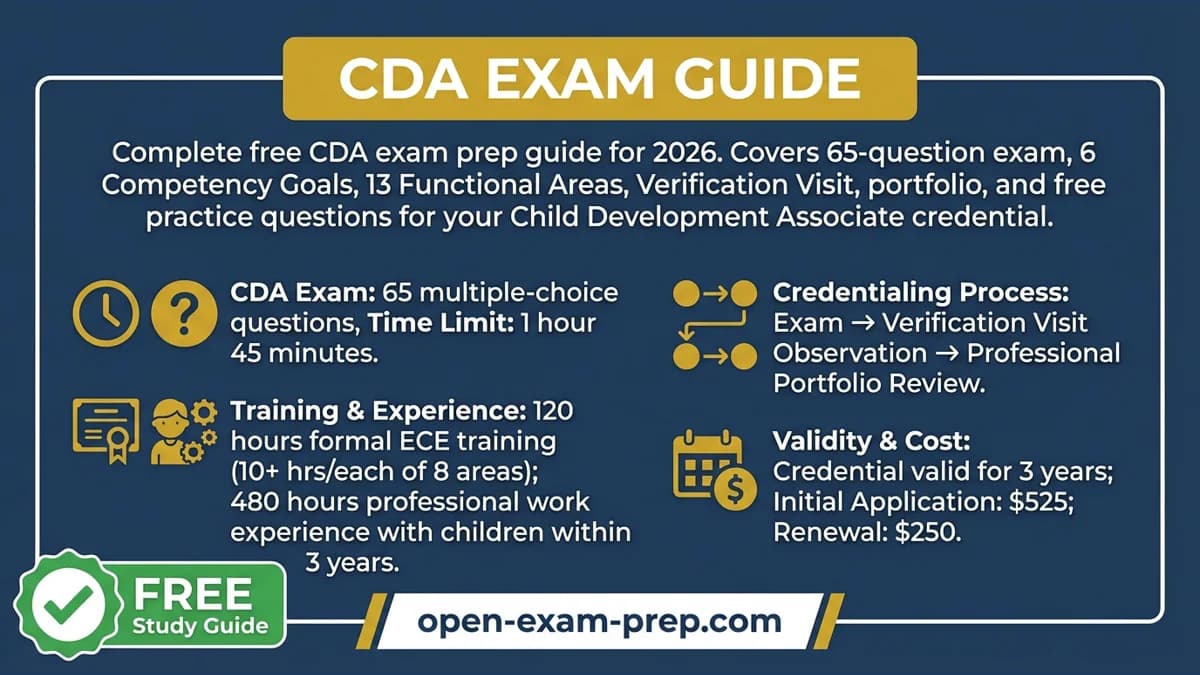
CDA Credential 2026: Your Complete Certification Guide
The CDA (Child Development Associate) Credential is the most widely recognized national credential in early childhood education (ECE). Issued by the Council for Professional Recognition, the CDA credential demonstrates your knowledge, skills, and abilities in working with young children from birth to age 5.
Whether you're starting your career in early childhood education or seeking to advance your professional standing, the CDA credential opens doors to lead teacher positions, director roles, and further educational opportunities.
Credential Overview
| Component | Details |
|---|---|
| Issuing Body | Council for Professional Recognition |
| Exam Questions | 65 multiple-choice questions |
| Exam Time | 1 hour 45 minutes (105 minutes) |
| Testing Vendor | Pearson VUE |
| Initial Application Fee | $525 |
| Renewal Fee | $250 |
| Credential Validity | 3 years |
The CDA credentialing process uses multiple sources of evidence to assess your competence:
- CDA Exam - 65 multiple-choice questions at a Pearson VUE testing center
- Verification Visit - Observation by a Professional Development (PD) Specialist
- Professional Portfolio - Documentation of your knowledge and practices
No single component decides the credential. The Council reviews your exam, your Verification Visit, and your portfolio together, then renders a credentialing decision. The Council does not publish a single passing percentage or cut score, so think of the exam as one of three evidence sources rather than a test you simply "pass" or "fail."
The 4-step assessment at a glance
| Step | What happens | Where |
|---|---|---|
| 1. Education & Experience | 120 training hours + 480 work hours documented | Self-paced, before applying |
| 2. Application | Online application + $525 fee submitted | YourCouncil portal |
| 3. CDA Exam | 65 questions, up to 1 hr 45 min, taken once | Pearson VUE test center |
| 4. Verification Visit | Observation + portfolio review + reflective dialogue | Your work setting |
You receive your credentialing decision within 15 business days of submitting your exam, provided your Verification Visit and portfolio are also complete.
Start Your FREE CDA Prep Today
Our comprehensive course covers all 6 Competency Goals and 13 Functional Areas - 100% FREE.
CDA Credential Types (Educator Pathways)
The Council offers four CDA credential settings based on your work environment:
Center-Based Infant-Toddler
For educators working with children ages birth to 36 months in center-based programs. Experience must include working with:
- Young infants (birth to 8 months)
- Mobile infants (9 to 17 months)
- Toddlers (18 to 36 months)
Center-Based Preschool
For educators working with children ages 3 to 5 years in center-based programs. Focuses on:
- Kindergarten readiness
- Social skill development
- Play-based learning foundations
Family Child Care
For providers caring for children birth to 5 years in a home-based setting. Acknowledges the unique aspects of:
- Mixed-age group care
- Home environment adaptations
- Family-style interactions
Home Visitor
For professionals who visit families in their homes to support child development and parent education.
The 6 CDA Competency Goals & 13 Functional Areas
The CDA credential is based on 6 Competency Goals organized into 13 Functional Areas. These form the foundation of the exam and verification process:
Goal I: To Establish and Maintain a Safe, Healthy Learning Environment
Functional Areas:
- 1. Safe - Providing a safe environment to prevent and reduce injuries
- 2. Healthy - Promoting good health and nutrition, preventing illness
- 3. Learning Environment - Organizing and using space for children's play, exploration, and learning
Goal II: To Advance Physical and Intellectual Competence
Functional Areas:
- 4. Physical - Providing activities for gross and fine motor development
- 5. Cognitive - Providing activities that encourage curiosity, exploration, and problem-solving
- 6. Communication - Promoting language and literacy development
- 7. Creative - Providing opportunities for creative expression through art, music, movement, and dramatic play
Goal III: To Support Social and Emotional Development and Provide Positive Guidance
Functional Areas:
- 8. Self - Helping children develop positive self-concepts and independence
- 9. Social - Helping children develop social skills and respect for others
- 10. Guidance - Providing positive guidance to help children learn appropriate behaviors
Goal IV: To Establish Positive and Productive Relationships with Families
Functional Areas:
- 11. Families - Maintaining open, collaborative relationships with families and encouraging involvement
Goal V: To Ensure a Well-Run, Purposeful Program Responsive to Participant Needs
Functional Areas:
- 12. Program Management - Using observation, documentation, and planning to support children's development
Goal VI: To Maintain a Commitment to Professionalism
Functional Areas:
- 13. Professionalism - Maintaining ethical standards, continuing professional growth, and advocating for children and families
8 CDA Subject Areas (Training Requirements)
Your 120 hours of training must cover at least 10 hours in each of these 8 subject areas:
| Subject Area | Topics Covered |
|---|---|
| 1. Planning a Safe and Healthy Learning Environment | Safety practices, health promotion, nutrition, emergency procedures |
| 2. Advancing Children's Physical and Intellectual Development | Motor skills, cognitive activities, STEM concepts |
| 3. Supporting Children's Social and Emotional Development | Self-esteem, social skills, emotional regulation |
| 4. Building Productive Relationships with Families | Communication, family engagement, cultural responsiveness |
| 5. Managing an Effective Program Operation | Record-keeping, scheduling, assessment practices |
| 6. Maintaining a Commitment to Professionalism | Ethics, professional growth, advocacy |
| 7. Observing and Recording Children's Behavior | Observation methods, documentation, developmental screening |
| 8. Understanding Principles of Child Development and Learning | Developmental milestones, learning theories, DAP principles |
Free Practice Questions & Study Materials
Take the FREE CDA Practice Test (200+ questions) - no signup required, instant explanations.
Start the FREE CDA Study Guide - chapter-by-chapter coverage of all 13 Functional Areas.
Our free CDA prep includes:
- 200+ realistic CDA practice questions with scenario items, just like the exam
- Detailed explanations for every answer
- Key takeaways for quick review
- AI-powered study assistance (10 free AI questions per day)
CDA Credential Requirements
Education Requirements
| Requirement | Details |
|---|---|
| High School Education | High school diploma, GED, or current junior/senior in HS career program |
| Formal Training | 120 clock hours of formal ECE training |
| Training Distribution | Minimum 10 hours in each of 8 subject areas |
| Training Sources | Accredited institutions, agencies with ECE expertise (not independent consultants or conferences) |
Converting Credits to Hours:
- 1 CEU = 10 clock hours
- 1 Semester Credit = 15 clock hours
- 1 Quarter Credit = 10 clock hours
Experience Requirements
| Requirement | Details |
|---|---|
| Total Hours | 480 hours of professional work experience |
| Timeframe | Within 3 years of application |
| Setting | Must match your chosen CDA credential type |
| Types Accepted | Paid or volunteer work |
Non-Eligible Experience:
- Babysitting
- Before and After School Programs
- Sunday school programs
- Drop-in programs
The CDA Exam
Exam Format
The CDA Exam is a computer-based test taken at a Pearson VUE testing center. All 65 questions are multiple choice: 60 standard knowledge questions plus 5 photo-and-scenario questions that show a classroom image with a short story and ask you to choose the best response.
| Component | Details |
|---|---|
| Questions | 65 multiple-choice (60 standard + 5 photo/scenario) |
| Time Limit | Up to 1 hour 45 minutes (105 minutes) |
| Languages | English or Spanish (chosen on your Sign Up Form) |
| Question Types | Knowledge-based and photo/scenario-based |
| Content | Based on 6 Competency Goals and 13 Functional Areas |
| Scoring | Evaluated across functional areas; no published cut score |
| Retakes | The exam may be taken only one time |
Two Exam Versions by Age Group
The Council gives you the exam that matches the credential setting you applied for:
- CDA Exam: Children 0-5 - for Preschool and Family Child Care candidates
- CDA Exam: Children 0-3 - for Infant/Toddler candidates
Home Visitor candidates receive the exam aligned with the age group they serve. Study the developmental content for the exact ages your version covers.
What Exam Day Looks Like
- Arrive 15 minutes early with a valid photo ID - late arrivals may forfeit the exam and the fee (no refunds).
- Store your belongings - you bring nothing into the room; a dry-erase board is provided for notes.
- 15-minute orientation - review instructions, agree to the Nondisclosure Agreement, and answer 3 practice clicks before the clock starts.
- One question at a time - move forward and back, change answers, and flag uncertain items for the review screen at the end.
- Time warnings - the computer alerts you at 30 minutes and 10 minutes remaining.
- Answer everything - unanswered (incomplete) questions are marked wrong, so guess rather than leave blanks.
- Submit and confirm - answers transmit to the Council immediately; keep the printed confirmation with your Candidate ID. Submitting feedback through the official survey earns a $50 Thank You Gift.
Rescheduling note: You can cancel or reschedule through Pearson VUE more than 24 hours in advance, but each cancellation costs a $15 fee (credit card only). You must complete the exam by the deadline in your Ready to Schedule notice.
Exam Preparation Tips
- Study the CDA Competency Standards Book - Required purchase for all candidates
- Review all 13 Functional Areas - Understand how they apply in practice
- Practice with scenarios - Many questions present classroom situations
- Focus on developmentally appropriate practice (DAP) - Key concept throughout
- Know child development milestones - Birth through age 5
The Verification Visit
The Verification Visit is conducted by a Council-approved Professional Development (PD) Specialist and includes three components:
1. Observation
The PD Specialist observes you working directly with children in your setting to evaluate:
- Your interactions with children
- Implementation of DAP principles
- Application of the Competency Standards
- Classroom management and environment
2. Portfolio Review
The PD Specialist reviews your Professional Portfolio, which includes:
Resource Collection:
- Materials demonstrating knowledge of child development best practices
- Activity ideas for each Competency Goal
Competency Statements:
- Written statements for each of the 6 Competency Goals
- Reflection on how you meet each standard
Professional Philosophy Statement:
- Your beliefs about teaching and child development
- Your approach to working with children and families
3. Reflective Dialogue
A conversation with the PD Specialist about:
- Your teaching philosophy
- Your understanding of ECE principles
- Your professional goals
- Reflection on your practice
5 Steps to Earn Your CDA Credential
Step 1: Prepare
- Complete 120 hours of formal ECE training
- Accumulate 480 hours of work experience
- Purchase CDA Competency Standards book
Step 2: Apply
- Create account at YourCouncil (cdacouncil.org/yourcda)
- Complete online application
- Pay $525 application fee
Step 3: Demonstrate
- Compile your Professional Portfolio
- Prepare for observation in your work setting
Step 4: Complete Assessment
- Take the CDA Exam at Pearson VUE (after your Ready to Schedule notice)
- Complete the Verification Visit with your PD Specialist
- Finish both by the deadline stated in your Ready to Schedule notice (commonly within 6 months)
Step 5: Receive Credential
- Council reviews all assessment components together
- Credentialing decision is rendered within 15 business days of exam submission
- CDA Credential awarded (valid for 3 years)
Study Timeline for CDA Success
| Week | Focus | Activities |
|---|---|---|
| 1-2 | Foundation | Safe/Healthy environments, Learning Environment setup |
| 3-4 | Development | Physical, Cognitive, Communication, Creative development |
| 5-6 | Social-Emotional | Self-concept, Social skills, Positive guidance |
| 7-8 | Relationships | Family engagement, Program management |
| 9-10 | Professionalism | Ethics, advocacy, portfolio preparation |
| 11-12 | Final Review | Practice tests, mock observation, portfolio completion |
Recommended: 100-150 hours total preparation
Test-Taking Strategies
For the CDA Exam
- Read scenarios carefully - Look for key details about the child's age and situation
- Choose developmentally appropriate answers - DAP is foundational to CDA
- Prioritize child safety - Safety is always the first consideration
- Consider family partnerships - Involving families is essential
- Think positive guidance - Focus on teaching rather than punishment
- Apply cultural responsiveness - Respect diverse backgrounds
For the Verification Visit
- Prepare your environment - Ensure your classroom reflects best practices
- Organize your portfolio - Make it easy to navigate
- Practice your philosophy statement - Be ready to articulate your beliefs
- Be natural with children - Show your authentic teaching style
- Reflect on your practice - Be prepared to discuss what you do and why
Career Advancement: CDA to Higher Credentials
The CDA credential is a stepping stone to career advancement in early childhood education:
| Path | Duration | Details |
|---|---|---|
| CDA to Associate Degree | 2 years | Associate's in ECE (CDA credits may transfer) |
| CDA to Bachelor's Degree | 4 years | BA/BS in Early Childhood Education |
| CDA to Director Credential | Varies | National Administrator's Credential (NAC) |
| CDA to State Credentials | Varies | State-specific teaching certifications |
Career Positions with CDA
| Position | Description |
|---|---|
| Lead Teacher | Plan curriculum, manage classroom, guide assistant teachers |
| Assistant Teacher | Support lead teacher, work directly with children |
| Family Child Care Provider | Own and operate home-based child care |
| Head Start Teacher | Work in federally funded early childhood programs |
| Center Director | Oversee entire child care program (may require additional credentials) |
CDA Credential Renewal
Your CDA is valid for 3 years. To renew:
| Requirement | Details |
|---|---|
| Application Window | 90 days before expiration |
| Renewal Fee | $250 |
| Continuing Education | 45 hours (4.5 CEUs) of ECE training |
| Work Experience | 80 hours working with children |
Is the CDA Exam Hard? What to Expect
Most candidates who completed the full 120 hours of training and have real classroom experience find the CDA Exam manageable. The questions are practical, not academic: they ask how you would respond to everyday situations with children, not how to recite child-development theory. If you can choose the developmentally appropriate, safety-first, family-friendly response, you are in good shape.
Where candidates stumble:
- Overthinking scenarios - the "textbook best practice" answer is almost always correct; avoid reading in exceptions.
- Choosing punishment over guidance - the CDA framework favors teaching appropriate behavior, never shaming or punishing.
- Forgetting age context - an answer that fits a 4-year-old may be wrong for an 18-month-old; check the child's age in every scenario.
- Leaving blanks - unanswered questions count as wrong, so always guess.
Because the exam can be taken only once per assessment cycle, prepare thoroughly the first time. Work through a full bank of practice scenarios, review the 13 Functional Areas, and you remove most of the surprise from test day.
Pass the CDA Exam with Confidence
Begin Your FREE CDA Journey Now | Practice 200+ CDA Questions
Join thousands of early childhood educators who earned their CDA credential using our comprehensive, 100% FREE study materials. Our course includes:
- Complete coverage of all 6 Competency Goals and 13 Functional Areas
- Scenario-based practice questions mirroring the actual exam
- AI-powered study assistance for instant explanations
- Regularly updated for 2026 credentialing requirements
No credit card required. Start studying today.

 Free CE
 Buy on Amazon
 Practice exams on ExamEdge