 View
ViewWho This Guide Is For (Read This First)
Two very different readers search for a welding helmet with a certification in mind, and most buying guides quietly conflate them.
If you are the one welding under test, you are sitting a welder performance qualification to a code such as AWS D1.1 Clause 4 or ASME Section IX. You weld a coupon, in a specified position, under supervision, and it gets bent, broken, or radiographed. Your helmet is on your face for the entire test, and every arc start you fumble because you could not see the joint is a defect the examiner may find later.
If you are pursuing the AWS Certified Welding Inspector credential, you will not strike a single arc. AWS delivers CWI Part A (Fundamentals) and Part C (Code Application) as computer-based tests at Prometric, and Part B is a hands-on practical built around a four-piece plastic weld replica set and an inspection tool kit -- fillet weld gauges, a V-WAC gauge, dial caliper, hi-lo gauge, protractor, mirror, and flashlight -- all supplied by AWS on test day. You do not need a welding helmet to sit the CWI exam.
A helmet still matters to an inspector, for two reasons. You will spend a career standing beside live arcs, where you are an exposed observer rather than the welder. And Safety is one of the AWS-listed Part A content areas, so filter shade selection, ANSI Z87.1, and arc radiation are examinable material, not just shop-floor trivia.
This guide is written to serve both readers honestly: the shade and standards sections are the exam-relevant material, and the helmet recommendations are for the person who actually welds.
On prices: every price in this guide was pulled from Amazon's product API on 2026-08-04. Welding helmet prices move constantly and often by large amounts. Treat them as tiers, not quotes, and check the live listing before you buy.
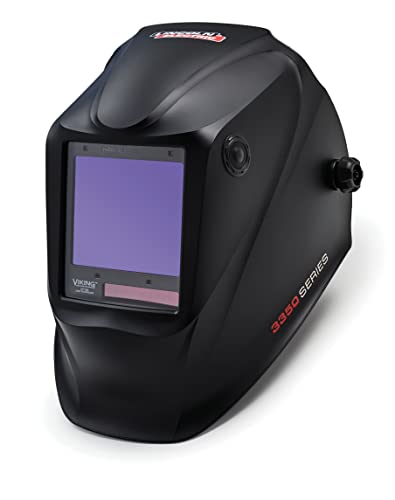
Lincoln Electric K3034-4 VIKING 3350 Auto Darkening Welding Helmet with 4C Lens Technology
by Lincoln Electric
$407.95
- 12.5 sq in viewing area with 1/1/1/1 optical clarity and Lincoln 4C true-color lens technology
- Variable shade 5-13, four arc sensors, 1/25,000-second switching, and a 2-amp TIG sensor rating
- Lightest hood here at 595 g, X6 headgear, and Lincoln's 5-year warranty with easy parts availability
The Short Answer
| If you are... | Buy | Why |
|---|---|---|
| Welding daily as a professional | Lincoln VIKING 3350 | Best headgear and shell in this group, 12.5 sq in of 1/1/1/1 optics, 2-amp TIG sensor rating, 5-year warranty |
| Wanting a real brand without pro pricing | ESAB Savage A40 | External glove-friendly grind button, four sensors, 500 g, backed by a major welding manufacturer |
| Testing out of position on a budget | YESWELDER LYG-M800H | Four sensors and a 14.4 sq in window -- physically larger than the VIKING -- at roughly an eighth of the price |
| Working in a badly lit shop | ARCCAPTAIN large view | Same large window plus a clip-on USB work light for seeing joint prep before you drop the hood |
| Buying your first hood on the cheapest budget | YESWELDER LYG-L600A | Genuine 1/1/1/1 optics with listed ANSI Z87.1 and CSA Z94.3 compliance for under $40 |
Shade Selection: The Part Where Getting It Wrong Actually Hurts
Filter shade is not a preference. In the United States it is regulated. OSHA 29 CFR 1910.133 Table I-5 sets minimum protective shade numbers, and this is the table an inspector or a safety officer will hold you to.
OSHA 1910.133 Table I-5 minimum protective shades
| Operation | Electrode size / plate | Arc current | Minimum shade |
|---|---|---|---|
| Shielded metal arc (stick) | Under 3/32 in. | Under 60 A | 7 |
| Shielded metal arc (stick) | 3/32 - 5/32 in. | 60 - 160 A | 8 |
| Shielded metal arc (stick) | 5/32 - 1/4 in. | 160 - 250 A | 10 |
| Shielded metal arc (stick) | Over 1/4 in. | 250 - 550 A | 11 |
| Gas metal arc (MIG) and flux-cored | -- | Under 60 A | 7 |
| Gas metal arc (MIG) and flux-cored | -- | 60 - 160 A | 10 |
| Gas metal arc (MIG) and flux-cored | -- | 160 - 250 A | 10 |
| Gas metal arc (MIG) and flux-cored | -- | 250 - 500 A | 10 |
| Gas tungsten arc (TIG) | -- | Under 50 A | 8 |
| Gas tungsten arc (TIG) | -- | 50 - 150 A | 8 |
| Gas tungsten arc (TIG) | -- | 150 - 500 A | 10 |
| Air carbon arc cutting (light) | -- | Under 500 A | 10 |
| Air carbon arc cutting (heavy) | -- | 500 - 1000 A | 11 |
| Plasma arc welding | -- | Under 20 A | 6 |
| Plasma arc welding | -- | 20 - 100 A | 8 |
| Plasma arc welding | -- | 100 - 400 A | 10 |
| Plasma arc cutting (light) | -- | Under 300 A | 8 |
| Plasma arc cutting (medium) | -- | 300 - 400 A | 9 |
| Carbon arc welding | -- | -- | 14 |
| Torch brazing | -- | -- | 3 |
| Torch soldering | -- | -- | 2 |
| Gas welding (light / medium / heavy) | Under 1/8 in. / 1/8-1/2 in. / over 1/2 in. | -- | 4 / 5 / 6 |
| Oxygen cutting (light / medium / heavy) | Under 1 in. / 1-6 in. / over 6 in. | -- | 3 / 4 / 5 |
Minimum is not the same as recommended
OSHA publishes a minimum. AWS Z49.1, Safety in Welding, Cutting, and Allied Processes, publishes a second column of suggested shades for comfort, typically two to four numbers darker than the OSHA floor -- for example, minimum 8 but suggested 10 for TIG under 50 A, and minimum 10 but suggested 12 for stick at 160-250 A.
The working method: start at the AWS suggested shade, then step lighter one number at a time only until the puddle is genuinely readable, and never go below the OSHA minimum. A shade that is too dark hides the toe of the weld and the leading edge of the puddle, which quietly costs you bead control. A shade that is too light is an injury.
The shade 5 trap
Marketing copy -- including, until this revision, an earlier version of this article -- likes to say that a shade 5 setting is for "low-amperage TIG." It is not. OSHA's minimum for gas tungsten arc welding is shade 8, even below 50 amps. The shade 5 through 8 band on a wide-range helmet exists for plasma cutting, oxyfuel operations, and torch work, which OSHA lists between shades 3 and 8.
What genuinely makes a helmet good for delicate TIG is a completely different specification: the low-amp sensor rating, the faintest arc the sensors will reliably detect. Lincoln rates the VIKING 3350 at 2 amps AC or DC. That number, not the presence of shade 5 on the dial, is what stops the lens failing to darken on a whisper-thin arc.
What the Safety Markings Mean in 2026
Standards moved recently, and most helmet listings have not caught up. Here is the current state of play.
ANSI/ISEA Z87.1: the 2025 edition is now current
The Vision Council announced publication of ANSI/ISEA Z87.1-2025 on January 9, 2026, superseding Z87.1-2020 after a five-year revision process. The changes are mostly clarifying rather than structural: a cross-reference to ANSI/ISEA Z87.62-2021 for blood and infectious-material splash, expanded marking requirements including prescription lens carriers, and tightened language around impact testing, lens haze, and minimum coverage.
Here is the wrinkle nobody mentions: OSHA has not caught up either. 29 CFR 1910.133 incorporates by reference ANSI/ISEA Z87.1-2010, ANSI Z87.1-2003, and ANSI Z87.1-1989 (R-1998). A helmet marked to any of those editions is compliant with the regulation as written. So a Z87.1-2010 marking on a helmet is not a sign the product is obsolete -- it is a sign the manufacturer marked it to the edition OSHA actually cites.
What Z87.1 requires of a welding helmet
- Impact resistance. Basic impact is a 1-inch steel ball dropped from 50 inches. High-velocity impact uses a quarter-inch steel ball, at a test velocity set by protector class -- 150 ft/s for spectacles and rising to 300 ft/s for face-protector classes. Products passing the high-velocity test carry a + in the marking.
- Optical radiation filtering. The filter must attenuate ultraviolet and infrared to specified limits. Crucially, in an auto-darkening cartridge this filtering is passive and permanent -- present in the light state, the dark state, and even with a dead battery.
- Marking. Look for the manufacturer's mark plus Z87 or Z87+, and a W followed by the shade number for welding filters.
- Coverage. The helmet must shield the eyes and face from optical radiation, heat, and impact, and Z87.1's own guidance notes that a welding helmet is not intended as a stand-alone impact protector -- safety glasses go on underneath.
CSA Z94.3 (Canada)
If you work or test in Canada, look for CSA Z94.3. Most mid-range and premium helmets carry both markings, and so does the sub-$40 YESWELDER in this guide.
EN 379 no longer exists
This is the one that surprises people. EN 379:2003+A1:2009, the European standard for auto-darkening welding filters and the origin of the four-digit optical rating, has been withdrawn. It was replaced by EN ISO 16321-2:2021, part of a suite (EN ISO 16321-1:2022 and -3:2022) that also retired EN 166, EN 169, EN 170, EN 171, EN 172, and EN 175. Per BSI, the presumption of conformity for products certified to EN 166 ended on 11 November 2025.
Helmets still printing "EN 379" on the box in 2026 -- including several in this guide -- are quoting a withdrawn standard. That is not a safety problem. It tells you the marketing copy is old, and it means the four-digit optical rating is now a legacy manufacturer spec rather than a live certification.
What 1/1/1/1 Actually Measures
The four digits each score one property from 1 (best) to 3 (worst):
| Position | Property | What a "1" buys you |
|---|---|---|
| 1st | Optical class | Minimal distortion and refractive error, so the puddle is where it looks |
| 2nd | Diffusion of light | Minimal haze and scatter, so the image is sharp rather than milky |
| 3rd | Luminous transmittance variation | Even shading edge to edge, with no light or dark patches |
| 4th | Angle dependence | Shade holds steady when you view the lens off-axis, as you do overhead |
1/1/1/2 is not a downgrade worth avoiding
ESAB rates the Savage A40 at 1/1/1/2 -- the same class as its premium Sentinel line -- and is unusually candid about why. In ESAB's own product announcement, the company states that helmets at this class "offer a sharp, clear, and consistent view of the weld puddle without the extra cost to obtain the angle dependency 1 rating, a difference that most operators find difficult to perceive."
That is a manufacturer arguing against its own upsell, and it is worth believing. Miller's Digital Elite is also 1/1/1/2. Meanwhile a $34 YESWELDER carries 1/1/1/1. The optical rating alone does not rank helmets, and anyone telling you 1/1/1/1 is a hard requirement is reading a spec sheet, not welding.
Specs That Matter, and Specs That Are Marketing
Switching speed is the most oversold number in the category
Current helmets cluster between 1/23,000 and 1/30,000 of a second, and the ranking does not track price at all:
| Helmet | Approximate tier | Switching speed |
|---|---|---|
| YESWELDER LYG-L600A | Under $40 | 1/30,000 s |
| YESWELDER LYG-M800H | Around $50 | 1/30,000 s |
| ARCCAPTAIN large view | Around $55 | 1/25,000 s |
| ESAB Savage A40 | Around $145 | 0.07 ms (about 1/14,000 s) |
| Lincoln VIKING 3350 | Around $400 | 1/25,000 s |
| Miller Classic Series | Mid-tier | 1/23,000 s |
The cheapest helmets in this guide are the fastest on paper. More to the point: because the UV and IR filtering is permanent and independent of the electronics, switching speed governs how much visible glare reaches your eye in the instant after arc strike. It is a comfort and afterimage specification, not your ultraviolet dose. Any helmet in this range is hundreds of times faster than a blink. Stop shopping on this number.
Specs that genuinely differentiate
- Arc sensor count. Two is fine flat and horizontal. Four matters out of position, where your body or the workpiece can shadow a sensor and delay the lens. Qualification tests run 3G, 4G, and 6G, so four sensors is the right default for anyone testing.
- Viewing area, in square inches. Marketing quotes inches; do the multiplication. The VIKING's 3.74 x 3.35 in window is 12.5 sq in. The YESWELDER LYG-M800H's 3.93 x 3.66 in window is about 14.4 sq in -- genuinely larger than the $400 helmet. The LYG-L600A's 3.64 x 1.67 in window is about 6.1 sq in, less than half.
- Weight. The VIKING is 595 g and the Savage A40 is 500 g. Cheap large-view hoods often run heavier, and a few hundred grams is the difference between a comfortable afternoon and neck strain that shows up in your bead.
- Light-state shade. Lower means you see more between welds. The VIKING sits at DIN 3.5, the ARCCAPTAIN at 4, the LYG-L600A at 3.5, and Miller's Classic at 3.0.
- Warranty and parts. Lincoln lists a five-year warranty on the VIKING 3350 and stocks cover lenses, sweatbands, and headgear everywhere. Budget brands vary, and a hood you cannot get a cover lens for is a disposable hood.
- Grind mode control location. An external button you can hit with a glove on is a real workflow gain over an internal switch you have to lift the hood to reach.
The Five Helmets
1. Lincoln Electric VIKING 3350 -- Best Overall
Verified specifications (Lincoln VIKING 3350 Series 4 specification sheet): variable shade 5-13; grind/light state DIN 3.5, internal control; 4 arc sensors; switching 1/25,000 s; delay 0.1-1.0 s; view size 95 x 85 mm (3.74 x 3.35 in, 12.5 sq in); optical clarity 1/1/1/1 with 4C lens technology; TIG rating 2 A AC/DC; weight 595 g; solar plus one CR2450 battery; X6 headgear fitting hat sizes 6-1/2 to 8; Lincoln lists a 5-year warranty.
The 4C lens is the real reason people stay with this helmet. It widens the visible color range in both light and dark states, so the base metal, arc, and puddle look like themselves instead of like a green photograph. Over a long session that reads as less eye strain, and on a multi-pass joint it makes the toe of the previous bead easier to find.
A correction to the common claim: the standard VIKING 3350 does not have an external grind button. Lincoln's specification sheet lists grind mode as DIN 3.5 with internal control. External grind control belongs to the VIKING 3350 ADV (K3034-5), which also steps up to five sensors and an internal digital interface. If a glove-friendly external grind button is what you want, the ESAB Savage A40 below has one for a third of the money.
Honest limitations. It is by far the most expensive helmet here and the price has been climbing. Its 12.5 sq in window is smaller than two sub-$60 helmets in this guide. And the analog interface, which many welders prefer for its simplicity, gives you fewer memory settings than digital rivals.
Buy it if you weld most days and the helmet is a tool you will own for a decade. The shell, the X6 headgear, the parts pipeline, and the five-year warranty are what your money is buying -- not the optical rating, which you can get for $34.
Lincoln Electric K3034-4 VIKING 3350 Auto Darkening Welding Helmet with 4C Lens Technology
by Lincoln Electric
$407.95
- 12.5 sq in viewing area with 1/1/1/1 optical clarity and Lincoln 4C true-color lens technology
- Variable shade 5-13, four arc sensors, 1/25,000-second switching, and a 2-amp TIG sensor rating
- Lightest hood here at 595 g, X6 headgear, and Lincoln's 5-year warranty with easy parts availability
2. ESAB Savage A40 -- Best Mid-Range
Verified specifications (ESAB Savage A40 fact sheet): viewing area 100 x 50 mm (3.93 x 1.96 in, about 7.7 sq in); lens shade DIN 9-13 automatic; shade 4 grind mode on an externally activated button; optical classification 1/1/1/2; 4 sensors; switch time light-to-dark 0.07 ms at 23 C, dark-to-light 0.1-0.9 s; solar cell plus one replaceable CR2450 with low-battery alert; weight 500 g (1.1 lb); 3-point adjustable headgear with an optional hard hat adapter; standards ANSI Z87.1, CSA Z94.3, AS/NZS 1338.1, and CE EN175/EN379.
This is the helmet that was missing from the previous version of this guide, which jumped straight from $55 hoods to a $400 one. The Savage A40 is the honest middle: a major welding manufacturer's product, four sensors, the lightest shell in the group, and an external grind button ESAB explicitly designed to be operated with a heavy glove on.
Honest limitations. The window is the smallest of the large-brand options here at about 7.7 sq in -- it is a wide letterbox rather than a big square, and if maximum field of view is your priority, the budget large-view hoods beat it outright. The shade range starts at 9, so it does not cover plasma or oxyfuel work the way a 5-13 helmet does. Shade adjustment on this variant is internal. And the optical class is 1/1/1/2, which ESAB will happily tell you that you cannot perceive.
Buy it if you want a real brand, real parts availability, and a glove-friendly grind button, and you mostly run stick, MIG, and TIG in the shade 9-13 band.

ESAB 0700000480 Black Savage A40 Auto-Darkening Welding Helmet
by ESAB
$143.03
- Externally activated shade-4 grind button you can hit with a heavy glove on, without lifting the hood
- Shade 9-13 with four arc sensors and 0.07 ms light-to-dark switching in a 500 g shell
- Optical class 1/1/1/2 - ESAB trades the top angle-dependence score for a mid-tier price
3. YESWELDER LYG-M800H Large View -- Best Value for Out-of-Position Work
Verified specifications (manufacturer listing): shade 3/5-9/9-13 across three bands; viewing area 3.93 x 3.66 in (about 14.4 sq in); 1/1/1/1 optical clarity with true color and a blue-light-blocking outer lens; 4 arc sensors; switching 1/30,000 s; adjustable sensitivity and delay; solar panel plus replaceable CR2450; reinforced PP shell with pivoting headgear.
This is the value pick of the entire guide. It has more viewing area than the VIKING 3350, the same four-sensor count, the same 1/1/1/1 optical rating, and a faster listed switching speed, at roughly an eighth of the price. The three-band shade layout is genuinely useful: 3 for grinding, 5-9 for cutting, 9-13 for welding.
Honest limitations. The PP shell and headgear are not in the same class as Lincoln's or ESAB's -- expect more flex and less refined adjustment. Long-term parts availability is weaker. And no budget brand has a decade of field data behind it the way Lincoln does.
Buy it if you are working toward a qualification test that includes 3G, 4G, or 6G positions and you would rather put the difference into filler metal, coupons, and shop time.
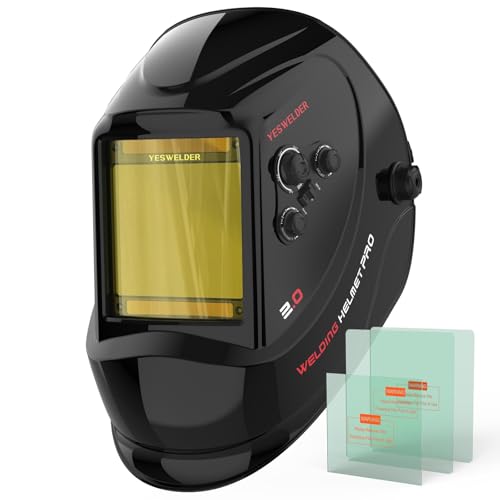
YESWELDER Auto Darkening Welding Helmet, Large View, LYG-M800H
by YESWELDER
$51.99
- 3.93 by 3.66 inch window - about 14.4 sq in, larger than the VIKING 3350's 12.5 sq in
- 1/1/1/1 optical clarity with four arc sensors and 1/30,000-second switching
- Three-band shade 3/5-9/9-13 covers grinding, cutting, and welding on one helmet
4. ARCCAPTAIN Large View with LED Light -- Best for Dark Shops
Verified specifications (manufacturer listing): shade 4/5-8/9-13; viewing area 3.94 x 3.66 in (about 14.4 sq in); 1/1/1/1 optical clarity with true color; 4 premium arc sensors; switching 1/25,000 s; two front solar panels plus a CR2450 lithium battery; permanent DIN 16 UV/IR filtering; PP shell weighing about 1 lb; two-brightness USB-powered LED work light.
The LED is the differentiator, and it earns its place if you work inside enclosures, under structures, or in a shop with bad overhead lighting. Being able to actually see your joint prep and your tacks before you drop the hood improves the first inch of every weld.
Honest limitation worth stating plainly: ARCCAPTAIN's own listing notes that the welding light comes uninstalled and has to be attached -- it is a clip-on USB accessory, not an integrated fixture. It takes about a minute, but if you were expecting a factory-built light, that is the reality. ARCCAPTAIN is also the newest brand here, with the least long-term durability data.

ARCCAPTAIN Auto Darkening Welding Helmet with Light, 3.94 x 3.66 in Large View
by ARCCAPTAIN
$54.99
- USB-powered two-level LED work light for dark shops - ships uninstalled and clips on in a minute
- 3.94 by 3.66 inch view with 1/1/1/1 true color, four arc sensors, and 1/25,000-second switching
- Shade 4/5-8/9-13 with permanent DIN 16 UV and IR filtering, about 1 lb on the head
5. YESWELDER LYG-L600A -- Cheapest Genuine 1/1/1/1
Verified specifications (manufacturer listing): shade 3.5/9-13; viewing area 3.64 x 1.67 in (about 6.1 sq in); 1/1/1/1 optical clarity with blue-light-blocking outer lens; 2 arc sensors; switching 1/30,000 s; adjustable sensitivity and delay; thickened PP shell; solar panel plus replaceable CR2450; listed compliance with ANSI Z87.1 and CSA Z94.3; accepts magnifying cheater lenses.
Under $40 for a helmet that lists both ANSI Z87.1 and CSA Z94.3 and carries a genuine 1/1/1/1 rating is remarkable, and it is the reason this helmet is a fixture in welding classrooms.
Honest limitations. The window is small -- about 6.1 sq in, less than half the large-view hoods -- and it has only two arc sensors, which is the one spec that genuinely argues against it for overhead and pipe work. Note also that the shade band is 3.5/9-13, not the 4/9-13 frequently quoted for it.
Buy it if budget is the binding constraint and your work is mostly flat and horizontal. If you are testing out of position, spend the extra and get the four-sensor LYG-M800H.

YESWELDER Auto Darkening Welding Helmet 1/1/1/1 True Color, LYG-L600A
by YESWELDER
$33.98
- Cheapest route to a genuine 1/1/1/1 optical rating, with listed ANSI Z87.1 and CSA Z94.3 compliance
- Shade 3.5/9-13 with 1/30,000-second switching - faster on paper than helmets ten times the price
- Small 3.64 by 1.67 inch window and only two arc sensors, so it suits flat and horizontal work
Full Comparison
| Spec | Lincoln VIKING 3350 | ESAB Savage A40 | YESWELDER LYG-M800H | ARCCAPTAIN large view | YESWELDER LYG-L600A |
|---|---|---|---|---|---|
| Price (2026-08-04) | $407.95 | $143.03 | $51.99 | $54.99 | $33.98 |
| Optical class | 1/1/1/1 | 1/1/1/2 | 1/1/1/1 | 1/1/1/1 | 1/1/1/1 |
| Shade range | 5-13 (light 3.5) | 9-13 (grind 4) | 3/5-9/9-13 | 4/5-8/9-13 | 3.5/9-13 |
| Viewing area | 3.74 x 3.35 in (12.5 sq in) | 3.93 x 1.96 in (7.7 sq in) | 3.93 x 3.66 in (14.4 sq in) | 3.94 x 3.66 in (14.4 sq in) | 3.64 x 1.67 in (6.1 sq in) |
| Arc sensors | 4 | 4 | 4 | 4 | 2 |
| Switching speed | 1/25,000 s | 0.07 ms | 1/30,000 s | 1/25,000 s | 1/30,000 s |
| Grind mode | Yes (internal) | Yes (external button) | Yes | Yes | Yes |
| Weight | 595 g | 500 g | Not published | About 1 lb | Not published |
| Power | Solar + CR2450 | Solar + CR2450 | Solar + CR2450 | Solar + CR2450 | Solar + CR2450 |
| Warranty | 5 years (Lincoln) | Not published on listing | Not published on listing | Not published on listing | Not published on listing |
| Best for | Daily professional use | Mid-range with real brand support | Out-of-position on a budget | Poorly lit shops | Cheapest compliant hood |
How to Check a Helmet Before You Trust It
- Find the marking. Manufacturer's mark plus Z87 or Z87+, and W with a shade number on the filter. No marking, no purchase. A scratched-off or illegible marking voids the rating in practice.
- Match the shade band to your process. Cross-check against OSHA Table I-5 above. A 9-13 helmet does not cover plasma or oxyfuel work, which OSHA places between shades 3 and 8.
- Test the darkening before every session. Point the lens at a bright light or use the test button and confirm it switches. Do this before the test coupon, not during it.
- Check the battery indicator. Solar-assisted does not mean battery-free. A dead CR2450 means the sensors may not fire in a dim shop.
- Inspect the cover lenses. The outer cover lens is a sacrificial part. A pitted, spattered one degrades your view regardless of the cartridge's optical rating. Keep spares -- they cost a few dollars and they are the cheapest optical upgrade you will ever make.
- Wear safety glasses underneath. Z87.1's own guidance is explicit that a welding helmet is not intended as a stand-alone impact protector.
Caring for the Helmet
- Store it out of the light. Prolonged UV exposure, including from shop lighting, degrades liquid crystal cells over time. A bag or a closed shelf is enough.
- Clean with a soft, lint-free cloth only. Solvents and abrasives destroy filter coatings.
- Replace cover lenses proactively, not when you finally cannot see.
- Inspect the headgear. Cracked or worn adjusters let the hood shift mid-pass, which is both a safety problem and a bead-quality problem. Replace worn parts before a test day, never during one.
- Keep the sensors clean. Spatter and grinding dust on the sensor windows is a leading cause of "my helmet stopped darkening" complaints.
Free Welding Certification Exam Prep
The helmet is the smallest part of passing a welding credential. If you are working toward the AWS Certified Welding Inspector credential, the material in the shade and standards sections above is directly examinable under the Part A Safety content area.
- Free CWI Exam Study Guide -- welding processes, metallurgy, AWS D1.1 code application, safety, visual inspection, and destructive and non-destructive testing
- AI Tutor -- 10 free questions per day on any CWI topic
- Practice Questions -- exam-style questions with a worked explanation for every answer
Useful prompts to try: "What is the OSHA minimum filter shade for stick welding with a 3/16 inch electrode?", "Explain the difference between a prequalified and a qualified WPS under AWS D1.1", or "What are the visual inspection acceptance criteria for fillet welds?"
Final Verdict
Buy the Lincoln Electric VIKING 3350 if you weld most days and want a hood that will still be on your bench in ten years. You are paying for the shell, the X6 headgear, the parts pipeline, and a five-year warranty -- not for optics, which are now available for a tenth of the price.
Buy the ESAB Savage A40 if you want a major manufacturer's product with an external, glove-operable grind button at a mid-range price, and you work in the shade 9-13 band.
Buy the YESWELDER LYG-M800H if you are the value-maximizing case, and especially if your qualification test includes vertical, overhead, or pipe positions. Four sensors and 14.4 sq in of 1/1/1/1 optics for around $50 is the best price-to-capability ratio in this guide.
Buy the ARCCAPTAIN large view if your shop lighting is genuinely bad -- just know the LED clips on rather than arriving installed.
Buy the YESWELDER LYG-L600A if the budget is hard and your welding is flat and horizontal. Two sensors is the compromise you are making.
And if you are here preparing for the CWI rather than to weld: you do not need any of them for the exam. What you need is the shade table, the standards, and the code book. Start with our free CWI exam study guide and practice questions.
As an Amazon Associate, OpenExamPrep earns from qualifying purchases. All recommendations are based on editorial review.

 Free CE
 Take courses on Udemy