 View
ViewWhy Every Student Pilot Needs a Kneeboard from Day One
Your first flight lesson will teach you something no ground school book mentions: the cockpit is a terrible place to organize paperwork. You are strapped into a seat with a control yoke in one hand, your other hand on the throttle, headset cords tangling with everything, and the instructor is asking you to copy the ATIS while configuring for taxi. Loose papers go everywhere. Pens roll under the rudder pedals. Charts unfold into your face.
A kneeboard solves this problem completely. It straps to your thigh, puts a clipboard at writing angle, holds your sectional chart folded to your route, and keeps a pen within reach — all without taking your hands off the controls for more than a few seconds. There is a reason flight instructors across the country tell their students to buy one before their second lesson.
What a kneeboard does in the cockpit:
- ATIS recording — write down wind, altimeter, runway, and information code without fumbling for paper
- ATC clearance copying — transcribe taxi instructions, departure clearances, and frequency changes accurately
- Navigation log — keep your cross-country planning sheet visible and accessible for checkpoint timing
- Frequency management — pre-write all frequencies for the flight so you never have to search mid-flight
- Approach plates — hold instrument approach charts during IFR operations (IFR kneeboards)
- Checkride organization — demonstrate professional cockpit management to your examiner
The kneeboards in this guide are all tri-fold designs — the format that has been the standard in flight training for decades. They fold to a compact size when not in use, open to reveal three organized panels, and strap securely to the thigh with an elastic band. Study for your pilot certificate and prepare for FAA knowledge tests with our free pilot exam prep resources.

ASA KB-3-A Tri-Fold VFR Kneeboard with Clipboard and Map Pocket
by ASA
$42.95
- Industry-standard VFR kneeboard recommended by most flight schools
- Tri-fold design with clipboard, map pocket for sectional charts, and pen holder
- Elastic leg strap stays secure during maneuvers — the kneeboard student pilots start with
VFR vs IFR Kneeboards: When You Need Which One
Understanding the difference between VFR and IFR kneeboards will save you from buying the wrong one — or buying twice when you did not need to.
VFR Kneeboards — For Visual Flight Training
A VFR kneeboard is designed for visual flight rules operations. The primary features are:
- Clipboard — for writing ATIS, copying taxi clearances, and recording checkpoint times during cross-country flights
- Map pocket — sized to hold a sectional chart folded to your route segment
- Pen holder — because a pen that rolls under the rudder pedals is a pen you cannot use
- Leg strap — elastic band that holds the kneeboard securely on your thigh during maneuvers
VFR kneeboards are what you need from your first training flight through your private pilot certificate. They are simple, lightweight, and inexpensive. The ASA KB-3-A (about $42.95 street, $49.95 MSRP) is the gold standard in this category.
IFR Kneeboards — For Instrument Training
An IFR kneeboard adds features specifically for instrument flight rules operations:
- Approach-plate clipboard clip — a wide metal clip holds instrument approach charts (IAPs) so you can reference them during approaches without loose pages
- Silkscreened IFR reference data — alternate minimums, required reports, lost-communication procedures, and equipment qualifiers printed on the aluminum board for instant recall
- Multi-chart organization — three-panel jacket holds approach plates for destination, missed approach, and alternate airports simultaneously
You need an IFR kneeboard when you start instrument rating training. The clearances become significantly more complex — a typical IFR clearance includes clearance limit, route (which may be amended multiple times), initial altitude, expected altitude, departure frequency, and transponder code. Trying to copy all of this on a small VFR kneeboard clipboard is frustrating and error-prone.
The Hybrid Option
The CYA VFR IFR Trifold ($27.99) is designed to handle both VFR and IFR operations in a single kneeboard. If you know you will pursue an instrument rating after your private pilot certificate, the CYA is a smart choice — you buy one kneeboard instead of two.

CYA VFR IFR Trifold Pilot Kneeboard
by CYA Supply
$27.99
- Upgraded VFR and IFR compatible design — one kneeboard for all flight operations
- Compact professional layout with clipboard holder for charts and approach plates
- Durable construction with modern design — excellent alternative to the classic ASA
How Pilots Use Kneeboards: Real Cockpit Workflows
A kneeboard is only useful if you know how to organize and use it effectively. Here are the workflows every pilot should master.
Copying ATIS (Automatic Terminal Information Service)
Before every flight, you listen to the ATIS broadcast on the designated frequency. The kneeboard is where you write it down:
ATIS Info: Kilo
Wind: 270/08
Vis: 10+
Ceiling: SCT 045
Temp: 22 / DP: 14
Altimeter: 30.12
Runway: 27L
Remarks: VFR approved
Write this on your kneeboard before calling ground control. When you call in, you say "...with information Kilo" — proving you have the current ATIS without the controller needing to read it to you. This is fundamental radio technique, and the kneeboard makes it efficient.
Copying ATC Clearances
VFR taxi clearances are short: "Cessna 45X, taxi to runway 27L via Alpha, Bravo." You can write that quickly on any clipboard.
IFR clearances are another matter entirely. Use the CRAFT method on your kneeboard:
- C — Clearance limit (usually the destination airport)
- R — Route (may include airways, fixes, SIDs, and amendments)
- A — Altitude (initial and expected)
- F — Frequency (departure control)
- T — Transponder (squawk code)
A typical IFR clearance: "Cessna 45X is cleared to Springfield airport via the ROLAN2 departure, then as filed, maintain 4000, expect 7000 in ten minutes, departure frequency 124.0, squawk 4521."
That is a lot of information delivered at speaking speed. Without a kneeboard organized for clearance copying, you will miss something and need a full read-back, which congests the frequency.
Cross-Country Navigation Log
For cross-country flights (required for the private pilot certificate), your kneeboard holds the navigation log:
| Checkpoint | Course | Distance | GS | ETE | ETA | ATA |
|---|---|---|---|---|---|---|
| KABC | 270° | — | — | — | — | — |
| Lake Fork | 265° | 18nm | 105kt | 10:17 | 10:37 | — |
| Hwy 35 | 268° | 22nm | 105kt | 12:34 | 10:50 | — |
| KXYZ | 272° | 15nm | 105kt | 8:34 | 10:58 | — |
Fill in the actual time of arrival (ATA) column as you cross each checkpoint. If your ATA differs significantly from your ETA, you know your groundspeed calculation was off — and you can adjust fuel planning and ETA for the remaining legs.
Practice aviation navigation questions for free with our instrument rating exam prep.
Tri-Fold vs Single-Panel vs iPad Kneeboards
There are three main categories of pilot kneeboards. Here is when each one makes sense.
Tri-Fold Kneeboards — The Training Standard
Pros:
- Three organized panels: clipboard, chart pocket, and approach plate section
- Folds compact when not in use
- Lightweight and inexpensive ($28-$47)
- No batteries, no screen glare, no software updates
- Works in every cockpit from a Cessna 152 to a Boeing 737
- Expected by examiners on checkrides
Cons:
- Limited to the paper you bring — no dynamic information
- Chart pocket can be tight for large sectional charts
- Writing surface is smaller than a full notepad
Best for: Student pilots, instrument rating candidates, checkride preparation, and any pilot who values simplicity and reliability.
Single-Panel Kneeboards
Pros:
- Maximum writing surface area
- Simplest design — just a clipboard with a leg strap
- Lightest weight option
Cons:
- No chart pocket or approach plate holder
- Limited organization — everything goes on the clipboard
- Not ideal for IFR operations
Best for: Pilots who only need a writing surface and carry charts separately, or as a secondary kneeboard.
iPad Kneeboards
Pros:
- Full electronic flight bag (ForeFlight, Garmin Pilot) at your fingertips
- Moving map, real-time weather, digital approach plates
- GPS track logging and flight plan amendments in real time
Cons:
- Expensive ($35-$200 for the mount, plus the iPad itself)
- Screen glare in bright sunlight
- Battery life concerns on long flights
- Most FAA examiners still expect paper backup proficiency on checkrides
- Software crashes at the worst possible moments
Best for: Rated pilots who have already demonstrated paper chart proficiency and want to add electronic capabilities to their cockpit.
The smart progression: Start with a tri-fold kneeboard for training. Add an iPad kneeboard after you earn your certificate. Carry both — traditional on one thigh, iPad on the other. This is what most professional pilots do.

ASA Tri-Fold IFR Kneeboard (KB-3I-A)
by ASA
$42.95
- Designed for instrument flight training; aluminum clipboard clip secures approach plates
- Silkscreened IFR reference data (alternate minimums, required reports, lost comms) on the clipboard
- Tri-fold organization keeps approach charts and an E6B accessible during instrument procedures
ASA vs Jeppesen vs Sporty's vs CYA: Brand Comparison
Each brand brings something different to the cockpit. Here is an honest breakdown.
ASA (Aviation Supplies & Academics) — The Training Standard
ASA dominates the flight training market. Their kneeboards, textbooks, test prep, and training materials are found in the majority of flight schools across the United States. When your CFI says "get a kneeboard," they almost certainly mean the ASA KB-3-A.
Strengths: Universal recognition, proven design, affordable, compatible with ASA training materials Weaknesses: Design has not changed significantly in years — functional but not innovative
The ASA KB-3-A (about $42.95 street, $49.95 MSRP) is the VFR standard. The ASA IFR Tri-Fold (KB-3I-A, about $42.95) is the instrument training standard. Together, they cover the full spectrum of flight training needs.
ASA KB-3-A Tri-Fold VFR Kneeboard with Clipboard and Map Pocket
by ASA
$42.95
- Industry-standard VFR kneeboard recommended by most flight schools
- Tri-fold design with clipboard, map pocket for sectional charts, and pen holder
- Elastic leg strap stays secure during maneuvers — the kneeboard student pilots start with
Jeppesen (Boeing Subsidiary) — The Professional's Choice
Jeppesen has been the standard in aviation charting since 1934. Their kneeboard is designed to integrate with Jeppesen approach plates and chart formats. If your flight school uses Jeppesen materials (rather than FAA/NACO charts), this is the kneeboard that fits the ecosystem.
Strengths: Designed for Jeppesen chart format, trusted aviation brand, durable 600D Cordura construction Weaknesses: Priced above ASA and CYA at $46.95, not as widely stocked at flight school pilot shops

Jeppesen VFR Tri-fold Kneeboard with Clipboard
by Jeppesen
$46.95
- From Jeppesen (Boeing subsidiary) — trusted name in aviation charts and navigation
- VFR layout with clipboard compatible with Jeppesen charts and approach plates
- Durable construction built to aviation standards for years of cockpit use
Sporty's Flight Gear — The iPad-Friendly Tri-Fold
Sporty's Pilot Shop has been serving pilots since 1961. Their Flight Gear Tri-Fold Kneeboard ($34.95) is a mid-range option that adds features ASA and Jeppesen do not: elastic corner straps that hold a 10-inch iPad, a reversible clipboard printed with VFR weather minimums and light gun signals, and Gear Mod-compatible felt side panels that accept add-on storage pockets. It is not the absolute cheapest tri-fold — the CYA hybrid is — but it is the most iPad-friendly traditional board here.
Strengths: Built-in 10-inch iPad corner straps, reversible clipboard with VFR/IFR reference data, Gear Mod-compatible side panels Weaknesses: Priced above the CYA hybrid; larger than minimalist single-panel boards
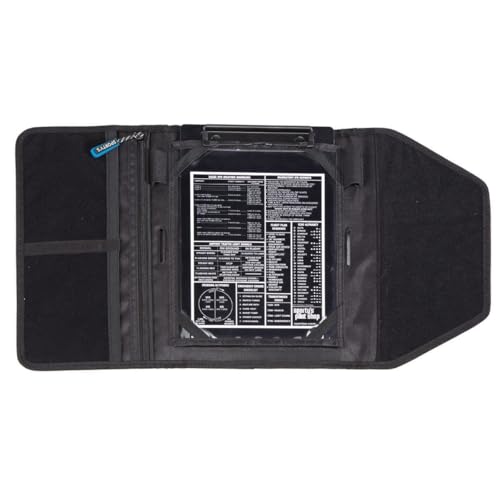
Flight Gear Tri-Fold Kneeboard
by Sporty's
$34.95
- Trusted Sporty's Flight Gear tri-fold with elastic corner straps for 10-inch iPads
- Reversible clipboard printed with VFR weather mins, IFR reports, and light gun signals
- Gear Mod-compatible felt side panels let you add storage pockets as your mission grows
CYA Supply — The Modern Upgrade (and Lowest Price)
CYA Supply is a newer entrant that designed their kneeboard from scratch with input from active pilots. The result is a VFR/IFR hybrid that works for both visual and instrument operations without compromise — and at $27.99 it is also the lowest-priced tri-fold in this guide.
Strengths: VFR and IFR compatible in one unit, lowest price in this guide, modern professional design, compact layout Weaknesses: Less established brand than ASA, Jeppesen, or Sporty's — but the product quality is excellent
CYA VFR IFR Trifold Pilot Kneeboard
by CYA Supply
$27.99
- Upgraded VFR and IFR compatible design — one kneeboard for all flight operations
- Compact professional layout with clipboard holder for charts and approach plates
- Durable construction with modern design — excellent alternative to the classic ASA
Quick Comparison Table
| Feature | ASA KB-3-A ($43) | CYA VFR/IFR ($28) | ASA IFR ($43) | Sporty's ($35) | Jeppesen ($47) |
|---|---|---|---|---|---|
| VFR Use | Excellent | Excellent | Good | Excellent | Excellent |
| IFR Use | Limited | Good | Excellent | Limited | Good |
| Approach Plate Clip | No | Yes | Yes (clipboard clip) | No | No |
| iPad Corner Straps | No | No | No | Yes (10-inch) | No |
| Map Pocket | Yes | Yes | Yes | Yes | Yes |
| Best For | PPL students | All-in-one / budget | IR students | iPad + paper | Jeppesen users |
Decision framework:
- Starting flight training? Get the ASA KB-3-A (about $42.95). It is the standard for a reason.
- On a tight budget or planning to get instrument rated? Get the CYA VFR/IFR ($27.99) — lowest price and handles both VFR and IFR so you skip buying a second kneeboard later.
- Already in instrument training? Get the ASA IFR Tri-Fold (KB-3I-A) (about $42.95) for the best approach plate organization.
- Want paper plus an iPad on one board? Get the Sporty's Flight Gear Tri-Fold ($34.95) — its 10-inch corner straps and Gear Mod panels do both.
- Using Jeppesen materials? Get the Jeppesen VFR ($46.95) for chart compatibility.
Kneeboard Use During Your PPL Checkride
The private pilot practical test (checkride) is where your kneeboard organization directly affects your pass/fail outcome. Designated Pilot Examiners (DPEs) evaluate cockpit management as part of the Airman Certification Standards (ACS), and a well-organized kneeboard demonstrates the professionalism they want to see.
What Your Kneeboard Should Have on Checkride Day
Before the flight:
- Cross-country navigation log filled out with courses, distances, checkpoints, calculated groundspeeds, and ETAs
- Sectional chart folded to the first leg of your route in the map pocket
- All frequencies pre-written: departure ATIS, ground, tower, departure, en-route, destination ATIS, tower, ground
- Aircraft tail number and type written at the top
- Personal minimums noted (if applicable)
- Weight and balance summary (actual numbers, already calculated)
During the flight:
- Copy ATIS before calling ground — have it written on the kneeboard before your first radio call
- Record actual times over checkpoints — the examiner wants to see you tracking your progress
- Note any diversions or amendments — if the examiner asks you to divert, plan it on the kneeboard
- Write down any unfamiliar clearances — never guess, always write it down and read it back
Common Checkride Kneeboard Mistakes
- Not having frequencies pre-written — scrambling to look up a CTAF while the examiner watches
- Loose papers instead of a kneeboard — screams "I did not prepare"
- Empty navigation log — you should have the planning done before the examiner arrives
- No pen backup — carry two pens. The primary in the kneeboard holder, the backup in your pocket
- Kneeboard too tight or too loose — adjust the leg strap before the flight so it does not shift during maneuvers
Study for your private pilot knowledge test with our free ATP pilot exam prep resources.
Tips for Kneeboard Organization During Cross-Country Flights
Cross-country flights are where kneeboard organization pays off the most. Here is a system that works from private pilot training through airline operations.
Pre-Flight Setup
- Navigation log on clipboard — this is your primary reference during the flight
- Sectional chart in map pocket — folded to show the departure area and first leg
- Frequencies written on notepad — departure, en-route, destination, plus emergency (121.5)
- Pen in holder, backup pen in pocket — non-negotiable
- E6B or electronic calculator accessible — for in-flight groundspeed calculations
In-Flight Workflow
- Copy ATIS before calling for taxi — write it on the kneeboard, not in your head
- Record actual departure time — start your navigation log timing
- Note checkpoint times — compare actual vs estimated, calculate actual groundspeed
- Refold chart at each waypoint — show only the next leg segment in the map pocket
- Update fuel calculations — if groundspeed differs from planned, recalculate fuel remaining
- Copy any amended clearances — ATC frequency changes, altitude amendments, traffic advisories
IFR Cross-Country Additions
For instrument cross-country flights, add these to your kneeboard workflow:
- Copy your full IFR clearance using CRAFT before taxi
- Have approach plates organized: destination primary approach, backup approach, missed approach, and alternate airport approach
- Pre-brief each approach before you need it — write the key altitudes and frequencies on the notepad
- Record any amended clearances or holding instructions immediately — IFR amendments happen fast
ASA Tri-Fold IFR Kneeboard (KB-3I-A)
by ASA
$42.95
- Designed for instrument flight training; aluminum clipboard clip secures approach plates
- Silkscreened IFR reference data (alternate minimums, required reports, lost comms) on the clipboard
- Tri-fold organization keeps approach charts and an E6B accessible during instrument procedures
Free Pilot Exam Prep Resources
Your kneeboard is one piece of your aviation training toolkit. Build your knowledge with these free resources:
- Free ATP Pilot Exam Prep — Study materials for the airline transport pilot knowledge test
- Free Instrument Rating Exam Prep — IFR procedures, navigation, weather, and regulations
- Free CFI Exam Prep — Prepare for the Certified Flight Instructor knowledge test
- AI Tutor — 10 free questions per day — ask about airspace classifications, IFR procedures, weather theory, or any aviation exam topic
- Practice Questions — Test your knowledge with exam-style questions and detailed explanations for every answer
The AI tutor is particularly useful for aviation knowledge practice. Ask it questions like "Walk me through briefing an ILS approach to minimums" or "Explain the different classes of airspace and their VFR weather minimums" and get detailed, exam-level responses instantly.
Final Verdict
Buy the ASA KB-3-A (about $42.95 street, $49.95 MSRP) if you are starting flight training and need the kneeboard that every flight instructor knows and recommends. It is the industry standard for VFR operations and the board your CFI will be most familiar with.
Buy the CYA VFR IFR Trifold ($27.99) if you want the lowest price in this guide and plan to pursue an instrument rating — one kneeboard that handles both VFR and IFR operations without needing to buy a second board later.
Buy the ASA IFR Tri-Fold (KB-3I-A) (about $42.95) if you are already in instrument training and want a silkscreened IFR reference clipboard and three-panel chart organization for copying complex IFR clearances.
Buy the Sporty's Flight Gear Tri-Fold ($34.95) if you want one board that holds both paper and a 10-inch iPad — its corner straps, reversible reference clipboard, and Gear Mod panels make it the most iPad-friendly traditional kneeboard here.
Buy the Jeppesen VFR ($46.95) if your flight school uses Jeppesen charts and materials and you want a kneeboard designed to integrate with that ecosystem.
Whatever kneeboard you choose, the most important thing is using it consistently from your very first training flight. Good cockpit organization habits built during training become automatic by the time you reach your checkride — and they stay with you for your entire flying career. Start studying today with our free pilot exam prep resources and practice questions.
As an Amazon Associate, OpenExamPrep earns from qualifying purchases. All recommendations are based on editorial review.

 Free CE

