 View
ViewWhy Gait Belts Are Critical for the CNA Skills Test
The gait belt is one of the most important pieces of equipment in a CNA's daily toolkit — and it is one of the most commonly tested skills on the CNA clinical exam. Whether you are transferring a patient from bed to wheelchair, assisting with ambulation down a hallway, or helping a resident stand from a seated position, the gait belt is what keeps both you and your patient safe.
On the CNA skills test, ambulation with a gait belt and transfer (bed to chair) are two of the 22 testable skills that evaluators can assign. If either one appears on your exam, you need to demonstrate flawless technique — proper belt application, correct body mechanics, safe patient handling, and the ability to respond if the patient loses balance.
This guide covers everything you need to know about gait belts for the CNA skills test: which type to buy, how to apply it correctly, what evaluators look for, and the 5 best gait belts for exam preparation and clinical practice in 2026.
Preparing for the full CNA exam? Start with our FREE CNA Exam Prep Course — it covers all 9 content areas plus step-by-step clinical skills procedures.
What Examiners Look For During Gait Belt Skills
Understanding exactly what the evaluator scores is the key to passing. During gait belt transfers and ambulation, the examiner marks a detailed checklist. Here is what they are watching:
Before the Transfer
| Step | What the Evaluator Checks |
|---|---|
| Hand hygiene | Proper handwashing before approaching the patient |
| Patient identification | Check ID band, call resident by name |
| Explanation | Tell the patient what you are about to do, in simple terms |
| Privacy | Close curtain or door |
| Safety check | Lock bed wheels, position wheelchair at correct angle |
| Contraindication check | Verify no abdominal surgery, colostomy, rib fractures, etc. |
| Footwear | Ensure patient has non-skid shoes or socks on |
During the Transfer
| Step | What the Evaluator Checks |
|---|---|
| Belt placement | Over clothing at the natural waist (not hips, not bare skin) |
| Buckle position | Off-center, to the front or side (never over the spine) |
| Snugness | Two fingers fit between belt and patient |
| Grip | Underhand grasp from underneath, palms up |
| Body mechanics | Knees bent, wide base of support, back straight |
| Patient close to body | CNA keeps patient close during the transfer |
| Verbal cues | "On the count of three, we stand together — one, two, three" |
| Patient stability | Pause after standing to ensure balance before moving |
After the Transfer
| Step | What the Evaluator Checks |
|---|---|
| Remove gait belt | Belt removed after transfer is complete |
| Patient comfort | Positioned comfortably with back support |
| Safety | Wheelchair wheels locked, call light within reach |
| Hand hygiene | Proper handwashing after the procedure |
The evaluator can only score what they see and hear. Even if you know exactly what you are doing, verbalize every step: "I'm checking that your bed wheels are locked." "I'm placing the gait belt over your clothing at your waist." "Can you feel two fingers between the belt and your body?" This narration is not optional — it demonstrates competency.
Standard vs. Handled Gait Belts: Which Do You Need?
There are two main types of gait belts, and understanding the difference is important for CNA exam preparation.
Standard Gait Belts (For the Skills Test)
Standard gait belts are flat, 1.5 to 2-inch wide cotton or cotton-blend belts with a metal buckle closure. They have no padding, no handles, and no extra features. This is the type used on the CNA clinical skills test.
Why the skills test uses standard belts: The exam tests your fundamental transfer technique — proper grip on a flat belt surface, correct body mechanics, and safe patient handling. If you can perform a flawless transfer with a basic belt, you can perform one with any belt. Standard belts also force you to develop a strong underhand grip, which is the foundation of safe patient handling.
Key features of standard gait belts:
- 60-inch length (fits most adult patients)
- Metal buckle with teeth for secure closure
- Cotton or cotton-blend material
- 1.5 to 2 inches wide
- No handles or padding
- Price range: $5.95 to $8.59
Handled Gait Belts (For Clinical Practice After Certification)
Handled gait belts have padded, sewn-on handles (typically 4 to 6 handles) positioned around the belt at strategic grip points. They are wider, often padded, and designed for comfort during frequent daily use.
Why handled belts are preferred in clinical work: After certification, you may perform 20 to 30 or more transfers per shift. Gripping a flat belt surface dozens of times causes hand fatigue, and the padded handles on a handled belt reduce strain significantly. The multiple grip positions also make it easier to adapt your hand placement for different types of transfers.
Key features of handled gait belts:
- 4 to 6 padded handles positioned around the belt
- Wider belt surface (3 to 4 inches) for patient comfort
- Often rated for higher weight capacity (300+ lbs)
- Padded interior to prevent skin irritation
- Price range: $14.99 to $24.99
Bottom line: Buy a standard belt for skills test practice. After you pass and start working, consider adding a handled belt to your clinical gear.
The 5 Best Gait Belts for CNA Skills Test Preparation (2026)
1. COW&COW Transfer and Gait Belt — Best Overall for CNA Exam Prep
The COW&COW gait belt is the top recommendation for CNA skills test preparation because it matches exactly what you will encounter on exam day: a standard-width belt with a metal buckle closure at a length that fits most patients. There are no handles, no padding, no unnecessary features — just a reliable, well-constructed transfer belt that teaches you proper technique.
Why this belt is ideal for exam practice: The metal buckle with teeth is the same closure mechanism used on testing center belts. Practicing with this style means your muscle memory for threading and securing the buckle transfers directly to the exam. The 60-inch length accommodates practice partners of varying sizes, and the cotton-blend material provides enough grip texture for a secure underhand hold.
Who should buy this: Any CNA candidate who wants to practice with a belt that mirrors testing conditions. This is also an excellent belt to keep in your clinical bag after certification as a backup to your everyday handled belt.
Pros:
- Metal buckle matches state board test requirements exactly
- 60-inch standard length for most adult patients
- Durable cotton-blend material with good grip texture
- Affordable at $7.99
Cons:
- No handles (by design — standard belts for exam prep do not have them)
- No padding for patient comfort during extended use
- Limited color options
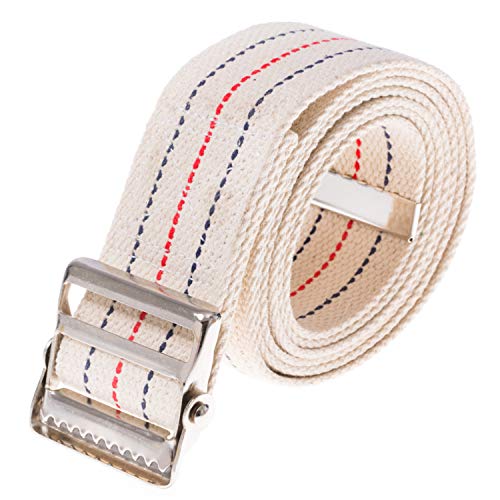
COW&COW Transfer and Gait Belt with Metal Buckle
by COW&COW
$7.99
- Standard gait belt with metal buckle — matches state board test requirements
- 60-inch length fits most adult patients
- Durable cotton-blend material for secure transfers
2. LiftAid Transfer and Gait Belt — Best Loop Design for Easy Grip
The LiftAid gait belt adds a practical feature that standard belts lack without compromising exam-readiness: a loop design that provides an integrated grip point. The belt still uses a metal buckle and 60-inch length — fully standard for the CNA skills test — but the loop gives you a built-in handhold that can reduce hand strain during practice sessions.
What the loop design offers: The loop is woven into the belt fabric, providing a natural grip point without the bulk of sewn-on handles. This means you still practice standard belt technique (underhand grip on the flat belt surface for the exam) but have an optional grip assist when doing repetitive practice transfers at home.
Another practical advantage: This belt is machine washable, which matters more than you might think. Gait belts absorb sweat and body oils during patient contact. Machine washability means you can maintain proper infection control hygiene without replacing the belt frequently.
Pros:
- Metal buckle standard design matches CNA exam conditions
- Loop design provides optional grip assist during practice
- Machine washable for clinical hygiene
- 60-inch standard length at $7.99
Cons:
- Loop may feel unfamiliar if testing center belts are purely flat
- Same limited padding as other standard belts
- May need to practice specifically without the loop to match exam conditions

LiftAid Transfer and Gait Belt 60 Inch with Metal Buckle and Loop
by LiftAid
$7.99
- 60-inch standard length with metal buckle
- Loop design for easy grip during transfers
- Machine washable for clinical hygiene
3. LAMBOX Gait Belt with Belt Loop Holder — Best for Portability
The LAMBOX gait belt includes a belt loop holder — a small clip that allows you to attach the gait belt to your own pants belt loop or scrub waistband for hands-free carry. In clinical practice after certification, this feature is invaluable: instead of draping the gait belt over the bedrail or hunting for it in a supply closet every time you need it, the belt is on your person and ready to go.
Why portability matters in clinical work: CNA shifts are constant motion. You move from room to room, patient to patient, transfer to transfer. Having your gait belt clipped to your waist means you are always prepared for an unscheduled assist — a patient who decides to stand up without waiting for help, a call light for a bathroom transfer, or a nurse asking you to ambulate a post-surgical patient on short notice.
For exam preparation: This is a fully standard gait belt with a metal buckle, so it works perfectly for CNA skills test practice. The belt loop holder is simply a bonus feature you will appreciate once you start working.
Pros:
- Belt loop holder for hands-free carry during clinical shifts
- Metal buckle closure matches exam standards
- Soft yet durable material balances grip and patient comfort
- Slightly wider than some competitors at this price point
Cons:
- At $8.59, slightly more expensive than the cheapest options
- Belt loop holder adds minor bulk
- Some candidates prefer to practice with the simplest belt possible

LAMBOX Gait Belt with Belt Loop Holder for Seniors, Caregivers
by LAMBOX
$8.59
- Includes belt loop holder for convenient carry
- Metal buckle closure for secure fastening
- Soft yet durable material for patient comfort
4. Vive Gait Belt with Handles — Best for Post-Certification Clinical Work
The Vive gait belt is a different category of product: a handled transfer belt designed for daily clinical use after you have passed the CNA skills test. With 6 padded handles, a 300-lb weight capacity, and a wider belt surface, it is built for the reality of performing dozens of transfers per shift.
Important note for CNA candidates: Do NOT practice exclusively with this belt for your skills test. The handles and padding create a different grip experience than the standard flat belt you will encounter on the exam. Use a standard belt (COW&COW, LiftAid, or Winteriew) for exam preparation, and save the Vive for clinical work after certification.
Why handles matter in daily practice: After certification, you will quickly understand why CNAs prefer handled belts. A standard flat belt is fine for 3 to 5 practice transfers, but performing 25+ transfers in a 12-hour shift with a flat belt causes significant hand fatigue. The Vive's 6 handles are positioned at strategic points around the belt — sides, back, and front — giving you multiple grip options for different transfer types (bed to chair, chair to standing, ambulation).
The 300-lb weight capacity is another practical advantage. In long-term care and skilled nursing facilities, bariatric patients are common. A standard $7 belt is not rated for heavy use, while the Vive is engineered for higher loads with reinforced stitching at every handle attachment point.
Pros:
- 6 padded handles reduce hand fatigue during frequent transfers
- 300-lb weight capacity for bariatric patients
- Wider belt surface for patient comfort
- Durable construction built for daily clinical use
Cons:
- NOT suitable for CNA skills test practice (handles change the grip technique)
- At $16.99, significantly more expensive than standard belts
- Bulkier than standard belts — harder to carry between rooms
- Overkill for exam preparation

Vive Gait Belt (300lbs) Transfer Belt with Handles
by Vive
$16.99
- 300-lb weight capacity with padded handles
- 6 handles for multiple grip positions during transfers
- Best for clinical practice and post-certification use
5. Winteriew Gait Belt — Best Budget Option
At $5.95, the Winteriew gait belt is the most affordable option on this list — and for CNA skills test preparation, affordable is exactly what you need. This is a no-frills, 60-inch gait belt with a metal buckle closure. It does one thing (secure a patient during transfers) and does it adequately at the lowest possible price.
Why the cheapest belt might be the smartest purchase: You need a gait belt to practice transfers at home before your skills test. You do not need a premium belt for this purpose — you need a belt that mimics testing conditions (standard length, metal buckle, no handles) and costs little enough that buying one is a no-brainer. The Winteriew meets all of these criteria for under $6.
For CNA candidates on a tight budget: Between CNA training program fees, testing fees, scrubs, shoes, a stethoscope, and a watch with a second hand, the costs of becoming certified add up quickly. The Winteriew lets you add gait belt practice to your preparation without adding meaningful cost.
Pros:
- Ultra-affordable at $5.95
- Standard 60-inch length with metal buckle
- Lightweight and portable for home practice
- Matches CNA testing conditions
Cons:
- Material may be thinner than more expensive options
- Less durable for long-term clinical use after certification
- Limited color selection
- May need replacement sooner than premium belts

Gait Belt for Seniors 60inch - Walking Transfer Belt
by Winteriew
$5.95
- Ultra-affordable 60-inch gait belt
- Metal buckle closure standard design
- Lightweight and portable for skills practice
How to Use a Gait Belt: Step-by-Step CNA Skills Test Technique
Mastering the gait belt technique is about more than passing the skills test — it is about keeping patients safe every day of your career. Here is the complete step-by-step procedure for the two most commonly tested gait belt skills.
Skill: Transfer from Bed to Wheelchair
Setup:
- Perform hand hygiene
- Identify the patient (check ID band, call by name)
- Explain the procedure: "I'm going to help you move from the bed to the wheelchair"
- Provide privacy (close curtain or door)
- Position wheelchair at a 45-degree angle to the bed, on the patient's strong side
- Lock wheelchair wheels and swing footrests out of the way
- Lock bed wheels and lower bed to lowest position
- Help patient sit on edge of bed with feet flat on the floor
Gait Belt Application:
- Place the gait belt over the patient's clothing at the natural waist
- Thread the belt through the metal buckle teeth
- Pull snug — check that two fingers fit between the belt and patient
- Position the buckle off-center (front or side, never over the spine)
- Tuck excess belt to prevent tripping
The Transfer:
- Stand facing the patient with your knees bent and feet shoulder-width apart
- Grip the gait belt from underneath with an underhand grasp (palms up) at the patient's sides
- Brace your knees against the patient's knees (block their knees to prevent buckling)
- Give a verbal cue: "On the count of three, we stand together — one, two, three"
- Straighten your legs (lift with your legs, not your back) to bring the patient to standing
- Pause — ensure the patient is stable and balanced before moving
- Pivot the patient toward the wheelchair
- Lower the patient into the wheelchair by bending your knees
- Ensure the patient's hips are at the back of the seat
Completion:
- Remove the gait belt
- Swing footrests back and place patient's feet on them
- Lock wheelchair wheels
- Place call light within reach
- Perform hand hygiene
Skill: Ambulation with Gait Belt
Setup:
- Perform hand hygiene
- Identify the patient and explain the procedure
- Provide privacy
- Ensure patient has non-skid footwear on
- Apply gait belt (same technique as above)
Ambulation:
- Help the patient stand using proper body mechanics
- Move to the patient's weak side (or behind, depending on state protocol)
- Grip the gait belt from underneath at the patient's back
- Walk at the patient's pace — never rush
- Observe the patient for signs of distress (dizziness, shortness of breath, unsteady gait)
- Walk the required distance (typically 10 to 20 feet and back)
If the Patient Begins to Fall:
- Hold the gait belt firmly — do NOT let go
- Bend your knees and widen your stance
- Guide the patient slowly to the floor, controlling the descent
- Protect the patient's head
- Do NOT try to catch or hold the patient upright
- Stay with the patient and call for help
Completion:
- Return the patient to their bed or chair
- Remove the gait belt
- Ensure patient comfort and safety (call light, bed position)
- Perform hand hygiene
Common Gait Belt Mistakes That Cause Failure on the CNA Skills Test
These are the errors evaluators see most frequently — and each one can result in a failed skill:
| Mistake | Why It Fails You | How to Avoid It |
|---|---|---|
| Placing belt over bare skin | Risk of skin tears, especially on elderly patients | Always place over clothing |
| Belt too loose | Patient can slide through during a fall | Two-finger check every time |
| Belt too tight | Causes pain, restricts breathing, or bruises skin | Two-finger check — snug but comfortable |
| Buckle over the spine | Pressure on vertebrae during transfer | Position off-center (front or side) |
| Overhand grip (palms down) | Less control, weaker hold, risk of dropping patient | Always use underhand grip, palms up |
| Bending at the waist | Back injury to CNA, poor leverage for transfer | Bend at the knees, keep back straight |
| Not locking wheelchair wheels | Wheelchair rolls away during transfer — patient falls | Lock wheels before every single transfer |
| Skipping verbal cues | Patient is not prepared for the movement | Count to three, explain every step |
| Not checking contraindications | Belt applied to patient with surgical incision | Verify care plan before applying |
| Forgetting to remove belt after | Patient discomfort, skin damage from prolonged wear | Remove immediately after transfer is complete |
Practice CNA Skills with AI-Powered Help
Our CNA course covers all 22 clinical skills with step-by-step procedures and critical steps highlighted. Plus, use our AI study assistant (10 free questions per day) to practice scenarios like:
- "Walk me through a bed-to-wheelchair transfer with a gait belt step by step"
- "What are the contraindications for gait belt use?"
- "Quiz me on the most common CNA skills test mistakes"
- "Explain proper body mechanics for patient transfers"
Product Comparison: Which Gait Belt Should You Buy?
| Feature | COW&COW | LiftAid | LAMBOX | Vive | Winteriew |
|---|---|---|---|---|---|
| Price | $7.99 | $7.99 | $8.59 | $16.99 | $5.95 |
| Length | 60 in | 60 in | 60 in | 60 in | 60 in |
| Buckle | Metal | Metal | Metal | Metal | Metal |
| Handles | No | No (loop) | No | 6 padded | No |
| Skills Test Ready | Yes | Yes | Yes | No | Yes |
| Best For | Exam prep (overall) | Exam prep + grip assist | Portability | Post-certification | Budget option |
Our recommendation by situation:
- CNA skills test preparation: COW&COW ($7.99) — best overall match to testing conditions
- Budget-conscious candidate: Winteriew ($5.95) — cheapest path to exam-matching practice
- Convenience and portability: LAMBOX ($8.59) — belt loop holder is great for clinical shifts
- After certification (clinical work): Vive ($16.99) — handled belt for frequent daily transfers
- Best value combo: Winteriew for exam practice ($5.95) + Vive for clinical work ($16.99) = $22.94 total
Gait Belt Care and Replacement
Cleaning
- Machine wash belts that are labeled machine washable (LiftAid, most cotton-blend belts)
- Spot clean with hospital-grade disinfectant wipes between patients
- Air dry — avoid high heat dryers that can shrink cotton belts or weaken buckle attachment
When to Replace
- Frayed edges or fabric tears — compromised structural integrity
- Buckle damage — bent teeth, loose rivets, or stiff closure mechanism
- Staining that cannot be cleaned — infection control concern
- After bariatric patient use — if the belt was stressed near its weight limit, replace as a precaution
- Annually — even with proper care, daily-use gait belts should be replaced once per year
Storage
- Hang on a hook or roll loosely — do not crumple or crush the buckle
- Keep dry — moisture causes mildew on cotton belts
- Store in a clean area away from soiled linens and contaminated equipment
Pass Your CNA Skills Test on the First Attempt
The gait belt is just one of the 22 skills you may be tested on. Our comprehensive, 100% FREE CNA study course covers:
- All 22 clinical skills with step-by-step procedures and critical steps
- Written exam prep covering all 9 content areas
- AI-powered study assistant — ask about any skill, technique, or concept
- Practice questions updated for 2026 testing standards
A $6 gait belt and free study materials are all you need to walk into your CNA skills test with confidence. Start practicing today.
As an Amazon Associate, OpenExamPrep earns from qualifying purchases. All recommendations are based on editorial review.

 Free CE
 Take courses on Udemy
 Online course on Mometrix
 Practice exams on ExamEdge