 View
View
![Enrolled Agent Study Cards 2026-2027: IRS Enrolled Agent Exam Prep and Practice Test Questions [Full Color Cards]](https://m.media-amazon.com/images/I/31MWqnd-ZkL._SL500_.jpg)
Why Choosing the Right EA Study Material Matters
The Enrolled Agent (EA) credential is the highest credential the IRS awards, and it comes with a powerful benefit: unlimited practice rights to represent any taxpayer before the IRS on any tax matter. Unlike CPAs or attorneys, who must meet state-specific requirements, EAs earn a federal credential that works in all 50 states.
Earning it means passing the Special Enrollment Examination (SEE) - a three-part exam that covers the full breadth of the Internal Revenue Code. This is not a casual exam, and with the fee now at $317 per part ($951 for all three), you want to pass on the first attempt. The right study materials are what keep that volume of tax law organized in your head.
This guide ranks the best EA study books for self-studiers, compares the major full review courses as alternatives, gives you the current 2026 exam facts (they changed this year), and shows how to combine paid materials with free resources to keep costs down.
2026 EA Exam Facts: What Changed This Year
The SEE went through its biggest administrative change in years for the 2026 cycle. Make sure any guide or course you buy reflects these current facts:
| Fact | 2026 detail |
|---|---|
| Exam vendor | PSI Services (replaced Prometric effective March 1, 2026) |
| Fee per part | $317 (up from $267); $951 for all three parts |
| Parts | 3: Individuals; Businesses; Representation, Practices & Procedures |
| Questions per part | 100 total - 85 scored + 15 unscored experimental |
| Time per part | 3.5 hours (seat time around 4 hours with the tutorial and survey) |
| Scoring | Scaled score 200-800; 500 is passing on each part |
| Testing window | July 1, 2026 - February 28, 2027 (after the extended March-June 2026 transition blackout) |
| Testing options | In-person PSI test centers or remote proctoring for U.S. candidates |
Why this matters for buying materials: older books and course editions still reference Prometric, the $267 fee, and a 40-130 scaled score with 105 passing. Those facts are out of date. Anything you study from should reflect PSI, the $317 fee, and the 200-800 / 500 scale.
What the three parts cover
| Part | Title | Questions | Time | Key Topics |
|---|---|---|---|---|
| Part 1 | Individuals | 100 | 3.5 hours | Filing status, income, adjustments, deductions, credits, AMT, basis |
| Part 2 | Businesses | 100 | 3.5 hours | Entity types, business income/expenses, retirement plans, farming, trusts |
| Part 3 | Representation, Practices & Procedures | 100 | 3.5 hours | Circular 230, IRS procedures, penalties, appeals, ethics, representation |
Part 1 (Individuals) tends to be the broadest, covering everything from W-2 income to Schedule C self-employment to capital gains. Part 2 (Businesses) dives into entity taxation - partnerships, S corporations, C corporations, and estates/trusts. Part 3 (Representation) tests your knowledge of IRS procedures, practitioner ethics under Circular 230, and the nuts and bolts of representing clients. Most candidates tackle one part at a time, so a part-by-part book or course matches how you will actually study.
How We Evaluated These Materials
We reviewed each EA study option on five criteria:
- Content coverage - Does it cover all three parts thoroughly and cover topics from current IRS exam specifications?
- Clarity of explanations - Can someone without a tax background follow the material?
- Practice questions - Quality and quantity of included questions, with detailed answer explanations
- Current-cycle tax law - Does it reflect 2025-2026 / 2026-2027 limits, deductions, and recent legislation, plus the PSI and fee changes?
- Value for money - Is the price justified given that strong free alternatives exist for practice and review?
We also considered how well each option works alongside free online resources like practice questions and AI tutoring.
Best EA Study Books for 2026 (Self-Study)
If you prefer print, want to highlight and tab pages, and like a fixed one-time cost, these are the books to consider - from the established publisher standard to budget all-in-one guides.
1. PassKey Learning Systems (with HOCK International) EA Review - Best Overall Book Series
PassKey is the long-standing print standard for EA self-study, now published together with HOCK International. Instead of one thin volume, it offers a separate study guide and workbook for each of the three parts, which is why serious self-studiers keep coming back to it. The study guides walk through the tax law part by part; the companion workbooks add three full practice exams each with detailed answer explanations.
What makes it stand out: depth. Because each part gets its own dedicated guide, the coverage of entity taxation (Part 2) and Circular 230 / representation rules (Part 3) is far more thorough than any single-volume crammer. Editions are updated for the current testing cycle and reflect recent legislation such as SECURE Act 2.0 provisions.
Pros:
- Dedicated study guide for each of the three EA parts - strong depth
- Companion workbooks add three full practice exams per part with explanations
- Established, trusted author team; widely used and reviewed
- Updated each testing cycle for current tax law
Cons:
- Buying all guides and workbooks adds up (roughly $60 per book; well over $300 for the full set)
- Print only - no online dashboard, video, or simulated testing environment
- Heavier and less portable than a single book
Best for: career changers and thorough self-studiers who want the most complete print coverage and do not mind buying multiple volumes.
2. Enrolled Agent (EA) Exam Guide 2025-2026 by Liam A. Caldwell - Best One-Volume Book
If you want a single, affordable book that covers the entire EA exam, this is a strong budget pick. Caldwell's guide is organized by exam part, making it easy to study Part 1, Part 2, and Part 3 sequentially.
What makes it stand out: value. At around $30 it includes 6 complete practice exams (2 per part) for a realistic sense of difficulty and timing, with explanations clear enough for readers new to tax.
Pros:
- Covers all three EA exam parts in one inexpensive volume
- 6 full practice exams with detailed answer explanations
- Well-organized by part - study one section at a time
- Clear, accessible writing suitable for all experience levels
Cons:
- One-volume format means less depth per topic than the PassKey series
- Newer publication with fewer long-term reviews than legacy publishers
- Verify the edition reflects the current PSI / $317 exam facts before relying on its exam-logistics pages
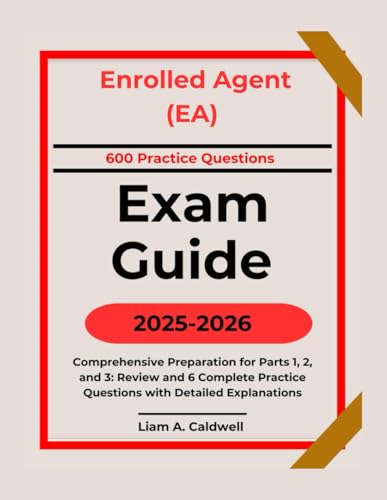
Enrolled Agent (EA) Exam Guide 2025-2026: Comprehensive Preparation for Parts 1, 2, and 3
by Caldwell, Liam A.
$29.99
3. The Complete Enrolled Agent Exam Prep by Miles Taxwell - Best for Practice Volume
Practice questions are where EA prep lives or dies. You can read about Circular 230 all day, but until you have worked through questions that test the specific rules, penalties, and exceptions, the material will not stick. This guide leans hard into practice, advertising 1,200+ practice questions and 9 full-length tests across all three parts, plus IRS-procedure walkthroughs and test strategies.
What makes it stand out: sheer drilling volume in one affordable book - roughly 400 questions per part, enough to find and fix weak areas before test day, alongside a concise content review.
Pros:
- High practice-question count (1,200+) and 9 full-length tests in one book
- Affordable single-volume format
- Includes IRS walkthroughs and test-taking strategy
- Good for a final drilling and review phase
Cons:
- Content review is lighter than a dedicated study guide series
- Best used as a question bank alongside a primary guide, not as your only resource
- Confirm the edition reflects current-cycle tax figures
4. Enrolled Agent Study Cards by Test Prep Books - Best Supplement
This is not a standalone study book - it is a study companion, and a good one. The EA exam requires you to memorize a lot of specific numbers: contribution limits, standard deduction amounts, phaseout ranges, penalty thresholds, and filing deadlines. These full-color study cards are designed to help you lock in those details.
What makes it stand out: the card format is ideal for quick review during lunch breaks, commutes, or the final days before your exam. The full-color design helps you visually associate concepts with categories (individual vs. business, for example).
Pros:
- Perfect for memorizing tax codes, limits, phaseout ranges, and deadlines
- Full-color format aids visual learning and retention
- Portable - review anywhere without carrying a full textbook
- Great complement to any primary study book
Cons:
- Not a standalone resource - you need a comprehensive study book alongside it
- Less helpful for understanding complex concepts or working through scenarios
- Limited practice question content
What About Full EA Review Courses?
Books are the cheapest paid path, but many candidates - especially those new to tax - pass faster with an online review course that adds video lectures, an adaptive question bank, simulated PSI-style testing, and progress tracking. They cost more (roughly $400-$800), and most sell per-part or full-set bundles. The main players:
| Course | Approx. price | Strengths | Best for |
|---|---|---|---|
| Gleim EA Review | ~$500-$630 (3 parts) | Largest question bank (3,900+ MCQs), SmartAdapt, audio lectures, "Access Until You Pass" | Self-paced learners who want the deepest practice bank |
| Surgent EA Review | ~$400-$700 | ReadySCORE readiness metric, adaptive A.S.A.P. technology, pass guarantee | Practice-driven learners who want adaptive efficiency |
| Fast Forward Academy | ~$400-$650 | Adaptive engine, clean interface, strong community, video | Learners who like video plus a modern dashboard |
| Becker EA | ~$600-$900 | Polished video, study planner, AI assistant, mock exams | Candidates who want the most structured, premium setup |
| Lambers EA | ~$400-$600 | 19+ video hours per part, flashcards, "access until you pass" | Learners who prefer conversational, lecture-heavy video |
| HOCK EA | membership pricing (lower-cost) | Full materials for all parts, PassMap study system, community | Budget-conscious, self-directed candidates |
Prices move with frequent promotions and bundle choices, so treat these as ranges and confirm on each provider's site. A course is worth it if you value video instruction, adaptive practice, and a simulated testing environment; a book plus free practice questions is far cheaper if you are disciplined and already comfortable with tax basics.
Study Strategy: How to Tackle the EA Exam
Study One Part at a Time
Most successful candidates focus on one part at a time rather than trying to study all three simultaneously. Here is a realistic timeline:
| Phase | Duration | Focus | Approach |
|---|---|---|---|
| Phase 1 | 4-8 weeks | Part 1: Individuals | Read study book chapters -> Practice questions -> AI review of weak areas |
| Phase 2 | 4-8 weeks | Part 2: Businesses | Read study book chapters -> Practice questions -> Focus on entity taxation |
| Phase 3 | 3-6 weeks | Part 3: Representation | Read study book chapters -> Practice questions -> Drill Circular 230 rules |
| Final Review | 1-2 weeks per part | All parts | Full-length practice exams -> Review missed questions -> Timed practice |
Total timeline: 3-6 months, depending on your tax background and how many hours per week you can dedicate. Candidates with professional tax experience (CPAs, tax preparers) often move through the material faster, while career changers may need the full 6 months. Note the 2026-2027 testing window runs July 1, 2026 through February 28, 2027, so plan your three test dates within it.
The Study Book + Free Resources Method
The most cost-effective approach is pairing a study book with free online tools:
- Read the chapter in your study book to learn the concepts
- Practice immediately - take the chapter quiz in the book, then do related questions on OpenExamPrep's free EA practice questions
- Review with AI - when you get a question wrong, ask the AI tutor to explain the concept in a different way
- Use study cards for memorization - review contribution limits, phaseout ranges, and filing deadlines during downtime
A Note on Tax Law Changes
Tax law changes every year. New contribution limits, updated standard deduction amounts, revised phaseout ranges, and legislative changes all get incorporated into the EA exam. This is why we emphasize getting 2025-2026 editions of any study book you buy.
Using a 2023 or 2024 book means you may be studying outdated numbers for:
- Standard deduction amounts
- IRA and 401(k) contribution limits
- Income tax bracket thresholds
- Earned Income Tax Credit amounts
- Gift tax exclusion amounts
- Estate tax exemption amounts
These numbers change annually, and the EA exam tests current-year figures. Do not risk losing points on questions you should get right simply because your book had last year's numbers.
Do You Even Need a Book?
Here is the honest truth: a study book is not strictly required to pass the EA exam, but it is more strongly recommended here than for many other professional exams. The sheer volume of tax law - across individuals, businesses, and representation procedures - makes structured study materials almost essential.
That said, you have options for keeping costs down:
A study book adds the most value if you:
- Are new to tax or changing careers into tax preparation
- Want a structured, linear path through each part of the exam
- Prefer physical materials you can highlight, tab, and annotate
- Need a single reference that covers all three parts
You might skip the book if you:
- Already have professional tax experience (3+ years preparing returns)
- Are a CPA or tax attorney adding the EA credential
- Prefer digital-first learning with online study guides and practice questions
Either way, supplement your study book (or replace it) with free resources:
- Free EA Study Guide - Content coverage for all three exam parts
- Free EA Practice Questions - Practice with detailed explanations
- AI Tutor - 10 free questions per day for personalized explanations of tax concepts
Final Verdict
For the most thorough print self-study, the PassKey Learning Systems (with HOCK International) EA Review series is our overall book pick - a dedicated study guide and workbook for each part gives unmatched depth, though the full set runs well over $300. On a budget, Caldwell's one-volume Enrolled Agent Exam Guide (around $30, with 6 practice exams) is the best value, and the Miles Taxwell Complete EA Exam Prep is a strong drilling companion for its 1,200+ questions. For pure memorization, the Test Prep Books study cards lock in the numbers.
If you want video, adaptive practice, and a simulated PSI-style testing environment, step up to a full review course - Gleim, Surgent, or Fast Forward Academy are the leaders, at roughly $400-$800.
The EA designation opens doors to a rewarding career in tax representation, and the right materials make the path much smoother. Start studying today, and you could be an Enrolled Agent within 3-6 months.
As an Amazon Associate, OpenExamPrep earns from qualifying purchases. All recommendations are based on editorial review.

 Take courses on Udemy
 Study resources on Achievable