 View
ViewWhy Budget Aviation Headsets Make Sense for Student Pilots
Flight training is one of the most expensive investments a professional pilot makes. The average cost of earning a Private Pilot License (PPL) in 2026 runs $12,000-$18,000 — and that is just the starting point. Instrument Rating adds another $8,000-$15,000. Commercial Pilot License adds $15,000-$30,000 more. Every dollar saved on gear that performs adequately is a dollar that can go toward flight hours, and flight hours are what actually get you to your checkride.
A quality aviation headset is non-negotiable. You need clear ATC communications, reasonable noise protection, and enough comfort to focus on learning to fly. What you do not need as a student pilot is the best headset money can buy. The Bose A20 ($1,195), Lightspeed Zulu 3 ($949), and even the David Clark H10-13.4 ($374.95) are excellent headsets — but they are designed for pilots who fly hundreds of hours per year and need maximum fatigue reduction on long flights.
As a student pilot, your typical flight is 1-1.5 hours in a Cessna 172 or Piper Cherokee. A budget headset with 22-25 dB passive noise reduction handles this environment effectively. The five headsets reviewed here range from $90.99 to $224.95, use standard GA dual plugs, and deliver the audio quality you need for clear radio work. Three of them come in under $100. Save the premium headset purchase for after your PPL checkride — when you know whether aviation is a hobby or a career.
Study for your Private Pilot, Instrument Rating, or ATP knowledge test for free with our aviation exam prep resources.
The $375 vs $100 Decision: When Budget Makes Sense
This is the core question every student pilot faces: spend $374.95 on a David Clark H10-13.4 (the flight school standard) or $90-$100 on a budget headset that covers training needs. Here is the honest math.
The Case for Budget ($90-$100)
Cost per flight hour matters. At $99.99, the Rugged Air RA200 costs approximately $1.25-$2.00 per flight hour over a typical 50-80 hour PPL course. A $375 David Clark costs $4.69-$7.50 per hour over the same period. That $275 difference buys 2-3 additional flight hours at current Cessna 172 rental rates — potentially the difference between being checkride-ready and needing more practice.
You do not know your preferences yet. Until you have logged 30-50 hours, you do not know whether you prefer over-ear PNR or in-ear ANR, whether a heavier headset bothers you on short flights, or whether you value Bluetooth connectivity. Starting with a budget headset lets you learn your preferences before making a $375-$1,200 commitment.
Flight school environment is hard on gear. Pre-flight in Texas summer heat, post-flight in Minnesota winter cold, bounced around in a flight bag with charts and fuel testers — student pilot gear takes abuse. A budget headset you replace after 200 hours costs less than repairing a premium headset.
The Case for Premium ($375+)
Better noise reduction reduces fatigue. If you are flying 3+ hours per session (cross-country flights, instrument training), the difference between 24 dB PNR and ANR with 10-15 dB additional electronic cancellation is significant. ANR headsets are measurably better at reducing low-frequency engine drone.
Long-term investment. A David Clark H10-13.4 lasts 10-20 years with ear seal replacements. If you are committed to a career in aviation, buying one from the start avoids buying twice.
Resale value. Premium headsets hold their value. A used David Clark sells for $150-$200. Budget headsets have minimal resale value.
Verdict
If you are unsure about committing to aviation, a budget headset is the smart choice. If you are enrolled in an accelerated professional program and know aviation is your career, the David Clark H10-13.4 at $374.95 is worth the investment from day one.
#1 Pick: Rugged Air RA200 — The Flight School Favorite
The Rugged Air RA200 is the most popular budget aviation headset in the United States, and for good reason. It delivers the best combination of noise reduction, features, and build quality under $100.

RA200 Aviation Pilot Headset for Student Pilots
by Rugged Air
$99.99
- #1 best-selling budget aviation headset with 24 dB NRR and 3.5mm MP3 input jack
- Includes free headset bag, stereo/mono switch, volume control, and standard GA dual plugs
- 7-year factory warranty with foam ear seals and 16 oz lightweight design
Why Flight Schools Choose the RA200
Dozens of flight schools across the country use the RA200 as their loaner headset or recommend it to incoming students. The reason is simple: it works reliably, students do not complain about audio quality during radio calls, and at $99.99 it does not add significant cost to an already expensive training program.
24 dB NRR is the headline spec, and it delivers. In a Cessna 172 cockpit running at roughly 85-95 dB during cruise, the RA200 brings perceived noise down to 61-71 dB — comfortable enough for 1-1.5 hour training flights without significant fatigue. The 24 dB rating is confirmed by Aircraft Spruce's product catalog and Rugged Air's own specifications.
The noise-cancelling electret microphone (M65HP-A) provides clear transmissions that ATC can understand without asking you to repeat. This matters more than you might think — garbled radio calls during pattern work create stress for a student pilot who is already managing multiple tasks.
3.5mm MP3 music input is a surprisingly useful feature for cross-country flights. Once you are established in cruise and the workload drops, being able to listen to music or (more usefully) audio study material through your headset makes long legs more productive.
The included headset bag protects the headset in your flight bag. Budget headsets without a bag tend to get crushed, tangled, and damaged faster.
7-year factory warranty from Rugged Air is exceptional for a sub-$100 headset and speaks to the build quality. Most budget competitors offer 1-2 year warranties at most.
RA200 Limitations
The ear seals are foam, not gel. They compress faster than gel seals and provide slightly less noise isolation when worn. Plan to replace them after 100-150 hours ($10-$15 for replacement seals). The headband clamp force is firm — comfortable for most head sizes but potentially uncomfortable for very large or very small heads. At 16 ounces, it is mid-weight for the budget category.
#2 Pick: KORE Aviation P1 — Best Mid-Budget PNR Option

P1 Aviation Pilot Headset for Student Pilots
by KORE Aviation
$124.95
- 24 dB PNR noise reduction with noise-cancelling microphone and acoustic foam ear cups
- 3.5mm AUX input jack for music or audio study materials during cruise flight
- Designed for student pilots and flight instructors with GA dual plugs
The KORE Aviation P1 at $124.95 sits just above the $100 threshold but earns its place through a strong feature set from an established aviation headset manufacturer. KORE Aviation (the brand behind both the P1 and the KA-1) has been a trusted name in flight school headsets for years.
24 dB PNR matches the RA200's noise reduction rating. The P1 uses acoustic foam ear cups that seal well against the head, providing solid passive attenuation for the single-engine piston training environment.
The noise-cancelling microphone performs well for ATC communications. KORE Aviation has been making aviation headsets for years and their microphone quality is consistent across models.
3.5mm AUX input lets you connect a phone or tablet for music, ATC recordings, or audio study materials during cruise flight.
Best for: Students who want a proven brand-name headset with an AUX input and are willing to spend $25 above the budget tier for the KORE Aviation reputation and build quality.
#3 Pick: KORE Aviation KA-1 — Best Mid-Tier Value with Gel Seals

KA-1 General Aviation Headset for Pilots
by KORE Aviation
$224.95
- 24 dB NRR with premium gel ear seals, 50mm speakers, and included headset bag
- Mono and stereo compatibility with 3.5mm audio input and adjustable headband
- 5-year warranty from KORE Aviation, a trusted flight school brand
The KORE Aviation KA-1 at $224.95 is no longer a sub-$100 budget pick, but it earns a place in this guide as the best value mid-tier headset. It bridges the gap between budget PNR headsets and the David Clark H10-13.4 ($374.95), offering premium features like gel ear seals at a price that undercuts David Clark by $150.
24 dB NRR matches both the RA200 and P1 for passive noise reduction. The key difference is the gel ear seals, which conform to your head shape better than foam, create a tighter acoustic seal, and last longer before needing replacement.
50mm speakers deliver clear audio quality for radio communications and music. The larger driver size (compared to typical budget 40mm speakers) provides richer sound reproduction.
3.5mm audio input lets you connect a phone or tablet for music or audio study materials during cruise flight.
Included headset bag protects the headset during transport and storage.
5-year warranty from KORE Aviation provides peace of mind that the KA-1 will last through primary and instrument training.
Mono and stereo compatibility ensures the KA-1 works with every training aircraft panel configuration, from older mono audio panels to newer stereo installations.
Best for: Students who want gel ear seal comfort and are willing to spend $225 for a headset that will carry them through PPL and Instrument Rating training. The KA-1 is the sweet spot between budget PNR and the $375+ David Clark tier.
#4 Pick: Retevis EHG001 — Best Sub-$100 with Gel Seals

Retevis EHG001 Premium Aviation Headsets for Pilots
by Retevis
$90.99
- 24 dB NRR with gel ear seals, 270-degree rotatable boom mic, and adjustable mic gain
- Mono and stereo switchable with passive noise reduction and noise-canceling microphone
- Comfortable gel ear seals with headrest, custom fit headband, and carrying bag included
The Retevis EHG001 at $90.99 (Amazon sale price, regularly $129.99) is the standout value pick for student pilots who want gel ear seals without paying $225 for the KORE KA-1. Retevis is a communications equipment manufacturer, and their expertise in radio hardware shows in the microphone performance.
24 dB NRR provides solid passive noise reduction for the training environment, matching the RA200 and KA-1.
Gel ear seals with headrest are the headline feature at this price point. Gel seals conform to your head shape, create a tighter acoustic seal than foam, and last longer — typically 300+ hours before significant compression. Finding gel seals under $100 is rare; the EHG001 is one of the only options.
The noise-canceling microphone is a strong point. The bi-directional electret mic effectively reduces flight noise and provides clear, crisp transmissions. ATC will not ask you to repeat yourself with this headset.
270-degree rotatable boom microphone with adjustable mic gain lets you position the mic exactly where you need it and fine-tune the audio input level.
Mono and stereo switchable ensures compatibility with every training aircraft panel configuration.
Includes carrying bag for protection during transport — a feature that some budget competitors omit.
Best for: Students who want gel ear seal comfort at a sub-$100 price and value a communications equipment brand's microphone quality.
#5 Pick: AIRVOICE PNR Headset — Best Value Under $95
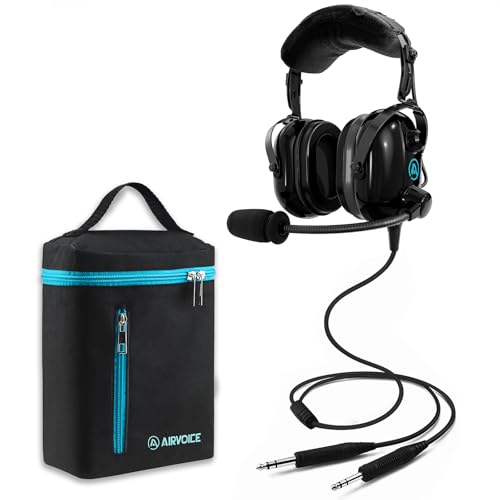
AIRVOICE Pilot Headset with Passive Noise Reduction
by AIRVOICE
$93.99
- Up to 25 dB noise reduction with 3.5mm audio input jack and included carrying case
- Neodymium speakers with noise-canceling microphone for clear ATC communications
- Standard GA dual plugs with adjustable headband for all training aircraft
The AIRVOICE PNR headset at $93.99 is one of the newer budget aviation headsets on the market, offering a solid feature set at a competitive price point with the highest NRR rating in this lineup.
Up to 25 dB noise reduction is the highest rating among the five headsets reviewed here, edging out the 24 dB ratings of the RA200, P1, KA-1, and EHG001. The extra decibel of attenuation is noticeable in louder cockpits.
3.5mm audio input jack lets you connect a phone or tablet for music or audio study materials during cruise flight — a feature the blog previously missed and a genuine advantage over the RA200's wired input at a similar price.
Neodymium speakers deliver clear, lightweight audio with good voice reproduction for ATC communications.
Included carrying case protects the headset during transport, along with an adjustment wrench and windproof microphone cover.
Adjustable headband allows for a customized fit across different head sizes. The adjustment mechanism is straightforward and holds its position during flight.
Standard GA dual plugs ensure compatibility with all GA training aircraft.
Best for: Students looking for the best noise reduction rating under $100 with a 3.5mm audio input and carrying case included.
What to Look for in a Budget Aviation Headset
Not all budget headsets are created equal. Here are the four factors that actually matter, and how to evaluate them before you buy.
1. Noise Reduction (NRR)
Look for at least 22 dB passive noise reduction, with 24-25 dB being the sweet spot for budget models. A Cessna 172 cockpit runs 85-95 dB during cruise flight. At 24 dB PNR (what the RA200, P1, KA-1, and EHG001 deliver), you are hearing 61-71 dB — equivalent to a normal conversation. The AIRVOICE goes a step further with up to 25 dB. Below 20 dB PNR, cockpit noise becomes fatiguing even on short flights and interferes with radio communications.
How to test: On your first flight with a new headset, ask your instructor how the radio quality sounds from the right seat. If they can hear you clearly without asking you to repeat or speak up, the headset is adequate.
2. Microphone Quality
A noise-cancelling electret microphone is the standard for aviation headsets at every price point. The microphone needs to do two things: transmit your voice clearly to ATC and reject cockpit background noise. All five headsets reviewed here use noise-cancelling microphones that meet this requirement.
What to avoid: Headsets with microphone booms that do not stay in position. If the boom drifts away from your mouth during flight, your transmissions become progressively quieter and harder for ATC to understand. The Retevis EHG001 addresses this with a 270-degree rotatable boom and adjustable gain.
3. Comfort and Fit
You will wear this headset for 1-3 hours per session, multiple times per week during active training. Headband padding, ear seal material (foam vs gel), clamping force, and weight all affect comfort.
- Foam ear seals (RA200, P1) are adequate for most students but compress over time and need replacement every 100-200 hours
- Gel ear seals (KA-1, EHG001) conform better to your head shape, create a tighter seal, and last 300+ hours before needing replacement
- Weight ranges from 14-18 ounces in the budget category — lighter is better for long sessions. The RA200 weighs 16 oz; the David Clark H10-13.4 weighs 16.5 oz
- Clamping force should be firm enough to seal without causing headaches
4. GA Dual Plug Compatibility
All five headsets use standard GA dual plugs (0.25-inch phone plug for audio, 0.206-inch plug for microphone). This is the universal standard for General Aviation aircraft. Do not buy a helicopter headset (single U-174 plug) for fixed-wing training — they are not compatible without an adapter.
Budget Headset Limitations: What You Are Giving Up
Honesty about limitations helps you set realistic expectations and know when an upgrade makes sense.
PNR Only — No Active Noise Reduction
Every headset under $100 is passive noise reduction only. ANR (Active Noise Reduction) headsets use electronics to cancel low-frequency engine noise — typically reducing cockpit noise by an additional 10-15 dB on top of the passive seal. ANR starts at approximately $200 for basic models and $949+ for premium Bose and Lightspeed units.
What this means in practice: On a 1-hour training flight in a Cessna 172, PNR is perfectly adequate. On a 3+ hour cross-country in turbulent conditions, you will notice more fatigue compared to an ANR headset. For primary training, this tradeoff is acceptable.
Less Durable Ear Seals (Foam Models)
Budget headset foam ear seals (RA200, P1) use less expensive foam that compresses and hardens faster than the gel seals used in the KA-1 and EHG001 or the premium materials in David Clark headsets. Plan to replace foam ear seals every 100-200 flight hours ($10-$20 per replacement). Gel ear seals (KA-1, EHG001) maintain their properties for 300+ hours.
Weight Comparable to Premium Models
Budget headsets weigh 14-18 ounces. The David Clark H10-13.4 weighs 16.5 oz, the RA200 weighs 16 oz — comparable weight. The Bose A20 at approximately 12 oz is notably lighter, but it costs $1,195. The 2-4 ounce difference between budget and David Clark models is barely noticeable on a 1-hour flight.
No Bluetooth or Audio Panel Integration
Premium headsets offer Bluetooth connectivity for phone calls, music, and aviation app audio routed directly through the headset. Budget headsets require a wired 3.5mm auxiliary connection (the RA200, P1, KA-1, EHG001, and AIRVOICE all include 3.5mm input jacks). This is a convenience feature, not a training necessity.
Quick Comparison: All 5 Headsets Ranked
| Feature | RA200 ($100) | P1 ($125) | KA-1 ($225) | EHG001 ($91) | AIRVOICE ($94) |
|---|---|---|---|---|---|
| NRR | 24 dB | 24 dB | 24 dB | 24 dB | Up to 25 dB |
| Ear Seals | Foam | Foam | Gel | Gel | Foam |
| Audio Input | Yes (3.5mm) | Yes (3.5mm) | Yes (3.5mm) | No | Yes (3.5mm) |
| Headset Bag | Included | Not included | Included | Included | Included |
| Stereo/Mono | Switch | Yes | Yes | Switchable | Yes |
| Gel Seals | No | No | Yes | Yes | No |
| Warranty | 7-year | Standard | 5-year | Lifetime support | Standard |
| Best For | All-around pick | Brand reliability | Mid-tier comfort | Best value with gel | Highest NRR |
Our top pick: The Rugged Air RA200 ($99.99) is the best overall budget aviation headset for student pilots. It has a proven 24 dB noise reduction rating, includes a headset bag, offers 3.5mm MP3 input for cross-country flights, comes with a 7-year factory warranty, and is proven across thousands of student pilots and flight schools.
Best for gel seals under $100: The Retevis EHG001 ($90.99) is the best choice if you want gel ear seal comfort without paying $225 for the KORE KA-1.
Best for tight budgets: The AIRVOICE ($93.99) offers the highest NRR rating (up to 25 dB) with a 3.5mm input jack and carrying case at a sub-$95 price.
Best mid-tier value: The KORE Aviation KA-1 ($224.95) is the best choice if you want gel ear seals, a 5-year warranty, and a headset bag — it bridges the gap between budget PNR and the David Clark H10-13.4 ($374.95).
When to Upgrade: The Budget-to-Premium Timeline
Budget headsets are a starting point, not an endpoint. Here is when upgrading makes sense:
Keep Your Budget Headset If:
- You are still working toward your PPL checkride
- Your flights are primarily 1-1.5 hours in the traffic pattern
- You are not sure whether aviation will become a career or stay a hobby
- Your budget headset still provides comfortable noise reduction with fresh ear seals
Upgrade to David Clark H10-13.4 ($374.95) If:
- You passed your PPL and are starting Instrument Rating training
- Your flights are regularly exceeding 2 hours
- You want a headset that will last 10-20 years with minimal maintenance
- You prefer proven reliability over cutting-edge features
Upgrade to Lightspeed Zulu 3 ($949) or Bose A20 ($1,195) If:
- You are pursuing a professional pilot career (CFI, airlines, charter)
- You fly 200+ hours per year
- Long cross-country flights are a regular part of your flying
- Bluetooth and audio panel integration would improve your workflow
- Noise fatigue is affecting your performance on long flights
The progression from budget to premium should match your commitment level. A $100 headset for PPL training, a $375 David Clark through Instrument and Commercial, and a $949+ ANR headset for career flying is the most financially efficient path.
Free Aviation Exam Prep Resources
Your headset gets you through the flying — our free resources get you through the knowledge tests:
- Free ATP Pilot Exam Prep — Airline Transport Pilot knowledge test coverage including aerodynamics, weather, regulations, and flight operations
- Free Instrument Rating Study Guide — IFR procedures, approach plates, weather minimums, and instrument navigation
- Free CFI Exam Prep — Fundamentals of instruction, teaching techniques, and flight instructor knowledge
- AI Tutor — 10 free questions per day — ask about airspace, weather theory, radio communications, or any aviation topic
- Practice Questions — Test your knowledge with exam-style questions covering all FAA knowledge test areas
The AI tutor is particularly useful for practicing ATC radio communications. Ask it questions like "Walk me through a radio call sequence for a VFR arrival at a Class D airport" or "Explain the difference between Class B and Class C airspace entry requirements" and get detailed, exam-level responses instantly.
Final Verdict
Buy the Rugged Air RA200 ($99.99) if you want the best overall budget aviation headset. It is the most-reviewed budget headset on Amazon for a reason — 24 dB NRR, 3.5mm MP3 input, included headset bag, 7-year factory warranty, and proven reliability across thousands of student pilots.
Buy the Retevis EHG001 ($90.99) if you want gel ear seals at a sub-$100 price. It is the only headset in this lineup that offers gel ear seal comfort under $100, with 24 dB NRR and a 270-degree rotatable boom mic.
Buy the AIRVOICE ($93.99) if you want the highest noise reduction rating under $100. Up to 25 dB NRR with a 3.5mm input jack and included carrying case makes it the best value pick.
The KORE Aviation P1 ($124.95) is a solid step up for students who want a proven brand-name headset with 24 dB PNR and AUX input.
The KORE Aviation KA-1 ($224.95) is the best mid-tier value if you want gel ear seals, a 5-year warranty, and a headset that bridges the gap between budget PNR and the David Clark H10-13.4 ($374.95).
Whatever headset you choose, pair it with serious exam preparation. Flight skills get you through the checkride, but knowledge test scores determine whether you get to take the checkride in the first place. Start studying today with our free aviation exam prep resources.
As an Amazon Associate, OpenExamPrep earns from qualifying purchases. All recommendations are based on editorial review.

 Free CE

