ASVAB Exam 2026: Your Complete Military Aptitude Test Guide
The ASVAB (Armed Services Vocational Aptitude Battery) is a multiple-aptitude test used by all branches of the U.S. military to determine qualification for enlistment and identify the best military occupational specialties (MOS) for each recruit. Whether you're aiming for the Army, Navy, Air Force, Marine Corps, Coast Guard, or Space Force, the ASVAB is your first step toward a military career.
The ASVAB measures your strengths and potential for future success in military training. Your scores help match you with jobs that fit your abilities.
Exam Format & Structure
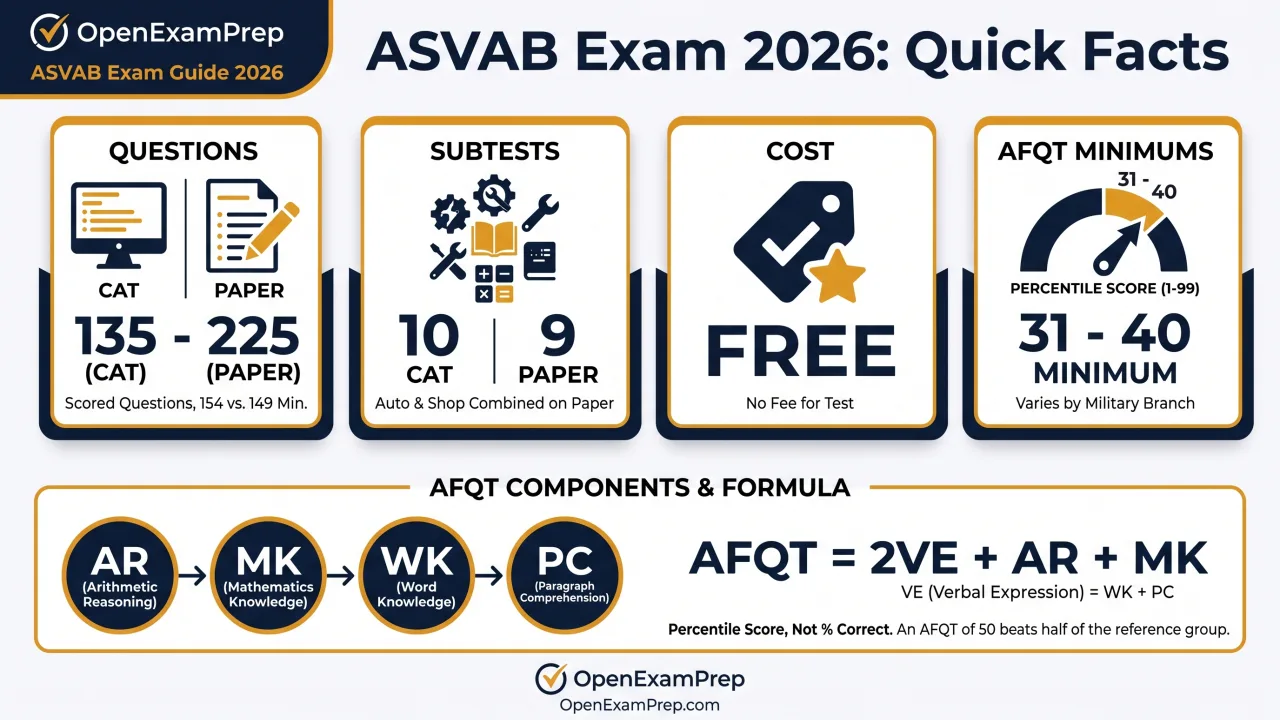
| Component | CAT-ASVAB (Computer) | Paper ASVAB (P&P) |
|---|---|---|
| Total Questions | 135 questions | 225 questions |
| Total Time | ~154 minutes (testing) | 149 minutes |
| Subtests | 10 subtests (Auto and Shop separate) | 9 subtests (Auto & Shop combined) |
| Scoring | Computer adaptive (adjusts to ability) | Fixed difficulty |
| Going back | Cannot return to earlier questions | Can review within a subtest |
| Cost | FREE | FREE |
| Location | MEPS or MET (Military Entrance Test) site | High schools, MET sites |
The ASVAB is offered in two formats:
- CAT-ASVAB (Computer Adaptive Test) - The version nearly all enlistees take at a MEPS (Military Entrance Processing Station) or MET site. Questions adapt to your ability level: answer correctly and the next item gets harder. It has 135 scored questions, and the adaptive design makes it faster than paper. Each subtest is individually timed, and you cannot go back to a previous question once you submit it.
- Paper-and-Pencil ASVAB (P&P) - A fixed-form test of 225 questions in 149 minutes, offered at schools through the ASVAB Career Exploration Program and at some MET sites. The paper version combines Auto Information and Shop Information into a single Auto & Shop Information subtest, so it has 9 subtests instead of the CAT's 10.
Note on CAT timing: Standard CAT-ASVAB testing time is about 154 minutes. When the computer adds unscored "tryout" research questions to 2-4 subtests, your allotted time can rise to roughly 197 minutes. Tryout questions do not affect your score, and you are given extra time when they appear.
Start Your FREE ASVAB Prep Today
Our comprehensive prep covers all 10 subtests with practice questions, strategies, and an AI tutor for instant explanations -- 100% FREE. Free accounts include 10 AI-assisted questions per day.
The 10 ASVAB Subtests
The ASVAB consists of 10 subtests that measure different aptitudes:
Verbal Domain
1. Word Knowledge (WK)
- CAT: 15 questions, 9 minutes
- P&P: 35 questions, 11 minutes
- Tests vocabulary and word meanings
- Includes synonyms and context clues
2. Paragraph Comprehension (PC)
- CAT: 10 questions, 27 minutes
- P&P: 15 questions, 13 minutes
- Tests reading comprehension
- Analyzes passages for main ideas and details
Math Domain
3. Arithmetic Reasoning (AR)
- CAT: 15 questions, 55 minutes
- P&P: 30 questions, 36 minutes
- Word problems requiring math
- Real-world math applications
- One of the four AFQT subtests
4. Mathematics Knowledge (MK)
- CAT: 15 questions, 31 minutes
- P&P: 25 questions, 24 minutes
- Pure math concepts
- Algebra, geometry, basic math principles
- One of the four AFQT subtests
Science & Technical Domain
5. General Science (GS)
- CAT: 15 questions, 12 minutes
- P&P: 25 questions, 11 minutes
- Life science, physical science, earth science
- Basic scientific principles and concepts
6. Electronics Information (EI)
- CAT: 15 questions, 10 minutes
- P&P: 20 questions, 9 minutes
- Electrical concepts and terminology
- Circuits, currents, resistance, voltage
7. Mechanical Comprehension (MC)
- CAT: 15 questions, 22 minutes
- P&P: 25 questions, 19 minutes
- Mechanical and physical principles
- Levers, pulleys, gears, forces
Auto & Shop Domain
8. Auto Information (AI)
- CAT: 10 questions, 7 minutes (separate subtest)
- P&P: Combined with Shop in one 25-question, 11-minute Auto & Shop Information subtest
- Automotive maintenance and repair
- Engine systems, electrical systems
9. Shop Information (SI)
- CAT: 10 questions, 6 minutes (separate subtest)
- P&P: Combined with Auto (see above)
- Wood and metal shop practices
- Tools, materials, procedures
On the CAT-ASVAB, Auto Information and Shop Information are two separate subtests. On the paper ASVAB, they are merged into a single Auto & Shop Information (AS) subtest, which is why the paper test has 9 subtests and the computer test has 10.
Spatial Domain
10. Assembling Objects (AO)
- CAT: 15 questions, 18 minutes
- P&P: 25 questions, 15 minutes
- Spatial relationships and visualization
- Connecting points and assembling shapes
Where and How to Take the ASVAB
There are three main ways to take the ASVAB, and which one you take depends on whether you are enlisting or exploring careers:
- At a MEPS (Military Entrance Processing Station): If you are enlisting, your recruiter schedules you for the CAT-ASVAB at the nearest MEPS. This is the version that counts for enlistment. You typically take the ASVAB and your MEPS physical over the same visit (plan for a full day).
- At a MET (Military Entrance Test) site: For applicants who live far from a MEPS, the test is offered at satellite MET sites (often a National Guard armory, federal building, or recruiting office). These may use the CAT-ASVAB or the paper version.
- At a high school through the Career Exploration Program (CEP): Students take the paper ASVAB at school as a free career-planning tool. CEP scores can be used for enlistment for up to two years, but results are not automatically sent to recruiters.
There is no fee to take the ASVAB in any of these settings, and you do not bring a calculator -- one is not permitted on the math subtests.
Understanding Your AFQT Score
The AFQT (Armed Forces Qualification Test) score is the most important number from your ASVAB. It is a percentile from 1 to 99 that compares you to a nationally representative sample of test-takers, and it determines whether you can enlist in the military. An AFQT of 60 means you scored as well as or better than 60% of that reference group -- it is not a percentage of questions answered correctly.
AFQT Formula
AFQT = 2VE + AR + MK
Where:
- VE (Verbal Expression) = WK + PC (combined standard score)
- AR = Arithmetic Reasoning standard score
- MK = Mathematics Knowledge standard score
AFQT Score Categories
| Category | Percentile | Description |
|---|---|---|
| I | 93-99 | Outstanding |
| II | 65-92 | Above Average |
| IIIA | 50-64 | Average |
| IIIB | 31-49 | Below Average |
| IV | 10-30 | Below Average (limited enlistment) |
| V | 1-9 | Not eligible for enlistment |
Minimum AFQT Scores by Branch (2026)
| Branch | Minimum AFQT (HS Diploma, Tier I) | Minimum AFQT (GED, Tier II) |
|---|---|---|
| Army | 31 | 50 |
| Navy | 31 (35 commonly cited) | 50 |
| Marine Corps | 32 | 50 |
| Air Force | 31 (36+ to be competitive) | 65 |
| Space Force | 31 (36+ to be competitive) | 65 |
| Coast Guard | 36 (40 commonly cited) | 47-50 |
These are the published floors. They change with recruiting needs and are applied at the recruiter's discretion -- branches routinely require higher scores for competitive enlistment and for desired MOS/ratings, and GED holders (Tier II) face both a higher AFQT floor and tighter enlistment quotas. Always confirm the current minimum with a recruiter for your specific branch and goal.
Free Practice Questions & Study Materials
Each subtest section includes:
- Detailed content explanations
- Official-style practice questions
- Test-taking strategies
- Key formulas and concepts
Composite Scores and Military Jobs
Beyond the AFQT, your subtest scores combine into composite scores (also called line scores) that determine which military jobs you qualify for:
Army Composite Scores (Example)
| Composite | Subtests | Job Categories |
|---|---|---|
| CL (Clerical) | VE + AR + MK | Administrative roles |
| CO (Combat) | AR + AS + MC | Combat arms |
| EL (Electronics) | GS + AR + MK + EI | Electronics/IT |
| FA (Field Artillery) | AR + MK + MC | Artillery operations |
| GM (General Maintenance) | GS + AS + MK + EI | Maintenance jobs |
| GT (General Technical) | VE + AR | Many specialized jobs |
| MM (Mechanical Maintenance) | AS + EI + MC | Vehicle/equipment maintenance |
| OF (Operators/Food) | VE + AS + MC | Operators, food service |
| SC (Surveillance/Communications) | VE + AR + AS + MC | Surveillance, communications |
| ST (Skilled Technical) | GS + VE + MK + MC | Technical specialists |
In the table above, AS = Auto & Shop Information (the combined paper-ASVAB subtest). Each branch has its own composite score system with different names: the Army uses line scores like GT and ST, the Navy and Coast Guard use ratings composites, the Air Force and Space Force use MAGE categories (Mechanical, Administrative, General, Electronics), and the Marine Corps uses MM, EL, GT, and CL. The same subtest scores get recombined differently for each branch's jobs.
Study Timeline for ASVAB Success
| Week | Focus | Activities |
|---|---|---|
| 1 | Diagnostic | Take practice test, identify weak areas |
| 2 | Verbal | Word Knowledge, Paragraph Comprehension |
| 3 | Math | Arithmetic Reasoning, Mathematics Knowledge |
| 4 | Technical | General Science, Electronics Information |
| 5 | Mechanical | Mechanical Comprehension, Auto/Shop |
| 6 | Review | Full practice tests, weak area focus |
Recommended: 4-8 weeks of focused study
Test-Taking Strategies
General Strategies
- Prioritize AFQT subtests - AR, MK, WK, PC determine eligibility
- Manage your time - CAT-ASVAB doesn't allow going back
- Don't leave blanks - No penalty for wrong answers
- Read carefully - Watch for words like "NOT" or "EXCEPT"
For Word Knowledge
- Learn common prefixes, suffixes, and roots
- Context clues often reveal meaning
- Eliminate obviously wrong answers first
For Arithmetic Reasoning
- Draw diagrams for word problems
- Write out your calculations
- Check if answer is reasonable
- Common topics: percentages, ratios, time/distance
For Mathematics Knowledge
- Memorize key formulas
- Know order of operations (PEMDAS)
- Practice algebra and geometry
- Focus on: quadratics, angles, area/volume
For Mechanical Comprehension
- Understand simple machines (levers, pulleys, gears)
- Know how forces work
- Visualize mechanical problems
- Practice reading diagrams
Retaking the ASVAB
If you don't score high enough, you can retake the ASVAB:
| Attempt | Waiting Period |
|---|---|
| 1st retest | 1 month after initial test |
| 2nd retest | 1 month after 1st retest |
| Subsequent | 6 months after previous test |
ASVAB scores are valid for 2 years for enlistment purposes.
ASVAB Career Exploration Program (CEP)
High school students can take the ASVAB through the Career Exploration Program:
- Free aptitude and career exploration tool
- Results are NOT sent to military recruiters automatically
- Provides valuable career insights regardless of military plans
- Same 10 subtests as enlistment ASVAB
- Can be used for enlistment within 2 years
ASVAB Eligibility Requirements
| Requirement | Details |
|---|---|
| Age | 17-39 (varies by branch) |
| Citizenship | U.S. citizen or permanent resident |
| Education | High school diploma preferred (GED accepted with higher scores) |
| Physical | Must also pass MEPS physical exam |
Pass the ASVAB with Confidence
Join thousands of future service members who prepared for their ASVAB using our comprehensive, 100% FREE study materials. Our course includes:
- All 10 subtests covered in detail
- Practice questions matching actual ASVAB style
- Math formulas and vocabulary lists for quick review
- AI-powered study assistance for instant explanations
- Regularly updated for 2026
No credit card required. Start studying today and serve your country.
Official Resources
- Official ASVAB Program - ASVAB Career Exploration Program
- Military OneSource - Military resources and support
- Today's Military - Branch comparisons and careers
- MEPS Locations - Find your nearest MEPS
- Your local military recruiter
Official-Source Check Before You Schedule
Treat this article as a study map, not a substitute for the current official ASVAB candidate materials. Use the official candidate handbook, exam content outline, state agency page, or credential sponsor page as the source of truth for requirements that affect scheduling and eligibility. Requirements can change by testing window, jurisdiction, sponsor update, or delivery vendor, and those changes often affect small details candidates overlook: identification rules, retake timing, calculator policy, reference materials, continuing-education language, application approvals, and the exact way domains are named.
Before you pay for an exam date, make a one-page source checklist. Put the official exam page, candidate handbook, content outline or blueprint, fee page, accommodation instructions, and reschedule policy in one place. Then compare your prep materials against that checklist. If a prep book, course, or old post disagrees with the sponsor, follow the sponsor. This is especially important for candidates returning after a failed attempt because they may be studying from notes built around an older outline.
How To Read The Blueprint Without Overstudying
Do not read the ASVAB content outline like a table of contents. Read it like a risk map. Each domain tells you what the exam writer is allowed to test, but the action verbs tell you how the topic may appear. A verb such as identify usually points to recognition. A verb such as apply, analyze, evaluate, calculate, determine, or recommend means the question can require judgment, sequencing, or multi-step reasoning.
Use four passes through the outline. First, mark topics you already use at work. Second, mark topics you recognize but cannot explain without notes. Third, mark topics that have unfamiliar vocabulary. Fourth, mark topics that combine two skills, such as a rule plus a calculation or a policy plus a scenario. The fourth group deserves the most practice because it is where candidates often feel prepared while still missing points.
For the ASVAB, route your weekly study around these high-friction buckets:
- eligibility and scheduling rules
- scenario vocabulary
- domain-by-domain weak areas
- exam-day time control
The goal is not to give every line of the outline equal time. The goal is to convert weak, testable behaviors into repeatable decisions. If a topic is easy in isolation but difficult inside a mixed set, it belongs in your active rotation until it stays stable under time pressure.
Scenario Strategy For Hard Questions
Most candidates miss hard ASVAB questions for one of three reasons: they answer the first familiar phrase, they ignore a limiting condition, or they spend too long trying to make every answer choice perfect. A better method is to treat each exam scenario as a short professional decision.
Start by naming the task in plain English. Ask: what is the exam actually asking me to decide? Then identify the controlling facts. Separate facts that change the answer from facts that merely describe the setting. Next, predict the principle before looking at the options. Even a rough prediction reduces the chance that an attractive distractor pulls you away from the rule, process, or judgment being tested.
When two answer choices remain, compare them against the exact role you are playing in the prompt. Are you acting as a supervisor, adviser, technician, manager, applicant, analyst, auditor, clinician, inspector, or public-facing professional? Exam writers often make the second-best option sound reasonable for the wrong role. If the question asks for the next action, prefer the answer that preserves safety, compliance, documentation, client interest, or process control before jumping to a final conclusion.
Practice Routing And Score Repair
Use practice questions as diagnostic data, not as a score-chasing game. After each timed block, tag every miss with one primary cause: content gap, vocabulary gap, careless reading, calculation setup, scenario judgment, or pacing. If you tag everything as content, your remediation will be too broad. If you tag every miss carefully, your next study block becomes obvious.
A strong remediation cycle has three steps. First, reread only the smallest source section that explains the miss. Second, write a one-sentence rule in your own words. Third, answer two or three nearby questions without notes. If you can only answer the original question after seeing the explanation, you have recognized the answer rather than repaired the skill.
Use mixed sets earlier than feels comfortable. Topic-by-topic drills build confidence, but the real exam rarely announces which rule is being tested. A mixed set forces you to identify the domain before solving. That recognition skill is part of readiness. Start with short mixed sets, then grow into longer timed blocks as your accuracy stabilizes.
Final Two-Week Readiness Plan
Two weeks before exam day, stop measuring progress by pages completed. Measure it by repeatable performance. Your target is not one lucky high score; it is several timed blocks where the same weak area no longer appears in the miss log.
During the first week, run alternating blocks: one targeted weak-area set, one mixed timed set, one review block, and one short recall session. The recall session should be closed-book. Write definitions, formulas, procedures, rule triggers, or decision steps from memory, then check them against the official outline and your notes.
During the final week, reduce new material. Keep daily contact with the hardest topics, but shift toward confidence, pacing, and clean execution. Rework missed questions from your log, especially the ones you missed twice. Review administrative requirements, testing location rules, remote-proctor rules if applicable, identification, permitted materials, and break policy. Those logistics are not content knowledge, but they can still disrupt performance if you handle them late.
Common Traps To Avoid
The first trap is passive rereading. Rereading feels productive because the material becomes familiar, but familiarity does not prove you can choose correctly under pressure. Convert reading into retrieval: close the source, explain the rule, then apply it.
The second trap is treating every miss as equal. A careless one-off miss needs a prevention habit. A repeated domain miss needs a study block. A pacing miss needs timed drills. A vocabulary miss needs flashcards or a glossary. Different misses require different repairs.
The third trap is delaying full-length or longer timed practice until the last few days. Longer practice exposes fatigue, sequencing problems, and weak time allocation. Find those problems while there is still time to fix them.
The fourth trap is ignoring why the right answer is right. For each reviewed item, write why the correct answer wins and why the best distractor fails. That second sentence is where durable learning happens.
When You Are Ready
You are ready for the ASVAB when you can explain the core subtests without reading the outline, complete timed sets without rushing the final questions, and identify your miss patterns before checking the score report. You should also be able to say what you will do if the first ten questions feel harder than expected. The answer should be simple: slow down, return to the task, identify controlling facts, eliminate role-inconsistent options, and keep moving.
Passing is usually less about finding a secret resource and more about building a reliable loop: official source, focused study, timed practice, miss analysis, and targeted repair. Keep that loop tight, and every practice session has a job.


 Buy on Amazon
 Practice exams on ExamEdge
 Online course on Mometrix
 Study resources on Achievable