Alcohol Server Certification Guide 2026: Complete Training Guide
Need your alcohol server certification? Whether you call it TIPS training, RBS certification, or responsible beverage service, this FREE guide will help you understand the requirements and pass your exam in 2026.
What Is Alcohol Server Certification?
Alcohol server certification (also called responsible beverage service or RBS) is training that teaches bartenders, servers, and alcohol sellers how to serve alcohol responsibly. This includes checking IDs, recognizing intoxication, and knowing when to refuse service.
Common Certification Programs
| Program | Full Name | Primary States |
|---|---|---|
| TIPS | Training for Intervention ProcedureS | Nationwide |
| RBS | Responsible Beverage Service | California |
| TABC | Texas Alcoholic Beverage Commission | Texas |
| TAM | Techniques of Alcohol Management | Nevada |
| RAMP | Responsible Alcohol Management Program | Pennsylvania |
State Requirements for Alcohol Server Certification
States Requiring Mandatory Certification
| State | Certification Name | Validity | Time to Complete |
|---|---|---|---|
| California | RBS | 3 years | Before serving |
| Texas | TABC Seller-Server | 2 years | Within 30 days |
| Nevada | TAM | 4 years | Before serving |
| Oregon | OLCC | 5 years | Within 30 days |
| Washington | MAST | 5 years | First 60 days |
| Florida | Responsible Vendor | 4 years | Recommended |
| Arizona | Title 4 Training | 2 years | Within 30 days |
Understanding Blood Alcohol Concentration (BAC)
What Is a Standard Drink?
All of these equal ONE standard drink:
| Beverage | Amount | ABV |
|---|---|---|
| Beer | 12 oz | 5% |
| Wine | 5 oz | 12% |
| Distilled spirits | 1.5 oz (shot) | 40% |
| Malt liquor | 8 oz | 7% |
BAC Limits and Effects
| BAC Level | Effects |
|---|---|
| 0.02% | Slight mood change, relaxation |
| 0.05% | Lowered inhibitions, impaired judgment |
| 0.08% | Legal intoxication (driving) |
| 0.10% | Slurred speech, poor coordination |
| 0.15% | Significant motor impairment |
| 0.30%+ | Loss of consciousness, danger |
Factors Affecting BAC
Faster absorption (higher BAC):
- Drinking on empty stomach
- Carbonated beverages (champagne, mixed drinks with soda)
- Lower body weight
- Female biological factors
Slower absorption (lower BAC):
- Eating before/while drinking
- Higher body weight
- Drinking water between drinks
Checking Identification
Acceptable Forms of ID
| Valid ID | Must Have |
|---|---|
| Driver's license | Photo, DOB, expiration |
| State ID card | Photo, DOB, expiration |
| Passport | Photo, DOB |
| Military ID | Photo, DOB |
| Passport card | Photo, DOB |
The FEAR Method for Checking IDs
| Letter | Meaning | What to Check |
|---|---|---|
| F | Feel | Card texture, raised lettering |
| E | Examine | Photo match, physical characteristics |
| A | Ask | Questions about info on ID |
| R | Return | Give back only to presenter |
Signs of a Fake ID
- Photo doesn't match the person
- ID looks altered or tampered
- Card feels too thick/thin
- Missing holograms or security features
- Person can't answer basic questions about their address/zodiac sign
- Numbers are misaligned or irregular
Recognizing Intoxication
Physical Signs of Intoxication
Early Signs:
- Flushed face
- Loud talking
- Relaxed inhibitions
- Increased confidence
Progressive Signs:
- Slurred speech
- Bloodshot or watery eyes
- Unsteady movement
- Spilling drinks
- Difficulty focusing
Severe Signs:
- Unable to stand without support
- Vomiting
- Unconsciousness
- Difficulty breathing
Behavioral Signs
| Sign | What You'll Notice |
|---|---|
| Drinking patterns | Ordering doubles, drinking fast |
| Speech | Slurred, loud, inappropriate |
| Coordination | Stumbling, knocking things over |
| Behavior | Aggressive, overly friendly |
| Focus | Difficulty making eye contact |
Intervention and Refusal Techniques
The S.L.O.W. Method
| Letter | Action | Example |
|---|---|---|
| S | Stop serving | Don't provide more alcohol |
| L | Listen | Let them respond |
| O | Offer alternatives | Water, food, coffee, ride |
| W | Walk away if needed | Involve manager if escalating |
How to Refuse Service
DO:
- Remain calm and professional
- Use "I" statements ("I can't serve you more alcohol")
- Offer alternatives (water, food, non-alcoholic drinks)
- Involve management if needed
- Arrange safe transportation
DON'T:
- Be confrontational or rude
- Say "You're drunk"
- Embarrass the customer publicly
- Continue serving to avoid conflict
Sample Refusal Scripts
Situation 1: Visibly intoxicated
"I'm sorry, but I'm not able to serve you any more alcohol tonight. Can I get you some water or food? I'd also be happy to call you a cab or rideshare."
Situation 2: Minor attempting to order
"I'll need to see your ID before I can serve you. This ID shows you're under 21, so I can't serve you alcohol. Can I get you a soft drink instead?"
Legal Responsibilities
Dram Shop Laws
What are Dram Shop Laws? These laws hold establishments and servers liable for serving alcohol to:
- Minors (under 21)
- Visibly intoxicated persons
Potential Consequences:
| For the Establishment | For the Server |
|---|---|
| Fines ($1,000-$100,000+) | Personal fines |
| License suspension/revocation | Criminal charges |
| Civil lawsuits | Civil liability |
| Loss of liquor license | Job termination |
Criminal Penalties for Serving Minors
| Offense | Typical Penalty |
|---|---|
| First offense | $250-$1,000 fine |
| Second offense | $500-$2,000 fine + possible jail |
| Third offense | $1,000-$5,000 fine + jail time |
| Serving to minor who causes injury | Felony charges possible |
Alcohol Server Exam Format
| Aspect | Details |
|---|---|
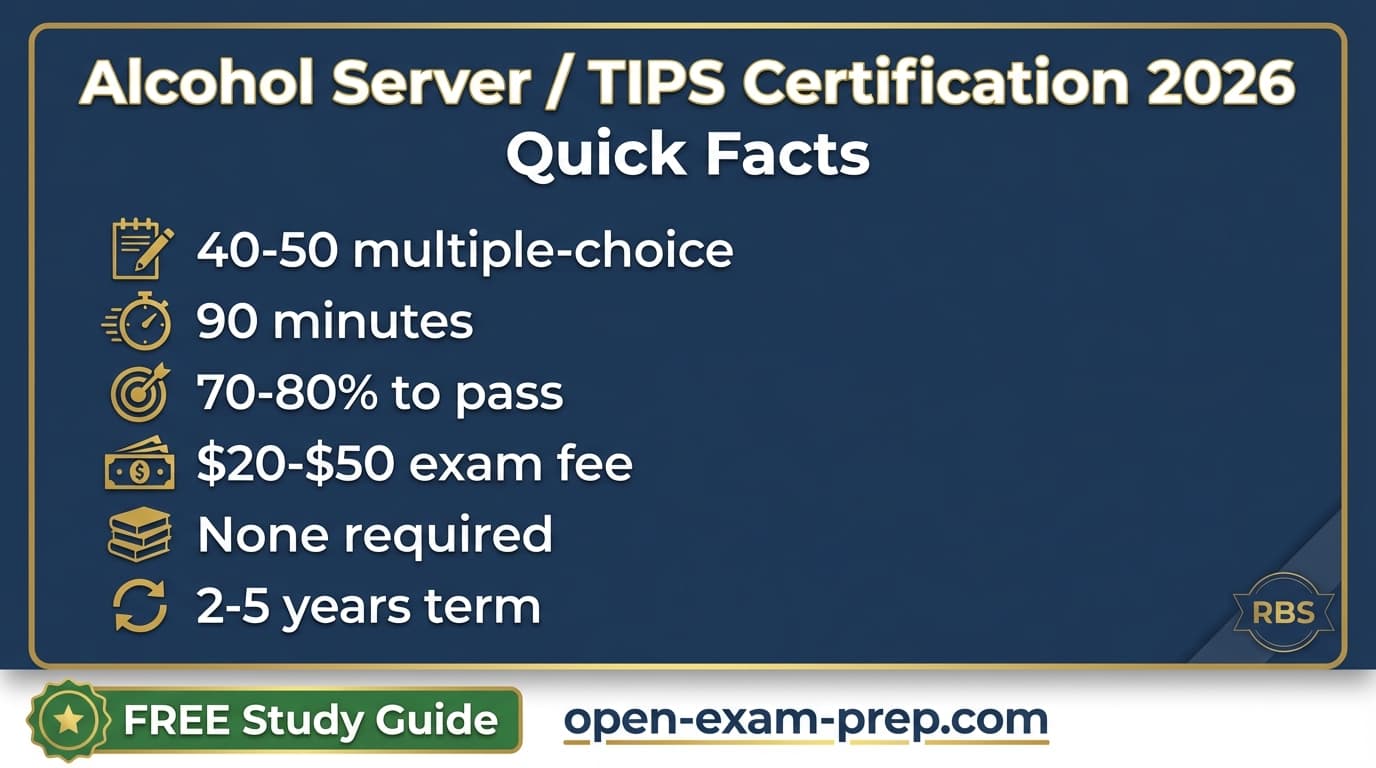
| Questions | 40-50 multiple-choice |
| Time | 60-90 minutes |
| Passing Score | 70-80% (varies by state) |
| Format | Online or in-person |
| Cost | $20-$50 |
| Validity | 2-5 years |
Top 5 Alcohol Server Exam Tips
- Know the standard drink sizes - 12 oz beer = 5 oz wine = 1.5 oz spirits
- Master the FEAR method - Feel, Examine, Ask, Return for checking IDs
- Understand BAC factors - What speeds up and slows down absorption
- Practice refusal techniques - S.L.O.W. method and professional scripts
- Learn your state's laws - Dram shop liability and penalties
Free vs. Paid Alcohol Server Certification
| Feature | Free (OpenExamPrep) | Paid Courses |
|---|---|---|
| Study materials | ✅ Complete guide | ✅ Complete guide |
| Practice questions | ✅ 80+ questions | ✅ 50-100 questions |
| AI study help | ✅ Included | ❌ Not available |
| Official certificate | ❌ Test elsewhere | ✅ Included |
| Cost | FREE | $20-$50 |
Our Approach: Use our FREE materials to prepare, then pay only for your official certificate.
Special Situations
High-Risk Scenarios
| Scenario | Best Response |
|---|---|
| Guest brought own alcohol | Politely explain house rules |
| Group buying for minor | Refuse entire order |
| Customer claims "designated driver" | Still verify if they're drinking |
| Wedding/event | Monitor consumption throughout |
| Late-night rush | Stay vigilant, don't rush ID checks |
Handling Intoxicated Customers Who Drive
- Never let them drive - This is your legal and moral responsibility
- Offer alternatives - Call rideshare, taxi, or sober friend
- Contact authorities if needed - If they insist on driving
- Document the incident - Record what happened
Frequently Asked Questions
How long does alcohol server certification take?
Most programs take 2-4 hours to complete, including the training course and exam. You can usually complete everything online in one sitting.
How much does TIPS certification cost?
TIPS certification typically costs $30-$45. Our study materials are FREE to help you prepare.
Do I need certification if I just check IDs at the door?
In most states requiring certification, anyone who handles alcohol sales or service needs certification - including door staff who check IDs.
Can I get my alcohol server certification online?
Yes! Most states accept online certification. You'll complete training and pass an exam to receive your certificate.
Start Your FREE Alcohol Server Prep Today
Our free alcohol server certification prep includes:
- Complete TIPS/RBS study guide
- 80+ practice questions
- ID checking scenarios
- Intervention techniques
- AI-powered study assistance
Prepare for FREE with OpenExamPrep, then get your official certificate from an accredited provider.
Official-Source Check Before You Schedule
Treat this article as a study map, not a substitute for the current Alcohol Server Certification Guide 2026: TIPS, RBS & State Training candidate materials. For food, alcohol, and safety credentials, confirm state or local acceptance rules with the regulator or approved training provider before assuming one certificate works everywhere. Requirements can change by testing window, jurisdiction, sponsor update, or delivery vendor, and those changes often affect small details candidates overlook: identification rules, retake timing, calculator policy, reference materials, continuing-education language, application approvals, and the exact way domains are named.
Before you pay for an exam date, make a one-page source checklist. Put the official exam page, candidate handbook, content outline or blueprint, fee page, accommodation instructions, and reschedule policy in one place. Then compare your prep materials against that checklist. If a prep book, course, or old post disagrees with the sponsor, follow the sponsor. This is especially important for candidates returning after a failed attempt because they may be studying from notes built around an older outline.
How To Read The Blueprint Without Overstudying
Do not read the Alcohol Server Certification Guide 2026: TIPS, RBS & State Training outline like a table of contents. Read it like a risk map. Each domain tells you what the exam writer is allowed to test, but the action verbs tell you how the topic may appear. A verb such as identify usually points to recognition. A verb such as apply, analyze, evaluate, calculate, determine, or recommend means the question can require judgment, sequencing, or multi-step reasoning.
Use four passes through the outline. First, mark topics you already use at work. Second, mark topics you recognize but cannot explain without notes. Third, mark topics that have unfamiliar vocabulary. Fourth, mark topics that combine two skills, such as a rule plus a calculation or a policy plus a scenario. The fourth group deserves the most practice because it is where candidates often feel prepared while still missing points.
For Alcohol Server Certification Guide 2026: TIPS, RBS & State Training, route your weekly study around these high-friction buckets:
- hazard recognition
- temperature or contamination controls
- manager responsibility
- state-specific rule acceptance
The goal is not to give every line of the outline equal time. The goal is to convert weak, testable behaviors into repeatable decisions. If a topic is easy in isolation but difficult inside a mixed set, it belongs in your active rotation until it stays stable under time pressure.
Scenario Strategy For Hard Questions
Most candidates miss hard Alcohol Server Certification Guide 2026: TIPS, RBS & State Training questions for one of three reasons: they answer the first familiar phrase, they ignore a limiting condition, or they spend too long trying to make every answer choice perfect. A better method is to treat each exam scenario as a short professional decision.
Start by naming the task in plain English. Ask: what is the exam actually asking me to decide? Then identify the controlling facts. Separate facts that change the answer from facts that merely describe the setting. Next, predict the principle before looking at the options. Even a rough prediction reduces the chance that an attractive distractor pulls you away from the rule, process, or judgment being tested.
When two answer choices remain, compare them against the exact role you are playing in the prompt. Are you acting as a supervisor, adviser, technician, manager, applicant, analyst, auditor, clinician, inspector, or public-facing professional? Exam writers often make the second-best option sound reasonable for the wrong role. If the question asks for the next action, prefer the answer that preserves safety, compliance, documentation, client interest, or process control before jumping to a final conclusion.
Practice Routing And Score Repair
Use practice questions as diagnostic data, not as a score-chasing game. After each timed block, tag every miss with one primary cause: content gap, vocabulary gap, careless reading, calculation setup, scenario judgment, or pacing. If you tag everything as content, your remediation will be too broad. If you tag every miss carefully, your next study block becomes obvious.
A strong remediation cycle has three steps. First, reread only the smallest source section that explains the miss. Second, write a one-sentence rule in your own words. Third, answer two or three nearby questions without notes. If you can only answer the original question after seeing the explanation, you have recognized the answer rather than repaired the skill.
Use mixed sets earlier than feels comfortable. Topic-by-topic drills build confidence, but the real exam rarely announces which rule is being tested. A mixed set forces you to identify the domain before solving. That recognition skill is part of readiness. Start with short mixed sets, then grow into longer timed blocks as your accuracy stabilizes.
Final Two-Week Readiness Plan
Two weeks before exam day, stop measuring progress by pages completed. Measure it by repeatable performance. Your target is not one lucky high score; it is several timed blocks where the same weak area no longer appears in the miss log.
During the first week, run alternating blocks: one targeted weak-area set, one mixed timed set, one review block, and one short recall session. The recall session should be closed-book. Write definitions, formulas, procedures, rule triggers, or decision steps from memory, then check them against the official outline and your notes.
During the final week, reduce new material. Keep daily contact with the hardest topics, but shift toward confidence, pacing, and clean execution. Rework missed questions from your log, especially the ones you missed twice. Review administrative requirements, testing location rules, remote-proctor rules if applicable, identification, permitted materials, and break policy. Those logistics are not content knowledge, but they can still disrupt performance if you handle them late.
Common Traps To Avoid
The first trap is passive rereading. Rereading feels productive because the material becomes familiar, but familiarity does not prove you can choose correctly under pressure. Convert reading into retrieval: close the source, explain the rule, then apply it.
The second trap is treating every miss as equal. A careless one-off miss needs a prevention habit. A repeated domain miss needs a study block. A pacing miss needs timed drills. A vocabulary miss needs flashcards or a glossary. Different misses require different repairs.
The third trap is delaying full-length or longer timed practice until the last few days. Longer practice exposes fatigue, sequencing problems, and weak time allocation. Find those problems while there is still time to fix them.
The fourth trap is ignoring why the right answer is right. For each reviewed item, write why the correct answer wins and why the best distractor fails. That second sentence is where durable learning happens.
When You Are Ready
You are ready for Alcohol Server Certification Guide 2026: TIPS, RBS & State Training when you can explain the core domains without reading the outline, complete timed sets without rushing the final questions, and identify your miss patterns before checking the score report. You should also be able to say what you will do if the first ten questions feel harder than expected. The answer should be simple: slow down, return to the task, identify controlling facts, eliminate role-inconsistent options, and keep moving.
Passing is usually less about finding a secret resource and more about building a reliable loop: official source, focused study, timed practice, miss analysis, and targeted repair. Keep that loop tight, and every practice session has a job.

 Buy on Amazon
 Take courses on Udemy
 Practice exams on ExamEdge