Does Texas Have a Notary Exam in 2026? Yes - This Is New
For decades the answer was no. Texas had no exam and no education requirement - you simply bought a $10,000 bond, filed an application, and paid a small fee. That changed on January 1, 2026.
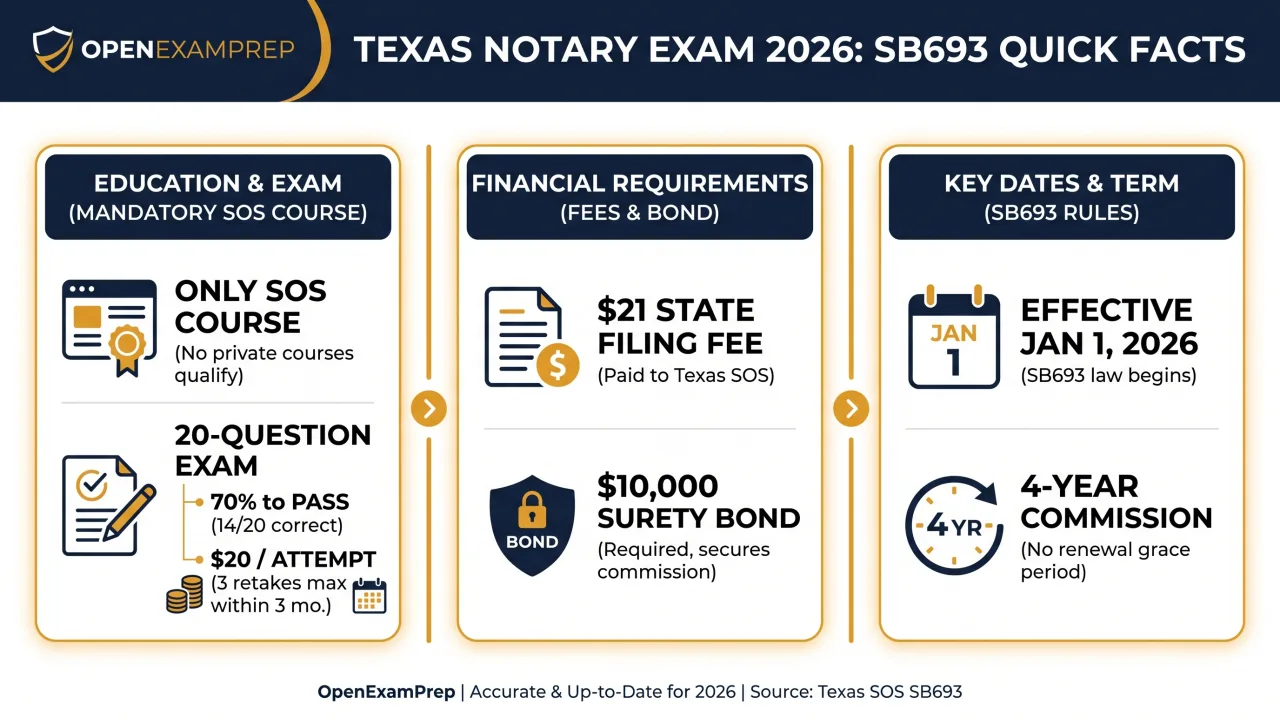
Under Senate Bill 693 (SB693), passed by the 89th Texas Legislature, every new and renewing notary must now complete a state education course and pass a 20-question online exam. The Texas Secretary of State (SOS) is the only authorized provider - no private course satisfies the requirement. This guide gives you the real, current process end to end, plus practice questions on the law the exam actually tests.
Texas Notary at a Glance (2026)
| Component | Detail |
|---|---|
| Education provider | Texas Secretary of State only |
| Course length | Up to 2 hours, online (SOS Notary Portal) |
| Exam | 20 multiple-choice questions, open-book |
| Passing score | 70% (14 of 20 correct) |
| Exam fee | $20 per attempt, non-refundable |
| Retakes | Up to 3 retakes within a 3-month window |
| Application filing fee | $21 (traditional); $11 for state employees |
| Surety bond | $10,000, from a Texas-licensed surety |
| Commission term | 4 years |
| Record book (journal) | Required; retain records 10 years |
| Online notary (RON) | Separate $50 registration with SOS |
What SB693 Changed (and What Stayed the Same)
| Item | Before SB693 | After SB693 (Jan 1, 2026) |
|---|---|---|
| Education | None | Up to 2-hour SOS course |
| Exam | None | 20 questions, 70% to pass, $20/attempt |
| Record book | Not strictly required for traditional notaries | Required; failure to keep one is grounds for revocation |
| Personal appearance | Required by rule | Notarizing without it is now a criminal offense |
| $10,000 bond | Required | Still required (unchanged) |
| $21 filing fee | Required | Still required (unchanged) |
| 4-year term | Yes | Yes (unchanged) |
Grandfathering: Notaries appointed before September 1, 2025 are exempt from the education and exam requirement - but only until their next renewal. When they renew on or after January 1, 2026, they must take the course and pass the exam like everyone else.
Start Your FREE Texas Notary Exam Prep
The SOS exam is open-book, but you still want to walk in knowing the law cold. Our completely free Texas notary prep covers every SB693 topic - acts, fees, ID rules, and the new criminal penalties - with practice questions and an AI tutor. The National Notary Association is also a solid resource for supplies and continuing education.
Step-by-Step: How to Become a Texas Notary in 2026
Everything is now handled online through the SOS Notary Portal. The old paper route - taking an oath before a county clerk and filing your bond with the county - is gone for new applicants.
| Step | What you do |
|---|---|
| 1. Confirm eligibility | 18+, Texas resident, no disqualifying conviction |
| 2. Buy your $10,000 bond | From a Texas-licensed surety/bonding company (keep the proof) |
| 3. Take the SOS course | Up to 2 hours of video instruction in the SOS Notary Portal |
| 4. Pass the exam | 20 questions, 70% to pass, $20 per attempt |
| 5. Submit the application | Form 2301 in the portal, upload bond proof |
| 6. Pay the filing fee | $21 ($11 for state employees) |
| 7. Sign the oath | Electronically in the portal - no county clerk visit |
| 8. Buy your seal and record book | Order a compliant stamp and a journal |
| 9. Start notarizing | Commission is valid for 4 years |
Eligibility Requirements
To qualify for a Texas notary commission you must:
- Be at least 18 years old
- Be a Texas resident (or have a regular Texas place of work or business)
- Have no final felony conviction and no conviction for a crime involving moral turpitude (e.g., theft) unless pardoned
- Be able to read and write English
- Complete the SOS course and pass the exam (new under SB693)
U.S. citizenship is not required - legal Texas residency is what matters.
The SB693 Exam: What to Expect
- Format: 20 multiple-choice questions, delivered online after the course
- Open-book: You may reference the course material while testing
- Passing score: 70% - you need 14 of 20 correct
- Fee: $20 per attempt, non-refundable (separate from the $21 filing fee)
- Retakes: Up to 3 retakes within 3 months; all questions are drawn from the SOS instructional material
- Provider: Texas Secretary of State only - private "Texas notary courses" do not count
Because it is open-book and pulls from a defined set of materials, most candidates who study the topics below pass on the first try. Use our practice questions to remove any doubt.
New Criminal Penalties Under SB693
SB693 made notarizing without the signer's personal appearance a criminal offense - the single most important risk every Texas notary must understand.
| Offense | Classification |
|---|---|
| Notarizing when the signer did NOT personally appear | Class A misdemeanor |
| The same offense involving a real property document | State jail felony |
Class A misdemeanor: up to 1 year in county jail and/or a fine up to $4,000.
State jail felony (real estate): 180 days to 2 years in a state jail and a fine up to $10,000 - plus a felony record.
There is an affirmative defense if the signer personally appeared, presented apparently valid identification, was committing identity fraud, and that fraud could not reasonably have been detected. Failing to keep a record book is also separate grounds for commission revocation.
Notarial Acts in Texas
Acknowledgment - the most common act. The signer personally appears and acknowledges signing willingly. The document does not have to be signed in your presence; it can be pre-signed. Used for deeds, contracts, and powers of attorney.
Jurat (oath/affirmation) - the signer signs in your presence, then swears or affirms aloud that the contents are true. A nod is not enough. Used for affidavits and sworn statements.
| Feature | Acknowledgment | Jurat |
|---|---|---|
| Oath required | No | Yes |
| Sign in your presence | Not required | Required |
| Certificate language | "Acknowledged before me" | "Subscribed and sworn to before me" |
Never notarize for someone who is not present, cannot be identified, or appears coerced or confused.
Maximum Fees a Texas Notary Can Charge (2026)
Texas caps notary fees in Government Code 406.024. These are the current statutory maximums published by the SOS. HB 255 raised the former $6 fees to $10 effective September 1, 2023; charging above an applicable maximum is a violation.
| Service | Maximum fee |
|---|---|
| Acknowledgment - first signature | $10 |
| Acknowledgment - each additional signature | $1 |
| Oath or affirmation with certificate and seal | $10 |
| Protest of a bill or note | $4 |
| Copy of a record/document, per page | $1 |
| Any other notarial act not listed | $10 |
| Online (RON) act - additional | up to $25 on top of the act fee |
For a 4,500-word deposition, the maximum is $10 for swearing the witness, the certificate, seal, and related business, plus 45 × $1 for the transcription: $55 total.
Note: HB 255 raised the former $6 first-acknowledgment fee to $10 effective September 1, 2023. The law separately requires five-year inflation adjustments. Travel fees are not regulated and may be charged separately by agreement.
Identity Verification
You may identify a signer two ways:
- Personal knowledge - you actually know the person.
- Satisfactory evidence - a current, government-issued photo ID.
Acceptable IDs include a Texas driver's license or ID card, a U.S. passport or passport card, a U.S. military ID, or another state's driver's license or ID. The ID must be current (not expired), government-issued, and bear a photo and signature.
Refuse the notarization if the ID is expired, the photo does not match, there are signs of tampering, the signer cannot be identified, or the signer seems coerced or does not understand the document.
Record Book (Journal) and Retention
Under SB693, keeping a record book is required, and you must retain records for 10 years. For each notarial act, record:
- Date and time of the act
- Type of notarial act and type of document
- Signer's name and signature
- How identity was established (personal knowledge or ID type and number)
- Fee charged
- Any notes or unusual circumstances
Failure to maintain the record book can lead to commission revocation. Store it securely and do not let others use your seal or journal.
Seal/Stamp Requirements
Your Texas notary seal may be circular (up to 2 inches) or rectangular (up to 1 x 2.5 inches) and must show:
- The words "Notary Public, State of Texas"
- Your name exactly as commissioned
- Your commission expiration date
- Your notary ID number
Remote Online Notarization (RON)
Texas has authorized RON since 2018 and also allows IPEN (in-person electronic notarization).
| Type | Description |
|---|---|
| RON | Signer appears live by audio-video technology |
| IPEN | Signer appears in person but signs electronically |
To perform RON you must hold an active Texas commission, then separately register as an online notary with the SOS (a $50 application). You also need an approved technology platform, identity verification (credential analysis plus knowledge-based authentication), and you must record the entire session and keep recordings for 10 years. KBA typically requires at least 5 questions with an 80% passing score.
Renewal
A Texas commission lasts 4 years with no grace period. To renew, reapply through the SOS Notary Portal, obtain a new $10,000 bond, pay the $21 fee - and, on or after January 1, 2026, complete the SOS course and pass the exam, even if you were grandfathered the first time around. Apply before your current commission expires to avoid a lapse.
Total Cost to Become a Texas Notary in 2026
| Item | Typical cost |
|---|---|
| State filing fee | $21 |
| SOS exam | $20 per attempt |
| $10,000 surety bond (4-year) | $25-$75 |
| Notary seal/stamp | $20-$40 |
| Record book (journal) | $15-$30 |
| Estimated total | about $100-$185 |
Texas remains one of the most affordable states to commission. Online notary (RON) registration adds a separate $50 application plus platform subscription costs.
Free Practice Questions Available
Test yourself on the exact law the SB693 exam covers - acts, fees, ID rules, and criminal penalties.
Common Mistakes to Avoid
- Paying for a private "Texas notary course" - only the SOS course satisfies SB693.
- Notarizing without personal appearance - now a criminal offense, a felony for real estate.
- Treating $6 as the maximum - the current first-acknowledgment cap is $10. Charging $6 or less is permitted because the statutory amounts are ceilings.
- Skipping the record book - it is required and must be kept 10 years.
- Confusing an acknowledgment with a jurat - only a jurat requires an oath and signing in your presence.
- Letting your commission lapse - there is no grace period; renew early.
Key Numbers to Remember
| Topic | Texas requirement |
|---|---|
| Bond amount | $10,000 |
| Commission term | 4 years |
| Minimum age | 18 |
| Exam | 20 questions, 70% to pass |
| Exam fee | $20 per attempt |
| Filing fee | $21 |
| Record retention | 10 years |
| Max fee (first acknowledgment) | $10 |
| RON registration | $50 |
Final Verification Step
Use this guide for strategy and explanation, then confirm the final administrative details against the current SOS Notary Portal instructions before you apply. That habit protects you from outdated forms, expired authorizations, and avoidable scheduling delays. Notary law and fee caps can change between renewal cycles.

 Free CE
 Buy on Amazon
 Texas notary training
 Take courses on Udemy