TEAS Study Guide 2026: Everything You Need to Know
This TEAS study guide covers everything you need to prepare for the ATI TEAS 7 exam in 2026: the exact exam format, a section-by-section breakdown of what is tested, how scoring and proficiency levels actually work, an 8-week study plan, math formulas, exam-day tactics, and free practice tests. The TEAS (Test of Essential Academic Skills) is the most widely used nursing and allied-health admissions exam in the United States, and Version 7 has been the current edition since June 2022.
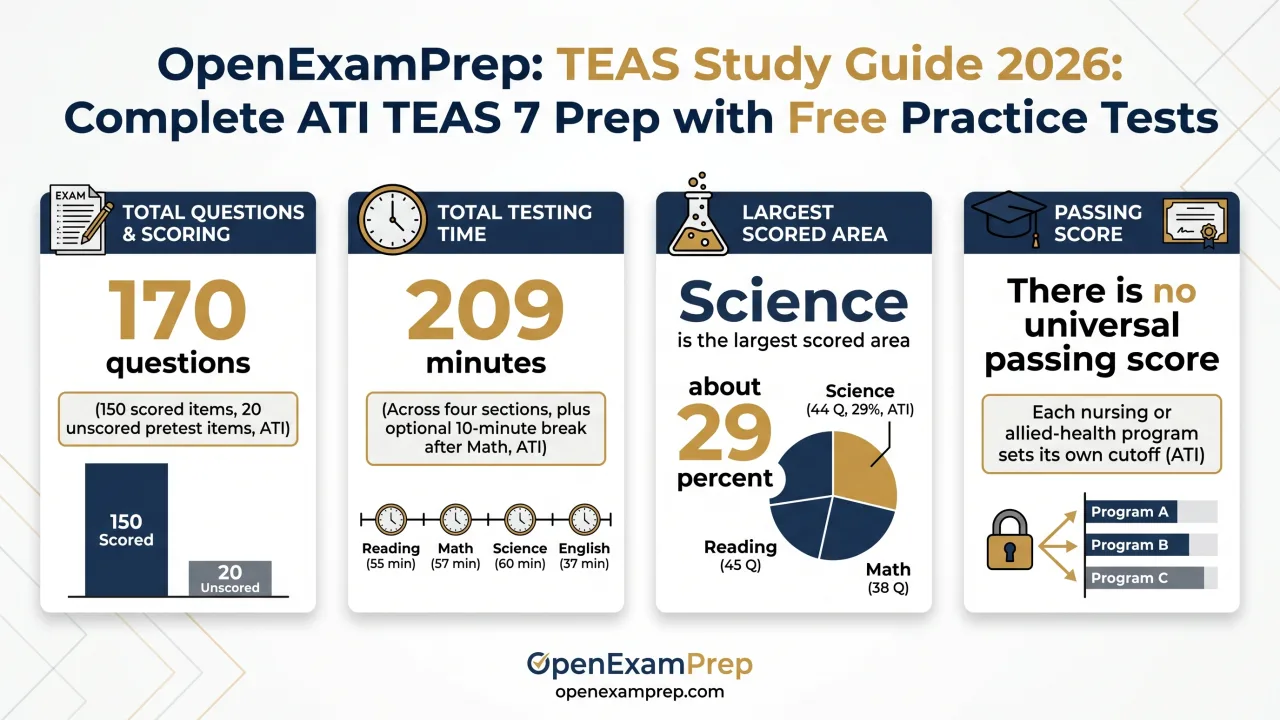
Quick Facts About the ATI TEAS 7
| Aspect | Details |
|---|---|
| Edition | ATI TEAS Version 7 (current since June 2022) |
| Total Questions | 170 (150 scored + 20 unscored pretest) |
| Time Limit | 209 minutes total testing time (about 3.5 hours) |
| Sections | Reading, Mathematics, Science, English & Language Usage |
| Question Types | Multiple choice, multiple-select, fill-in-the-blank, hot spot, ordered response |
| Break | One optional 10-minute break after Math (clock pauses) |
| Navigation | You cannot return to a section once it is closed |
| Format | Computer-based (at PSI/Prometric centers or remote-proctored online) |
| Calculator | Four-function on-screen calculator, Math section only |
| Cost | About $70-$140 depending on testing route and location |
| Passing Score | No universal pass score - each program sets its own cutoff |
| Retakes | Varies by program (commonly a wait period and a yearly cap) |
Unlike older editions, the TEAS 7 is not purely multiple choice. You will also see multiple-select ("select all that apply"), fill-in-the-blank, hot spot (click a region of an image), and ordered-response (drag items into sequence) questions. Practice with these formats so they do not slow you down on exam day.
Start Practicing with Free TEAS Questions
Take FREE TEAS Practice Tests - or browse the TEAS study guide for section-by-section review.
Our free practice includes hundreds of questions across all four sections with detailed, rationale-based explanations and an AI tutor that answers any concept question.
TEAS Section Breakdown (Questions, Time, and What Is Tested)
Each section is timed separately, and time does not carry over. The counts below show total questions, scored questions, and the official sub-content areas. Only the 150 scored questions count toward your result; the 20 unscored pretest items are mixed in invisibly.
| Section | Total Q | Scored Q | Time | Share of scored exam |
|---|---|---|---|---|
| Reading | 45 | 39 | 55 min | 26% |
| Mathematics | 38 | 34 | 57 min | 23% |
| Science | 50 | 44 | 60 min | 29% (largest) |
| English & Language Usage | 37 | 33 | 37 min | 22% |
| Total | 170 | 150 | 209 min | 100% |
Science is the single largest scored area (44 of the 150 scored questions, about 29%), so it deserves the most study time - and within Science, Human Anatomy & Physiology is the biggest piece.
Reading Section (45 questions, 55 minutes)
What It Tests (sub-content areas):
- Key Ideas and Details - main idea, supporting details, inference, summarizing, following directions
- Craft and Structure - author's purpose and point of view, text structure, word meaning in context
- Integration of Knowledge and Ideas - evaluating arguments, comparing multiple texts, interpreting graphics and labels
Study Tips:
- Read the question stem before the passage so you read with purpose
- Identify the main idea of each paragraph in a few words
- Use context clues - the answer to vocabulary-in-context questions is in the surrounding text
- Practice with graphics, labels, and "follow the directions" items, which trip up fast readers
- Budget about 73 seconds per question (45 questions in 55 minutes)
Mathematics Section (38 questions, 57 minutes)
What It Tests (sub-content areas):
- Numbers and Algebra (about 18 scored) - operations, fractions, decimals, percentages, ratios and proportions, equations, word problems
- Measurement and Data (about 16 scored) - unit conversions, geometry, reading charts and graphs, basic statistics (mean, median, mode)
Study Tips:
- Memorize the common conversions (see the formula tables below)
- The on-screen calculator is four-function only - it has no fraction or scientific buttons, so master fraction-to-decimal conversion by hand
- Translate word problems into an equation before solving
- Practice dimensional analysis for unit conversions
- Budget about 90 seconds per question - the most generous pace of any section
Science Section (50 questions, 60 minutes)
What It Tests (sub-content areas):
- Human Anatomy and Physiology (the largest piece) - all major body systems
- Biology - cells, genetics, macromolecules, the cell cycle
- Chemistry - atomic structure, the periodic table, bonds, reactions, properties of matter
- Scientific Reasoning - scientific method, experimental design, interpreting data
Key A&P body systems to know cold: cardiovascular, respiratory, neuromuscular, skeletal, gastrointestinal, genitourinary, endocrine, immune, integumentary, and reproductive.
Study Tips:
- Spend the most time here - it is the largest scored section and where scores rise fastest
- Lead with Anatomy & Physiology; build a body-system flashcard deck
- Learn to read data tables, graphs, and the experimental-design questions
- Budget about 72 seconds per question (50 questions in 60 minutes - the tightest pace)
English & Language Usage Section (37 questions, 37 minutes)
What It Tests (sub-content areas):
- Conventions of Standard English - spelling, punctuation, grammar, sentence structure
- Knowledge of Language - grammar in context, formal vs. informal language, clarity and concision
- Using Language and Vocabulary to Express Ideas - word meaning, affixes (prefixes, roots, suffixes), context clues
Study Tips:
- Review high-frequency grammar and punctuation rules (subject-verb agreement, comma use, apostrophes)
- Learn common prefixes, roots, and suffixes to decode unfamiliar words
- Practice spotting the error in a sentence
- Budget exactly 60 seconds per question - this is the fastest section
TEAS Scoring: There Is No Single Passing Score
This is the most misunderstood part of the TEAS. ATI does not set a pass/fail line. Your score is reported as a percentage of the 150 scored questions, and each nursing or allied-health program sets its own minimum. Always confirm the exact cutoff with the schools you are applying to.
ATI also reports an overall academic preparedness level based on your composite score:
| Proficiency Level | What it signals |
|---|---|
| Developmental | Below the level typically expected for program readiness |
| Basic | Minimum readiness; below many program cutoffs |
| Proficient | Solid readiness; meets the bar at many programs |
| Advanced | Strong, competitive performance |
| Exemplary | Top-tier performance |
Typical program cutoffs (always verify with your school)
The ranges below are common targets, not official ATI thresholds. Competitive admission usually requires scoring well above the bare minimum.
| Program Type | Common Minimum | Competitive Target |
|---|---|---|
| ADN / Associate (RN) | 55-65% | 70%+ |
| BSN / Bachelor's (RN) | 65-75% | 80%+ |
| Accelerated BSN | 70-80% | 85%+ |
| Graduate-Entry / Direct-Entry MSN | 75-85% | 90%+ |
Understanding Your Score Report
Your ATI score report includes:
- Total/Composite Score - your overall percentage of scored questions
- Individual Section Scores - percentage in Reading, Math, Science, and English
- Sub-Content Area Scores - performance on each topic, so you can target weak spots on a retake
- National and Program Percentile Rankings - how you compare to other test-takers
- Academic Preparedness Level - the proficiency band above
Use the sub-content breakdown to drive your remediation: rebuild only the topics where you scored lowest.
8-Week TEAS Study Plan
Weeks 1-2: Assessment & Content Review
Week 1:
- Take diagnostic practice test
- Identify weak areas
- Create study schedule
- Begin Science content review
Week 2:
- Continue Science (A&P focus)
- Start Math fundamentals
- Review 50-75 practice questions
Weeks 3-4: Core Content
Week 3:
- Math: Algebra and word problems
- Science: Biology and chemistry
- Practice questions: 75-100/week
Week 4:
- Reading: Passage strategies
- Math: Measurement and data
- Practice questions: 100/week
Weeks 5-6: English & Integration
Week 5:
- English grammar and conventions
- Science review
- Practice questions: 100-125/week
Week 6:
- English: Vocabulary strategies
- Integrate all sections
- Take full practice test
Weeks 7-8: Final Preparation
Week 7:
- Review weak areas from practice test
- Focus on timing strategies
- Practice questions: 75-100/week
Week 8:
- Take final practice test
- Light review only
- Rest before exam day
Free TEAS Study Resources
What We Offer FREE
| Resource | Description |
|---|---|
| Practice Questions | Hundreds of questions across all four sections |
| Explanations | Detailed rationales for every answer |
| AI Tutor | Get help with any concept (10 free AI questions per day) |
| Progress Tracking | Monitor your improvement by section and topic |
| Mobile Access | Study anywhere, anytime |
Focused practice by section: TEAS Math practice, TEAS Science practice, and TEAS Reading practice.
TEAS Math Formulas to Know
Essential Formulas
| Formula | Use |
|---|---|
| Percentage = (Part/Whole) × 100 | Finding percentages |
| Distance = Rate × Time | Word problems |
| Area of rectangle = L × W | Geometry |
| Area of triangle = ½ × b × h | Geometry |
| Mean = Sum of values / Number of values | Statistics |
Unit Conversions
| Conversion | Value |
|---|---|
| 1 inch | 2.54 cm |
| 1 pound | 0.45 kg |
| 1 mile | 1.6 km |
| 1 cup | 240 mL |
| 1 gallon | 3.78 L |
Test Day Tips
Before the Exam
- Get 8 hours of sleep
- Eat a good breakfast
- Arrive 30 minutes early
- Bring required ID
- Know the testing location
During the Exam
- Read each question carefully and watch for "select all that apply" items
- Use process of elimination
- Don't spend too long on one question - you cannot return to a section once it closes
- Answer every question (no penalty for guessing)
- Use the four-function on-screen calculator wisely in Math
- Take the optional 10-minute break after the Math section - the clock pauses, so it costs you no test time
Time Management (per section)
- Reading: ~73 seconds per question (45 in 55 min)
- Math: ~90 seconds per question (38 in 57 min)
- Science: ~72 seconds per question (50 in 60 min) - tightest pace
- English: ~60 seconds per question (37 in 37 min) - fastest pace
Note: time does not carry over between sections, and once you close a section you cannot go back to review or change answers in it.
Frequently Asked Questions
How long should I study for the TEAS?
Most successful test-takers study 4-8 weeks, dedicating 2-3 hours per day. Your timeline depends on your starting knowledge and target score.
Can I use a calculator on the TEAS?
Yes, a four-function calculator is provided during the Math section only. It's built into the testing software.
What if I fail the TEAS?
Most programs allow 2-3 retake attempts per year with waiting periods. Check your specific program's policy and review the official TEAS exam details for retake policies.
Should I guess on questions?
Yes! There's no penalty for wrong answers. Never leave a question blank.
Start Your TEAS Prep Today
Don't pay hundreds for TEAS prep courses. Our free resources include everything you need:
- Hundreds of practice questions
- All 4 sections covered (Reading, Math, Science, English)
- Detailed explanations and rationales
- AI study assistant (10 free questions per day)
- Progress tracking by section and topic
- Mobile-friendly
Join thousands of nursing school applicants who achieved their target TEAS scores using our free study guide and practice tests.
Where to Focus to Raise Your Score Fastest
Not all sections move the needle equally. Because Science is the largest scored area (about 29% of scored questions) and is the section where most applicants start weakest, it usually offers the biggest score gains per study hour. A practical priority order for most test-takers:
- Science first - especially Human Anatomy & Physiology, the single biggest topic. Build body-system flashcards and review until recall is automatic.
- Math second - it is highly learnable. Drill fractions, decimals, percentages, ratios, unit conversions, and word-problem setup. The on-screen calculator has no fraction button, so practice fraction work by hand.
- Reading and English last - these reward steady technique (main idea, context clues, grammar rules) more than memorization, so a few hours of targeted practice usually suffices.
Use a diagnostic test first, then spend your time on your lowest sub-content scores rather than re-reading what you already know.
Common TEAS Mistakes to Avoid
- Assuming there is a national passing score. There is not - confirm each program's exact cutoff, and aim well above it to stay competitive.
- Ignoring the new question types. Multiple-select, fill-in-the-blank, hot spot, and ordered-response items appear on the TEAS 7. Practice them so they do not cost you time.
- Forgetting you cannot go back. Once a section closes, it is locked. Pace yourself and answer every question before time runs out.
- Over-relying on the calculator. It is four-function only - no fractions, no scientific or graphing functions. Hand-calculation skills still matter in Math.
- Studying Reading and English at the expense of Science. Science carries the most scored weight; spend your hours where the points are.
- Taking practice test after practice test without remediation. Review every miss, log the rule you got wrong, and re-drill that topic before the next full test.
Verify Details with the Official Source
Before relying on any third-party outline, confirm current policies on the official ATI TEAS page and exam-details pages. The official site is where you verify the current testing route (in-person at PSI/Prometric centers or remote online proctoring), identification rules, rescheduling and retake policies, fees, accommodations, and any content-outline updates. The TEAS 7 has been the current edition since June 2022, but always confirm the latest specifics for your test date and the score requirements published by the specific programs you are applying to.


 Buy on Amazon
 Practice exams on ExamEdge
 Take courses on Udemy
 Study guide on Mometrix