Engineering28 min read

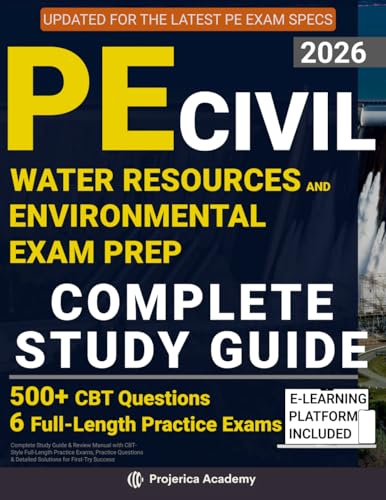
PE Water Resources Exam Guide 2026: FREE Civil Study Plan

Complete 2026 PE Civil: Water Resources & Environmental guide. 80 questions, 9-hour CBT at Pearson VUE, $375 NCEES fee, FE→4-yr experience→PE path, 7 knowledge areas, on-screen Reference Handbook, 16-20 week study plan, and FREE practice.

Ran Chen, EA, CFP®April 23, 2026

Key Facts

  • The 2026 PE Civil Water Resources and Environmental exam has 80 questions delivered as CBT at Pearson VUE in a 9-hour appointment (two 4-hour sessions + 1-hour break).
  • The current NCEES exam fee is $375; separate state board application and license issuance fees run $75-$350 each depending on jurisdiction.
  • PE eligibility requires passing the FE plus 4 years of progressive engineering experience under a licensed PE; specific rules set by each state board.
  • The NCEES spec covers 7 knowledge areas: Analysis & Design 30%, Open Channel 15%, Hydrology 15%, Closed Conduit 10%, Groundwater 10%, Wastewater 10%, Water Treatment 10%.
  • The only reference allowed during the exam is the on-screen NCEES PE Civil Reference Handbook; paper references, PDFs, and personal notes are prohibited.
  • NCEES requires approved calculators only: TI-30X, Casio fx-115, and HP 33s/35s series models per ncees.org/exams/calculators.
  • Core testable frameworks include Manning's equation, Hazen-Williams, Darcy-Weisbach, Bernoulli, NRCS curve number, rational method, Theis/Thiem, and Streeter-Phelps.
  • PE results are typically released 7-10 business days after testing through MyNCEES; NCEES does not publish a fixed percentage cut-score.
  • NCEES retake policy allows up to 3 attempts within 12 months with a 60-day minimum wait between attempts; each retake costs the full $375 fee.
  • Most successful first-time PE candidates study 250-350 hours across 16-20 weeks with emphasis on the 30% Analysis and Design block.
  • Licensed water-resources PE Civil engineers earn $95,000-$140,000 base in 2026 (7-10 years experience); senior/principal PEs reach $140,000-$200,000+ in major metros.
  • Only a licensed PE can seal construction drawings, hydraulic reports, stormwater plans, and NPDES/SDWA permit submittals in the United States.

Last updated: April 23, 2026. Verified against the NCEES PE Civil: Water Resources and Environmental exam specifications and ncees.org/exams/pe-exam/civil/ as of the 2026 testing year. Always confirm current fees, specs, and state board rules at ncees.org and your state's licensing board.

The PE Civil: Water Resources and Environmental Exam at a Glance

The Principles and Practice of Engineering (PE) Civil: Water Resources and Environmental exam is the depth exam taken by civil engineers who design and manage water-carrying infrastructure — stormwater systems, water and wastewater treatment plants, distribution networks, dams, and groundwater works. It is one of five PE Civil depth exams offered by the National Council of Examiners for Engineering and Surveying (NCEES), and passing it (plus the state-specific experience requirement) is the final academic hurdle between an engineer-in-training and a licensed Professional Engineer (PE).

The depth exam assumes candidates already have the FE fundamentals under their belt and have spent roughly four years practicing civil engineering at the side of a licensed PE. It is a computer-based test (CBT) delivered year-round at Pearson VUE Professional Centers and is scored pass/fail against a cut-score set by NCEES subject-matter experts.

Item2026 Detail
Credentialing bodyNCEES (exam) + individual state licensing boards (license)
NCEES exam fee$375 (verify current fee at ncees.org)
State board feesVary by state — typically $75-$350 application + $75-$250 license issuance
Testing vendorPearson VUE (Professional Center CBT)
SchedulingYear-round, by appointment
Questions80 multiple-choice and alternative-item-type (AIT) questions
Appointment length9 hours (8 hours testing + 1 hour break + tutorial/NDA)
FormatTwo 4-hour sessions with one scheduled 1-hour break between
Reference materialOn-screen NCEES PE Civil Reference Handbook only — no paper refs
CalculatorNCEES-approved models only (see ncees.org policy)
EligibilityPassed FE + state-specific experience (typically 4 years post-FE under a licensed PE)
Passing standardNCEES cut-score (not published as a fixed percentage)
ResultsTypically 7-10 business days after testing
Retake policyUp to 3 attempts per 12 months; 60-day waiting period
Start FREE PE Water Resources Practice -->Practice questions with detailed explanations

The Path to PE: FE → 4 Years → PE

Becoming a licensed Professional Engineer in any civil discipline follows a national framework administered by NCEES, but the license itself is granted by your state board of professional engineers. Every state has its own twist — on the experience count, the reference confirmations, and the ethics/jurisprudence supplement — but the core sequence below is nearly universal.

Step 1 — Earn an ABET-EAC accredited engineering degree (or equivalent)

Most states require a Bachelor of Science in engineering from a program accredited by the ABET Engineering Accreditation Commission. A handful of states accept non-ABET degrees with additional experience or a technology degree with extra years.

Step 2 — Pass the FE (Fundamentals of Engineering) exam

The FE is the 110-question, 6-hour CBT that validates undergraduate-level engineering knowledge. Most civil-track candidates take FE Civil in their senior year or shortly after graduation. Passing the FE earns the Engineer Intern (EI) or Engineer-in-Training (EIT) designation (title varies by state).

Step 3 — Accrue qualifying engineering experience

Typically four years of progressive, verifiable engineering experience under the direct supervision of a licensed PE. Several states credit a master's or PhD in engineering as one year of experience toward the four.

Step 4 — Submit PE application with references

States require three to five professional references, usually from licensed PEs who have directly supervised your work. Expect to document projects, roles, percentage of engineering vs. non-engineering duties, and the dates of supervised practice.

Step 5 — Pass the PE Civil: Water Resources and Environmental exam

Register through your MyNCEES account, pay the $375 NCEES fee, receive an Authorization to Test (ATT), then schedule at Pearson VUE within the ATT window.

Step 6 — Receive your PE license from the state board

After NCEES reports your pass, the state board issues the PE license (sometimes after an additional state ethics exam, e.g., California's Take Home Ethics Exam or the state surveying/seismic supplements). Annual or biennial renewal follows, with continuing-education (PDH) requirements in most states.


2026 Exam Specifications (Verify at ncees.org)

NCEES organizes the PE Civil: Water Resources and Environmental specification into seven knowledge areas. The weights below reflect the 2026 NCEES specification — always verify the exact breakdown at ncees.org/exams/pe-exam/civil/ before finalizing your study plan, as NCEES updates depth specs on a multi-year cycle.

#Knowledge AreaApprox. WeightTypical Topics
IAnalysis and Design~30%Mass/energy balances, hydraulic/hydrologic analysis, permitting context, engineering economics, construction
IIHydraulics — Closed Conduit~10%Energy and continuity equations, pressure pipe flow, Hazen-Williams, Darcy-Weisbach, pumps, water hammer
IIIHydraulics — Open Channel~15%Manning's equation, normal/critical flow, hydraulic jumps, weirs/spillways, culverts, stormwater conveyance
IVHydrology~15%Rainfall-runoff (rational, NRCS/SCS curve number), unit hydrographs, storm frequency/IDF, stormwater management
VGroundwater and Wells~10%Darcy's law, Theis/Thiem well equations, aquifer properties, dewatering, wellhead protection
VIWastewater Collection and Treatment~10%Sewer hydraulics, BOD/DO modeling, activated sludge (SRT/MLSS/F:M), secondary clarifiers, disinfection, biosolids
VIIWater Quality, Treatment, and Distribution~10%Coagulation/flocculation, sedimentation, filtration, disinfection (CT), water main sizing, distribution hydraulics

Because NCEES occasionally moves topics between knowledge areas and adjusts weights during spec refreshes, the safest posture is: download the current PDF spec from ncees.org, cross-check the table of contents in the NCEES PE Civil Reference Handbook (currently version 5.0+ at the time of writing), and let your study plan follow those two documents verbatim.


Per-Topic Deep Dives

Hydraulics — Closed Conduit: Hazen-Williams, Bernoulli, and Water Hammer

Closed-conduit hydraulics owns the pressure-pipe world: municipal water mains, force mains, raw-water transmission, and chilled/hot-water building loops. You will be expected to:

  • Apply Bernoulli's energy equation between two points accounting for elevation, velocity, pressure, and head losses
  • Compute friction head loss using Hazen-Williams (empirical, water only, imperial-friendly: hf = 10.67 × L × Q^1.852 / (C^1.852 × D^4.87) in SI) and Darcy-Weisbach (general, any fluid; requires Moody chart or Colebrook)
  • Size pumps from system curves — total dynamic head (TDH), shut-off head, NPSHa vs. NPSHr, and affinity laws
  • Solve water hammer problems using the Joukowsky equation ($\Delta$P = $\rho$ × a × $\Delta$V, where a is the wave celerity), including practical mitigations such as surge tanks, air-release valves, and slow-closing valves

Expect to see minor losses (K-factors for bends, valves, expansions) show up in every pipe-network problem. Keep your handbook page tabs ready for the Hazen-Williams nomograph and the Moody diagram.

Hydraulics — Open Channel: Manning's Equation and Hydraulic Jumps

Open-channel hydraulics covers storm sewers flowing partially full, trapezoidal channels, streams, and spillway/weir discharge. Core tools:

  • Manning's equation: V = (1.49/n) × R^(2/3) × S^(1/2) in English units; Q = V × A. Know n-values for concrete, corrugated metal, natural streams
  • Normal vs. critical depth: Fr = V / $\sqrt{g \cdot D_h}$. Fr < 1 subcritical; Fr > 1 supercritical; Fr = 1 critical
  • Hydraulic jumps: depth/energy loss relationships, sequent depths, jump efficiency
  • Weirs and spillways: sharp-crested rectangular Q = C × L × H^(3/2), V-notch Q = C × tan($\theta$/2) × H^(5/2), broad-crested weir coefficients
  • Culvert hydraulics: inlet vs. outlet control, FHWA HDS-5 approach (conceptually), headwater depth estimation

Almost every PE Water Resources form has at least one culvert or channel-sizing problem — practice until you can identify the controlling depth by inspection.

Hydrology: Rational Method and NRCS Curve Number

Hydrology is where the "Environmental" half of the spec starts to bleed in. Master:

  • Rational method for small urban watersheds (< ~200 acres): Q = C × i × A, with C = runoff coefficient, i = rainfall intensity at time-of-concentration, A = area
  • NRCS (SCS) Curve Number method for larger watersheds: runoff Q = (P - 0.2S)^2 / (P + 0.8S), where S = (1000/CN) - 10. Know CN adjustments for antecedent moisture conditions
  • Time of concentration: Kirpich, NRCS lag, and sheet+shallow concentrated flow segmenting per NRCS TR-55
  • Unit hydrographs (SCS dimensionless, Snyder synthetic) for compositing storm hydrographs
  • IDF curves and storm return periods — 2-, 10-, 25-, 100-year events and how they drive detention/retention sizing
  • Stormwater BMPs: detention ponds, extended detention, bioretention, permeable pavement

The curve number problem is a perennial NCEES favorite. Memorize the basic form and a handful of land-use CNs (urban residential 72-80, pasture 60-70, forest 55-70, HSG A vs. D shifts).

Groundwater and Wells: Darcy, Theis, and Thiem

Groundwater is a small-weight area but the formulas are tight and testable:

  • Darcy's law: Q = -K × A × (dh/dL). Units matter — typical K values for sand vs. clay should be familiar
  • Confined aquifer steady-state flow to a well (Thiem): Q = 2$\pi$ × T × (h2 - h1) / ln(r2/r1), where T = K × b
  • Unconfined aquifer steady-state (Thiem-Dupuit): Q = $\pi$ × K × (h2^2 - h1^2) / ln(r2/r1)
  • Transient/unsteady flow (Theis): drawdown s = (Q / 4$\pi$T) × W(u), where W(u) is the well function and u = r^2 × S / (4Tt)
  • Dewatering for construction: wellpoints, deep wells, and predicted drawdown cones
  • Wellhead protection concepts from the Safe Drinking Water Act

Wastewater Collection and Treatment: BOD/DO Modeling and Activated Sludge

Expect 2-4 problems from this area. Core competencies:

  • Sewer hydraulics: Manning's equation for partially full pipes, minimum self-cleansing velocity (2 ft/s), design peaking factors
  • BOD/DO modeling in receiving streams (Streeter-Phelps): DO sag curve, critical distance xc and critical deficit Dc
  • Activated sludge: SRT (solids retention time) = V × X / (Qw × Xr + Qe × Xe); MLSS/MLVSS; F:M ratio = Q × BOD / (V × X); sludge volume index (SVI)
  • Secondary clarifier design: surface overflow rate (SOR), solids loading rate (SLR)
  • Disinfection: chlorine dose/demand, CT value for contact time
  • Biosolids: thickening, digestion (aerobic/anaerobic), dewatering

Reserve a full study week for activated sludge — the math is forgiving but only if you use consistent units throughout the mass balance.

Water Quality, Treatment, and Distribution: Sedimentation, Filtration, AWWA C600

The drinking-water treatment sequence — screening, coagulation/flocculation, sedimentation, filtration, disinfection — and distribution are tested with numerical and conceptual items:

  • Coagulation/flocculation: alum and ferric doses, Gt values, rapid-mix vs. flocculation basin design
  • Sedimentation tank design: overflow rate (Vs = Q / As), detention time, weir loading rate
  • Filtration: rapid sand vs. dual/multi-media, filtration rates (2-10 gpm/ft^2), backwash hydraulics
  • Disinfection CT: CT = concentration × contact time; log-inactivation targets for Giardia/viruses per SWTR
  • Water main sizing: Hazen-Williams with C values, fire-flow demand, pressure zones
  • AWWA C600: installation and testing of ductile-iron water mains — pressure test, leakage allowance, disinfection per AWWA C651

Know the Safe Drinking Water Act (SDWA) MCL framework, Lead and Copper Rule action levels, and the conceptual difference between primary and secondary standards.


CBT Format and the On-Screen NCEES Reference Handbook

The PE Civil: Water Resources and Environmental is delivered as a computer-based test (CBT) at Pearson VUE Professional Centers. Candidates schedule year-round through MyNCEES; appointments are first-come, first-served for any open slot.

What the screen looks like:

  • The exam window is split: question on one side, a tabbed NCEES PE Civil Reference Handbook (PDF viewer) on the other. You can search, bookmark, and navigate the handbook during the exam.
  • You can flag questions for review and return to them during the same session.
  • Two 4-hour sessions are separated by a scheduled 1-hour break. Once you leave the first session, you cannot return to those questions.
  • The total appointment is 9 hours: tutorial + NDA + 4 hours session 1 + 1 hour break + 4 hours session 2.

Reference handbook strategy:

  • The on-screen handbook is the only reference allowed. You cannot bring paper copies, annotated PDFs, formula sheets, or hand-written notes.
  • Download the free PDF from NCEES and study the actual document you will use on test day. Memorize where things live — which section houses Manning's, which houses activated sludge kinetics.
  • Practice searching the handbook using the built-in PDF search; keyword choice matters.

Calculator: Only NCEES-approved models (currently TI-30X series, Casio fx-115 series, HP 33s and 35s at the time of writing — verify at ncees.org/exams/calculators).

No scratch paper restrictions in the traditional sense: Pearson VUE issues erasable note boards and fine-tip markers at check-in. You cannot bring your own paper. The note boards are collected at the end of each session.


Cost Stack: NCEES + State Board + Study Materials

Budget for the full license, not just the exam.

Line ItemTypical 2026 Cost
NCEES PE exam fee$375
State board application fee$75-$350 (varies by state)
State license issuance/initial fee$75-$250
FBI/state background check (some states)$50-$100
NCEES Record (optional but useful for multi-state)$125 initial + $75/year transmittal
NCEES PE Civil Reference HandbookFree PDF (ncees.org)
NCEES PE Civil: WRE practice exam$49.95
Review course (optional, recommended)$795-$1,995 (School of PE, Civil Engineering Academy, EET)
Textbooks / problem sets$150-$450
Calculator (if replacing)$20-$60
Retake (if needed, up to 3/year)$375 per attempt
Typical first-pass total$1,200-$3,200

Most candidates spend $1,500-$2,000 on a first attempt including a review course. The PE is a career-long credential with direct salary leverage — under-investing on study materials to save $500 is false economy.


The 16-20 Week PE Water Resources Study Plan

Most successful candidates put in 250-350 hours over 16-20 weeks while working full time. The plan below assumes 12-16 hours per week, weighted roughly to the NCEES spec percentages.

Weeks 1-2: Orientation and Baseline

  • Download the current NCEES spec and the PE Civil Reference Handbook 5.0+ (free PDF)
  • Sit the NCEES practice exam cold to establish a baseline (skip nothing, time yourself)
  • Identify 2-3 weakest knowledge areas; plan additional hours into those weeks

Weeks 3-5: Hydraulics Foundation

  • Closed conduit: Bernoulli, Hazen-Williams, Darcy-Weisbach, pump curves
  • Open channel: Manning's, specific energy, hydraulic jumps, weirs and culverts
  • Work 40-60 problems per subtopic; time every 10th problem

Weeks 6-8: Hydrology

  • Rational method, NRCS curve number, unit hydrographs
  • IDF curves, storm frequency, time of concentration
  • Detention basin sizing and routing (Puls method conceptually)

Weeks 9-10: Groundwater and Wells

  • Darcy, Thiem (confined and unconfined), Theis well function
  • Dewatering, wellhead protection, aquifer characterization

Weeks 11-12: Wastewater Collection and Treatment

  • Sewer hydraulics and peaking factors
  • BOD/DO modeling — Streeter-Phelps
  • Activated sludge kinetics — SRT, MLSS, F:M, clarifier SOR
  • Disinfection, biosolids basics

Weeks 13-14: Water Quality, Treatment, and Distribution

  • Coagulation/flocculation, sedimentation, filtration
  • CT disinfection, SDWA MCLs, Lead and Copper Rule
  • Water main sizing, AWWA C600 installation, fire flow

Weeks 15-16: Analysis and Design (the 30% pillar)

  • Mass and energy balances end-to-end
  • Permitting context — NPDES, SDWA, Clean Water Act basics
  • Engineering economics (present worth, annual cost, benefit/cost ratio)
  • Construction sequencing, submittals, shop drawings conceptually

Weeks 17-18: Full-Length Simulations

  • Simulate the NCEES practice exam under 8-hour timed conditions
  • Review every missed item to the handbook page
  • Sit one additional full simulation from School of PE or EET

Weeks 19-20: Handbook Drills and Gap Work

  • Spend each study block inside the handbook — search exercises, page-find drills
  • Target remaining weakest subtopics
  • Scale down volume the final 3-5 days; sleep, don't cram
free PE Water Resources practice questionsPractice questions with detailed explanations

Free and Paid Study Resources

Free (start here)

  • NCEES PE Civil Reference Handbook — free PDF via MyNCEES; this is the only reference on exam day
  • NCEES PE Civil: WRE Specification — free PDF outlining knowledge areas and weights
  • NCEES Exam Day Policies — calculator rules, break rules, ID requirements
  • EngProGuides sample problems — selected free hydraulics and hydrology problems
  • Civil Engineering Academy YouTube — free video walkthroughs of hydraulic and hydrology problems

Paid (worth the spend for most candidates)

  • NCEES PE Civil: Water Resources and Environmental Practice Exam ($49.95) — essential; retired items in the current CBT format
  • School of PE — PE Civil: WRE Review ($795-$1,495 depending on format) — most comprehensive live/on-demand course
  • EngProGuides PE Civil: WRE Study Guide and Practice Exams — condensed handbook-aligned problem sets, strong on water/wastewater treatment
  • Civil Engineering Academy (CEA) Ultimate Civil PE Review — subscription with WRE depth modules and Q&A
  • EET (Engineering Education and Training) PE Civil: WRE — well-regarded live review with experienced WRE instructors
  • PPI (Kaplan) Civil Engineering Reference Manual (CERM) — comprehensive reference, but remember only the NCEES handbook is allowed on the exam

Test-Taking Strategy

CBT navigation discipline

  • First pass: answer every question you can solve in 4-5 minutes. Flag anything that requires > 5 minutes and move on.
  • Second pass: return to flagged questions with the remaining time; handbook-searchable items often fall quickly on the second pass.
  • Third pass (if time): pure verification on non-flagged items — look for unit conversion blunders.

Handbook search habits

  • Practice searching on equation names ("Manning," "Hazen," "Theis") rather than variable names.
  • Bookmark high-traffic tables (n-values, CN table, CT tables) mentally by page ranges.
  • Never derive from scratch what a handbook table already tabulates.

Break management

  • The mandatory 1-hour break is scheduled between sessions. You cannot bank time from one session to the other.
  • Eat protein + complex carbs; avoid heavy sugar crashes.
  • Hydrate — but manage restroom stops within session time.

Flagging philosophy

  • Flag liberally. Unflag as soon as you are confident. A flag is free insurance.
  • If two answer choices look correct after a full read, flag, guess your best choice, and return.

Common Pitfalls

  1. Unit conversion errors. The exam mixes English and SI freely. Always write the units next to each number; cancel them explicitly. The single most common lost point on the PE is a factor-of-12, factor-of-60, or ft-to-m mismatch.
  2. Sign conventions. Energy equations use elevation head with a consistent datum. Pick it once, label it, and stick with it. Darcy's Q can flow "out of" or "into" a control volume; get the sign right before the math.
  3. Formula misapplication. Hazen-Williams applies only to water at ~60°F and only in the turbulent regime. Manning's applies to uniform flow in open channels. The rational method caps at ~200 acres. Know the boundary conditions before you plug numbers.
  4. Using average flow instead of design flow. Wastewater problems almost always ask for peak or design flow — apply the peaking factor.
  5. Missing the "closest answer" semantics. NCEES often includes 3-significant-figure tolerances. If your arithmetic is clean but you picked the wrong rounded option, that is the same wrong answer as missing the concept.
  6. Ignoring the handbook. Candidates who "memorize to pass" lose 20-40 minutes fumbling for pages during the actual test. The handbook is a navigable tool — train on it.
  7. Over-investing in the Analysis & Design block. At ~30%, Analysis & Design is the largest area — but it draws on the other six. Build topic depth first; the integrative block comes naturally after.
  8. Skipping the practice exam. The NCEES practice exam is the single best reflection of the current CBT style. Do it once cold (week 2) and once timed (week 17).

Career Value

Licensed PE Civil — Water Resources and Environmental engineers work in municipal public works, water and wastewater utilities, state DOTs, environmental consulting (AECOM, Jacobs, Stantec, Brown and Caldwell), federal agencies (USACE, EPA, Reclamation), and private developers. Typical 2026 compensation ranges for PE-licensed water-resources civil engineers:

  • PE Civil, 4-6 years (just-licensed): $95,000-$110,000 base
  • PE Civil, 7-10 years (project engineer/manager): $110,000-$140,000 base
  • Senior PE / Principal (15+ years, stamp authority on major projects): $140,000-$200,000+ base plus bonus
  • PE + PMP / project principal at top-tier consultancies: $160,000-$230,000 total comp in major metros

The PE stamp itself creates the leverage: only a PE can seal and sign construction drawings, hydraulic reports, stormwater management plans, and discharge permit applications for submittal to state environmental agencies. That legal authority is why the PE premium persists even when the base engineering labor market tightens.

For public-sector engineers, the PE also gates promotion. Many municipalities, state DOTs, and federal agencies require the PE for Senior Engineer, Principal Engineer, and Engineering Manager positions — the salary jump at the first PE-gated step is commonly $8,000-$20,000.


Closing: Pass Once, License for Life

The PE Civil: Water Resources and Environmental exam is a nine-hour intellectual marathon, but it is the last exam most water-resources engineers will ever have to take. Pass it once, complete your state board's administrative requirements, and the letters "PE" follow your name for the rest of your career.

The right strategy is simple:

  1. Work the current NCEES specification and handbook — not last year's advice from the internet.
  2. Build topic depth in hydraulics, hydrology, treatment, and groundwater before touching the 30% Analysis & Design block.
  3. Practice inside the handbook, not around it.
  4. Sit at least two full 8-hour simulations before test day.
  5. Respect the break — a calm Session 2 is worth 5-8 correct answers.

Start with a handful of warm-up problems right now.

Begin FREE PE Water Resources Practice -->Practice questions with detailed explanations

Sources and further reading

Disclaimer: This guide is for informational purposes only. Always verify current fees, exam specifications, calculator policies, and state licensing rules at ncees.org and your state board. NCEES, PE, and FE are registered marks of the National Council of Examiners for Engineering and Surveying. OpenExamPrep is independent and not affiliated with or endorsed by NCEES.

Test Your Knowledge
Question 1 of 8

A rectangular concrete channel (Manning n = 0.013) has a bottom width of 6 ft, a depth of flow of 3 ft, and a longitudinal slope of 0.002 ft/ft. Using Manning's equation in U.S. customary units, what is the approximate discharge Q?

A
72 cfs
B
108 cfs
C
144 cfs
D
192 cfs
Learn More with AI

10 free AI interactions per day

PE CivilPE Water ResourcesPE EnvironmentalNCEESProfessional EngineerCivil Engineering LicenseHydraulicsHydrologyGroundwaterWater TreatmentWastewater TreatmentManning EquationHazen-WilliamsNRCS Curve NumberActivated SludgeAWWA C600Exam Guide 2026

Related Articles

Stay Updated

Get free exam tips and study guides delivered to your inbox.

Free exam tips & study guides. Unsubscribe anytime.