NCLEX-RN Study Guide 2026: Your Complete Preparation Resource
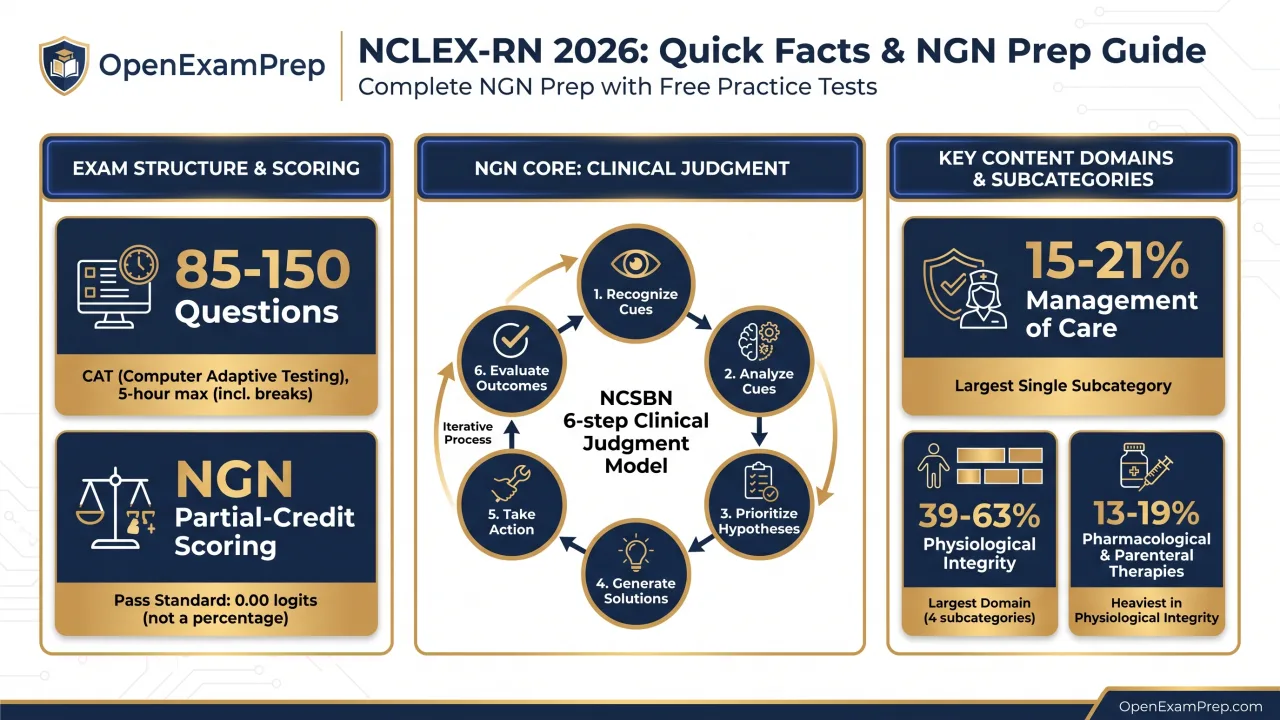
This NCLEX-RN study guide provides everything you need to pass the Next Generation NCLEX in 2026. Developed by NCSBN (National Council of State Boards of Nursing), the NCLEX-RN is the standardized exam for registered nurse licensure. This guide covers everything from understanding the test format outlined in the 2026 NCLEX-RN Test Plan to mastering clinical judgment - plus free practice tests.
Understanding the NCLEX-RN
Since April 1, 2023, every NCLEX-RN is a Next Generation NCLEX (NGN). It is a variable-length Computer Adaptive Test that ends when the algorithm is 95% confident you are above or below the passing standard of 0.00 logits (a standard the NCSBN Board upheld through March 31, 2029). The 2026 NCLEX-RN Test Plan took effect April 1, 2026 and runs through March 31, 2029.
| Aspect | Details |
|---|---|
| Questions | 85-150 items (15 are unscored pretest items) |
| Time | 5 hours maximum, including all breaks and the tutorial |
| Format | Computer Adaptive Testing (CAT) with NGN item types |
| Passing standard | 0.00 logits (not a percentage), upheld through March 31, 2029 |
| Case studies | 3 unfolding NGN case studies (6 items each = 18 items) |
| Results | Unofficial Quick Results in ~2 business days (where offered) |
| Cost | $200 registration fee, paid to Pearson VUE |
Start Your Free NCLEX-RN Practice
Access 500+ NGN-format questions with detailed rationales and AI tutoring.
NCLEX-RN Content Areas
The 2026 Test Plan organizes content into four Client Needs categories, two of which have subcategories. The percentages below are the official 2026 item-distribution ranges effective April 1, 2026. The biggest change from older blueprints is naming: "Safety and Infection Control" is now "Safety and Infection Prevention and Control," and the Management of Care and overall Physiological Integrity ranges were adjusted. Master every category, but weight your hours toward Physiological Integrity (39-63% combined) and the Safe & Effective Care Environment domain (25-37% combined).
1. Management of Care (15-21%)
Part of the Safe and Effective Care Environment domain, this content area focuses on:
- Advance Directives - Understanding patient wishes
- Advocacy - Protecting patient rights
- Case Management - Coordinating care
- Delegation/Supervision - Assigning tasks appropriately
- Ethical Practice - Making ethical decisions
- Informed Consent - Ensuring understanding
- Legal Rights - Patient and nurse responsibilities
- Performance Improvement - Quality assurance
- Referrals - Connecting patients to resources
Key Study Focus: Delegation scenarios and ethical dilemmas
2. Safety and Infection Prevention and Control (10-16%)
The second Safe and Effective Care Environment area (renamed in the 2026 plan) covers patient and environment safety:
- Accident Prevention - Fall prevention, medication safety
- Emergency Response - Fire, disaster protocols
- Error Prevention - Avoiding mistakes
- Handling Hazardous Materials - Proper procedures
- Home Safety - Patient education
- Reporting - Incident documentation
- Restraints - Use and alternatives
- Standard Precautions - Infection control
- Surgical Asepsis - Sterile technique
Key Study Focus: Priority setting and infection control principles
3. Health Promotion and Maintenance (6-12%)
Preventive care and wellness:
- Aging Process - Normal changes
- Ante/Intra/Postpartum Care - Maternal-child nursing
- Developmental Stages - Erikson, Piaget
- Health Screening - Recommended screenings
- High-Risk Behaviors - Prevention strategies
- Immunizations - Schedule and contraindications
- Lifestyle Choices - Health education
- Self-Care - Teaching independence
Key Study Focus: Growth and development, maternity concepts
4. Psychosocial Integrity (6-12%)
Mental health and emotional support:
- Abuse/Neglect - Recognition and reporting
- Behavioral Interventions - De-escalation
- Chemical Dependencies - Substance abuse care
- Coping Mechanisms - Healthy vs unhealthy
- Crisis Intervention - Emergency mental health
- Cultural Awareness - Respectful care
- Grief and Loss - Support strategies
- Mental Health Concepts - Disorders and treatment
- Therapeutic Communication - Effective techniques
Key Study Focus: Therapeutic communication techniques
5. Physiological Integrity (39-63% combined)
The largest domain, split into four subcategories:
Basic Care and Comfort (6-12%)
- Nutrition, mobility, elimination, rest, non-pharmacological comfort
Pharmacological and Parenteral Therapies (13-19%)
- Dosage calculations, medication administration, expected actions, adverse effects, IV/parenteral therapy
Reduction of Risk Potential (9-15%)
- Diagnostic tests, lab values, potential complications, monitoring
Physiological Adaptation (11-17%)
- Alterations in body systems, fluid/electrolyte imbalances, medical emergencies, interventions
Next Generation NCLEX (NGN) Features
Clinical Judgment Measurement Model
The NCSBN uses a 6-step framework:
| Step | Description | Example |
|---|---|---|
| Recognize Cues | What matters most? | Identifying vital signs changes |
| Analyze Cues | What does it mean? | Connecting symptoms to conditions |
| Prioritize Hypotheses | Most likely cause? | Ranking possible diagnoses |
| Generate Solutions | What can be done? | Planning interventions |
| Take Action | What will you do? | Implementing care |
| Evaluate Outcomes | Did it work? | Assessing effectiveness |
NGN Item Types
| Type | Format | Scoring |
|---|---|---|
| Extended Multiple Response | Select N of N correct | Partial credit |
| Matrix/Grid | Table format decisions | Partial credit |
| Cloze (Drop-down) | Fill blanks from options | Partial credit |
| Drag and Drop | Order/categorize items | Partial credit |
| Highlight | Select text portions | Partial credit |
| Bow-tie | Condition-action-parameter | Partial credit |
| Trend | Analyze data over time | Partial credit |
Unlike traditional multiple-choice items (right or wrong), most NGN items use polytomous scoring, where you earn partial credit through one of three NCSBN rules: 0/1 (dichotomous), +/- (plus credit for correct selections, minus for incorrect), or rationale scoring (linking the right condition, action, and parameter). Stand-alone NGN items and the three unfolding case studies both use these item types.
12-Week NCLEX-RN Study Plan
Phase 1: Foundation (Weeks 1-4)
Week 1-2: Assessment
- Take diagnostic practice test
- Identify weak content areas
- Create study schedule
- Gather resources
Week 3-4: Core Content
- Medical-surgical nursing
- Pharmacology basics
- 50 practice questions/day
Phase 2: Building (Weeks 5-8)
Week 5-6: Clinical Areas
- Maternity nursing
- Pediatric nursing
- Mental health nursing
- 75 practice questions/day
Week 7-8: Advanced Content
- Critical care concepts
- Complex pharmacology
- Priority/delegation
- 100 practice questions/day
Phase 3: Mastery (Weeks 9-12)
Week 9-10: Integration
- Full practice tests
- NGN case studies
- Review weak areas
- 100+ questions/day
Week 11-12: Final Prep
- Timed practice tests
- Focus on test-taking strategies
- Light review
- Rest before exam
Top NCLEX-RN Study Strategies
1. Active Learning Techniques
- Create concept maps
- Teach concepts to others
- Use mnemonics
- Practice critical thinking
2. Question Practice Approach
- Quality over quantity
- Review rationales thoroughly
- Understand why wrong answers are wrong
- Track weak areas
3. Time Management
- Consistent daily study
- Scheduled breaks
- Practice under timed conditions
- Don't cram
4. Self-Care During Prep
- Adequate sleep (7-8 hours)
- Regular exercise
- Healthy nutrition
- Stress management
Common NCLEX-RN Topics by Frequency
| Topic | Frequency | Priority |
|---|---|---|
| Delegation/Priority | Very High | Essential |
| Safety/Infection Control | Very High | Essential |
| Pharmacology | High | Essential |
| Lab Values | High | Important |
| Mental Health | Medium | Important |
| Maternity/Peds | Medium | Important |
| Leadership | Medium | Review |
Test Day Preparation
The Day Before
- Light review only - no cramming
- Prepare required documents (ATT, ID)
- Know your testing center location
- Get 8 hours of sleep
- Prepare comfortable clothes
Test Day Morning
- Eat a balanced breakfast
- Arrive 30 minutes early
- Take breaks when needed
- Stay calm and focused
- Trust your preparation
During the Test
- Read each question completely
- Identify what's being asked
- Use process of elimination
- Don't change answers unless certain
- Take scheduled breaks
Frequently Asked Questions
How long should I study for the NCLEX-RN?
Most successful candidates study 8-12 weeks, completing 100-150 practice questions daily. Your timeline depends on how recently you graduated and your baseline knowledge.
What's a passing score on the NCLEX-RN?
There isn't a specific percentage. The passing standard is 0.00 logits (upheld by the NCSBN Board through March 31, 2029). The CAT algorithm stops when it is 95% confident your ability is clearly above or below that standard.
How many questions mean I passed?
Finishing at 85 questions can mean pass or fail; it depends on your performance level when the test ended. Many successful candidates answer all 150 questions.
Should I take a review course?
Structured review courses can help, but aren't required. Many candidates pass using free resources and self-study. Our free practice tests provide comprehensive preparation.
Free NCLEX-RN Study Resources
Our free resources include:
- 500+ NGN-format questions
- All content areas covered
- Detailed rationales
- Case study practice
- AI study assistant
- Progress tracking
- Mobile-friendly access
Don't spend hundreds on NCLEX prep. Start your free NCLEX-RN practice today and pass on your first attempt.
Add This Clinical Review Layer Before Test Day
Use the final stretch for decision quality, not just more exposure to facts. Start each study block for NCLEX-RN Study Guide 2026: Complete NGN Prep with Free Practice Tests by naming the task the question is really testing: recognition, prioritization, safety, communication, documentation, or workflow. Healthcare exams often hide the correct answer behind a familiar detail, so the safest habit is to pause before reading the options and predict what a competent entry-level professional would do next. That prediction keeps you from chasing the option that sounds medically interesting but does not answer the actual patient-care problem.
Build a small error log with four columns: missed topic, missed cue, correct rule, and next drill. A missed cue is more useful than a broad content label. For example, do not only write cardiovascular, infection control, medication safety, specimen handling, imaging, or professional practice. Write the actual cue you ignored: unstable finding, contraindication, timing before a procedure, patient identification, scope boundary, chain of custody, isolation wording, or documentation sequence. Review that log every two or three days and convert repeated misses into short practice sets.
Official-Source Check
Before relying on any third-party outline, compare your plan with NCSBN NCLEX site. Official pages and candidate handbooks are the place to confirm current eligibility language, testing vendor instructions, identification rules, rescheduling policies, accommodations steps, and any content outline changes. You do not need to memorize administrative details for every practice question, but you do need to avoid preparing from an outdated blueprint or an old retake policy. If a handbook uses different domain names than your notes, rename your notes to match the handbook so your remediation stays aligned with the exam owner.
Scenario Strategy for Clinical and Administrative Questions
Read healthcare scenarios in this order: setting, role, patient or client status, time pressure, and requested action. The role matters because many distractors are clinically reasonable but outside the expected scope for the candidate. A nursing, allied health, pharmacy, laboratory, imaging, respiratory, compliance, or management exam may ask what should be done first, what should be reported, what should be documented, or what should be delegated. Those verbs change the answer. Highlight them in practice even if the real test interface does not let you mark text the same way.
When two options both look correct, choose the one that best protects the patient, preserves specimen or data integrity, follows policy, or escalates an unsafe condition. Avoid answers that skip assessment, skip identification, skip hand hygiene or privacy safeguards, give education before immediate safety is addressed, or perform a task that belongs to another licensed professional. For management and compliance exams, translate clinical safety into system safety: risk identification, incident response, documentation, auditing, corrective action, and communication with the right stakeholder.
Practice Routing After Each Score Report
Do not retake full-length practice exams until you know what the previous one taught you. After each set, sort misses into three groups. Knowledge misses need a short content review and then ten targeted questions. Reasoning misses need rationales: write why the correct answer is safer or more aligned with the role than your answer. Speed misses need shorter timed sets, not another full review chapter.
In the last week, keep practice mixed. Real exam questions rarely announce the domain, and mixed sets force you to choose between similar procedures, symptoms, lab clues, safety steps, and communication tasks. End each day with a brief review of high-yield normal findings, urgent findings, infection prevention, medication or equipment safety, and professional boundaries that appear in your own missed-question history. The goal is not to feel as if every topic is finished. The goal is to enter the exam with a repeatable method for unfamiliar cases: identify the role, find the safety issue, rule out unsafe shortcuts, and choose the action that a careful professional could defend.

 4 Job Wiki
 Buy on Amazon
 Take courses on Udemy
 Prep course on Achievable
 Study guide on Mometrix