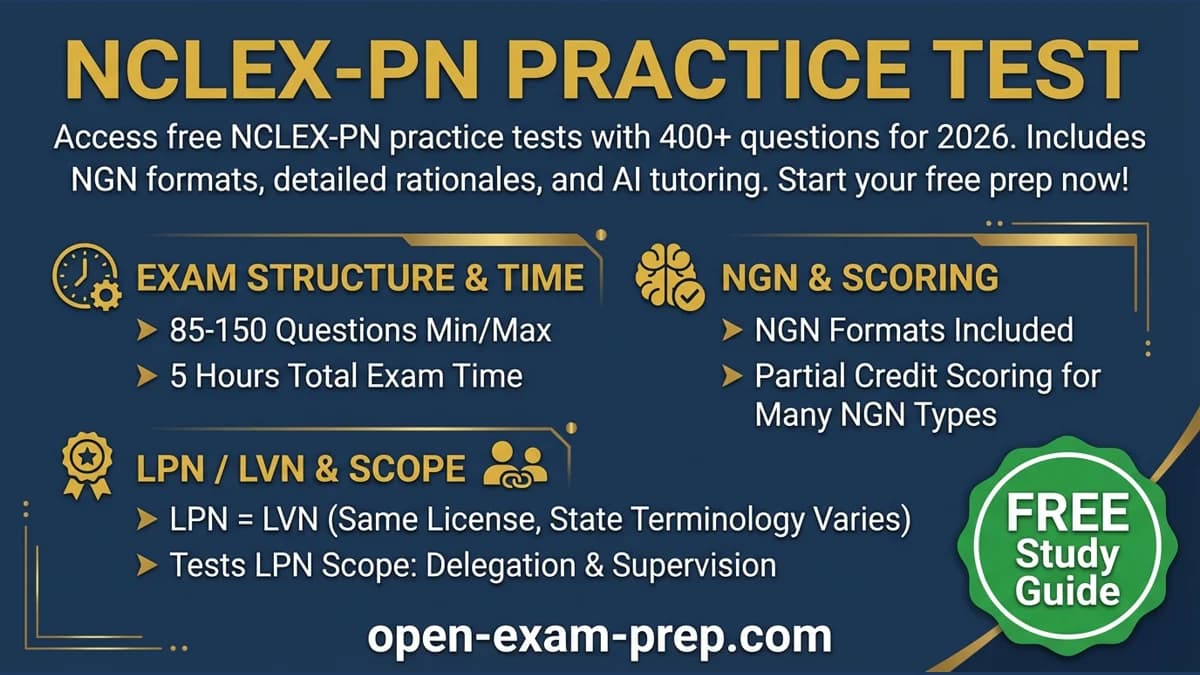
Free NCLEX-PN Practice Test 2026: Your Complete LPN/LVN Prep Resource
Looking for a free NCLEX-PN practice test? You've found the most complete, accurate resource for 2026. Every practice question is 100% free, written for the Next Generation NCLEX (NGN), and mapped to the 2026 NCLEX-PN Test Plan that took effect April 1, 2026.
The NCLEX-PN is built and owned by the NCSBN (National Council of State Boards of Nursing) and delivered at Pearson VUE test centers using Computer Adaptive Testing (CAT). You answer a minimum of 85 and a maximum of 150 items in up to 5 hours, and the exam decides pass/fail using a 95% confidence rule against the official passing standard. Passing earns your Licensed Practical Nurse (LPN) or Licensed Vocational Nurse (LVN) license. This page gives you the exact format, the 2026 Client Needs weights, NGN item types, scoring, and free practice questions with rationales organized by category - then routes you straight into our free NCLEX-PN question bank.
Why Free NCLEX-PN Practice Tests Matter
| Paid NCLEX-PN Prep | Our Free Practice |
|---|---|
| $150-400 for courses | 100% FREE |
| Limited questions | 400+ practice questions |
| Pre-NGN content | Updated for the April 2026 Test Plan |
| No personalized help | 10 free AI tutor questions/day |
Start Your Free NCLEX-PN Practice Test Now
Our free practice test covers every 2026 Client Needs category with NGN question formats and detailed rationales. Want structured review first? Use the NCLEX-PN study guide.
NCLEX-PN Exam Format at a Glance (2026)
| Component | Detail |
|---|---|
| Test owner | NCSBN; delivered at Pearson VUE |
| Format | Computer Adaptive Testing (CAT) |
| Number of items | 85 minimum, 150 maximum (variable length) |
| Scored vs pretest | 80 of the first 85 items are scored; ~5 are unscored pretest items |
| Time limit | 5 hours (includes a tutorial and two optional breaks) |
| Test plan in effect | 2026 NCLEX-PN Test Plan, effective April 1, 2026 - March 31, 2029 |
| Passing standard | -0.18 logits (upheld through March 31, 2029) |
| Pass/fail rule | 95% confidence interval, run-out-of-time, or maximum-length rule |
| Exam fee | $200 (non-refundable) |
| Quick Results | Unofficial result ~48 hours after testing for $7.95 (where the state allows) |
| Official results | Sent by your state board of nursing, usually within 6 weeks |
| Retake wait | 45 days between attempts (NCSBN policy) |
Every 85-item exam contains at least three NGN case study sets (18 items) plus standalone clinical-judgment items, so NGN is guaranteed on test day.
2026 NCLEX-PN Client Needs Categories and Weights
The NCLEX-PN organizes content into four Client Needs categories; two are split into subcategories. These are the exact 2026 PN percentage ranges - note they differ from the NCLEX-RN. Physiological Integrity is the largest block, but on the PN exam it is reported by subcategory rather than as a single 38-62% figure.
| Client Needs Category | 2026 PN Weight |
|---|---|
| Safe and Effective Care Environment | |
| - Coordinated Care | 18-24% |
| - Safety and Infection Prevention and Control | 10-16% |
| Health Promotion and Maintenance | 6-12% |
| Psychosocial Integrity | 9-15% |
| Physiological Integrity | |
| - Basic Care and Comfort | 7-13% |
| - Pharmacological Therapies | 10-16% |
| - Reduction of Risk Potential | 9-15% |
| - Physiological Adaptation | 7-13% |
2026 change to know: the old subcategory "Safety and Infection Control" is now "Safety and Infection Prevention and Control." Coordinated Care (18-24%) remains the single largest tested area on the PN exam.
Coordinated Care (18-24%)
- Advance directives and client rights
- Advocacy and informed consent reinforcement
- Collaboration with the healthcare team
- Continuity of care and referrals
- Ethical and legal responsibilities
- Assignment, supervision, and the limits of LPN delegation
Safety and Infection Prevention and Control (10-16%)
- Accident and injury prevention
- Emergency response and reporting
- Handling hazardous and infectious materials
- Standard and transmission-based precautions
- Safe use of equipment and restraints
Health Promotion and Maintenance (6-12%)
- Aging process and developmental stages
- Ante/intra/postpartum and newborn care
- Health screening and disease prevention
- Lifestyle choices and self-care
Psychosocial Integrity (9-15%)
- Abuse and neglect recognition
- Behavioral and crisis interventions
- Coping and support systems
- Cultural awareness and therapeutic communication
Physiological Integrity (largest block by subcategory)
- Basic Care and Comfort (7-13%): mobility, nutrition, hygiene, rest, elimination
- Pharmacological Therapies (10-16%): medication administration, expected effects, adverse reactions, reinforcing teaching
- Reduction of Risk Potential (9-15%): vital signs, lab values, complications, monitoring after procedures
- Physiological Adaptation (7-13%): fluid/electrolyte balance, illness management, basic pathophysiology
NCLEX-PN vs NCLEX-RN: Key Differences
Both exams use CAT, 85-150 items, 5 hours, and NGN. The differences are scope and content emphasis - the PN exam centers on data collection and implementation under supervision, while the RN exam adds full assessment, planning, and evaluation.
| Aspect | NCLEX-PN | NCLEX-RN |
|---|---|---|
| Minimum questions | 85 | 85 |
| Maximum questions | 150 | 150 |
| Time limit | 5 hours | 5 hours |
| Passing standard | -0.18 logits | 0.00 logits |
| Nursing process focus | Data collection, implementation | Assessment, planning, evaluation |
| Care planning | Reinforces/contributes | Develops and evaluates plans |
| Supervision | Works under RN/provider | Independent; supervises LPNs |
| Coordinated Care weight | 18-24% | 15-21% (Management of Care) |
The most important practical difference: the PN exam tests what an LPN/LVN may legally do. Many wrong answers are correct nursing actions that fall outside the LPN scope (initial assessment, creating care plans, IV push in most states, evaluating outcomes).
Free NCLEX-PN Practice Questions With Rationales
These sample items mirror the NGN style and PN scope. Each shows the correct answer and why the other options are wrong. For the full bank, go to the free NCLEX-PN practice test.
Coordinated Care - Delegation
An LPN is assigned four clients. Which task may the LPN delegate to the unlicensed assistive personnel (UAP)?
- A. Administering oral medications
- B. Assisting a stable client with ambulation (correct)
- C. Obtaining the first set of vital signs on a new admission
- D. Reinforcing discharge teaching
Rationale: A UAP may assist a stable client with routine ambulation (B). Medication administration (A) and teaching (D) are nursing tasks; the first assessment data on a new admission (C) should be gathered by a nurse. Delegate only stable, predictable, routine tasks.
Pharmacological Therapies - Patient Teaching
A client newly prescribed metformin asks how to take it. Which statement by the LPN reinforces correct teaching?
- A. "Take it on an empty stomach for best absorption."
- B. "Take it with meals to reduce stomach upset." (correct)
- C. "Stop the drug if you feel hungry between meals."
- D. "Skip it on days you exercise."
Rationale: Metformin is taken with food to limit GI upset (B). It is not taken on an empty stomach (A); hunger is not a reason to stop it (C); and it should not be skipped around exercise without provider direction (D). LPNs reinforce provider/RN teaching rather than initiate it.
Basic Care and Comfort - Aspiration Safety
When positioning a client with dysphagia for a meal, the LPN should:
- A. Recline the client to 30 degrees
- B. Offer thin liquids first
- C. Place the client upright at 90 degrees and have them tuck the chin while swallowing (correct)
- D. Encourage rapid eating to finish before fatigue
Rationale: Upright positioning with a chin tuck (C) protects the airway and prevents aspiration. Reclining (A) and thin liquids (B) increase aspiration risk; rapid eating (D) is unsafe. Airway safety is the priority.
Reduction of Risk Potential - Recognizing Deterioration
An LPN collecting data finds a postoperative client's blood pressure has dropped and heart rate has risen. The LPN should first:
- A. Document the findings and recheck in one hour
- B. Report the change to the supervising RN promptly (correct)
- C. Increase the IV rate independently
- D. Reassure the client it is normal after surgery
Rationale: The LPN collects data and reports significant changes to the RN (B), who assesses and intervenes. Delaying (A), changing the IV rate independently (C), or false reassurance (D) are unsafe and outside LPN scope.
NGN Question Types on the NCLEX-PN
The Next Generation NCLEX added item types that test clinical judgment, scored with partial credit (plus/minus, zero/one, or rationale scoring). Expect them on every exam:
- Matrix/Grid - mark multiple decisions in a table
- Multiple Response - select all that apply, partial-credit scored
- Cloze (drop-down) - complete a sentence from menus
- Drag-and-drop / ordered response - sequence or categorize
- Highlight - click the relevant words in a chart or note
- Bow-tie and trend - link cause, action, and parameters to monitor
NGN case studies: each unfolding case has a single client scenario followed by 6 items that move through the Clinical Judgment Measurement Model (recognize cues, analyze, prioritize, generate solutions, take action, evaluate). Every minimum-length PN exam includes three case study sets (18 items) plus standalone clinical-judgment items.
How the NCLEX-PN Is Scored
- The computer re-estimates your ability after each item and selects the next item near your level.
- 95% confidence rule: the exam ends as soon as it is 95% certain your ability is clearly above or below the -0.18 logit passing standard.
- Maximum-length rule: if you reach 150 items, your final ability estimate decides pass/fail.
- Run-out-of-time rule: if the 5 hours end early, you pass only if your estimate stayed above the standard over your last items.
- There is no percentage score - you cannot "get 75%." A short exam can be a pass or a fail; length alone tells you nothing.
- Quick Results give an unofficial pass/fail ~48 hours after the exam for $7.95 (where your state participates); the official result comes from your nursing board, usually within 6 weeks.
Free NCLEX-PN Study Strategy
LPN Scope of Practice Focus
The single best score-mover on the PN exam is knowing the boundary of LPN/LVN practice:
| LPN/LVN Can Do | LPN/LVN Cannot Do (RN scope) |
|---|---|
| Collect/monitor data and vital signs | Perform the initial admission assessment |
| Reinforce teaching the RN started | Develop or revise the care plan |
| Administer most routine medications | Give IV push meds (restricted in most states) |
| Contribute to planning | Create nursing diagnoses |
| Report changes to the RN | Independently evaluate client outcomes |
Recommended Study Timeline
| Week | Focus Area | Activities |
|---|---|---|
| 1-2 | Content review | Study core nursing concepts by Client Needs category |
| 3-4 | Question practice | 50-75 questions/day; read every rationale |
| 5-6 | Weak areas + NGN | Drill lowest categories and case studies |
| 7-8 | Full practice tests | Mixed-category sets under timed conditions |
Why Our Free NCLEX-PN Practice Is Different
LPN-Specific Content
Our questions stay inside LPN/LVN scope: delegation, data collection vs. assessment, reinforcing vs. initiating teaching, and reporting up the chain.
Detailed Rationales
Every question explains the correct answer, why each distractor is wrong, the scope-of-practice principle, and a test-taking tip.
AI-Powered Study Help
Stuck on a concept? Our AI tutor gives instant explanations, LPN scope clarification, study tips, and extra scenarios - 10 free AI questions every day, no credit card.
Frequently Asked Questions About the Free NCLEX-PN Practice Test
Are free NCLEX-PN practice tests accurate?
Yes. Our questions mirror NGN item types and the 2026 NCLEX-PN Test Plan effective April 1, 2026. Content follows current NCSBN Client Needs weights and LPN scope of practice.
How many questions are on the NCLEX-PN?
The NCLEX-PN is variable-length: a minimum of 85 and a maximum of 150 items, delivered by Computer Adaptive Testing within a 5-hour limit. Every exam includes NGN case studies.
What is a passing score on the NCLEX-PN?
There is no percentage score. You pass if the CAT engine is 95% confident your ability is above the -0.18 logit standard (in effect through March 31, 2029). Practice-test percentages do not transfer.
How much does the NCLEX-PN cost?
The NCLEX registration fee is $200, paid to Pearson VUE and non-refundable. Optional Quick Results cost an extra $7.95. State boards may add separate licensure or application fees.
How soon can I retake the NCLEX-PN if I fail?
NCSBN policy requires waiting at least 45 days between attempts, and you re-register and pay the $200 fee again. Your state board may set additional limits on total attempts.
What is the difference between LPN and LVN?
LPN (Licensed Practical Nurse) and LVN (Licensed Vocational Nurse) are the same license and the same exam. California and Texas use "LVN"; most other states use "LPN."
Start Your Free NCLEX-PN Practice Today
Join thousands of practical nursing graduates preparing with our free resources. No credit card, no hidden fees.
What you get:
- 400+ NGN-format questions across all 2026 Client Needs categories
- LPN/LVN scope-of-practice focus
- Detailed rationales for every option
- 10 free AI tutor questions per day
- Progress tracking
Stop paying hundreds for NCLEX prep. Start your free NCLEX-PN practice test now and launch your practical nursing career.
Add This Clinical Review Layer Before Test Day
Use the final stretch for decision quality, not just more exposure to facts. Start each study block for FREE NCLEX-PN Practice Test 2026: 400+ LPN Questions with Rationales by naming the task the question is really testing: recognition, prioritization, safety, communication, documentation, or workflow. Healthcare exams often hide the correct answer behind a familiar detail, so the safest habit is to pause before reading the options and predict what a competent entry-level professional would do next. That prediction keeps you from chasing the option that sounds medically interesting but does not answer the actual patient-care problem.
Build a small error log with four columns: missed topic, missed cue, correct rule, and next drill. A missed cue is more useful than a broad content label. For example, do not only write cardiovascular, infection control, medication safety, specimen handling, imaging, or professional practice. Write the actual cue you ignored: unstable finding, contraindication, timing before a procedure, patient identification, scope boundary, chain of custody, isolation wording, or documentation sequence. Review that log every two or three days and convert repeated misses into short practice sets.
Official-Source Check
Before relying on any third-party outline, compare your plan with NCSBN NCLEX site. Official pages and candidate handbooks are the place to confirm current eligibility language, testing vendor instructions, identification rules, rescheduling policies, accommodations steps, and any content outline changes. You do not need to memorize administrative details for every practice question, but you do need to avoid preparing from an outdated blueprint or an old retake policy. If a handbook uses different domain names than your notes, rename your notes to match the handbook so your remediation stays aligned with the exam owner.
Scenario Strategy for Clinical and Administrative Questions
Read healthcare scenarios in this order: setting, role, patient or client status, time pressure, and requested action. The role matters because many distractors are clinically reasonable but outside the expected scope for the candidate. A nursing, allied health, pharmacy, laboratory, imaging, respiratory, compliance, or management exam may ask what should be done first, what should be reported, what should be documented, or what should be delegated. Those verbs change the answer. Highlight them in practice even if the real test interface does not let you mark text the same way.
When two options both look correct, choose the one that best protects the patient, preserves specimen or data integrity, follows policy, or escalates an unsafe condition. Avoid answers that skip assessment, skip identification, skip hand hygiene or privacy safeguards, give education before immediate safety is addressed, or perform a task that belongs to another licensed professional. For management and compliance exams, translate clinical safety into system safety: risk identification, incident response, documentation, auditing, corrective action, and communication with the right stakeholder.
Practice Routing After Each Score Report
Do not retake full-length practice exams until you know what the previous one taught you. After each set, sort misses into three groups. Knowledge misses need a short content review and then ten targeted questions. Reasoning misses need rationales: write why the correct answer is safer or more aligned with the role than your answer. Speed misses need shorter timed sets, not another full review chapter.
In the last week, keep practice mixed. Real exam questions rarely announce the domain, and mixed sets force you to choose between similar procedures, symptoms, lab clues, safety steps, and communication tasks. End each day with a brief review of high-yield normal findings, urgent findings, infection prevention, medication or equipment safety, and professional boundaries that appear in your own missed-question history. The goal is not to feel as if every topic is finished. The goal is to enter the exam with a repeatable method for unfamiliar cases: identify the role, find the safety issue, rule out unsafe shortcuts, and choose the action that a careful professional could defend.

 1 Job Wiki
 Buy on Amazon
 Take courses on Udemy
 Study guide on Mometrix
 Practice exams on ExamEdge