Why Most Life Insurance Agents Struggle (And How Free Training Fixes It)
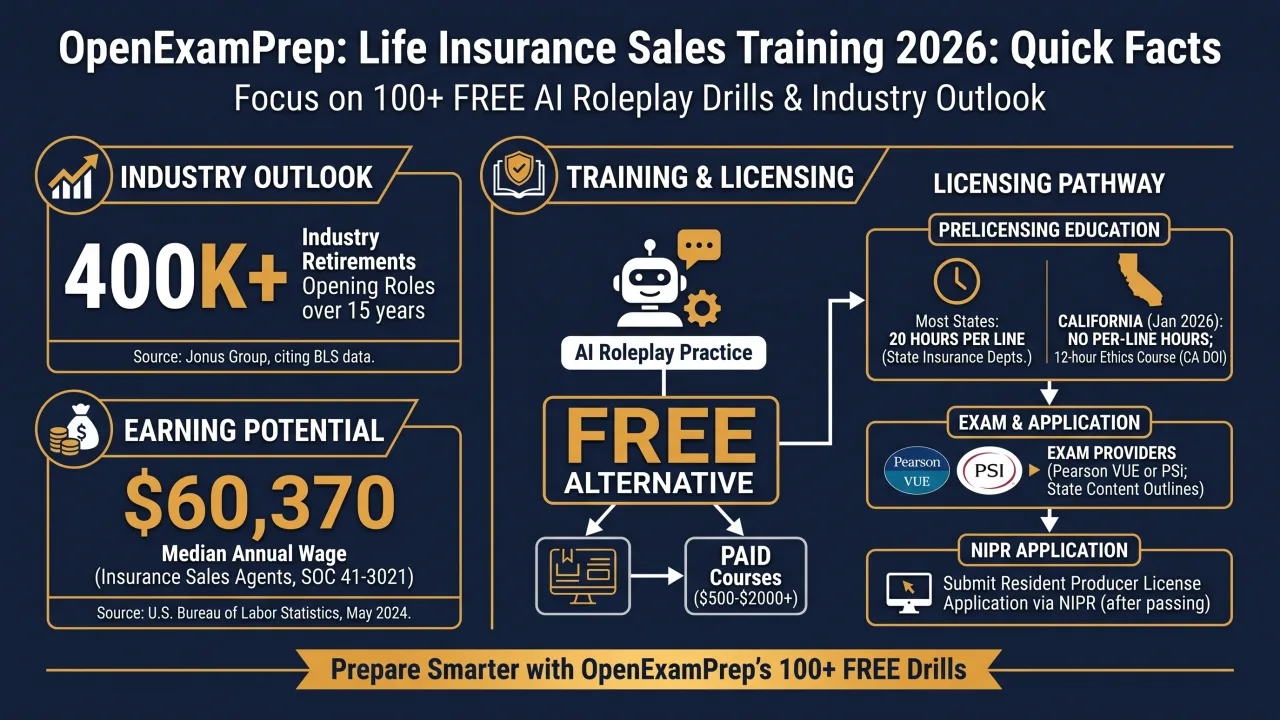
The U.S. insurance industry is projected to lose 400,000+ workers to retirement over the next 15 years, opening significant opportunity for new agents (Jonus Group, citing BLS data). The median annual wage for insurance sales agents (SOC 41-3021) was $60,370 in May 2024 (BLS). But here's the problem: most new agents struggle in their first year because they never learn how to handle real client conversations.
Paid training programs charge $500-$2,000+. But the agents who succeed aren't the ones who paid the most—they're the ones who practiced the most.
This guide shows you how to get comprehensive life insurance sales training completely free, plus the license-process roadmap, a 30-day study plan, sales-call frameworks, objection-handling scripts, and a list of reputable free training resources.
What You Need to Learn (Paid or Free)
Every successful life insurance agent masters these skills:
| Skill | What It Means | Common Mistake |
|---|---|---|
| Getting Appointments | Booking meetings with prospects | Waiting for leads instead of creating them |
| Discovery | Understanding client needs and motivations | Jumping to product before understanding |
| Product Presentation | Explaining term, whole life, IUL clearly | Using jargon clients don't understand |
| Objection Handling | Responding to "too expensive" and "think about it" | Arguing instead of asking questions |
| Closing | Moving from conversation to application | Never actually asking for the business |
| Referrals | Getting introductions from satisfied clients | Not asking or asking awkwardly |
License Process Roadmap: From Zero to Appointed Agent
Before you can sell life insurance, you need a state-issued producer license. Requirements vary by state, but the general path is the same across the country. Always confirm specifics with your state department of insurance.
1. Choose Your Lines of Authority
Life-only is the most common starting line. Many new agents add Accident & Health (A&H) as a combined "Life & Health" license so they can also sell disability, long-term care, and supplemental health products. Property & Casualty is a separate track.
2. Complete Prelicensing Education
Most states require roughly 20 hours of approved prelicensing education per line of authority. A few states have streamlined this: for example, California eliminated per-line hours effective January 1, 2026 (AB 943), retaining a one-time 12-hour Ethics and California Insurance Code course. Check your state's current hour requirement on its department of insurance site.
3. Pass the State Licensing Exam
Exams are administered by vendors such as Pearson VUE or PSI, depending on your state. Each state publishes a content outline (test blueprint) showing the topics and question counts. Most life exams are 75–150 questions with a passing score around 70%, but both vary by state. Schedule through the vendor's website and bring your prelicensing certificate.
4. Submit Fingerprints and Background Check
Most states require fingerprinting (often done at the testing center or through a vendor like Fieldprint) for a background check. Some states require this before you can submit your application.
5. Apply Through NIPR
Resident producer license applications are submitted online through the National Insurance Producer Registry (NIPR) at nipr.com. Application fees vary by state and line (commonly $30–$185). Some states impose a waiting period after passing the exam before you can apply (Illinois, for example, requires a 5-day wait).
6. Get Appointed with Carriers
Once licensed, you contract with one or more insurance carriers (often through an IMO/FMO) to earn commissions and access their products. Appointment is separate from the license itself.
7. Complete Continuing Education to Renew
Most states require continuing education (CE) for license renewal—commonly around 24 hours per compliance period, often including a mandatory ethics or state-specific law module. Track your CE hours so your license doesn't lapse.
Free exam prep: Once you're studying for the state life insurance exam, our Life & Health practice questions help you drill the testable concepts—insurance types, policy provisions, ethics, and state law—at no cost.
Paid Training Options (2026)
Carrier Training Programs
- Cost: Usually free but limited
- Pros: Product-specific, compliance-approved
- Cons: Focused on their products only, minimal sales training
IMO/FMO Training
- Cost: Free for contracted agents
- Pros: Multiple carriers, some sales training
- Cons: Quality varies wildly, often recruiting-focused
Independent Sales Training
- Cost: $500-$2,000+
- Pros: Focused on sales skills
- Cons: Expensive, often outdated methods
AI Roleplay Platforms (Paid)
- Cost: $50-$200/month
- Pros: Modern, unlimited practice
- Cons: Monthly fees add up
The Free Alternative: Complete Training with AI Roleplay
What if you could get:
- Complete life insurance sales curriculum
- 100+ roleplay scenarios
- Term, whole life, and IUL training
- Unlimited practice with AI feedback
- All for $0?
Start now: Free Life Insurance Sales Training →
Free Course Breakdown:
| Module | What You'll Learn | Roleplay Scenarios |
|---|---|---|
| Getting Appointments | Life event triggers, overcoming initial resistance | 15+ |
| Discovery | Needs analysis, emotional drivers, family situations | 20+ |
| Term Life | Features, benefits, when to recommend | 15+ |
| Whole Life | Cash value, permanent protection, comparisons | 15+ |
| IUL | Index linking, floors, caps, tax advantages | 15+ |
| Objection Handling | Price, timing, spouse, health concerns | 20+ |
| Closing | Moving to application, underwriting prep | 10+ |
| Referrals | Asking naturally, follow-up systems | 10+ |
Life Insurance Products Explained Simply
Term Life Insurance
What it is: Pure protection for a set period (10, 20, or 30 years)
Best for: Young families needing maximum coverage at lowest cost
How to explain it:
"Term life is like renting protection—you're covered for a specific time when your family needs it most. If something happens to you during that period, your family gets the full death benefit. It's the most affordable way to get the coverage your family needs."
Common objection: "What if I outlive the term?" Response: "That's actually the goal—we want you to outlive it! By then, your kids are grown, mortgage is paid, and your need for coverage is lower. We can also look at convertible options."
Whole Life Insurance
What it is: Permanent protection with guaranteed cash value growth
Best for: People wanting lifelong coverage plus a savings component
How to explain it:
"Whole life is like owning instead of renting. You're covered for your entire life, and part of your premium builds cash value you can access later. It's more expensive than term, but you're building an asset while staying protected."
Common objection: "I read that whole life is a scam." Response: "I've heard that too—usually from people comparing it to term. They're different tools for different needs. Whole life isn't right for everyone, but for someone who [client's specific situation], the permanent coverage and cash value can make sense. Let me show you how it would actually work for you."
Indexed Universal Life (IUL)
What it is: Permanent coverage with cash value growth linked to market indexes
Best for: People wanting growth potential with downside protection
How to explain it:
"IUL gives you permanent life insurance plus the opportunity for your cash value to grow based on market performance—but with a floor that protects you from losses. When the market goes up, you participate. When it goes down, your floor keeps you from losing what you've built."
Common objection: "Why not just buy term and invest the difference?" Response: "Great question—that's called 'buy term invest the difference,' and it can work. The difference with IUL is: your growth is tax-advantaged, you have a floor protecting against losses, and you get permanent coverage. For someone focused on [tax efficiency / wealth transfer / legacy], these benefits often outweigh higher fees."
Handling the 7 Most Common Objections
1. "It's too expensive"
Don't say: "It's not that expensive" or "You can't afford NOT to have it"
Do say: "I hear you—help me understand what you were expecting to pay? ... Interesting. What if I could show you how to get the protection your family needs closer to that number?"
2. "I need to think about it"
Don't say: "What's there to think about?" or "Okay, I'll call you next week"
Do say: "Absolutely—this is important. Can you help me understand what specifically you want to think through? Is it the coverage amount, the cost, or something else? I want to make sure I've addressed everything."
3. "I need to talk to my spouse"
Don't say: "Can I talk to both of you together?"
Do say: "Of course—this should be a joint decision. What questions do you think they'll have? Let me make sure you have all the information you need for that conversation."
4. "I already have coverage through work"
Don't say: "That's not enough"
Do say: "That's great you have some protection. What happens to that coverage if you change jobs or get laid off? Most people don't realize group coverage doesn't follow you. Let's look at what you'd actually have in that scenario."
5. "I'm healthy—I don't need it yet"
Don't say: "You never know when something will happen"
Do say: "That's actually the best time to get coverage—when you're healthy, you qualify for the best rates. Once health changes, coverage becomes expensive or unavailable. What would happen to your family's income if something happened tomorrow?"
6. "I have health issues—can I even get coverage?"
Don't say: "I'm not sure, let's try"
Do say: "I work with people in all health situations. Some conditions affect rates more than others. Can you tell me more about your situation? There are often more options than people expect."
7. "Let me shop around first"
Don't say: "I'll match any price"
Do say: "I'd expect nothing less—this is a big decision. What will you be comparing? I want to make sure you're looking at apples-to-apples, since policies can look similar but have important differences."
Practice Makes Perfect: AI Roleplay Scenarios
Reading about objection handling isn't enough. You need to practice until responses become natural.
Sample Scenario:
Client: "I appreciate the information, but honestly, life insurance just isn't a priority for me right now. I've got a mortgage, car payments, and I'm trying to save for my kids' college. Maybe in a few years when things calm down."
How would you respond?
Weak response: "I understand. Life insurance is really important though. Should I call you in a year?"
Strong response: "I hear you—you've got a lot on your plate. Can I ask: the mortgage, the cars, the college savings—who pays for all of that if something happens to you? ... That's exactly why most people in your situation see life insurance as protection FOR those priorities, not competing with them. Would it help if I showed you how $30/month could protect all of it?"
Practice this scenario and 100+ more →
The 5-Stage Sales-Call Framework
A repeatable structure keeps calls on track and stops you from pitching too early. Use this framework on every appointment:
| Stage | Goal | Key Moves |
|---|---|---|
| 1. Open | Build rapport and set the agenda | Confirm time available, state your purpose, get permission to ask questions |
| 2. Discovery | Understand needs, goals, and motivations | Ask open-ended questions: who depends on you, what would happen to them, what you already have |
| 3. Educate | Match a product to the stated need | Explain one product in client-friendly language; tie every feature back to a need they named |
| 4. Handle Objections | Resolve concerns without arguing | Acknowledge, ask a clarifying question, reframe around their stated need (see the 7 scripts below) |
| 5. Close & Refer | Move to application and ask for introductions | Summarize the gap, propose next steps (application, medical exam), and ask for referrals naturally |
The biggest mistake new agents make is jumping from Stage 1 straight to Stage 3—pitching before they've discovered the need. Stay in discovery longer than feels comfortable; the close gets much easier.
30-Day Study Plan Template (Free)
Use this template to combine license-exam prep with sales-skill practice. Adjust hours to fit your schedule.
Week 1 — Exam Foundations
- Days 1–3: Insurance basics — policy types, term vs. whole vs. universal, policy provisions, beneficiaries. Drill with free Life & Health practice questions.
- Days 4–5: Ethics, state insurance law, and regulations. Read your state's content outline.
- Day 6: Take a full-length timed practice exam; review every miss.
- Day 7: Rest or light review of weak topics.
Week 2 — Pass the Exam
- Days 8–10: Targeted review of your lowest-scoring domains from Day 6.
- Day 11: Second full practice exam.
- Days 12–13: Schedule and sit for the state exam (Pearson VUE or PSI).
- Days 14–15: Apply for your license via NIPR; complete fingerprints if required.
Week 3 — Sales Skills
- Days 16–17: Learn the 5-stage sales-call framework above.
- Days 18–19: Practice discovery questions with AI roleplay until they feel natural.
- Days 20–21: Practice product explanations (term, whole life, IUL) out loud.
Week 4 — Objections and Closing
- Days 22–24: Drill the 7 common objections below until responses are automatic.
- Days 25–26: Practice closing language and application/underwriting handoff.
- Days 27–28: Full roleplay appointments — discovery through close — with AI feedback.
- Days 29–30: Get appointed with your first carrier and start prospecting.
Free Training Resources (Beyond This Course)
Reputable free resources to supplement your training:
- Your state department of insurance — publishes the exam content outline, prelicensing rules, and candidate handbook. This is the authoritative source for what's on your exam.
- NIPR (nipr.com) — free licensing information, state fee schedules, and the online application portal.
- Carrier agent portals — most major life insurers (legal & compliance-approved) offer free product training once you're appointed, often with certification exams.
- IMO/FMO resource libraries — many marketing organizations give contracted agents free sales scripts, needs-analysis worksheets, and recorded calls.
- NAIC (naic.org) — free consumer and producer education on insurance fundamentals and regulatory basics.
- Insurance Information Institute (iii.org) — free, plain-English explainers on term, whole life, universal life, and IUL for client-facing conversations.
- OpenExamPrep — free AI roleplay (this course), free Life & Health practice questions, and free study guides.
Pair any of these with the AI roleplay drills below so knowledge turns into conversational skill.
Why This Free Training Works
Traditional Training:
- Read material ❌
- Watch videos ❌
- Role play once in a workshop ❌
- Forget everything in 2 weeks ❌
AI-Powered Training:
- Read material ✅
- Practice with AI client immediately ✅
- Get feedback on your response ✅
- Practice again until natural ✅
- Come back and practice anytime ✅
The difference is unlimited, judgment-free practice. You can stumble through an objection 10 times with an AI before trying it with a real client.
Start Your Free Training Now
What's Included (Free):
- 100+ roleplay scenarios covering the complete sales cycle
- Term, whole life, and IUL product training
- Objection handling scripts for every common pushback
- Closing techniques that don't feel pushy
- Referral strategies to build a sustainable practice
- AI feedback on every practice conversation
No Cost, No Catch:
- No credit card required
- No trial that converts to paid
- Practice as much as you want
- Use AI credits for deeper conversations
Start Free Life Insurance Sales Training →
Key Takeaways
- The insurance industry faces 400,000+ retirements over 15 years—opportunity for new agents is real
- Most agents struggle because they don't practice conversations—not because of bad training
- Free training with AI roleplay lets you practice unlimited scenarios at no cost
- Handling objections is the #1 skill that separates successful agents
- You can master life insurance sales without spending money on training
- Get licensed first—prelicensing hours, state exam, NIPR application, then get appointed
The agents who succeed are the ones who practice the most. Start practicing for free today.


 Buy on Amazon
 Prep course on Achievable
 Online course on Mometrix
 Take courses on Udemy