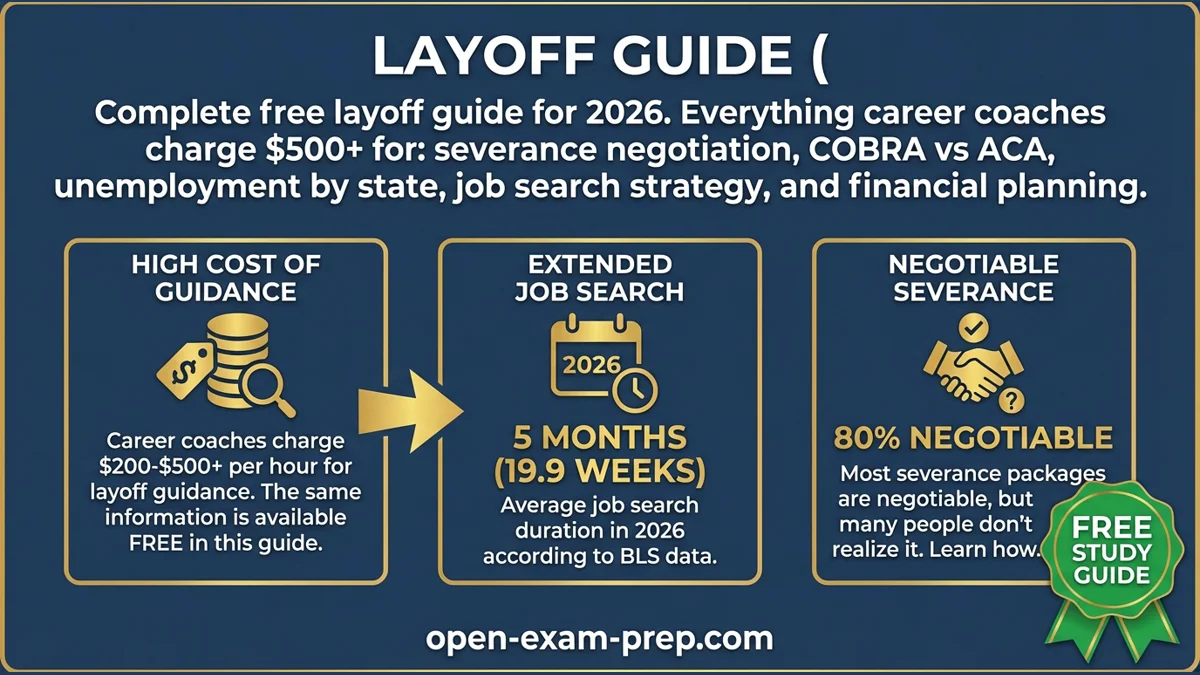
You Don't Need to Pay $500+/Hour for Layoff Guidance
Career coaches charge $200-$500+ per hour for layoff guidance. They'll help you negotiate severance, plan your finances, and strategize your job search.
Here's the truth: everything they teach is available for free.
This guide gives you the complete playbook—what to do in the first 24 hours, how to negotiate severance, health insurance decisions, financial planning, and job search strategy. All based on 2026 data.
What Career Coaches Actually Charge
| Service | Typical Cost | What You Get |
|---|---|---|
| Initial consultation | $200-$300 | Assessment of your situation |
| Severance negotiation help | $500-$1,000 | Script and strategy |
| Job search strategy | $300-$500/session | Resume, LinkedIn, targeting |
| Interview prep | $200-$400/session | Mock interviews |
| Full coaching package | $2,000-$5,000 | Everything above |
Total for comprehensive help: $3,000-$7,000
Or you could learn the same strategies for free.
Get the complete guide: Free Layoff Handbook →
Part 1: The First 24 Hours
Don't Sign Anything Yet
When handed a severance agreement, your instinct might be to sign immediately—especially if you're in shock. Don't.
Key facts:
- You typically have 21 days to review before signing
- If you're over 40, you get 45 days (Age Discrimination in Employment Act)
- After signing, you have 7 days to revoke (in most states)
What to Secure Immediately
Before leaving the building or returning equipment:
- Personal files from work computer (forward to personal email or USB)
- Contact list of colleagues and clients
- Work samples (if not confidential)
- List of accomplishments and metrics for your resume
- Return all company property (laptop, badge, etc.)
Processing the News
Getting laid off triggers real grief. The stages are:
- Shock and denial
- Anger
- Bargaining ("What if I had...")
- Sadness
- Acceptance
Don't make major financial decisions while in stages 1-3. Wait 24-48 hours.
Part 2: Severance Negotiation
80% of Packages Are Negotiable
Most people don't realize this. Companies expect negotiation—they often start with their minimum offer.
What You Can Negotiate
| Item | Typical Ask | Your Leverage |
|---|---|---|
| Additional pay | 1-2 extra weeks per year of service | High value employees |
| Extended health insurance | 3-6 months continued coverage | Cheaper than COBRA |
| Outplacement services | Resume writing, job search help | Easy for company to add |
| Equity vesting | Accelerate unvested stock options | Tech/startup employees |
| Reference language | Specific positive wording | Protects your reputation |
| Non-compete modification | Shorten or eliminate restrictions | Limits your options otherwise |
The Negotiation Script
"Thank you for presenting this package. Before I sign, I'd like to discuss a few items. Given my [X years of service / specialized knowledge / client relationships], I was hoping for [specific ask]. Is there flexibility on that?"
Key rules:
- Be professional, not emotional
- Make specific asks (not "more money")
- Have a reason for each ask
- Be willing to trade items
Part 3: Health Insurance Decision
COBRA vs Marketplace (ACA)
This is one of the biggest decisions you'll make. Here's the 2026 reality:
| Factor | COBRA | Marketplace (ACA) |
|---|---|---|
| Average cost | $700+/month individual | $50-$300 with subsidies |
| Coverage | Same as your employer plan | New plan options |
| Your doctors | Keep same network | May need to switch |
| Eligibility | 18 months after job loss | Open enrollment or special period |
| Subsidies | None | 8 out of 10 people qualify |
When COBRA Makes Sense
- You're mid-treatment for a serious condition
- Your doctors are out-of-network on marketplace plans
- You'll be employed again within 1-2 months
- Your employer heavily subsidized COBRA
When Marketplace Wins (Most People)
- You qualify for subsidies (check Healthcare.gov)
- You're flexible on doctors/network
- You're in good health currently
- You need coverage for 3+ months
Pro tip: You can choose COBRA later. You have 60 days to elect COBRA retroactively. So check marketplace options first, then decide.
Part 4: Unemployment Benefits
2026 Unemployment by State (Examples)
| State | Maximum Weekly Benefit | Duration |
|---|---|---|
| California | $450 | 26 weeks |
| Texas | $549 | 26 weeks |
| New York | $504 | 26 weeks |
| Florida | $275 | 12 weeks |
| Massachusetts | $823 | 26 weeks |
How to File
- File immediately—there's usually a waiting week
- Document everything—job applications, interviews
- Understand requirements—active job search is mandatory
- Know your disqualifiers—don't turn down suitable work
What Counts as "Looking for Work"
Most states require 3 job search activities per week:
- Applying for jobs
- Attending interviews
- Networking events
- Job fairs
- Skills training
Keep a log—you may be audited.
Part 5: Financial Triage
Immediate Budget Adjustment
Calculate your runway:
Available funds = Savings + Severance (after tax) + Expected unemployment + Partner income (if applicable)
Monthly burn = Essential expenses only (housing, food, insurance, utilities, minimum debt payments)
Runway = Available funds / Monthly burn
What to Cut First
Cut immediately:
- Subscriptions you don't use
- Dining out / food delivery
- Discretionary shopping
- Expensive gym memberships (switch to free alternatives)
Cut if needed:
- Cable/streaming (keep 1-2 max)
- Phone plan (switch to cheaper option)
- Reduce grocery budget
Don't cut:
- Health insurance (you need this)
- Internet (required for job search)
- Minimum debt payments (protect credit)
What NOT to Do
❌ Don't cash out your 401(k)—you'll pay taxes + 10% penalty ❌ Don't stop all debt payments—this hurts credit when you need it ❌ Don't make major purchases—preserve cash ❌ Don't start a business with savings—risky timing
Part 6: Job Search Reality (2026)
The Numbers You Need to Know
| Metric | 2026 Data |
|---|---|
| Average job search length | 5 months (19.9 weeks) |
| Long-term unemployed (27+ weeks) | 24% of job seekers |
| Jobs found through networking | 70%+ |
| Jobs found through applications | Less than 30% |
| Average applications to get interview | 21-80 |
| Interviews to offer ratio | 3-10 interviews |
What Actually Works
High impact:
- Referrals from your network (highest conversion)
- Reaching out to specific people at target companies
- Informational interviews that lead to opportunities
- LinkedIn with active engagement
Medium impact:
- Targeted applications (10-15 per week, customized)
- Recruiter relationships
- Industry events
Low impact:
- Mass applications (applying to 50+ jobs/week)
- Generic resume for all applications
- Just waiting for responses
The 70% Rule
70% of your job search time should be networking, not applying. Here's why:
| Method | Applications | Interviews | Offers |
|---|---|---|---|
| Mass applying | 100 | 3-5 | 0-1 |
| Targeted + referrals | 25 | 8-12 | 2-3 |
Quality over quantity wins.
Part 7: Mental Health
Normal Reactions
It's normal to feel:
- Shock and numbness
- Anger at employer or self
- Anxiety about finances
- Loss of identity
- Difficulty sleeping
- Reduced motivation
When to Seek Help
Consider professional support if:
- Symptoms persist more than 2 weeks
- You're using alcohol/substances to cope
- You have thoughts of self-harm
- You can't complete basic daily tasks
- Relationships are deteriorating
Free Resources
- 988 Suicide & Crisis Lifeline: Call or text 988
- Crisis Text Line: Text HOME to 741741
- NAMI Helpline: 1-800-950-6264
- Open Path Collective: Sliding scale therapy ($30-$80/session)
Part 8: H-1B Special Considerations
If you're on an H-1B visa, time is critical.
The 60-Day Rule
- Maximum grace period: 60 days from last paid day
- Or until I-94 expires—whichever comes FIRST
- You can work immediately once H-1B transfer is filed
- Premium processing ($2,805) gets decision in 15 business days
Immediate Actions
- Start job search immediately—no time to process emotionally first
- Consult immigration attorney within first week
- Consider H-1B transfer vs. other options (O-1, L-1, etc.)
- Keep documentation of employment end date
- Have backup plan (departure, tourist status conversion, etc.)
Get the Complete Free Guide
This article covers the highlights. The full course includes:
- 10 comprehensive modules from Day 1 to Month 6+
- Roleplay scenarios for negotiation and networking
- Checklists for every stage
- 2026 data on unemployment, insurance, job market
- Calculators for runway and budget
Key Takeaways
- Don't sign severance immediately—you have 21-45 days
- 80% of severance is negotiable—ask for more
- Marketplace often beats COBRA—check subsidies first
- File unemployment immediately—waiting week is required
- 70% of jobs come through networking—don't just apply
- Average job search is 5 months—plan accordingly
- You don't need a career coach—this guide has what they charge for
Everything career coaches charge $500+/hour for is in this guide—free.
