EA exam-year baseline: The 2026–2027 SEE uses Tax Year 2025 and federal tax law through December 31, 2025. Unless a question names a different year, current year means 2025. Use 2025 amounts, including OBBBA changes effective in 2025; distinguish later effective dates. IRS policy.
Enrolled Agent (EA) Exam Overview
The Enrolled Agent (EA) credential is the highest designation the IRS awards to tax professionals. EAs have unlimited rights to represent any taxpayer, on any tax matter, before any IRS office. The exam is officially the Special Enrollment Examination (SEE), and it has three separate parts you pass one at a time.
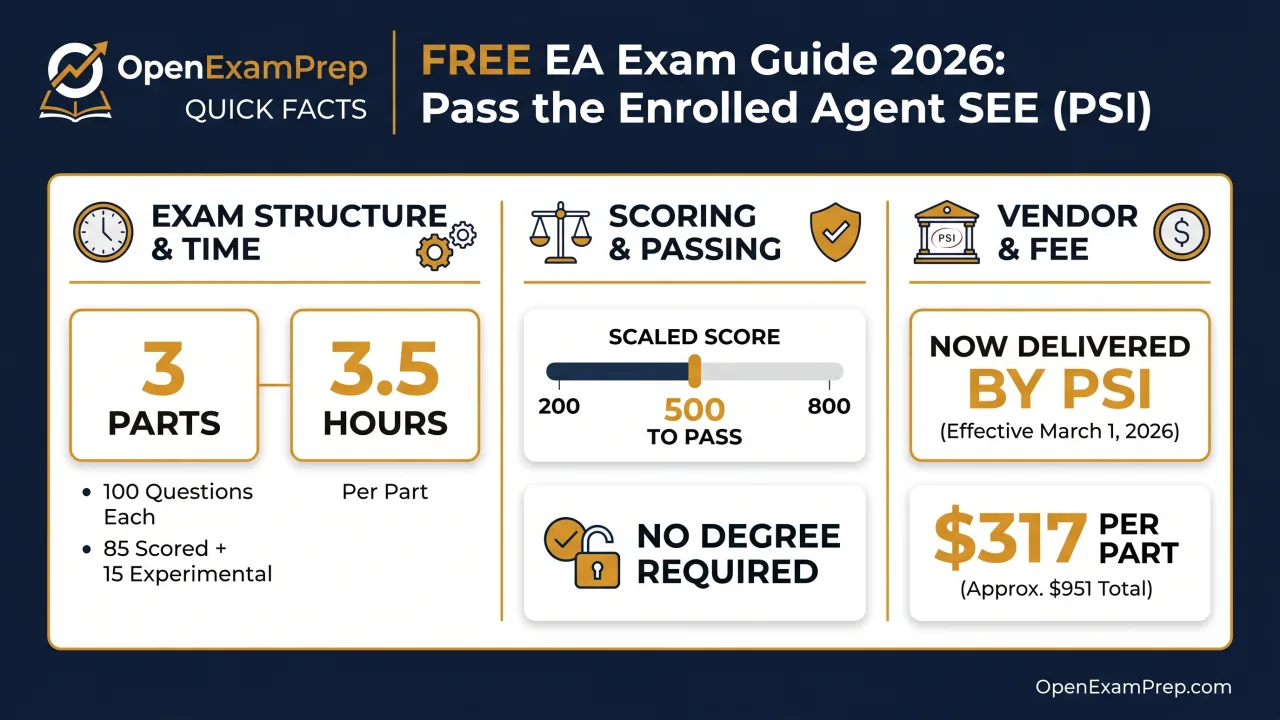
Big 2026 change: effective March 1, 2026, the SEE is no longer developed or delivered by Prometric. The IRS selected PSI Services as the new testing vendor. With PSI, U.S. candidates can test at a PSI test center or by remote online proctoring at no extra charge; international candidates test remotely only. Scheduling opened May 1, 2026, and the testing window runs July 1, 2026 - February 28, 2027 (international testing remains delayed; no new start date has been announced as of October 11, 2026).
EA Exam Format at a Glance (2026-2027)
| Component | Detail |
|---|---|
| Testing vendor | PSI Services (replaced Prometric on March 1, 2026) |
| Parts | 3 - Part 1 Individuals, Part 2 Businesses, Part 3 Representation, Practices & Procedures |
| Questions per part | 100 multiple-choice (85 scored + 15 unscored experimental) |
| Time per part | 3.5 hours (about 4 hours seat time with tutorial, survey, two 10-minute breaks) |
| Scoring | Scaled score 200-800; 500 to pass each part |
| Fee | $317 per part (about $951 for all three), paid at scheduling |
| Delivery | PSI test center or remote online proctoring (U.S.) |
| Eligibility | Valid PTIN; no degree or experience required |
| Carryover | Passed parts stay valid 3 years; pass all three within that window |
The old facts you may still see online - $206 or $267 per part, a "105 / ~70% passing score" on a 40-130 scale, or Prometric delivery - are outdated. For 2026-2027 the fee is $317, scoring is 200-800 with 500 to pass, and delivery is PSI.
Start FREE EA Exam Prep
Start free EA practice questions | Open the free EA study guide
How the SEE Is Scored
Every part has 100 questions, but only 85 are scored. The other 15 are experimental questions PSI is testing for future exams - they look identical and you cannot tell which is which, so answer all 100 carefully. Your raw score on the 85 scored questions is converted to a scaled score from 200 to 800, and you need 500 or higher to pass. There is no fixed percentage; scaling adjusts for how hard your particular question set was, so two candidates with different raw scores can both land at 500. Pass results simply say "pass"; fail results include a diagnostic by topic so you know where to focus on a retake.
Results are shown immediately at the test center after you finish, and a printed score report is available on request - the same as you would expect from a high-stakes professional exam.
The Three Exam Parts and Their Topic Weights
The SEE is built directly from the IRS SEE content outlines. The domain weights below reflect the share of the 85 scored questions in the 2026-2027 window. Use them to budget your study hours.
Part 1: Individuals (Form 1040)
| Domain | Approx. weight |
|---|---|
| Preliminary Work and Taxpayer Data | 16% |
| Income and Assets | 20% |
| Deductions and Credits | 20% |
| Taxation | 18% |
| Advising the Individual Taxpayer | 13% |
| Specialized Returns for Individuals | 13% |
Key topics: filing status (Single, MFJ, MFS, HOH, qualifying surviving spouse), gross income (wages, interest, dividends, capital gains, retirement distributions), adjustments (IRA, HSA, student loan interest), the standard vs. itemized deduction, credits (Child Tax Credit, EITC, education, dependent care), basis of assets and inherited/gifted property, capital gains netting, AMT, self-employment tax (Schedule C and SE), estate and gift basics, and retirement plans (traditional and Roth IRAs, distributions).
Free Practice Questions
Access free EA practice questions - mixed Part 1, 2, and 3 sets with full explanations.
Part 2: Businesses (Forms 1120, 1120-S, 1065)
| Domain | Approx. weight |
|---|---|
| Business Entities and Considerations | 35% |
| Business Tax Preparation | 44% |
| Specialized Returns and Taxpayers | 21% |
Key topics: choosing and taxing entities (sole proprietorships, partnerships, S corps, C corps, LLCs), corporate income and deductions (Form 1120), partnership distributive share and basis (Form 1065), S corporation shareholder basis and distributions (Form 1120-S), ordinary and necessary expenses, depreciation (MACRS, bonus, Section 179, listed property), accounting methods (cash vs. accrual, inventory), business credits, trust and estate returns (Form 1041), tax-exempt organizations, and retirement plans for businesses (SEP, SIMPLE, qualified plans).
Part 3: Representation, Practices and Procedures
| Domain | Approx. weight |
|---|---|
| Practices and Procedures | 31% |
| Representation before the IRS | 29% |
| Specific Areas of Representation | 24% |
| Filing Process | 16% |
Key topics: Circular 230 practice standards and sanctions, due diligence and preparer penalties, Power of Attorney (Form 2848) and the CAF number, e-file rules (ERO, EFIN, e-Services), taxpayer penalties (accuracy, fraud, failure to file/pay), the audit and examination process, the IRS appeals process and Tax Court, collection procedures (liens, levies, installment agreements, Offer in Compromise), and records retention. Part 3 is conceptual rather than computational, which is why many candidates save it for last.
Eligibility: What You Actually Need
The EA path is open - there are no education or experience requirements. To sit for the SEE you must:
- Hold a valid PTIN (Preparer Tax Identification Number). New PTINs and renewals cost $18.75 for 2026, applied for at the IRS Tax Professional PTIN system.
- Have no IRS filing or payment delinquencies that would block enrollment.
- Provide acceptable government-issued ID at the test center (or pass the ID check for remote proctoring).
You do not need a college degree, an accounting background, or sponsorship. Anyone who can master the material can become an EA.
The Enrollment Process (After You Pass All 3 Parts)
Passing the exam is not the final step - you must apply for enrollment to practice:
- Pass all three parts within the rolling 3-year carryover window.
- File Form 23 (Application for Enrollment to Practice Before the IRS) within one year of passing your final part.
- Pay the $140 enrollment fee with Form 23.
- Pass a suitability (tax-compliance and background) check - the IRS confirms you have filed and paid your own taxes.
- Once approved, maintain the credential with 72 hours of continuing education every 3-year cycle (minimum 16 hours per year, including 2 hours of ethics).
What It Costs to Become an EA in 2026
| Item | Cost |
|---|---|
| PTIN (per year) | $18.75 |
| SEE exam - 3 parts | $317 x 3 = $951 |
| Form 23 enrollment fee | $140 |
| Study materials | $0 with OpenExamPrep (commercial courses $200-$1,500) |
| Typical total | ~$1,110 plus optional paid materials |
Even at the new $317 fee, the EA is one of the most affordable advanced tax credentials - far less than the CPA path - and our practice questions and study guide keep your study cost at zero.
Study Plan and Timeline
Most candidates need 40-70 hours per part depending on tax background; 130-200 total hours is a realistic full-credential range.
| Phase | Focus | Hours |
|---|---|---|
| Weeks 1-4 | Part 1: Individuals | 40-55 |
| Weeks 5-8 | Part 2: Businesses | 45-65 |
| Weeks 9-11 | Part 3: Representation | 30-45 |
| Week 12 | Mixed timed exams + weak-area repair | 20-30 |
Take the parts in any order PSI lets you schedule, but most people go 1 then 2 then 3: Part 1 builds the foundation, Part 2 is the heaviest (most candidates' hardest), and Part 3 is conceptual and often quickest. You have a generous carryover window, so spread the parts out rather than cramming all three.
How to Study to Pass
- Anchor on the IRS content outline. The SEE is built from it; the domain weights above tell you where the questions live. Spend more time where the percentages are higher (Part 2 Business Tax Preparation, Part 1 Income/Deductions).
- Learn from IRS sources, not commentary. Questions follow IRS publications, instructions, and the Internal Revenue Code - not a commercial author's interpretation.
- Drill calculations. Basis, depreciation, capital gain netting, credit phase-outs, and SE tax are computed constantly - practice the math until it is automatic.
- Master Circular 230. Part 3 leans heavily on practice standards, due diligence, and penalties; know who can do what and when.
- Use mixed, timed sets early. The real exam never announces which rule it is testing. Identify the domain first, then solve.
- Treat practice as diagnostics. Tag each miss - content gap, careless reading, calculation setup, pacing - and let the tags drive your next study block.
Quiz yourself on EA topics now and let our free AI tutor explain any rule you miss.
Scenario Strategy for Hard Questions
Many candidates miss hard SEE questions for one of three reasons: they grab the first familiar phrase, they ignore a limiting condition, or they over-polish every answer choice. A better method: name the task in plain English ("what am I being asked to decide?"), separate the controlling facts from background, then predict the rule before reading the options. When two choices remain, pick the one consistent with the role in the prompt (preparer, representative, or adviser) and with documentation and compliance. In tax, a single phrase - basis, holding period, related party, reasonable cause, fiduciary, disclosed position - can flip the answer even when the numbers look familiar. Circle the controlling fact before you calculate.
Practice Routing and Score Repair
After each timed block, reread only the smallest source section that explains a miss, write the rule in one sentence in your own words, then answer two or three nearby questions with no notes. If you can only get the original item right after seeing the explanation, you have recognized the answer rather than learned the skill. Move to longer, mixed, timed sets earlier than feels comfortable - that builds the domain-recognition reflex the real exam rewards.
Pair this guide with the free practice path: EA practice questions and the EA study guide.
Final Two-Week Readiness Plan
Stop measuring progress by pages read; measure it by repeatable performance. In the first week, alternate a targeted weak-area set, a mixed timed set, a review block, and a closed-book recall session (write formulas, filing thresholds, and Circular 230 triggers from memory, then check them). In the final week, reduce new material, keep daily contact with the hardest topics, and rework items you missed twice. Confirm logistics: PSI center location or remote-proctor system check, acceptable ID, the calculator provided on screen, and the two scheduled breaks. You are ready when you can explain each part's core domains without the outline and finish timed sets without rushing the last ten questions.
Why Become an Enrolled Agent?
- Unlimited representation rights - represent any taxpayer on any matter before any IRS office, the same authority as a CPA or attorney for tax.
- A federal credential - recognized in all 50 states with no state-by-state licensing.
- Lower cost and faster path than the CPA, with no degree requirement.
- Strong, steady demand as tax complexity grows and IRS enforcement expands.
- Career flexibility - work solo, at a firm, in a tax-prep chain, or in representation and resolution.
Start Your EA Journey Today
Begin free EA exam prep now - 100% free practice questions, a study guide, and an AI tutor. Build the loop that passes the SEE: official source, focused study, timed practice, miss analysis, targeted repair.

 Free CE
 Buy on Amazon
 Take courses on Udemy
 Study resources on Achievable