 View
ViewWhy Proper Welding Gloves Are Required PPE for Certification
Walk into any accredited welding program or certification testing facility and try to pick up a torch without gloves. You will be stopped before you strike an arc. Welding gloves are not optional equipment — they are mandatory personal protective equipment (PPE) under OSHA 29 CFR 1910.252 and every AWS (American Welding Society) safety standard.
Here is what your hands face during welding:
- Molten spatter — tiny droplets of molten metal that reach 2,000°F+ and can cause instant second-degree burns on unprotected skin
- Radiant heat — the welding arc produces intense infrared radiation that heats everything nearby, including your hands holding the torch
- UV radiation — the same UV that requires a welding helmet also damages exposed skin on your hands
- Sharp edges — freshly cut and ground metal, wire ends, and slag chips can cut unprotected hands
- Electrical contact — in stick and TIG welding, you are holding an electrode that carries welding current
The right gloves protect against all five hazards while preserving enough dexterity to produce quality welds. The wrong gloves — or worn-out gloves — compromise either safety or weld quality, and often both.
If you are preparing for a welding certification (AWS D1.1, API 1104, or any structural/pipe qualification), your gloves are part of your test equipment. Invest in the right pair for your process. Study welding safety and inspection standards for free with our CWI exam study guide.

Caiman Premium Goat Grain TIG/MIG Welding Gloves with Wool Insulated Back
by Caiman
$24.99
- Premium goat grain leather for TIG/MIG with wool insulated back for heat protection
- Boarhide palm reinforcement for extended durability in high-wear areas
- Scalloped cuff design — the professional standard in welding shops and trade schools
TIG vs MIG vs Stick: Different Processes Need Different Gloves
This is the most important concept for choosing welding gloves, and it directly relates to process knowledge tested on the CWI exam. Each welding process produces different amounts of heat, spatter, and radiation — and demands different levels of hand dexterity.
TIG Welding (GTAW) — Maximum Dexterity Required
TIG welding is the most demanding process for hand skill. The welder holds the torch in one hand and feeds filler rod with the other, controlling puddle size, travel speed, and filler addition simultaneously. Your fingertips need to feel the rod and torch to make micro-adjustments.
Glove requirements for TIG:
- Thin, flexible leather — goatskin or deerskin, 0.6-0.8mm thickness
- Close, snug fit — the glove should feel like a second skin
- Short to medium cuff — 2-4 inches, enough to cover the wrist without restricting movement
- Minimal insulation — TIG produces less heat than MIG or stick, so heavy insulation is unnecessary and reduces dexterity
TIG gloves look more like driving gloves than what most people picture as welding gloves. That is intentional — precision is the priority.
MIG Welding (GMAW) — Balance of Protection and Control
MIG welding produces moderate spatter and higher sustained heat than TIG. The welder holds a gun with a trigger, which requires less fine motor control than TIG but still needs good hand feel for travel speed and gun angle.
Glove requirements for MIG:
- Medium-weight leather — top grain cowhide or heavy goatskin, 0.8-1.2mm thickness
- Reinforced palms — spatter hits the palm area most frequently
- Medium cuff — 4-6 inches for forearm protection against spatter
- Moderate insulation — cotton or foam lining for sustained heat comfort
MIG gloves are the workhorse category. They handle more abuse than TIG gloves while maintaining enough feel to control the welding gun effectively.
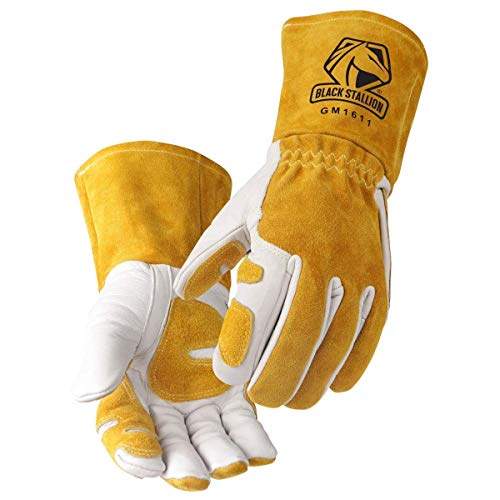
Black Stallion GM1611-WT Top Grain Leather Cowhide MIG Welding Gloves
by Black Stallion
$17.80
- Top grain cowhide built for MIG and stick welding heat and spatter
- Reinforced patched palm and thumb for durability in high-wear zones
- Cotton/foam lining for comfort — professional-grade protection at an affordable price
Stick Welding (SMAW) and Flux-Core (FCAW) — Maximum Heat Protection
Stick welding produces the most spatter, highest sustained heat, and largest slag volume of any common welding process. Flux-core welding is similar. The welder holds an electrode holder or gun that requires grip strength more than fine dexterity.
Glove requirements for stick and flux-core:
- Heavy leather — split cowhide or thick top grain cowhide, 1.2-1.5mm+ thickness
- Extended cuffs — 14-16 inches to protect the forearm from falling spatter and slag
- Heavy insulation — multiple layers for sustained high-heat work
- Reinforced stitching — Kevlar thread resists heat better than cotton or polyester
These are the big, bulky gloves that most people associate with welding. They sacrifice dexterity for maximum protection — which is the right trade-off for processes where spatter and heat are intense.
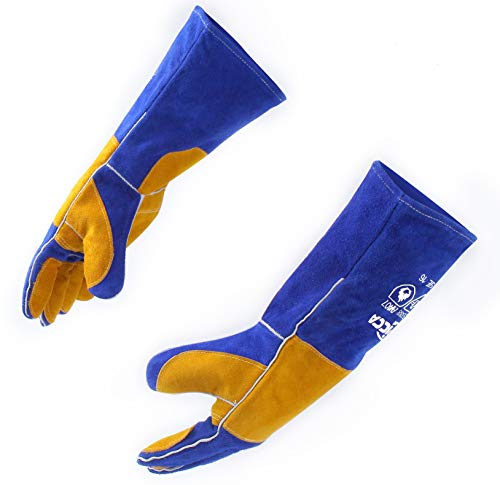
RAPICCA Welding Gloves Fire Heat Resistant 16" 932°F
by RAPICCA
$18.99
- 932°F heat resistant with 16-inch length for maximum forearm protection
- Fireproof leather with Kevlar stitching — built for stick and flux-core welding
- Best choice for high-heat processes where forearm coverage is critical
Leather Types: Goatskin vs Cowhide vs Deerskin
The leather in your welding gloves determines the balance between dexterity, heat resistance, and durability. Understanding leather types helps you make an informed choice.
Goatskin (Goat Grain) — The TIG Standard
Goatskin has the tightest natural fiber structure of any common glove leather. This gives it unique properties:
- Excellent tactile sensitivity — you can feel the filler rod and torch through the leather
- Natural heat resistance — withstands approximately 400°F before degradation
- High abrasion resistance — the tight fiber structure resists wear from rough metal surfaces
- Natural lanolin content — keeps the leather supple even after repeated heat cycles
- Thin cross-section — typically 0.6-0.8mm for maximum dexterity
Goatskin is the undisputed choice for TIG welding and precision work. Premium TIG gloves from Caiman and YESWELDER use top grain goatskin because nothing else matches its combination of feel and protection.
Cowhide (Top Grain and Split) — The MIG/Stick Standard
Cowhide is the most common welding glove leather, available in two grades:
- Top grain cowhide — the outer layer of the hide, smoother and more durable. Used in quality MIG gloves like the Black Stallion GM1611. Good heat resistance (450°F+), excellent abrasion resistance, moderate dexterity.
- Split cowhide — the inner layer after top grain is separated. Thicker, rougher, and less flexible. Used in economy stick welding gloves and as reinforcement patches. Maximum heat resistance but minimal dexterity.
For MIG welding, top grain cowhide offers the best balance. For stick welding, split cowhide or a combination provides maximum protection.
Deerskin — The Comfort Option
Deerskin is the softest glove leather, prized for comfort during long sessions:
- Exceptional softness — breaks in faster than goatskin or cowhide
- Good dexterity — nearly as flexible as goatskin
- Lower heat resistance — degrades faster under sustained heat than goatskin
- Lower durability — wears through more quickly than cowhide
Deerskin is a valid choice for light TIG work and low-amperage welding, but most professional welders and certification programs favor goatskin for its superior durability.

Caiman Premium Goat Grain TIG/Multi-Task Welding Gloves, 4" Extended Cuff
by Caiman
$23.67
- 4-inch extended cuff for extra wrist protection during overhead and out-of-position welding
- Premium goat grain leather palm with split cowhide back for heat resistance
- Ideal for TIG and multi-task welding — versatile enough for MIG at lower amperages
ANSI/ISEA 105 Protection Levels Explained
The ANSI/ISEA 105 standard provides a standardized way to compare hand protection across different glove brands and models. Understanding these ratings helps you verify that your gloves provide adequate protection.
Cut Resistance (A1-A9)
Cut resistance measures how much force is needed to cut through the glove material using a standardized blade:
| Level | Cut Force (grams) | Typical Application |
|---|---|---|
| A1 | 200-499g | Light handling, packaging |
| A2 | 500-999g | General welding, light metal handling |
| A3 | 1000-1499g | Sheet metal, sharp edge handling |
| A4 | 1500-2199g | Heavy metal fabrication |
| A5-A9 | 2200g+ | Glass handling, specialty industrial |
For welding certification students, A2-A4 cut resistance is appropriate. You are handling cut metal edges, wire, and grinding — A2 protects against incidental contact while A4 covers frequent sharp-edge handling.
Puncture Resistance (Levels 1-5)
Puncture resistance measures force needed to push a standard probe through the glove material:
| Level | Puncture Force (Newtons) | Typical Application |
|---|---|---|
| 1 | ≥10N | Light duty |
| 2 | ≥20N | General handling |
| 3 | ≥60N | Welding, metal fabrication |
| 4 | ≥100N | Heavy industrial |
| 5 | ≥150N | Extreme puncture hazards |
Level 3 puncture resistance is the minimum recommended for welding. Wire ends, electrode stubs, and broken tack welds can puncture thin leather.
Abrasion Resistance (Levels 0-6)
Abrasion resistance measures how many cycles of standard abrasive contact the material withstands before wearing through. Level 3-4 is typical for quality welding gloves. Higher abrasion resistance means longer glove life when handling rough metal surfaces and slag.
For the CWI exam: Understanding PPE standards including glove protection ratings demonstrates practical safety knowledge. AWS and OSHA require employers to provide appropriate PPE — knowing what appropriate means in specific situations is part of a welding inspector's role. Practice welding safety questions with our free CWI exam prep.
How to Size Welding Gloves Properly
Glove fit directly affects weld quality. This matters more than most certification students realize.
Why Fit Matters for Weld Quality
When your gloves are too loose:
- You grip the torch and filler rod harder to compensate for the slack, causing hand fatigue within 30 minutes
- Extra material between your fingers catches on filler rod and disrupts feeding rhythm
- Loose fingertips delay tactile feedback, making puddle control inconsistent
- Torch angle drifts because you cannot feel the torch orientation precisely
When your gloves are too tight:
- Blood flow restriction causes numbness after 15-20 minutes
- Finger movement is restricted, slowing filler rod manipulation
- Leather stretches thin at stress points, reducing protection and glove life
- Hand cramping forces you to stop and rest more frequently
How to Measure Your Hand
- Wrap a flexible tape measure around the widest part of your dominant hand (across the knuckles, excluding the thumb)
- Note the measurement in inches
- Use this guide:
| Hand Circumference | Glove Size |
|---|---|
| 7.0 - 7.5 inches | Small |
| 8.0 - 8.5 inches | Medium |
| 9.0 - 9.5 inches | Large |
| 10.0+ inches | X-Large |
Brand-Specific Sizing Notes
- Caiman gloves tend to run slightly large — if you are between sizes, go down
- YESWELDER gloves run true to size
- Black Stallion gloves run true to size with a slightly wider palm
- RAPICCA gloves run large (they are designed to accommodate thicker inner liners)
Break-In Period
New leather welding gloves require 5-10 hours of welding to fully break in. During this period, the leather conforms to your hand shape and softens at the flex points. Do not judge a new pair of gloves based on the first session — give them time to mold to your hands. This is why buying your test-day gloves well in advance of the certification exam is important.

YESWELDER Premium Goatskin TIG Welding Gloves, Top Grain Leather, High Dexterity
by YESWELDER
$15.99
- Top grain goatskin leather with high dexterity for precision TIG work
- Most affordable quality TIG glove — excellent value for certification students on a budget
- Excellent touch sensitivity for filler rod control and torch manipulation
Caiman: The Professional's Choice
Walk through any professional welding shop, union training center, or pipeline fabrication facility and count the glove brands. Caiman dominates for a reason.
What Makes Caiman Different
Caiman has manufactured welding gloves for over 30 years, specializing exclusively in hand protection for welders. Their advantages:
- Consistent leather quality — Caiman sources premium goat grain leather from the same tanneries, so every pair feels and performs the same
- Welding-specific design — cut patterns, reinforcement placement, and cuff styles are designed by welders for welders, not adapted from general-purpose work gloves
- Boarhide palm reinforcement — Caiman's proprietary material extends palm life significantly in high-wear areas where the torch rests
- Wool-insulated backs — heat protection on the back of the hand without adding bulk to the palm where dexterity matters
Caiman 1600 Series (Product #1 — $24.99)
The Caiman 1600 is the most widely used welding glove in professional TIG and MIG shops. Premium goat grain palm, wool insulated back, Boarhide reinforcement, and a scalloped cuff. At $24.99, it costs more than budget alternatives but delivers noticeably better fit, feel, and longevity. If you are welding 20+ hours per week in a certification program, the Caiman 1600 will outlast two pairs of budget gloves while providing superior dexterity.
Caiman 1878 Series (Product #2 — $23.67)
The Caiman 1878 adds a 4-inch extended cuff and split cowhide back to the goat grain palm. This makes it more versatile — the extended cuff provides extra wrist protection for MIG welding and overhead work, while the goat grain palm maintains TIG-level dexterity. If you need one glove for multiple processes, the 1878 is the best compromise.
Budget Alternatives Worth Considering
Not every certification student needs Caiman gloves. If you are welding fewer than 10 hours per week or are early in your training:
- YESWELDER goatskin TIG gloves ($15.99) — genuinely good quality for the price. The goatskin is thinner than Caiman's but provides adequate protection for TIG work. Excellent value for students still developing their welding positions.
- Black Stallion GM1611 cowhide MIG gloves ($17.80) — professional-grade MIG protection at nearly half the price of premium options. The reinforced palm and thumb hold up well under MIG spatter.
- RAPICCA 16-inch stick gloves ($18.99) — the 16-inch length and 932°F heat rating make these the best budget option for stick and flux-core welding where forearm protection is critical.
When to Replace Your Welding Gloves
This is a safety issue, not a convenience issue. Worn welding gloves are dangerous.
Replace Immediately If You See:
- Holes or burn-through — even pinholes allow molten spatter to reach skin. A single drop of 2,000°F spatter through a pinhole causes an instant blister.
- Hardened, stiff leather — heat-damaged leather loses flexibility and can crack unpredictably during use, exposing your hand at the worst possible moment.
- Cracked grain surface — visible cracks in the leather face indicate structural failure. The leather will not protect against heat or spatter.
- Separated stitching — burned or worn thread allows the glove to open at seams. Kevlar-stitched gloves (like the RAPICCA) resist this longer than cotton-stitched gloves.
- Thinned leather — areas where the leather has worn noticeably thinner, especially on the palm and between fingers. These are failure points.
Expected Glove Lifespan by Process
| Process | Hours Per Week | Expected Lifespan |
|---|---|---|
| TIG (goatskin) | 20+ hours | 2-3 months |
| TIG (goatskin) | 5-10 hours | 4-6 months |
| MIG (cowhide) | 20+ hours | 3-4 months |
| MIG (cowhide) | 5-10 hours | 5-8 months |
| Stick (heavy cowhide) | 20+ hours | 3-5 months |
| Stick (heavy cowhide) | 5-10 hours | 6-10 months |
These are estimates for quality gloves used in normal conditions. High-amperage work, overhead welding, and harsh environments accelerate wear.
Budget for Replacement
Factor glove replacement into your certification training costs. At 20+ hours per week of TIG practice, budget for a new pair of TIG gloves every 2-3 months ($16-25 per pair). That is $6-12 per month — less than the cost of treating one spatter burn from a worn-out glove.
Quick Comparison: Which Welding Gloves Should You Buy?
| Feature | Caiman 1600 ($25) | Caiman 1878 ($24) | YESWELDER ($16) | Black Stallion ($18) | RAPICCA ($19) |
|---|---|---|---|---|---|
| Best Process | TIG/MIG | TIG/Multi | TIG | MIG/Stick | Stick/Flux-Core |
| Leather | Goat grain | Goat grain + split cowhide | Goatskin | Top grain cowhide | Fireproof leather |
| Dexterity | Excellent | Very good | Excellent | Good | Low |
| Heat Protection | Good | Very good | Moderate | Good | Excellent (932°F) |
| Cuff Length | Scalloped | 4" extended | Short | Standard | 16" extended |
| Best For | Daily TIG/MIG pros | Multi-process versatility | Budget TIG students | Budget MIG/stick | High-heat stick/FCAW |
Decision framework:
- TIG certification? Get the Caiman 1600 ($24.99) for professional quality, or YESWELDER goatskin ($15.99) for budget value.
- MIG certification? Get the Caiman 1878 ($23.67) for versatility with an extended cuff, or Black Stallion GM1611 ($17.80) for dedicated MIG protection.
- Stick or flux-core certification? Get the RAPICCA 16-inch ($18.99) for maximum heat and forearm protection.
- Multiple processes? Get the Caiman 1878 ($23.67) as your all-around glove, plus a pair of RAPICCA ($18.99) for stick work.
Free CWI Exam Prep Resources
Welding gloves are one piece of your certification toolkit. Build your knowledge with these free resources:
- Free CWI Exam Study Guide — Complete coverage of welding processes, metallurgy, inspection methods, AWS codes, and safety standards
- AI Tutor — 10 free questions per day — ask about welding symbols, weld defects, inspection procedures, or any CWI exam topic
- Practice Questions — Test your knowledge with exam-style questions and detailed explanations for every answer
The AI tutor is particularly useful for welding process questions. Ask it things like "Explain the difference between undercut and underfill weld defects" or "Walk me through the visual inspection process for a fillet weld" and get detailed, exam-level responses instantly.
Final Verdict
Buy the Caiman 1600 ($24.99) or Caiman 1878 ($23.67) if you are serious about welding certification and practice 20+ hours per week. Premium goat grain leather provides the best balance of dexterity and protection, and the build quality means they will last through months of intensive practice.
Buy the YESWELDER goatskin TIG gloves ($15.99) if you are a budget-conscious student who needs quality TIG gloves without the premium price. These punch well above their price point.
Buy the Black Stallion GM1611 ($17.80) for dedicated MIG and stick work — professional-grade cowhide protection at an affordable price.
Buy the RAPICCA 16-inch gloves ($18.99) for stick welding, flux-core welding, or any high-heat process where forearm protection matters most.
Whatever gloves you choose, match them to your welding process and replace them before they fail. Start preparing for your welding certification today with our free CWI exam study guide and practice questions.
As an Amazon Associate, OpenExamPrep earns from qualifying purchases. All recommendations are based on editorial review.

 Free CE
 Take courses on Udemy