 View
ViewWhy Vet Tech Students Need a Veterinary-Specific Stethoscope
If you are preparing for the VTNE (Veterinary Technician National Examination) and enrolled in an AVMA-accredited vet tech program, a stethoscope is one of the first clinical tools you will purchase. You will use it every single day of your clinical rotations — from your first semester listening to a dog's heartbeat to your final clinical year monitoring anesthetized surgical patients.
But here is what many vet tech students discover too late: a stethoscope designed for human medicine is not always the best choice for veterinary practice. While a Littmann Classic III works perfectly well on dogs and cats, veterinary-specific stethoscopes are designed with features that address the unique challenges of animal auscultation:
- Anti-cooling rings — cold metal chestpieces startle nervous animals, causing heart rate elevation and muscle tension that make accurate auscultation difficult
- Larger diaphragms — barrel-chested breeds like Bulldogs and deep-chested breeds like Great Danes benefit from a wider contact surface
- Extension tubes — auscultating a horse or cow requires standing at a safe distance from hooves and horns
- Durable construction — veterinary clinical environments involve fur, saliva, dirt, and patients that bite, scratch, and shake
- Lower price point — vet tech salaries average $38,000-42,000, and veterinary-specific stethoscopes deliver clinical-grade performance at $20-45 rather than $100+
This guide reviews the 3 best veterinary stethoscopes for vet tech students in 2026, covering everything from budget picks under $20 to professional models with large animal extension tubes — all with your VTNE exam preparation in mind.
How Veterinary Stethoscopes Differ from Human Models
If you have already used a human stethoscope in an anatomy lab or during your pre-veterinary coursework, you might wonder why veterinary-specific models exist. The differences are practical, not gimmicky:
The Fur Problem
Human stethoscopes are designed to contact bare skin. In veterinary medicine, you are auscultating through fur — sometimes dense double coats, sometimes wiry terrier hair, sometimes the thick hide of a horse. A standard diaphragm can trap fur underneath, creating crackling artifact sounds that mimic pathological crackles. Veterinary stethoscopes typically have firmer diaphragm contact and smoother rims that seat better against animal coats.
The Size Problem
A Chihuahua's chest is roughly the size of a tennis ball. A Great Dane's chest is the size of a basketball. A horse's thorax is the size of a barrel. No single chestpiece is optimal for all of these patients. Veterinary stethoscopes address this with interchangeable chestpieces — some models include both a standard and a smaller pediatric/feline chestpiece, while others include extension tubes for large animal work.
The Safety Problem
Horses kick. Cattle headbutt. Even a friendly 80-pound Labrador can whip its head around and catch you in the face. Extension tubes allow you to auscultate large animals while maintaining a safe working distance — your head is not pressed against the animal's ribcage where a sudden movement could injure you.
Single Head vs. Dual Head for Veterinary Use
Single head (diaphragm only): Detects high-frequency sounds — normal heart sounds (S1/S2), most murmurs, lung crackles, wheezes. This is sufficient for the vast majority of veterinary auscultation. Most routine exams and VTNE-tested scenarios use the diaphragm side.
Dual head (diaphragm + bell): The bell (open cup) detects low-frequency sounds — S3 gallop, some low-pitched murmurs. In veterinary cardiology, the bell is occasionally useful for detecting subtle gallop rhythms in cats with hypertrophic cardiomyopathy (HCM). For general vet tech practice, a single head is adequate.
Bottom line: If you are a vet tech student who will work primarily in general practice, a single-head stethoscope is perfectly fine. If you want maximum versatility or plan to specialize in cardiology or emergency/critical care, consider a dual-head model.
Product Comparison: All 3 Veterinary Stethoscopes at a Glance
| Stethoscope | Price | Chestpiece | Extension Tube | Best For |
|---|---|---|---|---|
| Good Harbor Clinical IV | $27.99 | Single head, zinc alloy | No | Small animal general practice |
| Lane Instrument Veterinary | $43.95 | Single AND dual head included | Yes | Mixed practice, large + small animal |
| Daylor Keep Calm Rescue On | $19.99 | Single head, aluminum | No | Budget option, shelter/rescue work |
Our Top 3 Veterinary Stethoscopes for Vet Tech Students (2026)
1. Good Harbor Clinical IV Veterinary Stethoscope — Best Overall Value
The Good Harbor Clinical IV is the stethoscope that hits the sweet spot for most vet tech students: professional-grade construction at a student-friendly price. At $27.99, it costs less than a single veterinary pharmacology textbook — yet it delivers acoustic performance that will serve you through every clinical rotation and well into your career.
What sets it apart: The zinc alloy chestpiece is the standout feature. Unlike cheaper aluminum or plastic chestpieces that can produce tinny, distorted sound, zinc alloy provides the density and rigidity needed for clear acoustic transmission. This matters when you are trying to hear a Grade II/VI heart murmur through a Golden Retriever's thick chest coat or detect subtle crackles in a cat with early-stage pulmonary edema.
The anti-cooling ring is a veterinary-specific feature that human stethoscopes at this price point rarely include. When you place a cold metal chestpiece on a nervous cat's thorax, the animal tenses up, heart rate spikes, and you get an inaccurate reading. The anti-cooling ring maintains a neutral temperature contact, keeping the patient calmer and your auscultation more accurate.
Key advantages for vet tech students:
- Professional single-head design — the diaphragm handles all routine auscultation tasks tested on the VTNE
- Chrome-plated finish — durable, easy to clean between patients, resists corrosion from disinfectants
- Ergonomic ear tips — comfortable during long clinical rotation days (vet tech students often spend 8-10 hours on their feet)
- Appropriate weight — heavy enough for stable chestpiece contact, light enough for all-day wear
Best suited for: Vet tech students in small animal-focused programs, general practice clinical rotations, and shelter/rescue medicine. If your program is primarily dogs, cats, and exotic small animals, this stethoscope covers everything you need.
Pros:
- Excellent value at $27.99 — professional features at a student price
- Zinc alloy chestpiece delivers clear acoustic transmission
- Anti-cooling ring keeps nervous patients calm during auscultation
- Chrome-plated construction resists corrosion from veterinary disinfectants
- Ergonomic ear tips for comfortable extended clinical use
Cons:
- Single head only — no bell for low-frequency sound isolation
- No extension tube for large animal auscultation
- Less established brand recognition compared to Littmann or Welch Allyn
- Limited color options compared to human stethoscope brands

Good Harbor Clinical IV Veterinary Stethoscope
by Good|Harbor
$27.99
- Professional single-head design with zinc alloy chestpiece for superior acoustics
- Anti-cooling ring prevents startling sensitive animal patients during auscultation
- Chrome-plated finish with ergonomic ear tips for comfortable extended clinical use
2. Lane Instrument Veterinary Stethoscope — Best for Mixed Practice
If you need one stethoscope that handles every animal you will encounter in your vet tech program — from a 4-pound Chihuahua to a 1,200-pound horse — the Lane Instrument Veterinary Stethoscope is the clear choice. At $43.95, it is the most expensive option on our list, but it is also the most versatile by a significant margin.
Why it stands out: The Lane Instrument is the only stethoscope on our list that includes both a single-head and a dual-head chestpiece. You get two complete chestpiece assemblies in the box — swap between them depending on your clinical rotation. Use the single head for routine small animal exams (dogs, cats, rabbits), and switch to the dual head when you need the bell for suspected gallop rhythms or low-frequency murmurs.
The extension tube is the feature that makes this a true veterinary stethoscope. It connects between the chestpiece and the binaural tubing, extending your reach by several inches. This is not a luxury — it is a safety feature. When you are auscultating a horse's left thorax, standing close enough for a standard-length stethoscope puts your head in the strike zone for a kick. The extension tube gives you the distance you need while maintaining adequate acoustic transmission.
What is included in the box:
- Single-head chestpiece (flat diaphragm)
- Dual-head chestpiece (diaphragm + bell)
- Extension tube for large animal auscultation
- Spare diaphragm (one of the most wear-prone components)
- Extra ear tips
- Black-plated binaurals
Key advantages for vet tech students:
- Two chestpieces — switch between single and dual head depending on the clinical situation
- Extension tube — essential for large animal clinical rotations (equine, bovine, caprine)
- Spare parts included — the spare diaphragm and extra ear tips save you money over time
- Mixed practice ready — one purchase covers small animal, large animal, and everything in between
Best suited for: Vet tech students in programs with both small and large animal rotations, students planning to work in mixed practice or equine/food animal medicine after graduation, and anyone who wants maximum versatility from a single purchase.
Pros:
- Includes both single-head AND dual-head chestpieces — maximum diagnostic versatility
- Extension tube for safe large animal auscultation (horses, cattle, goats)
- Spare diaphragm and extra ear tips included in the box
- Black-plated binaurals with professional appearance
- Covers every species you will encounter in vet tech clinical rotations
Cons:
- $43.95 — the most expensive option on our list (though still very affordable compared to human clinical stethoscopes)
- Smaller product image and less packaging polish than premium brands
- Extension tube adds length, which can be cumbersome when working with small animals
- Acoustic quality, while good, does not match premium brands like Littmann Cardiology IV

Lane Instrument Veterinary Stethoscope
by Lane
$43.95
- Includes both single-head AND dual-head chestpieces for maximum diagnostic versatility
- Extension tube for safe auscultation of large animals like horses and cattle
- Comes with spare diaphragm, extra ear tips, and black-plated binaurals
3. Daylor Keep Calm Rescue On Stethoscope — Best Budget Option
At $19.99, the Daylor is the most affordable stethoscope on our list — and it works well enough for vet tech students who need a functional clinical tool without stretching their budget. The paw print design and "Keep Calm and Rescue On" branding make it clear this stethoscope was designed with veterinary and animal rescue professionals in mind.
Realistic expectations: This is a $20 stethoscope with an aluminum chestpiece. It will pick up normal heart sounds (S1/S2), audible murmurs (Grade III/VI and above), obvious lung crackles, and Korotkoff sounds for blood pressure measurement. It will not reliably detect subtle Grade I-II murmurs, faint gallop rhythms, or fine inspiratory crackles in a noisy clinic environment. For routine wellness exams and basic patient assessment — which is the majority of what vet tech students do in their first clinical year — it performs adequately.
The design factor: The paw print design is not just cute — it is functional in a veterinary clinic. In a shared clinical environment where multiple students and staff leave stethoscopes on counters, a distinctively designed stethoscope is immediately identifiable as yours. Pet owners also respond positively to veterinary-themed equipment — it signals that you are in the right profession.
Where the Daylor makes sense:
- Vet tech students in their first year who want a low-risk purchase before investing more
- Shelter and rescue volunteer work where equipment may get damaged or lost
- As a backup stethoscope to keep in your car or clinical bag
- Students unsure about pursuing veterinary technology who want to test the field affordably
Pros:
- $19.99 — the most affordable veterinary stethoscope option available
- Lightweight aluminum chestpiece comfortable for all-day clinical use
- Paw print design identifies it as a veterinary tool and prevents mix-ups
- Single-head design fits under blood pressure cuffs for versatile use
- Low-risk entry point for students exploring veterinary technology
Cons:
- Acoustic sensitivity is below zinc alloy and stainless steel chestpieces
- Not suitable for detecting subtle murmurs or faint abnormal sounds
- No extension tube for large animal work
- Aluminum chestpiece may not withstand heavy daily clinical use long-term
- Limited to basic auscultation tasks
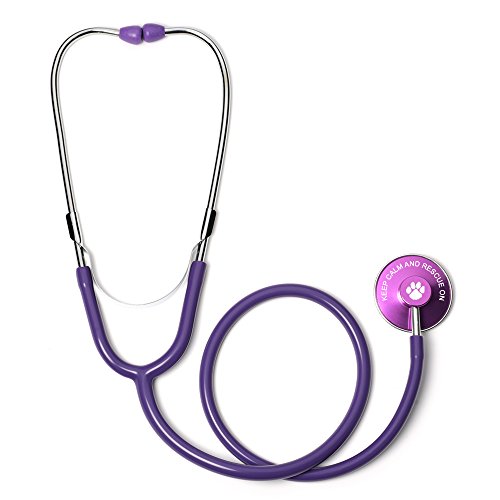
Daylor Keep Calm Rescue On Stethoscope
by Daylor
$19.99
- Lightweight aluminum chestpiece with fun paw print design for veterinary settings
- Single-head design fits under BP cuff for versatile clinical use
- Budget-friendly option under $20 — ideal for vet tech students on tight budgets
Auscultation in Veterinary Practice: What the VTNE Tests
Understanding auscultation is not just about owning a stethoscope — it is about knowing what to listen for across different species. The VTNE tests your ability to assess patients using auscultation, and these questions span multiple exam domains.
Heart Sounds by Species
Every vet tech must know the normal heart sounds and resting heart rates for common veterinary species:
| Species | Normal Resting Heart Rate | Auscultation Notes |
|---|---|---|
| Dog (small breed) | 100-140 bpm | Higher rates normal; sinus arrhythmia common and usually benign |
| Dog (large breed) | 60-100 bpm | Lower rates normal; athletic dogs may have resting HR of 50-60 |
| Cat | 120-240 bpm | Fast rate makes individual sound identification challenging; purring interferes with auscultation |
| Horse | 28-44 bpm | Slow rate; all four heart sounds (S1, S2, S3, S4) may be audible normally |
| Cattle | 40-80 bpm | Auscultate on left side; rumen sounds also assessed on left flank |
| Rabbit | 130-325 bpm | Very fast; stress easily elevates rate; handle minimally during assessment |
VTNE exam tip: Questions about normal vital sign ranges are among the most commonly tested topics. Know these heart rate ranges cold. OpenExamPrep offers free VTNE practice questions that cover vital signs across all major species.
Heart Murmur Grading in Veterinary Medicine
Veterinary heart murmurs are graded on a I-VI scale (different from the I-IV scale sometimes used in human medicine):
- Grade I/VI — Very soft, only heard in a quiet room with careful auscultation. Requires a quality stethoscope.
- Grade II/VI — Soft but readily identified. Heard with a standard stethoscope in a reasonably quiet environment.
- Grade III/VI — Moderate intensity. Clearly audible with any functional stethoscope.
- Grade IV/VI — Loud murmur. Easily heard, may have a palpable thrill (vibration felt through the chest wall).
- Grade V/VI — Very loud with a palpable thrill. Audible with the stethoscope barely touching the chest.
- Grade VI/VI — Audible with the stethoscope lifted off the chest wall. Palpable thrill always present.
Why this matters for stethoscope choice: A $20 stethoscope will reliably detect Grade III/VI and above. To consistently detect Grade I-II murmurs — which is what your clinical instructors and the VTNE will test you on — you need a stethoscope with better acoustic sensitivity, like the Good Harbor Clinical IV or Lane Instrument.
Lung Sounds in Veterinary Patients
Abnormal lung sounds vet techs should recognize:
- Crackles (rales) — discontinuous popping sounds indicating fluid in the airways (pulmonary edema, pneumonia)
- Wheezes — continuous high-pitched sounds indicating airway narrowing (feline asthma, tracheal collapse)
- Stridor — harsh breathing sound indicating upper airway obstruction (brachycephalic breeds, laryngeal paralysis)
- Diminished/absent sounds — reduced or absent breath sounds over an area (pleural effusion, pneumothorax, diaphragmatic hernia)
VTNE connection: The exam tests your ability to not only identify these sounds but to correlate them with clinical conditions and recommend appropriate diagnostic follow-up. Practice these concepts with OpenExamPrep's free AI tutor — ask it to explain the difference between crackles and wheezes, or to describe the expected auscultation findings in a cat with pleural effusion.
VTNE Exam Preparation: Beyond the Stethoscope
A stethoscope is one tool in your clinical arsenal. The VTNE is a comprehensive 170-question exam covering nine domains that test your knowledge across the full scope of veterinary technology practice:
- Pharmacy and Pharmacology — drug calculations, common veterinary medications, controlled substance regulations
- Surgical Nursing — surgical preparation, instrument identification, aseptic technique, suture materials
- Dentistry — dental charting, prophylaxis, extractions, dental radiography
- Laboratory Procedures — hematology, urinalysis, cytology, parasitology, microbiology
- Animal Care and Nursing — patient assessment (including auscultation), nutrition, husbandry, restraint
- Diagnostic Imaging — radiographic technique, positioning, radiation safety, ultrasound basics
- Anesthesia and Analgesia — anesthetic protocols, patient monitoring, pain assessment, emergency procedures
- Emergency Medicine and Critical Care — triage, CPR, shock treatment, fluid therapy
- Pain Management and Analgesia — multimodal pain management, recognition of pain in animals
Auscultation appears across multiple domains. In anesthesia, you monitor heart rate and rhythm during procedures. In emergency medicine, you assess cardiac and respiratory status during triage. In animal care and nursing, you perform comprehensive physical exams. A quality stethoscope and strong auscultation skills are not limited to one section of the exam — they are foundational to veterinary technology practice.
How to Study Auscultation for the VTNE
- Practice on real animals — every clinical rotation is an opportunity to auscultate. Listen to every patient, even if your task is something else. Ask your clinical supervisor to let you listen to interesting cases.
- Learn normal first — you cannot identify abnormal sounds if you do not know what normal sounds like for each species. Spend your early rotations establishing a baseline for normal heart and lung sounds in dogs, cats, and (if available) horses.
- Use online resources — veterinary auscultation recordings are available online. Listen to recordings of normal hearts, murmurs at different grades, and abnormal lung sounds while studying.
- Practice with OpenExamPrep — use the free AI tutor (10 questions per day) to quiz yourself on auscultation concepts. Ask questions like "What auscultation findings would you expect in a dog with dilated cardiomyopathy?" or "Describe the difference between a Grade II and Grade IV heart murmur."
- Study vital sign ranges — memorize normal heart rates, respiratory rates, and temperatures for dogs, cats, horses, cattle, and common exotic species. These are high-yield VTNE topics.
Which Veterinary Stethoscope Should You Buy?
Here is the simplest way to decide:
If you want the best overall value: Buy the Good Harbor Clinical IV at $27.99. The zinc alloy chestpiece provides professional-grade acoustic performance, the anti-cooling ring is a genuine veterinary advantage, and the chrome-plated finish will hold up through years of clinical use. This is the best stethoscope for vet tech students focused on small animal practice.
If you need large animal capability: Buy the Lane Instrument at $43.95. The dual chestpiece system (single-head + dual-head) and extension tube make it the only stethoscope on our list that handles everything from a kitten to a draft horse. If your program includes equine, bovine, or mixed practice rotations, this is the smart choice.
If your budget is under $20: The Daylor at $19.99 gets the job done for basic clinical training and routine wellness exams. Plan to upgrade to the Good Harbor or Lane Instrument when your auscultation skills advance and you need to detect more subtle findings.
Free VTNE and NAVLE Study Resources
Whether you are preparing for the VTNE as a vet tech student or the NAVLE as a veterinary student, OpenExamPrep offers free study materials to help you pass:
- Free VTNE Study Guide — comprehensive coverage of all nine VTNE domains
- Free NAVLE Study Guide — complete veterinary licensing exam preparation
- AI Tutor — 10 free questions per day — ask about auscultation, pharmacology, surgical nursing, anesthesia, or any veterinary concept
The AI tutor is particularly useful for auscultation and patient assessment review. Ask it questions like "What are the normal vital signs for a healthy adult cat?" or "Explain how to grade heart murmurs in veterinary medicine and give examples of conditions associated with each grade" — and it will walk you through the clinical reasoning you need for the VTNE.
Your stethoscope is the tool that connects your textbook knowledge to real clinical practice. Choose one that fits your program's requirements, your clinical rotation needs, and your budget — then use it on every patient you encounter. The more you auscultate, the better your ear becomes, and the more confident you will be on exam day.
As an Amazon Associate, OpenExamPrep earns from qualifying purchases. All recommendations are based on editorial review.

 Free CE
 Flashcards on Mometrix
 Practice exams on ExamEdge