 View
ViewWhy Refrigerant Leak Detection Is Critical for HVAC Technicians
If you work in HVAC, leak detection is not optional - it is a federal requirement. The EPA Clean Air Act prohibits the knowing venting of refrigerants into the atmosphere, with fines up to $44,539 per day per violation. Every HVAC technician with an EPA 608 certification is expected to use proper leak detection methods when servicing refrigeration and air conditioning equipment.
Beyond regulations, the economics are compelling. Refrigerant prices have surged - R-410A now costs $15-25 per pound wholesale, and a typical residential split system holds 6-12 pounds. A system losing just 1 pound per month wastes $180-300 annually in refrigerant alone. Add the energy efficiency loss from running at low charge (a 10% undercharge reduces cooling capacity by 20% and increases energy consumption), and the compressor damage from oil migration and liquid slugging, and the true cost of an undetected leak multiplies rapidly.
For EPA 608 and NATE HVAC certification candidates, understanding leak detection technology, procedures, and regulations is not just exam material - it is daily professional practice. The right leak detector makes you faster, more accurate, and more profitable on every service call. Prepare for your EPA 608 exam for free with our EPA 608 study guide.

Fieldpiece DR58 Heated Diode Refrigerant Leak Detector
by Fieldpiece
$299.99
- Heated diode sensor finds leaks down to 0.03 oz/yr (1 g/a) with up to 18-hour battery
- Large backlit LCD with bar graph and numeric leak readout - industry standard for HVAC pros
- A2L compatible; detects R-410A, R-454B, R-22, R-32, R-134a, R-1234yf and other halogenated refrigerants
EPA Section 608: What It Says About Leak Detection
EPA Section 608 of the Clean Air Act establishes the rules for refrigerant management. Here is what every HVAC technician needs to know - and what the EPA 608 certification exam tests.
Allowable Leak Rates
For a covered appliance, the EPA sets an annual leak-rate trigger by system type. Exceed the trigger and you must repair the leak (or develop a retrofit/retirement plan):
- Comfort cooling (air conditioning): 10% per year
- Commercial refrigeration: 20% per year
- Industrial process refrigeration: 30% per year
Note the common exam trap: comfort cooling has the lowest tolerance (10%) and industrial process refrigeration the highest (30%). Memorize the 10/20/30 order.
2026 update (AIM Act): The historic Section 608 rules cover appliances with a full charge of 50 or more pounds of ozone-depleting refrigerant. Effective January 1, 2026, the AIM Act's Emissions Reduction and Reclamation program extends leak-repair and recordkeeping requirements to systems charged with 15 or more pounds of high-GWP HFCs (such as R-410A, R-404A, and R-407C) - a major expansion in the number of systems you must track. Smaller residential split systems often fall below the charge threshold, but technicians may never knowingly vent refrigerant regardless of charge size.
Required Repair Timelines
Once a leak is identified in a system requiring repair under 608 regulations:
- 30 days to complete the repair after discovery
- Verification test required within 30 days after repair to confirm the leak is fixed
- Retrofit or retirement plan if the repair cannot be completed within the timeline
Approved Detection Methods
The EPA recognizes several leak detection methods:
- Electronic leak detectors (heated diode, infrared, corona discharge, ultrasonic)
- Fluorescent dye injection and UV light detection
- Standing pressure/vacuum tests with nitrogen
- Bubble solution (soap bubbles) for visual confirmation
The certification exam tests your understanding of when to use each method and the proper sequence for a complete leak detection procedure.
For the EPA 608 exam: You must know specific leak rate thresholds, repair timelines, and which detection methods are approved. These are high-frequency exam questions. Study with our free EPA 608 practice questions.
The A2L Refrigerant Transition: Why It Changes Your Leak Detector Choice
The single biggest change facing HVAC technicians in 2025-2026 is the switch to A2L refrigerants. Under the EPA's AIM Act HFC phasedown, new residential and light-commercial air conditioners and heat pumps manufactured for 2025 and beyond use lower-GWP A2L refrigerants - primarily R-454B (Puron Advance, used by Carrier, Trane, and others) and R-32 (used by Daikin, Goodman, and others) - in place of R-410A.
The "A2L" safety classification means mildly flammable. These refrigerants are far harder to ignite than propane (R-290, an A3), but they are not nonflammable like the old R-410A (A1). That has direct implications for leak detection:
- Use an A2L-rated detector. R-454B and R-32 are halogenated, so most heated diode and infrared sensors will respond to them. But manufacturers now specifically certify and calibrate detectors for A2L gases, and many newer A2L systems include a factory-installed A2L leak sensor that can shut the system down. For service work, choose a handheld detector the maker lists as A2L compatible.
- Leak detection is a safety task, not just a compliance task. Because A2L refrigerants can burn at high concentrations, finding and clearing leaks promptly matters for occupant safety, not only refrigerant savings.
- Older detectors may not be listed for A2L. A budget sniffer from a few years ago may physically detect R-32 but is not certified for the flammable-refrigerant environment. Verify the rating before you rely on it on an A2L system.
Every primary pick in this guide -- the Fieldpiece DR58, Fieldpiece DR82, Inficon TEK-Mate 705-202-G1, and Elitech ILD-200 -- is listed by its manufacturer as A2L compatible.
Heated Diode vs Infrared (NDIR) Sensors: The Technology That Matters
The two dominant sensor technologies in electronic refrigerant leak detectors are heated diode and infrared (NDIR). Understanding both is essential for choosing the right tool - and for answering NATE HVAC exam questions about diagnostic equipment.
Heated Diode Technology
A heated diode sensor uses a ceramic element heated to approximately 800-1000 degrees F. When halogenated refrigerant molecules contact the hot surface, they break down and release ions that change the electrical current flowing through the sensor. The detector measures this current change and translates it into a leak signal.
Advantages:
- Highest sensitivity - can detect leaks as small as 0.1 oz/year
- Fast response time - reacts to refrigerant presence almost instantly
- Lower upfront cost ($70-400 depending on model)
- Well-proven technology used for decades in the HVAC industry
Disadvantages:
- False positives - the sensor reacts to any halogenated compound, including cleaning solvents, oil mist, flux residue, and even some plastics when heated. In a mechanical room with multiple chemical sources, false alarms are common.
- Sensor degradation - the heated element degrades with use and exposure to contaminants. Typical sensor life is 100-200 hours of active use, or roughly 1-2 years for a working technician. Replacement sensors cost $30-80.
- Warm-up time - requires 2-5 minutes to heat the sensor to operating temperature before use.
- Contamination sensitivity - exposure to high concentrations of refrigerant (like during recovery) can temporarily saturate and desensitize the sensor.

Elitech HVAC Refrigerant Leak Detector, Heated Diode Sensor
by Elitech
$69.99
- Heated diode sensor with seven sensitivity levels (up to ~0.21 oz/yr) - affordable starter detector
- LED indicator plus audible alarm for fast leak location in noisy environments
- Detects R-410A, R-22, R-134a, R-1234yf; not manufacturer-listed for A2L - verify before R-454B/R-32 use
Infrared (NDIR) Technology
An infrared or NDIR (Non-Dispersive Infrared) sensor works on a completely different principle. Air is drawn through a sample chamber where an infrared light source shines through it. Refrigerant molecules absorb infrared light at specific wavelengths. A detector on the other side measures the reduction in infrared intensity - the greater the absorption, the higher the refrigerant concentration.
Advantages:
- Virtually no false positives - the sensor only responds to molecules that absorb infrared at the refrigerant-specific wavelength. Oil mist, solvents, and other contaminants do not trigger false alarms.
- 10+ year sensor life - infrared sensors do not degrade with use. The light source and detector last the life of the instrument, eliminating recurring sensor replacement costs.
- No warm-up time - ready to use immediately after powering on.
- Consistent sensitivity - detection accuracy does not degrade over time, unlike heated diode sensors that lose sensitivity as the element wears.
Disadvantages:
- Higher upfront cost - infrared detectors range from $140-500, versus $70-400 for heated diode models
- Slightly slower response - the air sampling process adds a small delay compared to the instant reaction of heated diode sensors
- Requires clean optics - dust or moisture on the infrared optics can reduce sensitivity (most modern units have self-cleaning or sealed chambers)

Fieldpiece DR82 Infrared Refrigerant Leak Detector
by Fieldpiece
$449.99
- Infrared (NDIR) sensor with 10+ year lifespan - ignores oil and moisture for virtually no false positives
- Senses leaks to 0.03 oz/yr; A1 and A2L rated for R-454B and R-32 systems
- Backlit LCD with leak level indicator - premium tool for commercial HVAC technicians
Which Sensor Technology Should You Choose?
| Factor | Heated Diode | Infrared (NDIR) |
|---|---|---|
| Sensitivity | Highest (0.1 oz/year) | High (0.1-0.15 oz/year) |
| False Positives | Common in contaminated environments | Virtually none |
| Sensor Life | 1-2 years (100-200 hours) | 10+ years |
| Replacement Cost | $30-80 per sensor | None (sensor outlasts the tool) |
| Upfront Cost | $70-400 | $140-500 |
| 5-Year Total Cost | Higher (purchase + 3-4 sensors) | Lower (purchase only) |
| Best For | Maximum sensitivity, budget buyers | Reliability, high-volume use |
Decision framework:
- Budget-conscious or starting out? Start with the Elitech heated diode ($69.99) and upgrade later.
- Want the best value long-term? The Elitech infrared ($139.99) eliminates sensor replacement costs.
- Need the professional standard? The Fieldpiece DR58 heated diode ($299.99) is what most shops run.
- Want zero false alarms? The Fieldpiece DR82 infrared ($449.99) is the premium choice.
The 5 Best Refrigerant Leak Detectors for HVAC Technicians
1. Fieldpiece DR58 Heated Diode - Industry Standard ($299.99)
Best for: Professional HVAC technicians who want the tool most widely used in the industry.
The Fieldpiece DR58 is the leak detector you will see in most professional HVAC service vans. Its heated diode sensor senses leaks as small as 0.03 oz/yr (1 g/a) -- about 20 times more sensitive than soap bubbles -- and the large backlit LCD shows a bar graph and numeric reading even in dark mechanical rooms. It runs up to 18 hours per charge in an impact-resistant IP54 body, and Fieldpiece lists it as A2L compatible for R-454B and R-32 systems.
The DR58 detects all common refrigerants including R-410A, R-454B, R-22, R-32, R-134a, R-1234yf, and other HFC, CFC, HCFC, HFO, and blended compounds. Sensitivity is adjustable across multiple levels, allowing you to start with high sensitivity for initial scanning and reduce it when zeroing in on the leak source in a contaminated area.
Pros:
- Ultra-sensitive heated diode sensor - finds the smallest leaks
- Large backlit LCD readable in dark environments
- Flexible probe reaches tight spaces behind evaporator coils
- Adjustable sensitivity for different environments
- Industry standard - most HVAC supply houses stock replacement sensors
Cons:
- Sensor replacement needed every 1-2 years ($50-70)
- False positives in contaminated environments (kitchens, manufacturing)
- Requires warm-up time before use
Fieldpiece DR58 Heated Diode Refrigerant Leak Detector
by Fieldpiece
$299.99
- Heated diode sensor finds leaks down to 0.03 oz/yr (1 g/a) with up to 18-hour battery
- Large backlit LCD with bar graph and numeric leak readout - industry standard for HVAC pros
- A2L compatible; detects R-410A, R-454B, R-22, R-32, R-134a, R-1234yf and other halogenated refrigerants
2. Fieldpiece DR82 Infrared - Premium Professional Choice ($449.99)
Best for: Experienced technicians who want zero false positives and no sensor replacement costs.
The Fieldpiece DR82 represents the top tier of refrigerant leak detection. Its NDIR infrared sensor eliminates the two biggest frustrations with heated diode detectors: false alarms and sensor degradation. In environments where oil mist, cleaning solvents, or flux residue trigger constant false positives on heated diode detectors, the DR82 stays silent until it actually detects refrigerant.
The 10+ year sensor lifespan means you buy the DR82 once and use it for the rest of your career without spending $50-70 annually on replacement sensors. Over 5 years, the DR82 actually costs less than a Fieldpiece DR58 when you factor in sensor replacements.
The DR82 shares the same professional build quality as the DR58 - large backlit LCD, flexible probe, adjustable sensitivity - but adds the confidence of knowing that every alarm is a real leak, not a false positive from the environment.
Pros:
- Infrared sensor produces virtually no false positives
- 10+ year sensor life - no replacement costs
- Same professional build quality as the DR58
- Highest accuracy in contaminated environments
- Ready to use immediately - no warm-up time
Cons:
- Highest upfront cost at $449.99
- Slightly slower response than heated diode in clean environments
- Overkill for residential-only technicians who rarely encounter contaminants
Fieldpiece DR82 Infrared Refrigerant Leak Detector
by Fieldpiece
$449.99
- Infrared (NDIR) sensor with 10+ year lifespan - ignores oil and moisture for virtually no false positives
- Senses leaks to 0.03 oz/yr; A1 and A2L rated for R-454B and R-32 systems
- Backlit LCD with leak level indicator - premium tool for commercial HVAC technicians
3. Elitech ILD-200 Infrared - Best Value Infrared ($139.99)
Best for: Technicians who want infrared reliability at a budget price.
The Elitech ILD-200 is the value play in infrared leak detection. It uses the same NDIR sensing principle as detectors costing three times as much, with a 10-year sensor life and maximum sensitivity up to 0.14 oz/yr (about 4 g/yr) across four selectable sensitivity levels. For a technician who wants to skip the heated diode phase entirely and go straight to infrared, the Elitech ILD-200 makes it financially easy.
The detector handles halogenated refrigerants -- including A2L gases like R-32 -- and runs about six hours on its rechargeable battery, enough for a typical service day. The LED leak level indicator and audible alarm provide clear feedback during scanning. Build quality is a step below Fieldpiece - the housing is lighter, the probe less flexible, and the display simpler - but the core sensor technology is comparable.
Pros:
- Infrared sensor with 10-year life at a fraction of the cost of the Fieldpiece DR82
- Sensitivity up to 0.14 oz/yr (about 4 g/yr) across four selectable levels
- A2L compatible - detects R-32 and other A2L gases
- Rechargeable battery for a full service day
- No false positives from oil mist or solvents
Cons:
- Build quality below Fieldpiece - lighter housing, simpler display
- Less ergonomic probe for reaching tight spaces
- Smaller brand presence - fewer HVAC supply houses stock accessories
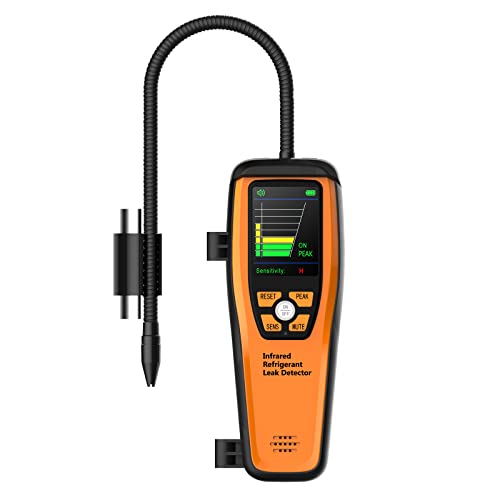
Elitech HVAC Refrigerant Leak Detector, 10 Year Infrared Sensor Life
by Elitech
$139.99
- Infrared sensor with 10-year life - excellent value NDIR detector
- Sensitivity up to 0.14 oz/yr (about 4 g/yr) across four selectable levels
- A2L compatible (detects R-32); rechargeable battery for a full service day
4. Elitech WJL-6000 Heated Diode - Most Affordable Professional Detector ($69.99)
Best for: Apprentices, students, and budget-conscious technicians who need a reliable heated diode detector.
At around $69.99, the Elitech WJL-6000 is one of the most affordable heated diode refrigerant leak detectors available. It pairs a heated diode sensor with seven adjustable sensitivity levels (maximum sensitivity around 0.21 oz/yr), an LED indicator, and an audible alarm. For EPA 608 certification candidates who need a detector for training and early career work, it delivers the core functionality at a price that does not strain a student budget.
The detector finds halogenated refrigerants including R-410A, R-22, R-134a, and R-1234yf. One caveat for 2026: Elitech does not list this budget model as A2L-certified, so if you regularly service R-454B or R-32 equipment, step up to the A2L-rated ILD-200 infrared or a Fieldpiece/Inficon detector. The seven sensitivity levels help manage false positives, but you will still get more nuisance alarms than with an infrared sensor.
Pros:
- Among the most affordable heated diode detectors at about $69.99
- Seven adjustable sensitivity levels with LED and audible alarm
- Detects common halogenated refrigerants (R-410A, R-22, R-134a, R-1234yf)
- Good starter or backup tool for EPA 608 candidates and apprentices
Cons:
- Not manufacturer-listed as A2L-certified - verify before use on R-454B/R-32 systems
- Sensor degrades and needs periodic replacement
- More false positives than infrared detectors
- Limited LED display - no LCD bar graph or numeric readout
Elitech HVAC Refrigerant Leak Detector, Heated Diode Sensor
by Elitech
$69.99
- Heated diode sensor with seven sensitivity levels (up to ~0.21 oz/yr) - affordable starter detector
- LED indicator plus audible alarm for fast leak location in noisy environments
- Detects R-410A, R-22, R-134a, R-1234yf; not manufacturer-listed for A2L - verify before R-454B/R-32 use
5. Inficon TEK-Mate 705-202-G1 - Proven Heated Diode Value ($259.99)
Best for: Technicians who want a rugged, time-tested heated diode detector with automatic background compensation at a mid-tier price.
The Inficon 705-202-G1 (the TEK-Mate) is one of the most established heated diode detectors in HVAC, built by a company whose heritage is in industrial leak detection for semiconductor, aerospace, and pharmaceutical manufacturing. It is A2L compatible and detects R-22, R-410A, R-454B, R-32, R-134a, R-1234yf, and other CFCs, HCFCs, and HFCs.
The standout feature is automatic background compensation: the detector continuously samples ambient air and re-zeros its baseline, so it responds to changes in refrigerant concentration rather than constant background levels. That cuts nuisance alarms in mechanical rooms where trace refrigerant is always present. Be realistic about sensitivity, though - the TEK-Mate is rated to 0.25 oz/yr (7 g/a), which is solid for field work but less sensitive than the Fieldpiece DR58 (0.03 oz/yr) or the Elitech ILD-200 infrared. It runs about 16 hours on two D-cell batteries (no rechargeable pack), so keep spares in the van.
Pros:
- Automatic background compensation reduces false alarms in contaminated rooms
- A2L compatible for R-454B and R-32 service
- Decades of proven reliability and simple, rugged operation
- Mid-tier price (around $260) undercuts the Fieldpiece infrared
Cons:
- Lower stated sensitivity (0.25 oz/yr) than the DR58 or Elitech infrared
- Heated diode sensor still degrades and needs periodic replacement
- Runs on disposable D-cell batteries rather than a rechargeable pack
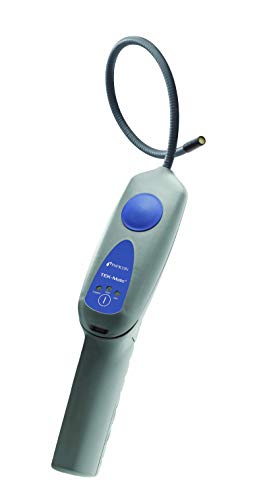
Inficon TEK-Mate 705-202-G1 Refrigerant Leak Detector
by Inficon
$259.99
- Heated diode sensor with automatic background compensation to reduce false alarms
- A2L compatible; detects R-410A, R-454B, R-32, R-22, R-134a and other CFCs/HCFCs/HFCs
- Detects leaks to 0.25 oz/yr; runs ~16 hours on two D-cell batteries
Quick Comparison: Which Leak Detector Should You Buy?
| Feature | Fieldpiece DR58 ($300) | Fieldpiece DR82 ($450) | Elitech ILD-200 ($140) | Elitech WJL-6000 ($70) | Inficon TEK-Mate ($260) |
|---|---|---|---|---|---|
| Sensor Type | Heated Diode | Infrared (NDIR) | Infrared (NDIR) | Heated Diode | Heated Diode |
| Sensitivity | 0.03 oz/yr | 0.03 oz/yr | 0.14 oz/yr | 0.21 oz/yr | 0.25 oz/yr |
| A2L Rated | Yes | Yes | Yes | Not listed | Yes |
| False Positives | Moderate | Virtually None | Virtually None | Moderate | Low (auto-zero) |
| Sensor Life | 1-2 years | 10+ years | 10+ years | 1-2 years | 1-2 years |
| Display | Backlit LCD | Backlit LCD | TFT/LED | LED indicator | LED bar |
| Best For | Pro standard | Zero false alarms | Budget infrared | Budget starter | Auto-zero value |
Decision framework:
- Professional HVAC technician? Get the Fieldpiece DR58 ($299.99) - it is the industry standard for a reason.
- Tired of false alarms? Get the Fieldpiece DR82 ($449.99) or Elitech ILD-200 ($139.99) - infrared eliminates the frustration.
- Building your first tool kit? Get the Elitech WJL-6000 ($69.99) to start, then upgrade as your career develops.
- Want automatic background compensation on a budget? Get the Inficon TEK-Mate (around $260) - its auto-zeroing cuts nuisance alarms in messy mechanical rooms.
Proper Leak Detection Procedure: What the EPA 608 Exam Tests
The EPA 608 certification exam tests your understanding of the correct leak detection sequence. Here is the three-step procedure that every HVAC technician should follow.
Step 1: Nitrogen Pressure Test
Before using an electronic leak detector, perform a standing pressure test with dry nitrogen:
- Recover all refrigerant from the system per EPA requirements
- Pressurize the system with dry nitrogen to the manufacturer-recommended test pressure (typically 150-500 PSI depending on the system)
- Install a calibrated pressure gauge and record the initial pressure
- Wait 15-30 minutes (longer for large systems) and check for pressure drop
- If pressure drops, a leak is confirmed - proceed to electronic detection
Why nitrogen first? Nitrogen is inexpensive, non-toxic, non-flammable, and does not deplete the ozone layer. Using it to confirm a leak exists before spending time with an electronic detector is efficient and EPA-compliant. Never use refrigerant for pressure testing.
Step 2: Electronic Leak Detection
With the system pressurized (either with nitrogen or the normal operating charge), use your electronic leak detector:
- Zero the detector in clean air away from the system
- Scan systematically - start at the highest points and work down (though refrigerant is heavier than air, leaks can occur anywhere). Cover every joint, fitting, valve, coil connection, Schrader core, and solder/braze joint.
- Move the probe slowly - approximately 1 inch per second, keeping the tip within 1/4 inch of the surface being tested
- Follow the leak indication - when the detector alarms, slow down and circle the area to pinpoint the maximum signal strength
- Check common leak points - Schrader valve cores, flare fittings, service valves, filter drier connections, TXV bulb connections, and evaporator/condenser coil u-bends
Step 3: Bubble Solution Verification
After the electronic detector identifies the suspected leak point:
- Apply commercial leak detection bubble solution (or a soap/water mixture) directly to the suspected area
- Watch for bubbles forming - even small, slow-forming bubbles indicate a leak
- For very small leaks, apply solution and wait 5-10 minutes before checking
- Mark the verified leak point for repair
- Document the leak location, estimated leak rate, and planned repair method
For the EPA 608 exam: You must know this three-step sequence and understand why each step matters. The exam frequently tests whether candidates know to pressure test with nitrogen first (not refrigerant), and that bubble solution alone is not sufficient for a complete leak search. Study with our free EPA 608 exam prep.
Fieldpiece vs Elitech vs Inficon: Brand Comparison
Fieldpiece - The HVAC Professional Standard
Fieldpiece designs tools exclusively for HVAC/R professionals. Their instruments are found in service vans across the country, and HVAC supply houses universally stock their products and accessories. When your DR58 sensor needs replacement at 6 PM on a Friday, you can usually find one at the local supply house. That ecosystem support matters for working technicians.
Fieldpiece also offers a complete line of HVAC diagnostic tools - manifolds, psychrometers, combustion analyzers, and wireless measurement systems - that integrate with each other. If you standardize on Fieldpiece, your entire diagnostic workflow is consistent.
Elitech - Budget Professional Quality
Elitech manufactures a range of HVAC instruments at aggressive price points. Their leak detectors use the same core sensor technologies (heated diode and infrared) as premium brands, but at 30-70% lower prices. The tradeoffs are in build quality, ergonomics, and brand support - Elitech tools are lighter, displays are simpler, and replacement parts may require online ordering rather than a quick trip to the supply house.
For technicians building their first professional tool kit, Elitech offers an excellent entry point. The infrared detector at $139.99 is particularly compelling - it delivers the key benefit of infrared technology (no false positives, long sensor life) at a price lower than most heated diode competitors.
Inficon - Precision Heritage
Inficon comes from the industrial leak detection world - semiconductor fabs, pharmaceutical clean rooms, and aerospace manufacturing. Their HVAC instruments inherit engineering principles from environments where detecting parts-per-billion concentrations is routine. The automatic zeroing technology on the 705-202-G1 is a direct carryover from industrial applications.
The Inficon name carries weight with experienced technicians who value rugged, dependable tools. It is not the most popular choice among HVAC technicians (Fieldpiece dominates that market) and the TEK-Mate is not the most sensitive sniffer on the list, but its automatic background compensation and proven track record make it a reliable mid-tier value.
How Leak Detection Appears on the EPA 608 and NATE HVAC Exams
EPA 608 Exam Coverage
Leak detection questions appear across all three EPA 608 certification types:
- Type I (Small Appliances): Leak detection methods for sealed systems, allowable leak rates, when to repair vs retire equipment
- Type II (High-Pressure): Standing pressure test procedures, electronic detection methods, verification requirements, repair timelines
- Type III (Low-Pressure): Unique challenges of detecting leaks in low-pressure/vacuum systems, pressurization methods, system-specific detection approaches
- Universal: All of the above, plus knowledge of the regulatory framework, recordkeeping, and enforcement penalties
Key exam topics:
- Maximum allowable leak rates by system type
- 30-day repair timeline requirements
- Nitrogen pressure test procedure (never use refrigerant for testing)
- Three-step detection sequence: pressure test -> electronic detection -> bubble verification
- Recordkeeping requirements for leak inspections and repairs
- Fines and penalties for non-compliance
NATE HVAC Exam Coverage
The NATE (North American Technician Excellence) HVAC certification exam covers leak detection as part of the broader service and troubleshooting domain. NATE questions tend to be more practical than EPA 608 questions - they test your ability to diagnose real-world scenarios rather than recite regulations.
Example NATE-style question areas:
- Interpreting superheat and subcooling readings that indicate a refrigerant leak
- Choosing the appropriate leak detection method for a given scenario
- Understanding how leak location affects system performance
- Knowing when to recommend system replacement vs repair based on leak severity and system age
Prepare for both exams for free at OpenExamPrep - we cover EPA 608 regulations, NATE HVAC service topics, and practical diagnostic skills.
Free HVAC Exam Prep Resources
A quality leak detector is one piece of your HVAC career toolkit. Build your knowledge with these free resources:
- Free EPA 608 Study Guide - Complete coverage of refrigerant handling, leak detection, recovery procedures, and environmental regulations
- Free NATE HVAC Exam Prep - Service fundamentals, diagnostics, system performance, and practical skills
- AI Tutor - 10 free questions per day - ask about refrigerant properties, leak detection methods, EPA regulations, or any HVAC certification topic
- Practice Questions - Test your knowledge with exam-style questions and detailed explanations for every answer
The AI tutor is especially useful for HVAC troubleshooting practice. Ask it questions like "Walk me through diagnosing a system with low superheat and low subcooling" or "Explain the EPA requirements for leak repair timelines on commercial refrigeration" and get detailed, exam-level responses instantly.
Final Verdict
Buy the Fieldpiece DR58 ($299.99) if you want the industry standard heated diode detector. It is the most widely used professional leak detector for a reason - ultra-sensitive, well-built, and universally supported by HVAC supply houses. Accept the sensor replacement cost as part of doing business.
Buy the Fieldpiece DR82 ($449.99) if you are tired of false positives and want the premium infrared experience. The 10+ year sensor life and zero false alarms justify the price for high-volume technicians.
Buy the Elitech ILD-200 Infrared ($139.99) if you want infrared technology without the premium price. Same NDIR sensor principle, same long sensor life, at one-third the cost of the Fieldpiece DR82. The best value in the lineup.
Buy the Elitech WJL-6000 Heated Diode ($69.99) if you are starting out, studying for your EPA 608, or need an affordable backup detector. It gets the job done at a price that does not strain a student budget.
Buy the Inficon TEK-Mate 705-202-G1 (around $260) if you want a rugged, proven heated diode detector whose automatic background compensation tames false alarms in trace-refrigerant environments. It is A2L compatible and a strong mid-tier value, though not the most sensitive option here.
Whatever detector you choose, pair it with serious exam preparation. Start studying today with our free EPA 608 study guide and practice questions.
As an Amazon Associate, OpenExamPrep earns from qualifying purchases. All recommendations are based on editorial review.

 Course Playlist
 Free CE
 Take courses on Udemy