 View
ViewWhy Pulse Oximeters Matter for EMTs and Nurses
A pulse oximeter gives you a number that can change your next clinical decision. Within seconds of clipping a fingertip sensor onto a patient, you have two critical vital signs: SpO2 (blood oxygen saturation) and heart rate. For an EMT on a roadside, a nurse rounding on a post-surgical floor, or a paramedic triaging multiple casualties, that number is the difference between "stable" and "needs oxygen now."
SpO2 is not just another vital sign to document. It is a real-time indicator of respiratory function that tells you whether your patient's lungs are effectively moving oxygen into the bloodstream. A normal SpO2 of 95-100% means arterial hemoglobin is nearly fully saturated. A reading at or below 90% means the patient is hypoxemic and needs immediate intervention.
This guide reviews five affordable fingertip pulse oximeters popular with EMTs, nurses, and paramedics in 2026, and is honest about what they are, what they are not, and when you should reach for an FDA-cleared device instead.
The FDA Clearance Reality (Read This First)
Here is the truth most pulse oximeter buying guides bury or omit: the popular consumer fingertip oximeters on Amazon, including every Zacurate and Innovo model in this guide, are marketed and labeled for "sports and aviation use," not as medical devices. Their Amazon listings and manufacturer pages explicitly state "This device is for Sports & Aviation use only and is not a medical device." None of the five products reviewed below are FDA 510(k)-cleared.
That does not mean they are useless for clinicians. A 2021 peer-reviewed ICU validation study (published in PMC as article PMC8423509) tested ten top-selling Amazon pulse oximeters against arterial blood gas samples in intensive care patients and found the Zacurate Pro Series 500DL achieved 90% overall accuracy, second only to the Contec CMS50D1 at 91%. But the same study found none of the ten consumer oximeters met the ISO/FDA ArMS accuracy threshold of 3% or less required for 510(k) clearance. They are reasonably accurate for spot-checks, training, and backup use, but they are not clinical-grade instruments.
For true clinical decision-making (ICU, ED, perioperative, critical care transport, or any setting where an SpO2 number drives an intervention), the FDA-cleared gold standard is the Nonin Onyx Vantage 9590, covered in its own section at the end of this guide. The five products below are best understood as affordable backups, student kits, and field spot-checkers that punch above their price, not as replacements for a cleared device in high-acuity care.
How Pulse Oximetry Works
A pulse oximeter shines two wavelengths of light through the fingertip: red (660 nm) and infrared (940 nm). A photodetector on the opposite side measures how much of each wavelength is absorbed.
The key principle: oxygenated and deoxygenated hemoglobin absorb these two wavelengths differently.
- Oxygenated hemoglobin (HbO2) absorbs more infrared light and allows more red light to pass through.
- Deoxygenated hemoglobin (Hb) absorbs more red light and allows more infrared light to pass through.
The oximeter calculates the ratio of red-to-infrared absorption, runs it through a calibration curve, and displays the result as SpO2. An SpO2 of 98% means 98% of the hemoglobin molecules in the pulsatile arterial blood at the sensor site are carrying oxygen.
The Plethysmograph Waveform
Advanced oximeters display a plethysmograph waveform, a real-time graph of pulsatile blood flow at the sensor site. This is your quality indicator:
- Strong, regular waveform = good peripheral perfusion, trustworthy SpO2.
- Weak or flat waveform = poor perfusion. Reposition the sensor or change fingers.
- Erratic waveform = motion artifact or arrhythmia. Hold the hand still and correlate with ECG if available.
If you see an SpO2 of 88% with a weak, erratic waveform, do not trust the number. Reposition, reassess, and treat the patient based on clinical presentation.
The Perfusion Index (PI)
Some advanced oximeters display a perfusion index, a numerical value (typically 0.02% to 20%) that quantifies the strength of the pulsatile signal. Think of it as a confidence score:
- PI above 1.0% = strong signal, high confidence in the SpO2 value.
- PI 0.4-1.0% = acceptable signal, interpret with caution.
- PI below 0.4% = weak signal, SpO2 may be inaccurate. Warm the finger, reposition, or try an earlobe sensor.
The Innovo iP900AP in this guide displays PI alongside SpO2, pulse rate, and plethysmograph waveform.
What to Look for in a Pulse Oximeter
FDA Clearance (the most important factor)
For clinical use, prioritize FDA 510(k)-cleared devices. These have been validated against arterial blood gas analysis in controlled desaturation studies with subjects spanning a range of skin pigmentations, per ISO 80601-2-61. None of the five products reviewed below carry this clearance; they are sports, aviation, and wellness devices. The Nonin Onyx Vantage 9590, covered separately, is the most accessible FDA-cleared fingertip option.
If you use a non-cleared device clinically, treat its readings as screening values, not diagnostic. Confirm abnormal readings with a cleared device, an arterial blood gas, or a thorough clinical assessment.
Display: OLED vs LED
| Feature | OLED | LED |
|---|---|---|
| Brightness | High, readable in direct sunlight | Moderate, washes out in bright light |
| Color | Multi-color (SpO2, HR, waveform in different colors) | Single color (usually red or blue) |
| Viewing angle | Wide, readable from any direction | Narrow, must look straight on |
| Waveform | Yes, plethysmograph | Numbers only or bar graph |
| Best for | EMS variable lighting, advanced assessment | Indoor clinical use, budget models |
For EMTs and paramedics working in variable lighting (bright roadside sun, dim ambulance cabins, nighttime calls), OLED is worth the extra cost. For nurses primarily indoors, LED is usually sufficient, though OLED is still the better choice if you float between units.
Battery Type and Life
Fingertip oximeters run on 2x AAA batteries. This is an advantage over rechargeable units for field use; dead batteries are replaced in 10 seconds from any supply room or convenience store. Most models deliver 24-30+ hours of continuous use, and the auto-off feature (powers down after 5-8 seconds without a finger) stretches a set of batteries across weeks of intermittent clinical use. The Zacurate models advertise roughly 12 months of typical use from a single set of batteries.
Audible Alarm
An audible alarm that fires when SpO2 or pulse rate crosses a preset threshold is a genuinely useful feature for clinicians, especially when you cannot watch the screen continuously during transport. The Innovo iP900AP and the Zacurate 500C Elite both include alarms; the 500DL and 500BL do not.
Lanyard, Silicone Cover, and Carrying Case
A lanyard keeps the oximeter accessible and off the floor. A silicone cover absorbs impact from drops onto pavement and ambulance floors, essential for EMS. A carrying case protects the sensor window from scratches in a jump bag. Most Zacurate models ship with a silicone cover and lanyard; the Innovo iP900AP ships with a lanyard only. None of the five budget models in this guide include a hard carrying case in the base package (the Zacurate 500DL plus case bundle exists as a separate ASIN).
Product Comparison: All 5 Pulse Oximeters at a Glance
| Pulse Oximeter | Price (2026) | Display | Waveform | PI | Alarm | Silicone Cover | Best For |
|---|---|---|---|---|---|---|---|
| Zacurate 500DL | ~$22.99 | OLED | Yes | No | No | Yes | Best overall value |
| Zacurate 500BL | ~$9.99 | LED | No | No | No | No | Budget pick |
| Innovo iP900AP | ~$34.99 | OLED | Yes | Yes | Yes | No | Advanced assessment |
| HealthTree | ~$9.49 | OLED | No | No | No | No | Ultra-budget OLED |
| Zacurate 500C Elite | ~$34.99 | OLED | Yes | No | Yes | Yes | EMS durability plus alarm |
Prices are approximate as of 2026 and fluctuate on Amazon. None of the above are FDA-cleared medical devices; all are labeled for sports and aviation use.
Our Top 5 Pulse Oximeters for EMTs and Nurses (2026)
1. Zacurate Pro Series 500DL, Best Overall Value
The Zacurate 500DL hits the sweet spot for most EMTs and nurses: OLED display, plethysmograph waveform, silicone cover, and a price around $23. It delivers the features you actually need in the field or at the bedside without the premium price of a clinical-grade unit, and it is the model most often endorsed by EMS reviewers.
The bright OLED display shows SpO2, pulse rate, and a real-time plethysmograph waveform in crisp, multi-color graphics readable from any angle. In the back of a moving ambulance at 2 AM or on a sunlit roadside at noon, you can glance at the display and immediately read oxygenation status and gauge whether the reading is reliable by checking the waveform.
The 2021 peer-reviewed ICU validation study (PMC8423509) found the 500DL achieved 90% overall accuracy against arterial blood gas, second among ten consumer oximeters tested, behind only the Contec CMS50D1. That is genuinely impressive for a $23 device, though the same study confirmed it does not meet the FDA ArMS threshold of 3% or less required for 510(k) clearance.
Key features:
- OLED display readable in any lighting condition you encounter in EMS or hospital settings
- Plethysmograph waveform for built-in reading-quality assessment
- Silicone cover, lanyard, and 2x AAA batteries included out of the box
- Manufacturer-claimed accuracy of plus or minus 2% SpO2 in the 70-100% range; 30-250 bpm pulse rate range
- Approximately 10-second reading time, fast enough for rapid patient assessment
Pros:
- Best-in-class value for the feature set
- OLED plus plethysmograph at a budget price
- Silicone cover survives field drops
- Independently validated in a peer-reviewed ICU study
- Nearly a quarter-million Amazon reviews (4.7-star average as of 2026)
Cons:
- Not FDA-cleared, labeled for sports and aviation use only
- No perfusion index (the Innovo iP900AP adds this)
- No audible alarm (the 500C Elite adds this)
- No battery-life indicator on the display
- Finger spring can feel tight on larger fingers

Zacurate Pro Series 500DL Fingertip Pulse Oximeter
by Zacurate
$22.99
- Pro series with bright OLED display, readable from any angle
- Plethysmograph waveform for SpO2 reading-quality assessment
- Includes silicone cover, lanyard, and 2x AAA batteries
2. Zacurate 500BL, Best Budget Pulse Oximeter
At around $9.99, the Zacurate 500BL proves you do not need to spend $30+ to get a functional SpO2 and pulse-rate reader. It includes 2x AAA batteries and a lanyard, works out of the box, and uses the same sensor module as the higher-end Zacurate models, just with a simpler display and no silicone cover.
The 500BL uses an LED display (not OLED) that shows SpO2 and pulse rate in clear, bright numbers. There is no plethysmograph waveform or perfusion index. You get the two numbers you need most. For many spot-check situations, that is sufficient; clinical context and serial assessments provide the confirmation a waveform would otherwise offer.
Zacurate's Amazon listing is explicit: "This device is for Sports & Aviation use only and is not a medical device." Treat the 500BL as a quick screening tool, not a diagnostic instrument.
Where it works well:
- Quick SpO2 spot-checks during patient rounding
- Backup oximeter when shared unit equipment is in use
- EMT and nursing student clinical rotations
- Personal monitoring during illness or altitude exposure
Where you should upgrade: If you assess patients in variable outdoor lighting, the LED display will frustrate you. If you need waveform confirmation for documentation, you need the 500DL or Innovo. If you need perfusion index or an alarm, the 500BL does not offer either.
Pros:
- Around $9.99, the least expensive Zacurate model
- Batteries and lanyard included, ready to use immediately
- Same sensor module as pricier Zacurate models
- Compact and pocketable
Cons:
- LED display washes out in bright or very dark environments
- No plethysmograph waveform, perfusion index, or alarm
- No silicone cover or carrying case
- Not FDA-cleared, sports and aviation labeling
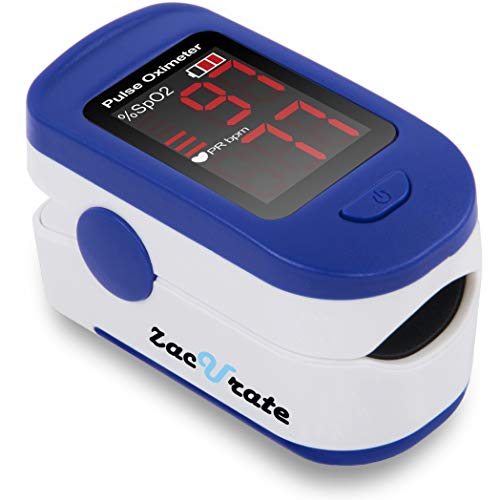
Zacurate 500BL Fingertip Pulse Oximeter Blood Oxygen Saturation Monitor
by Zacurate
$9.99
- Budget-friendly fingertip pulse oximeter with LED display
- Shows SpO2 and pulse rate; sports and aviation use only
- Includes 2x AAA batteries and lanyard, ready to use out of box
3. Innovo Deluxe iP900AP, Best for Advanced Assessment
The Innovo iP900AP is the most feature-rich pulse oximeter on our list, and the only one that displays perfusion index alongside SpO2, pulse rate, and plethysmograph waveform, plus a six-direction OLED display and an adjustable alarm. For nurses in ICU, step-down, or respiratory care, and for paramedics who want the most data possible during assessment, the iP900AP delivers information the budget models simply cannot.
The perfusion index advantage: PI is the iP900AP's standout feature. An SpO2 of 91% with a PI of 5.2% means strong peripheral perfusion and a trustworthy number. An SpO2 of 91% with a PI of 0.2% means that number may be inaccurate due to poor perfusion. Reposition, warm the finger, try a different digit, and reassess before acting. Without PI, you are guessing whether to trust the reading.
The six-direction OLED display rotates through six viewing angles, per Innovo Medical's official specification, so you can read the screen regardless of how the oximeter sits on the patient's finger. When the oximeter is on a patient's hand resting at their side, you do not have to twist their wrist to read it.
What is in the box: The Innovo iP900AP ships with 2x AAA batteries and a lanyard. There is no protective case or silicone cover included. Store it in a pocket or after-market case if you carry it in a jump bag.
Pros:
- Only oximeter on our list with perfusion index display
- Six-direction OLED readable from any orientation
- Plethysmograph waveform plus adjustable alarm and brightness
- Innovo user manual confirms plus or minus 2% SpO2 accuracy (70-100%), 25-250 bpm pulse range, PI minimum 0.2%
- Widely recommended by AARP, NCOA, and TechGearLab as the best-value full-featured consumer oximeter
Cons:
- Around $34.99, the most expensive model on our list (AARP pegs it at $37 as of 2026)
- No silicone cover or carrying case included
- More features than some clinicians need for basic spot-checks
- Not FDA-cleared, same sports and aviation labeling as the Zacurate models
- PI interpretation has a learning curve for clinicians new to the metric

Innovo Deluxe iP900AP Fingertip Pulse Oximeter
by Innovo
$34.99
- Plethysmograph waveform and perfusion index for advanced assessment
- Six-direction OLED display with adjustable alarm and brightness
- Includes 2x AAA batteries and lanyard
4. HealthTree Fingertip Pulse Oximeter, Best Ultra-Budget OLED Option
At around $9.49, the HealthTree is the most affordable pulse oximeter on our list, and notably it ships with an OLED screen, not the LED display you would expect at this price. The Amazon listing title explicitly calls out the OLED screen, and the included package is the oximeter, 2x AAA batteries, a lanyard, and an instruction manual.
What you get: A dual-color OLED display showing SpO2, pulse rate, and a pulse-strength bar graph. The bar graph is a simplified alternative to a true plethysmograph waveform, a rough indication of signal strength without the detail of a full waveform. Auto power-off after a few seconds without a finger conserves battery when the device is tossed in a bag.
Who this is for: Nursing students already spending hundreds on stethoscopes, scrubs, and textbooks who need a functional oximeter for clinical rotations. EMTs who want a cheap backup in a personal jump bag. Anyone who needs a working oximeter for under $10 and wants OLED over LED.
Realistic expectations: This is a $9 oximeter. The OLED display is a pleasant surprise at this price, but the plastic housing will not survive many drops onto concrete, and there is no silicone cover or carrying case to protect it. Manufacturer-claimed accuracy is plus or minus 2% SpO2 in the 70-100% range. As with every model on this list, it is not FDA-cleared; treat readings as screening values.
Pros:
- Around $9.49, the most affordable oximeter on our list
- OLED screen (not LED) at a sub-$10 price, a rare combination
- Auto power-off preserves battery life
- Compact fingertip design fits any pocket
- Batteries, lanyard, and manual included
Cons:
- No plethysmograph waveform or perfusion index, only a pulse bar graph
- No silicone cover or carrying case
- Basic plastic housing not built for field durability
- No audible alarm
- Not FDA-cleared, sports and aviation labeling

HealthTree Fingertip Pulse Oximeter Blood Oxygen Saturation Monitor
by HealthTree
$9.49
- Compact fingertip design with dual-color OLED screen
- Displays SpO2, pulse rate, and pulse-strength bar graph
- Auto power-off saves battery; includes 2x AAA batteries and lanyard
5. Zacurate 500C Elite, Best for EMS Field Use with Alarm
The Zacurate 500C Elite is built for the environment where pulse oximeters take the most abuse: emergency medical services. Per Zacurate, the 500C is the "elite version" of the 500DL, with the same OLED display and plethysmograph waveform, plus two features that matter for EMS: an audible alarm that fires when SpO2 or pulse rate crosses preset thresholds, and a silicone protective cover that wraps the housing against impact from drops onto pavement, ambulance floors, and equipment bags.
Why the alarm matters in EMS: During a chaotic transport with sirens, radio traffic, and multiple monitors, you cannot watch the pulse oximeter screen continuously. An alarm that fires when your intubated patient's SpO2 drops below 90% gives you a critical early warning that a human eyeball on the screen would otherwise miss. The 500DL and 500BL do not have this; the 500C Elite and the Innovo iP900AP do.
Why durability matters in EMS: In a hospital, an oximeter sits on a counter or clips to an IV pole. In EMS, it is clipped to a finger in a bouncing ambulance, handed between providers, tossed into a jump bag, and pulled out 15 minutes later for the next call. The silicone cover on the 500C Elite is meaningful protection for a device that will see hard use.
What is in the box: 500C Elite oximeter, silicone cover, 2x AAA batteries, lanyard. No hard carrying case in the base package.
Pros:
- Silicone cover absorbs impact from field drops
- Audible alarm for SpO2 and pulse rate thresholds (the 500DL lacks this)
- Bright OLED display readable in any lighting condition
- Plethysmograph waveform for reading-quality assessment
- Same Zacurate build quality and roughly 12-month battery life as the 500DL
Cons:
- Around $34.99, tied with the Innovo iP900AP as the most expensive on our list
- No perfusion index (the Innovo iP900AP adds this for the same price)
- Silicone cover adds slight bulk to the housing
- No carrying case included
- Not FDA-cleared, same sports and aviation labeling as every Zacurate model

Zacurate 500C Elite Fingertip Pulse Oximeter
by Zacurate
$34.99
- Elite 500DL upgrade with audible SpO2 and pulse rate alarm
- Bright OLED display with plethysmograph waveform
- Silicone cover for drop protection in EMS environments
The FDA-Cleared Alternative: Nonin Onyx Vantage 9590
If you work in a setting where the SpO2 number directly drives an intervention (ICU, ED, perioperative care, critical care transport, or any high-acuity environment), you should reach for an FDA-cleared device, not a sports and aviation oximeter.
The Nonin Onyx Vantage 9590 is the FDA-cleared fingertip oximeter most often recommended by independent reviewers (Wirecutter, TechGearLab, AARP) and used clinically by respiratory therapists and EMS agencies. Per Nonin, it provides up to 6,000 spot-checks on two AAA batteries, is indicated for use on both well and poorly perfused patients, and carries a 4-year warranty. It is the only FDA-cleared fingertip model in TechGearLab's review, and published research supports its relative accuracy across darker skin tones compared with non-cleared consumer options.
The trade-off is price: the Nonin Onyx Vantage 9590 typically runs $70 to $100+, three to four times the cost of the Zacurate 500DL. For a personal backup or a student kit, that is hard to justify. For a device whose number will drive a clinical decision in a sick patient, it is the right tool.
Clinical Interpretation Guide: SpO2 Values and What They Mean
SpO2 Reference Ranges
| SpO2 Range | Clinical Interpretation | Action |
|---|---|---|
| 96-100% | Normal for healthy adults on room air | Document, continue monitoring |
| 94-95% | Low-normal, may be baseline for some patients | Assess respiratory rate, effort, breath sounds |
| 90-93% | Hypoxemia, respiratory compromise likely | Apply supplemental O2, assess airway, escalate care |
| 85-89% | Severe hypoxemia, significant respiratory failure | High-flow O2, prepare for advanced airway, emergent transport or rapid response |
| Below 85% | Critical hypoxemia, imminent respiratory arrest | Immediate BVM ventilation, advanced airway management, code team activation |
Important Clinical Caveats
Chronic COPD patients may baseline at 88-92% on room air. For these patients, 88% is not necessarily an emergency, but 85% still is. Always ask about baseline oxygen levels and home O2 use.
Altitude affects normal ranges. At 5,000 feet, normal SpO2 may be 92-95%. At 10,000 feet, 88-92% may be physiologically appropriate. Know your local elevation if you work in mountain communities.
Pediatric patients generally maintain SpO2 above 95% on room air. Neonates in the first minutes of life may have transitional SpO2 in the 60-90% range that rises above 95% within 10 minutes of birth. The NREMT and NCLEX exams both test these distinctions.
Carbon monoxide poisoning produces falsely normal SpO2 readings because carboxyhemoglobin absorbs light similarly to oxyhemoglobin. If you suspect CO exposure (house fires, enclosed spaces with combustion sources, multiple patients with headache and nausea), treat based on clinical presentation regardless of the pulse oximeter reading.
Limitations and the Skin Pigmentation Problem
A pulse oximeter is a powerful tool, but it has well-documented limitations that can lead to clinical errors if you do not understand them. These are tested on the NREMT exam and the NCLEX-RN.
The FDA Skin Pigmentation Safety Concern
In 2021, the FDA issued a safety communication warning that pulse oximeters can overestimate SpO2 in patients with darker skin pigmentation, potentially delaying recognition of hypoxemia. In January 2025, the FDA released draft guidance titled "Pulse Oximeters for Medical Purposes" requiring manufacturers to test performance across a range of skin tones, including at least 2 darkly pigmented subjects or 15% of the subject pool, whichever is larger. A January 2026 FDA-funded study (covered by STAT News) complicated the picture, finding smaller-than-expected accuracy gaps, but the regulatory concern remains active. A 2023 lawsuit by Roots Community Health Center against pulse oximeter makers (Masimo, ChoiceMMed, Walgreens) is scheduled for an August 2026 trial.
Practical takeaway for EMTs and nurses: When a pulse oximeter reads 91-94% on a patient with darker skin, hypoxemia is more likely than the number suggests. Correlate with respiratory rate, effort, breath sounds, and mental status. If the patient looks sick, treat the patient, not the number.
Other Conditions That Produce Inaccurate Readings
- Poor peripheral perfusion from hypotension, hypothermia, vasoconstriction, peripheral vascular disease, or cardiac arrest reduces pulsatile flow at the fingertip
- Motion artifact from shivering, seizing, or restless patients generates signal noise the oximeter cannot filter
- Nail polish and artificial nails in dark colors (blue, black, green) absorb interfering wavelengths; remove polish or rotate the sensor 90 degrees side-to-side on the finger
- Methemoglobinemia drives SpO2 toward 85% regardless of true oxygenation because methemoglobin absorbs both red and infrared light equally
- Severe anemia can produce a normal SpO2 even when total oxygen delivery is critically inadequate; SpO2 measures saturation percentage, not total oxygen content
- Ambient light from bright overhead lights, direct sunlight, or fluorescent lighting can interfere with the photodetector; shield the sensor or cover it with a towel
When to Distrust Your Pulse Oximeter
Treat the patient based on clinical assessment, not the SpO2 number, if any of the following are present:
- Weak or absent plethysmograph waveform, meaning the oximeter is not getting a reliable signal
- Very low perfusion index (below 0.4% on devices that display PI)
- SpO2 does not match the clinical picture; a patient in obvious respiratory distress with an SpO2 of 99% should make you suspicious, not reassured
- Known or suspected CO exposure
- Cardiac arrest; pulse oximetry requires pulsatile blood flow, which is absent in arrest (CPR-generated flow may produce intermittent readings, but these are unreliable)
Pulse Oximetry on the NREMT and NCLEX Exams
Pulse oximetry is tested on both the NREMT (EMT and paramedic certification) and NCLEX-RN / NCLEX-PN (nursing licensure) exams.
NREMT Exam Focus Areas
- Normal SpO2 ranges for adults, children, and neonates
- When to apply supplemental oxygen based on SpO2 readings
- Limitations of pulse oximetry, including CO poisoning, poor perfusion, motion artifact, and skin pigmentation bias
- Pulse oximetry as part of the primary and secondary assessment
- Trending SpO2 during patient transport
NCLEX Exam Focus Areas
- SpO2 interpretation in the context of respiratory assessment
- Nursing interventions for abnormal SpO2 readings
- Patient education about pulse oximetry (home use, when to call for help)
- Recognizing and troubleshooting inaccurate readings
- SpO2 monitoring during procedural sedation and post-anesthesia recovery
Practice these concepts for free with our AI tutor, 10 free questions per day on pulse oximetry, vital signs, patient assessment, and any clinical topic you need to review.
Free Study Resources for EMT and Nursing Certification
Whether you are preparing for the NREMT, NCLEX-RN, NCLEX-PN, or any healthcare certification exam, OpenExamPrep offers free study materials:
- Free NREMT Study Guide, complete EMT exam content review including patient assessment and vital signs
- Free NREMT Paramedic Study Guide, advanced paramedic certification preparation
- Free NREMT AEMT Study Guide, advanced EMT certification preparation
- Free NCLEX-RN Study Guide, comprehensive nursing exam preparation for registered nurses
- Free NCLEX-PN Study Guide, complete practical nursing exam review
- AI Tutor, 10 free questions per day on pulse oximetry, SpO2 interpretation, oxygen therapy, or any clinical concept
The AI tutor excels at scenario-based practice. Ask it "Give me a patient scenario where the pulse oximeter reading is misleading and I need to recognize the limitation" or "Explain the oxyhemoglobin dissociation curve and why SpO2 drops rapidly below a PaO2 of 60 mmHg," and it will walk you through the clinical reasoning step by step.
Which Pulse Oximeter Should You Buy?
For most EMTs and nurses (best overall value): The Zacurate 500DL at around $22.99. OLED display, plethysmograph waveform, silicone cover, and an independently validated 90% accuracy in a peer-reviewed ICU study. This is the model most often endorsed by EMS reviewers and the best feature-to-price ratio on the list.
For ICU, step-down, respiratory care, and paramedics who want maximum data: The Innovo iP900AP at around $34.99. The perfusion index is a genuinely useful clinical tool no other device on our list offers, plus a six-direction OLED and alarm. AARP and NCOA both name it their best overall consumer oximeter.
For EMS providers who need an alarm and durability: The Zacurate 500C Elite at around $34.99. The silicone cover is built for field abuse, and the audible alarm is a feature the 500DL lacks. Same OLED display and plethysmograph as the 500DL.
For nursing students and budget-conscious clinicians: The Zacurate 500BL at around $9.99. Same Zacurate sensor module as the pricier models, just with an LED display and no waveform. A legitimate spot-check tool for under $10.
For the absolute cheapest OLED option: The HealthTree at around $9.49. An OLED screen at a sub-$10 price is rare; the trade-off is no waveform, no alarm, and basic housing.
For true clinical decision-making in high-acuity settings: Skip the consumer models entirely and buy the Nonin Onyx Vantage 9590 (around $70-100). It is the FDA-cleared fingertip gold standard, and it is the only device in this guide's competitive set that should drive an intervention in a critically ill patient.
Whatever you choose, remember the rule every EMS1 reviewer and NREMT examiner repeats: treat the patient, not the number. A pulse oximeter is a screening tool that pays for itself the first time a patient's SpO2 tells you something their appearance has not yet revealed, but it is never a substitute for clinical judgment, a thorough assessment, and an FDA-cleared device when the stakes are high.
As an Amazon Associate, OpenExamPrep earns from qualifying purchases. All recommendations are based on editorial review.

 2 Job Wiki
 Free CE
 Practice exams on ExamEdge
 Take courses on Udemy
 Study guide on Mometrix

 Course Playlist
 Prep course on Achievable
 NCLEX-RN prep on DRCertifications