 View
ViewWhy Manifold Gauges Are the Most Essential HVAC Diagnostic Tool
Every HVAC service call starts and ends with the same instrument: a manifold gauge set. Whether you are diagnosing a system that is not cooling, charging a new installation, recovering refrigerant from a condemned unit, or verifying proper operation after a repair — manifold gauges are the tool that tells you what the refrigerant system is actually doing.
A manifold gauge set measures the two most critical variables in any refrigeration cycle: suction pressure (low side) and discharge pressure (high side). From these two pressure readings, combined with line temperature measurements, you can calculate subcooling, superheat, and determine the overall health of every component in the system — compressor, condenser, metering device, and evaporator.
No other single tool gives you this level of diagnostic power. A multimeter tells you about the electrical side. A thermometer tells you about temperature. But manifold gauges tell you what the refrigerant is doing — and refrigerant behavior is the foundation of every HVAC diagnosis.
If you are preparing for your EPA 608 certification or NATE HVAC exam, understanding manifold gauge operation is not optional — it is core exam content. Start studying with our free EPA 608 study guide and NATE HVAC exam prep.
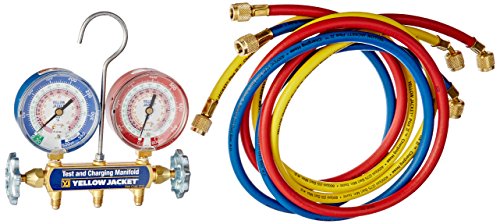
Yellow Jacket 42004 Series 41 Manifold with 3-1/8" Gauge, R-22/404A/410A
by Yellow Jacket
$159.99
- Industry-standard Yellow Jacket brand with 3-1/8" gauges for easy field reading
- Covers R-22, R-404A, and R-410A refrigerants — brass body construction
- Professional-grade accuracy trusted by HVAC contractors for decades
How Manifold Gauges Work: Pressure, Temperature, and System Diagnostics
Understanding what your gauges are telling you requires knowledge of the pressure-temperature relationship of refrigerants — a concept tested heavily on both EPA 608 and NATE HVAC exams.
The Two Gauges
Blue compound gauge (low side): Connects to the suction service port of the system. Reads vacuum (in inches of mercury) during evacuation and positive pressure (in psig) during operation. The low-side pressure corresponds to the evaporator saturation temperature — the temperature at which the refrigerant is boiling inside the evaporator coil.
Red high-pressure gauge (high side): Connects to the discharge (liquid) service port. Reads only positive pressure (in psig). The high-side pressure corresponds to the condensing temperature — the temperature at which the refrigerant is condensing from gas back to liquid inside the condenser coil.
Subcooling and Superheat — The Two Critical Calculations
Superheat measures how much the refrigerant vapor has been heated above its saturation (boiling) temperature after leaving the evaporator:
Superheat = Suction line temperature − Evaporator saturation temperature (from low-side gauge)
A typical residential system targets 10-15°F of superheat. Low superheat indicates potential liquid floodback to the compressor. High superheat indicates low refrigerant charge or a restriction.
Subcooling measures how much the liquid refrigerant has been cooled below its saturation (condensing) temperature after leaving the condenser:
Subcooling = Condensing temperature (from high-side gauge) − Liquid line temperature
A typical residential system targets 10-15°F of subcooling. Low subcooling indicates low charge. High subcooling indicates overcharge or a restriction.
For the EPA 608 and NATE exams: You need to know how to read the pressure-temperature scales on manifold gauges and convert pressures to saturation temperatures for the specific refrigerant in the system. This is fundamental diagnostic knowledge that separates a certified technician from a parts-changer. Practice these calculations with our free HVAC practice questions.
What Gauge Readings Tell You
| Symptom | Low Side | High Side | Likely Cause |
|---|---|---|---|
| System not cooling | Low | Low | Low refrigerant charge or restriction |
| System not cooling | High | High | Overcharge, dirty condenser, or non-condensable gas |
| System not cooling | Low | High | Restriction at metering device |
| Short cycling | Normal | Very high | Condenser fan failure or airflow restriction |
| Compressor not running | Equalized | Equalized | Electrical issue — compressor not pumping |
2-Valve vs 4-Valve Manifolds: When to Use Each
This is one of the most common questions HVAC students ask, and the answer depends on how you will use the gauges.
2-Valve Manifold (Traditional)
A 2-valve manifold has two hand valves (high side and low side) and three hose connections: high-side (red), low-side (blue), and center (yellow). The center port is shared — you connect either your vacuum pump or your refrigerant cylinder, but not both simultaneously.
Workflow for charging with a 2-valve manifold:
- Connect high and low side hoses to system service ports
- Connect center hose to vacuum pump → evacuate system
- Close valves, disconnect vacuum pump from center hose
- Connect center hose to refrigerant cylinder → charge system
The extra step of disconnecting and reconnecting the center hose introduces a small risk of moisture or air contamination. On a single installation, this is manageable. On your fifth install of the day, it slows you down.
The Yellow Jacket 42004 is a 2-valve manifold — and it remains the industry standard because most professional technicians pair it with a separate evacuation setup or use quick-connect adapters to minimize hose swapping.
4-Valve Manifold (Modern)
A 4-valve manifold has four hand valves and four hose connections: high side, low side, vacuum, and charge. You can connect the vacuum pump AND refrigerant cylinder simultaneously and switch between evacuation and charging by turning valves — no hose swapping required.
Workflow for charging with a 4-valve manifold:
- Connect high and low side hoses to system service ports
- Connect vacuum hose to vacuum pump, charge hose to refrigerant cylinder
- Open vacuum valves → evacuate system
- Close vacuum valves, open charge valves → charge system
The BACOENG and VIVOHOME sets in this guide are both 4-valve manifolds. For HVAC students learning the trade, a 4-valve manifold simplifies the workflow and reduces the chance of contaminating the system during hose transitions.

BACOENG AC Manifold Gauge Set for R134A R410A R22, 4-Way HVAC Gauges with Hoses
by BACOENG
$59.99
- 4-way manifold with high side, low side, vacuum, and charge ports
- Includes hoses — covers R134A, R410A, and R22 refrigerants
- Best value complete kit for HVAC students and EPA 608 exam candidates
Refrigerant Compatibility: R-22 vs R-410A vs R-454B/R-32
Understanding refrigerant types is critical for choosing the right manifold gauge set — and it is extensively tested on the EPA 608 exam.
R-22 (Chlorodifluoromethane) — Legacy
R-22 was the dominant residential refrigerant for decades. Production for new equipment was banned in 2010, and production for servicing existing equipment ended in 2020. However, millions of R-22 systems are still operating and will need service for years to come. Any manifold gauge set you buy must include R-22 scales — you will encounter these systems on service calls.
Key R-22 facts for EPA 608:
- Contains chlorine — depletes the ozone layer (this is why it was phased out)
- Operating pressures: approximately 69 psig low side, 243 psig high side at standard conditions
- Cannot be mixed with R-410A or any other refrigerant
- Recovery is required before any system repair that opens the refrigerant circuit
R-410A (Puron) — Current Standard
R-410A replaced R-22 as the residential standard. It contains no chlorine and does not deplete the ozone layer. However, R-410A has a high Global Warming Potential (GWP) of 2,088, which is why it is being phased down under the AIM Act.
Key R-410A facts:
- Operating pressures are approximately 60% higher than R-22 — equipment, hoses, and gauges must be rated for R-410A pressures
- Uses POE (polyolester) synthetic oil — incompatible with mineral oil used in R-22 systems
- All five gauge sets in this guide cover R-410A
R-454B and R-32 — The A2L Future
Starting in 2025, new residential AC systems are transitioning to A2L (mildly flammable) refrigerants with significantly lower GWP:
- R-454B (Opteon XL41): GWP 466 — the leading R-410A replacement for residential split systems
- R-32: GWP 675 — widely used in Asia and gaining adoption in North America for ductless mini-splits
What A2L means for your gauge set: A2L refrigerants operate at similar pressures to R-410A but have mild flammability. Gauge sets must be compatible with the refrigerant chemistry (hose materials, o-ring materials) and technicians must follow updated safety procedures — no brazing with refrigerant in the system, proper ventilation, and approved recovery equipment.
The VIVOHOME 4-valve set ($69.99) explicitly covers R-454B and R-32, making it the most future-proof budget option in this guide.

VIVOHOME HVAC Manifold Gauge Set for R410a R454B R32 R22, 4-Valve
by VIVOHOME
$69.99
- 4-valve design for precise control — covers R410A, R454B, R32, and R22
- A2L refrigerant compatible including next-gen R-454B and R-32
- Carrying case included — ideal for HVAC students entering the A2L era
EPA Section 608 Certification: What You Need to Know About Gauge Operation
EPA Section 608 certification is federally required for anyone who handles refrigerants. The exam has four sections, and manifold gauge knowledge appears in all of them.
The Four EPA 608 Certification Types
| Type | Covers | Equipment |
|---|---|---|
| Type I | Small appliances | Window units, PTACs, refrigerators, dehumidifiers |
| Type II | High-pressure equipment | Residential and commercial AC, heat pumps |
| Type III | Low-pressure equipment | Centrifugal chillers, large commercial systems |
| Universal | All of the above | Type I + II + III combined |
Most HVAC employers require Universal certification. The exam is administered by EPA-approved organizations (ESCO Institute, RSES, etc.) and is a one-time certification — it does not expire.
How Manifold Gauge Skills Are Tested on EPA 608
Section on recovery procedures: Questions ask about proper gauge connection sequence, when to open and close manifold valves during recovery, and how to verify that the required vacuum level has been reached. You must know the recovery requirements: 0 psig for appliances with less than 200 pounds of refrigerant, and specific vacuum levels for larger systems.
Section on evacuation: Questions cover using manifold gauges to pull a deep vacuum, understanding what vacuum level (measured in microns) indicates a properly dehydrated system, and why you must isolate the manifold gauges before reading the final vacuum (gauge port volume can give false readings).
Section on leak testing: Proper use of manifold gauges to pressurize a system with dry nitrogen for leak testing — including the correct test pressure and why you never use refrigerant alone for leak testing.
Section on charging: How to use manifold gauges to charge refrigerant by weight (subcooling method) or by superheat (superheat method), and why overcharging is both a system performance issue and an environmental concern.
Study all EPA 608 sections with our free EPA 608 exam prep. Practice with realistic exam questions that cover manifold gauge procedures, refrigerant handling regulations, and system diagnostics.
Yellow Jacket: The Professional Gold Standard vs Budget Alternatives
Why Yellow Jacket Commands a Premium
Yellow Jacket (manufactured by Ritchie Engineering) has been the dominant name in HVAC manifold gauges for over 60 years. The premium price reflects real engineering differences:
Gauge size and readability: The 42004 Series 41 features 3-1/8" gauge faces — significantly larger than the 2-1/2" or 2-5/8" gauges on budget sets. In the field, reading gauge pressures while kneeling next to a condenser in direct sunlight, the larger face makes a meaningful difference in speed and accuracy.
Brass body construction: The manifold body is machined brass, not die-cast aluminum or plastic. Brass resists corrosion from refrigerants and moisture, maintains tighter valve tolerances over time, and survives repeated drops onto concrete.
Calibration accuracy: Yellow Jacket gauges are factory-calibrated and hold their accuracy over years of use. Budget gauges may drift, requiring periodic re-calibration or replacement.
Valve quality: The hand valves on Yellow Jacket manifolds seal precisely and actuate smoothly even after years of use. Budget manifold valves can develop leaks or become stiff, which affects both accuracy and workflow speed.
When Budget Gauges Make Sense
For HVAC students in a training program, EPA 608 exam candidates, or technicians who need a second set for occasional use, budget gauges deliver functional accuracy at one-quarter to one-third the price of Yellow Jacket. The pressure readings are accurate enough for learning, exam preparation, and basic service work.
The key is to understand that budget gauges are consumable tools with a shorter working life. A Yellow Jacket set will last 10-15 years of professional daily use. A budget set may last 2-5 years before valve seals degrade or gauge calibration drifts. For a student who will upgrade to professional tools after certification, that lifespan is perfectly adequate.

Orion Motor Tech R410a Gauges, AC Manifold Gauge Set for R22 R32 410A 134A
by Orion Motor Tech
$44.99
- 3-way manifold covers R22, R32, R410A, and R134A refrigerants
- Includes 5ft hoses for accurate pressure readings in the field
- Budget-friendly option for HVAC students at $44.99
How Gauge Reading Is Tested on NATE HVAC Exams
NATE (North American Technician Excellence) certification is the most widely recognized HVAC technician credential in North America. Unlike EPA 608, which focuses on refrigerant regulations and environmental protection, NATE exams test practical diagnostic skills — and manifold gauge interpretation is a core competency.
What NATE Tests on Manifold Gauge Reading
System diagnosis from pressure readings: Given a set of manifold gauge readings (high side and low side pressures) along with outdoor and indoor conditions, identify the system problem. For example:
- Low suction pressure + low discharge pressure = low charge or restriction at the metering device
- High suction pressure + high discharge pressure = overcharge or non-condensable gas (air) in the system
- Normal suction pressure + high discharge pressure = condenser airflow problem or dirty condenser coil
- Low suction pressure + normal discharge pressure = low airflow across evaporator or dirty evaporator coil
Charging procedures: NATE tests whether you know to charge liquid R-410A into the high side (or low side as a vapor to avoid liquid slugging the compressor) and how to verify proper charge using subcooling or superheat methods.
Recovery and evacuation: Proper procedures for connecting manifold gauges, pulling vacuum, and verifying system integrity before charging — including the 500-micron standing vacuum test.
System performance verification: After a repair or installation, using manifold gauges along with temperature measurements to verify that subcooling, superheat, temperature split, and static pressures all fall within manufacturer specifications.
Study NATE HVAC exam topics with our free NATE HVAC study guide. Our practice questions include diagnostic scenarios that require interpreting manifold gauge readings.
A2L Refrigerants and the Industry Transition
The HVAC industry is in the middle of the most significant refrigerant transition since R-22 was phased out. Understanding A2L refrigerants is essential for anyone entering the trade in 2026.
What Changed and Why
The AIM Act (American Innovation and Manufacturing Act of 2020) mandates an 85% phasedown of HFC production and consumption by 2036. R-410A, with its GWP of 2,088, is a primary target. The EPA finalized rules requiring new residential and light commercial AC equipment manufactured after January 1, 2025 to use refrigerants with a GWP of 700 or less.
This effectively mandates A2L refrigerants:
- R-454B (GWP 466) — the leading candidate for residential split systems and packaged units
- R-32 (GWP 675) — already dominant in Asia, gaining ground in North American ductless mini-splits
What A2L Means for HVAC Technicians
Mild flammability: A2L refrigerants have a low flame propagation speed (less than 10 cm/s) and require a high ignition energy. They are not explosive like propane (A3), but they can ignite under the right conditions. This means:
- No brazing or soldering with refrigerant present in the system (already best practice, now mandatory)
- Recovery required before opening any refrigerant circuit (already an EPA requirement)
- Proper ventilation in confined spaces when working with A2L systems
- Leak detectors must be capable of detecting A2L refrigerants at their lower flammability limit
For your gauge set: Ensure your manifold gauges, hoses, and fittings are compatible with A2L refrigerants. The primary concerns are hose material compatibility with the specific refrigerant chemistry and proper pressure ratings. The VIVOHOME set explicitly lists R-454B and R-32 compatibility, making it the standout budget choice for technicians preparing for the A2L transition.
For EPA 608 and NATE exams: Expect increasing questions about A2L refrigerant properties, handling requirements, and the regulatory framework driving the transition. The fundamentals of pressure-temperature relationships, subcooling, and superheat remain the same — but the safety procedures and regulatory knowledge are evolving.

Lichamp HVAC Gauges with Hoses, AC Manifold Gauge Set R134A R410A R404A R22
by Lichamp
$39.99
- Most affordable manifold gauge set at $39.99 — covers R134A, R410A, R404A, R22
- Includes charging hoses for immediate use out of the box
- Good starter set for HVAC students on a budget preparing for EPA 608
Quick Comparison: Which Manifold Gauge Set Should You Buy?
| Feature | Yellow Jacket 42004 ($160) | BACOENG 4-Way ($60) | VIVOHOME 4-Valve ($70) | Orion Motor Tech ($45) | Lichamp ($40) |
|---|---|---|---|---|---|
| Manifold Type | 2-valve | 4-valve | 4-valve | 3-way | 3-way |
| Gauge Size | 3-1/8" | 2-1/2" | 2-1/2" | 2-1/2" | 2-1/2" |
| R-22 | Yes | Yes | Yes | Yes | Yes |
| R-410A | Yes | Yes | Yes | Yes | Yes |
| R-454B/R-32 | No | No | Yes | R-32 only | No |
| R-404A | Yes | No | No | No | Yes |
| Hoses Included | No | Yes | Yes | Yes | Yes |
| Carrying Case | No | No | Yes | No | No |
| Best For | Working professionals | Best value complete kit | A2L future-proofing | Budget students | Lowest price entry |
Decision framework:
- Working HVAC professional? Get the Yellow Jacket 42004 ($159.99). The larger gauges, brass construction, and long-term durability justify the premium for daily use.
- HVAC student who wants the best value? Get the BACOENG 4-Way ($59.99). Four-valve convenience with included hoses at a price that does not break a student budget.
- Want A2L refrigerant compatibility? Get the VIVOHOME 4-Valve ($69.99). The only budget set here that explicitly covers R-454B and R-32 — smart future-proofing for $10 more than the BACOENG.
- Tightest possible budget? Get the Orion Motor Tech ($44.99) or Lichamp ($39.99). Both deliver functional accuracy for learning and EPA 608 exam preparation.
Free HVAC Exam Prep Resources
Your manifold gauge set is one piece of your HVAC career toolkit. Build the knowledge to use it effectively with these free resources:
- Free EPA 608 Study Guide — Complete coverage of all four EPA 608 sections: refrigerant handling, recovery procedures, system diagnostics, and environmental regulations
- Free NATE HVAC Exam Prep — Practical diagnostic skills including manifold gauge interpretation, subcooling and superheat calculations, and system troubleshooting
- AI Tutor — 10 free questions per day — ask about refrigerant properties, manifold gauge procedures, EPA regulations, or any HVAC exam topic
- Practice Questions — Test your knowledge with exam-style questions covering refrigerant handling, system diagnostics, and electrical troubleshooting
The AI tutor is particularly useful for HVAC diagnostic practice. Ask it questions like "Walk me through diagnosing a system with high suction pressure and high discharge pressure" or "Explain the difference between subcooling and superheat and when to use each charging method" and get detailed, exam-level responses instantly.
Final Verdict
Buy the Yellow Jacket 42004 ($159.99) if you are a working HVAC technician or will be entering the workforce soon. The 3-1/8" gauges, brass construction, and professional-grade accuracy make it the tool that will serve you for a decade of daily service calls. It is the gauge set you will see in every experienced technician's toolbox.
Buy the BACOENG 4-Way ($59.99) or VIVOHOME 4-Valve ($69.99) if you are an HVAC student who needs a functional, accurate gauge set for training and certification. The VIVOHOME's A2L refrigerant coverage makes it worth the extra $10 if you want future-proofing for the R-454B transition.
Buy the Orion Motor Tech ($44.99) or Lichamp ($39.99) if you are on the tightest possible budget. Both sets deliver the accuracy you need for EPA 608 exam preparation and basic training at prices that leave room for other essential tools.
Whatever gauge set you choose, pair it with solid exam preparation. The technicians who understand why their gauges read what they read — not just how to connect them — are the ones who pass EPA 608 and NATE on the first try and diagnose systems faster than everyone else on the crew. Start studying today with our free EPA 608 study guide and practice questions.
As an Amazon Associate, OpenExamPrep earns from qualifying purchases. All recommendations are based on editorial review.

 Course Playlist
 Free CE
 Take courses on Udemy