 View
ViewWhat ATP Candidates Need to Know About Flight Computers
The FAA Airline Transport Pilot knowledge test is the most demanding written exam in civilian aviation. With 100 questions spanning 4 hours, it tests advanced aerodynamics, turbine engine systems, high-altitude weather, crew resource management, and — critically — complex flight planning that requires fast, accurate E6B calculations.
If you are reading this, you are not a student pilot learning to fly. You have 1,500+ flight hours (or 1,000 for Restricted ATP) and a career riding on this certificate. You already know what an E6B does. The question is which E6B gives you the speed and accuracy advantage on the ATP written test — and which supporting tools help you nail the IFR questions that trip up even experienced pilots.
Here is the reality most guides ignore: since September 2024, PSI testing centers provide a built-in digital E6B on the exam computer. That changes the calculus. You no longer need to bring your own E6B. But you absolutely should — because the PSI tool is generic, unfamiliar, and slower than the electronic E6B you have been practicing with for months. At the ATP level, every minute matters.
ATP Knowledge Test vs Checkride: Different Tool Requirements
Understanding the distinction between the knowledge test and the practical test is essential for choosing the right equipment.
ATP Knowledge Test (FAA-S-ACS-11A)
- Format: 100 multiple-choice questions, 4-hour time limit
- Where: PSI testing center (computer-based)
- Tools allowed: Any non-programmable E6B (electronic or manual), navigation plotters, holding pattern visualizers
- Strategy: Speed is king — electronic E6Bs dominate
ATP Checkride (Practical Test)
- Format: Oral exam + flight evaluation with a Designated Pilot Examiner (DPE)
- Where: In-person, at the examiner's location
- Tools required: You must demonstrate proficiency in manual flight planning
- Strategy: You need to show competence with a manual E6B, regardless of what you use in the cockpit
Bottom line: You need both an electronic E6B for the knowledge test and a manual E6B for the checkride. Buying both now means you can practice with each and be fully prepared for both evaluations.
Why Electronic E6Bs Dominate at the ATP Level
At the private pilot and instrument rating level, a manual E6B is a perfectly adequate tool. The calculations are straightforward: basic wind correction, time-speed-distance, and simple fuel burns. But ATP-level flight planning is a different beast entirely.
ATP exam calculations are harder because:
- Multi-leg flight plans — You are planning jet routes with 3-5 legs at different altitudes, each with different winds and fuel burns. On a manual E6B, that is 3-5 separate wind-side calculations plus fuel computations. On an electronic E6B, it is a few button presses per leg.
- Jet fuel density — Jet-A weighs 6.7 lb/gal at standard conditions, but density varies with temperature. ATP questions test fuel weight calculations that require precise unit conversions — trivial on an electronic E6B, tedious on a manual one.
- High-altitude wind corrections — Winds at FL350 can exceed 150 knots. Manual E6B wind-side accuracy degrades with extreme wind values because the slide rule has physical limitations at the edges of its scales.
- Pressure altitude and density altitude at high FLs — Turbine performance calculations at flight levels require precise altitude corrections that benefit from electronic computation.
- Time pressure — 100 questions in 4 hours gives you 2.4 minutes per question. Complex flight planning problems on a manual E6B can easily consume 5+ minutes. An electronic E6B cuts that to under 2 minutes.
The math is simple: if an electronic E6B saves you 2 minutes on each of 15-20 flight planning questions, you reclaim 30-40 minutes — nearly an extra hour to spend on the aerodynamics, weather, and CRM questions that require careful reading.
Our Top Picks for ATP Exam Flight Computers
1. ASA CX-3 Pathfinder — Top Pick for ATP Candidates
The ASA CX-3 Pathfinder is the flagship electronic flight computer from Aviation Supplies & Academics, and it is the tool of choice for professional pilots preparing for the ATP knowledge test. Its color LCD display and menu-driven interface set it apart from every other E6B on the market.
Why ATP candidates choose it: The CX-3 was designed from the ground up for professional-level flight planning. While budget electronic E6Bs require you to remember function codes and navigate cryptic menus, the CX-3 presents clear, labeled screens for each calculation type. You select "Flight Planning," enter your known values, and get immediate results. For multi-leg flights, you can work through each leg sequentially without losing your previous calculations.
Key capabilities for ATP:
- Flight planning: Heading, ground speed, wind correction angle, time en route — all from a single menu
- Fuel calculations: Fuel burn rate, endurance, fuel required with reserves — handles Jet-A density conversions
- Altitude: Pressure altitude, density altitude, true altitude, true airspeed — essential for high-altitude operations
- Weight & balance: Input arms and weights, get CG and moment — useful for ATP oral prep
- Unit conversions: Pounds to gallons (with fuel density), nautical to statute miles, Celsius to Fahrenheit, and dozens more
- Timer functions: Count up/down timers useful during exam time management
What sets it apart from cheaper electronic E6Bs: The CX-3 does not just calculate — it organizes. Its menu structure mirrors how pilots actually think about flight planning problems. Instead of remembering that "Function 14" is wind correction, you navigate to "Flight Planning" > "Wind" and see a clear input screen. Under exam pressure, this intuitive design eliminates the mental overhead of recalling function codes.
Pros:
- Color LCD with the clearest display of any aviation E6B
- Menu-driven interface mirrors actual flight planning workflow
- Handles every calculation type on the ATP knowledge test
- FAA approved for all pilot certificate and rating knowledge exams
- Backlit display — useful if testing center lighting is suboptimal
- Built-in timer for tracking exam time
Cons:
- $131 is the most expensive E6B on this list
- Requires 2 AAA batteries (carry spares)
- Slightly larger footprint than budget electronic E6Bs
- More features than a private pilot needs — but perfect for ATP

ASA CX-3 Flight Computer
by ASA
$131.00
- FAA approved for all pilot knowledge exams
- Color LCD with intuitive flight planning menus
- Advanced calculations for professional pilots
2. Sporty's Electronic E6B — Best Budget Electronic Option
If the CX-3's price tag gives you pause, the Sporty's Electronic E6B delivers solid electronic performance at $99.95. With over 250,000 units sold, it is the best-selling electronic flight computer in aviation history — and it is FAA approved for every pilot knowledge test, including ATP.
Why budget-conscious ATP candidates choose it: The Sporty's E6B packs 24 aviation functions and 20 unit conversions into a compact, reliable package. It handles all the core calculations ATP candidates need: wind correction, heading/ground speed, fuel burn, density altitude, true airspeed, and more. It lacks the CX-3's color display and menu-driven interface, but for pilots who have used an electronic E6B throughout their training, the Sporty's unit feels like a familiar tool.
Key capabilities for ATP:
- Wind calculations: Heading, ground speed, wind correction angle, crosswind/headwind components
- Flight planning: Time-speed-distance, fuel burn, endurance
- Altitude: Pressure altitude, density altitude, true airspeed, true altitude
- Unit conversions: 20 built-in conversions covering distance, speed, volume, weight, and temperature
- Timer: Built-in flight timer with count-up and count-down modes
Comparison with CX-3: The Sporty's E6B handles the same mathematical calculations as the CX-3 — the physics does not change between devices. The difference is user experience. The CX-3's color menus make complex multi-step problems faster and less error-prone. The Sporty's requires more memorization of function sequences. For pilots who have used a Sporty's E6B since their private pilot training, the familiarity advantage may outweigh the CX-3's interface advantages.
Pros:
- $31 cheaper than the ASA CX-3
- Over 250,000 units sold — proven track record
- 24 aviation functions cover every ATP calculation type
- Compact size fits easily on the testing desk
- Simple, reliable operation
- FAA approved for all knowledge exams
Cons:
- No color display — basic LCD screen
- Function-code navigation is less intuitive than CX-3's menus
- Smaller display can be harder to read under pressure
- No backlighting

Sporty's Electronic E6B Flight Computer
by Sporty's
$99.95
- FAA approved for all pilot knowledge exams
- 24 aviation functions plus 20 unit conversions
- Over 250,000 units sold — proven reliability
3. ASA Metal E6B — Essential Manual Backup
Every ATP candidate should own a manual E6B regardless of which electronic model they choose. The ASA Metal E6B is the industry standard: a precision-machined aluminum flight computer that has been training professional pilots for decades.
Why every ATP candidate needs one: Two reasons. First, batteries die. If your electronic E6B fails mid-exam and the PSI built-in tool is unfamiliar, a manual E6B saves your test. Second — and more importantly — the ATP checkride requires demonstrating manual flight planning proficiency. Your DPE will expect you to compute headings, ground speeds, fuel burns, and time en route using a manual E6B during the oral portion of the practical test. If you cannot, you fail.
Key capabilities for ATP:
- Wind side: Wind correction angle, heading, ground speed — the slide-rule method every pilot learns on day one
- Computer side: Time-speed-distance, fuel consumption, altitude conversions, unit conversions
- Durability: Aluminum construction survives being tossed in a flight bag for years
- No batteries: Works in any condition, every time, forever
Manual E6B limitations at the ATP level: Let's be honest — a manual E6B is slower than an electronic one for complex calculations. Multi-leg flight plans require resetting the wind side for each leg. Extreme wind values (common at jet altitudes) push you to the edges of the slide rule's scales, reducing accuracy. Fuel density conversions require additional steps. These limitations are exactly why electronic E6Bs dominate on the knowledge test — but they also explain why DPEs still require manual proficiency. If you can solve the problem the hard way, you truly understand the underlying aviation science.
Pros:
- No batteries required — 100% reliable
- Required skill for ATP checkride oral exam
- Durable aluminum construction lasts a career
- Lightweight — easy to carry as a backup
- The standard that every pilot training program teaches
- $44.28 — affordable insurance against electronic failure
Cons:
- Significantly slower than electronic E6Bs for complex ATP calculations
- Accuracy degrades at extreme wind values (high-altitude jet operations)
- Multi-leg flight plans require repeated wind-side setups
- Cannot perform unit conversions as quickly as electronic models

ASA Metal E6B Flight Computer
by ASA
$44.28
- Durable aluminum for years of professional use
- No batteries required — always works
- Essential backup for electronic E6B
IFR Tools for ATP Preparation
The ATP knowledge test is fundamentally an IFR exam. Beyond flight planning calculations, it tests your ability to interpret instrument procedures, navigate airways, and determine holding pattern entries. Two specialized tools can give you an edge.
4. ASA Instrument Flight (IFR) Navigation Plotter
The ASA IFR Plotter is purpose-built for instrument chart work. Unlike VFR plotters designed for sectional charts, this tool accommodates the scale and format of both NACO (FAA) and Jeppesen instrument approach plates, SIDs, STARs, and en route charts.
Why ATP candidates use it: ATP-level IFR questions require precise course measurements and distance calculations on instrument charts. The IFR plotter includes holding pattern entry reference diagrams printed directly on the tool, giving you a quick visual reference for determining direct, parallel, and teardrop entries without doing the mental geometry from scratch.
Key features:
- Scaled for both NACO and Jeppesen instrument charts
- Holding pattern entry diagrams printed on the plotter
- Distance scales for IFR en route and approach charts
- Durable Lexan construction — clear, scratch-resistant, professional-grade
- Course measurement protractor for precise bearing readouts
When to use it on the ATP exam: Any question that references an instrument chart, approach plate, SID, or STAR and asks you to measure a course, determine a distance, or identify a holding pattern entry. The ATP test includes more of these questions than the instrument rating test, and they tend to involve more complex procedures (DME arcs, procedure turns with specific radials, multi-segment approaches).
Pros:
- Designed specifically for IFR chart work — not a VFR plotter repurposed
- Holding pattern entry reference saves time and eliminates errors
- Works with both NACO and Jeppesen format charts
- Durable Lexan will not crack, warp, or cloud
- $18.96 — a small price for faster IFR question solving
Cons:
- Only useful for chart-based questions (not all ATP questions involve charts)
- Adds one more item to carry to the testing center
- Takes practice to use quickly — do not buy it the week before the exam

ASA Instrument Flight (IFR) Navigation Plotter
by ASA
$18.96
- Accommodates both NACO and Jeppesen instrument charts
- Holding pattern entries for standard and non-standard
- Durable Lexan — built for professional use
5. ASA Holding Pattern Visualizer
Holding pattern entry determination is one of the most frequently tested IFR concepts on the ATP knowledge test. Given a holding fix, an inbound course, and your aircraft's heading, you must determine whether to fly a direct, parallel, or teardrop entry. Experienced pilots can do this mentally — but under exam pressure, a pocket-sized visualizer eliminates errors and saves 30-60 seconds per question.
Why ATP candidates love it: The ASA Holding Pattern Visualizer is a simple, elegant tool. You align the holding course on the dial, find your heading, and the tool immediately shows which entry type to use. It handles both standard (right turns) and non-standard (left turns) holding patterns — a detail that trips up many candidates who only practiced standard patterns.
Key features:
- Shows all three entry types: direct, parallel, and teardrop
- Handles both standard and non-standard holding patterns
- Pocket-sized — fits in a shirt pocket or small flight bag pouch
- FAA approved for all knowledge tests
- Clear, easy-to-read markings under testing center lighting
When to use it on the ATP exam: Any question that asks "What entry would you use to enter a holding pattern at [fix] on the [radial] inbound course?" The ATP exam typically includes 3-5 holding pattern questions, and they often feature non-standard patterns or unusual headings designed to make mental calculations error-prone.
The time savings math: If you encounter 4 holding pattern questions and the visualizer saves you 45 seconds each, that is 3 minutes reclaimed. Over a 4-hour exam with 100 questions, 3 minutes is an extra question and a half — which could be the difference between passing with an 80 and squeaking by with a 70.
Pros:
- Eliminates holding pattern entry errors — the most common IFR mistake on ATP exams
- Handles non-standard patterns that trip up experienced pilots
- Pocket-sized and featherweight
- FAA approved for all knowledge exams
- $20.81 — trivial investment for a high-value tool
Cons:
- Single-purpose tool — only useful for holding pattern questions
- Not necessary if you can reliably determine entries mentally in under 15 seconds
- Requires brief practice to use at full speed
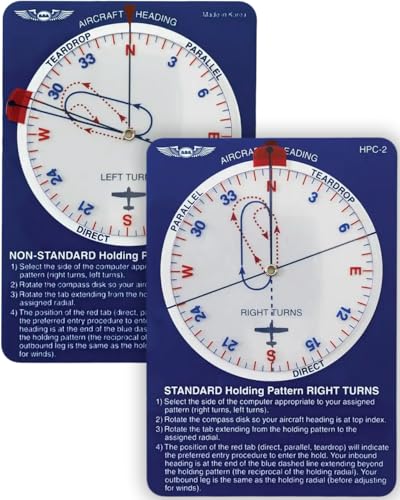
ASA Holding Pattern Visualizer
by ASA
$20.81
- FAA exam approved for knowledge tests
- Shows direct, parallel, and teardrop entries
- Pocket-sized for quick cockpit reference
ATP Exam Day Checklist
Use this checklist the night before and morning of your ATP knowledge test:
Flight Computers & Tools:
- Primary electronic E6B (ASA CX-3 or Sporty's) — fresh batteries installed, spare batteries in pocket
- Manual metal E6B — as backup and for checkride preparation
- IFR navigation plotter — if you find it useful for chart questions
- Holding pattern visualizer — pocket-sized, easy to bring just in case
- Straightedge — some candidates bring a small ruler for chart work
Batteries & Power:
- Install fresh batteries in your electronic E6B the night before — do not trust half-used batteries
- Carry 2 spare batteries in your pocket (AAA for CX-3, check your model's requirements)
- Test your electronic E6B after installing fresh batteries — confirm all functions work
Documents & ID:
- Government-issued photo ID — matches your FAA record exactly
- Authorization to test — from your flight school or training center (if required by your ATP CTP program)
- Endorsement — if your CFI or ATP CTP program provided a written endorsement
Preparation:
- Run through 5 practice E6B problems the morning of the exam — warm up your speed
- Practice one holding pattern entry with your visualizer — confirm you remember the procedure
- Review the PSI testing center rules — know what you can and cannot bring to the desk
- Arrive 30 minutes early — PSI requires check-in time and your tools will be inspected
Mindset:
- You have 1,500+ flight hours — you know this material. The exam confirms what you already know.
- Budget your time: 2.4 minutes per question average. Flag hard questions and come back to them.
- Use your electronic E6B first, manual E6B as backup. Do not waste time on the PSI built-in tool if you brought your own.
How to Choose Your ATP Flight Computer Setup
The best setup depends on your experience and budget. Here are our recommendations for three common profiles:
Career airline pilot (budget is not a concern): → ASA CX-3 Pathfinder ($131) + ASA Metal E6B ($44.28) + Holding Pattern Visualizer ($20.81) = $196.09 total. The professional setup. The CX-3 handles every knowledge test calculation at maximum speed. The metal E6B prepares you for the checkride oral. The holding pattern visualizer eliminates errors on the most commonly tested IFR topic. Total investment is less than one hour of flight instruction.
Experienced pilot on a budget: → Sporty's Electronic E6B ($99.95) + ASA Metal E6B ($44.28) = $144.23 total. Solid electronic performance plus manual backup. Skip the IFR plotter and holding pattern visualizer if you can determine entries mentally — you have the flight experience to do it.
Already own a manual E6B: → ASA CX-3 Pathfinder ($131) or Sporty's Electronic E6B ($99.95) — add an electronic E6B to your existing manual. The speed advantage on the knowledge test is worth the upgrade from manual-only.
Free ATP Exam Prep Resources
A great flight computer is only part of the equation. Pair it with solid study materials:
- Free ATP Study Guide — Complete content coverage across all ATP knowledge test topics
- Free ATP Practice Questions — Unlimited attempts with detailed answer explanations
- AI Tutor — 10 free questions per day — ask it to walk you through flight planning problems, holding pattern entries, or turbine system concepts
- ATP Practice Questions — Key formulas, regulations, and aerodynamic principles
The AI tutor is especially useful for ATP preparation. Ask it questions like "Walk me through a multi-leg flight plan with wind corrections at FL350" or "Explain how to determine the holding pattern entry for a non-standard hold on the 270 radial" and it will give you step-by-step explanations.
Final Verdict
For most ATP candidates, the ASA CX-3 Pathfinder ($131) is the top choice. Its color LCD, menu-driven interface, and professional-grade calculations make it the fastest E6B for ATP-level flight planning problems. Pair it with the ASA Metal E6B ($44.28) for checkride preparation and as a battery-failure backup.
If budget matters, the Sporty's Electronic E6B ($99.95) is a proven performer with over 250,000 units sold. It handles every calculation the ATP exam throws at you — just with a simpler interface.
Regardless of which electronic E6B you choose, bring a manual metal E6B to every exam and checkride. It is the universal backup that never runs out of power, and demonstrating manual flight planning proficiency is a non-negotiable part of earning the ATP certificate.
At the airline transport pilot level, you are not just passing a test — you are proving you belong in the left seat of an airliner. The right tools, practiced until they are second nature, let your knowledge and experience shine through without equipment getting in the way.
Start your ATP exam preparation today with our free ATP study guide and practice questions.
As an Amazon Associate, OpenExamPrep earns from qualifying purchases. All recommendations are based on editorial review.

 Free CE