 View
ViewWhy Dental Hygiene Students Need Their Own Instrument Kit
If you are enrolled in a dental hygiene program, one of your first major purchases will be a set of hand instruments. Unlike lecture-based courses where a textbook is your main tool, dental hygiene education is fundamentally hands-on. From your first preclinical lab to your final clinical board exam, you will spend hundreds of hours holding, adapting, and activating instruments on typodonts, mannequins, and live patients.
Here is what most incoming students do not realize: your instruments are an extension of your clinical skills. The way a scaler feels in your hand, the tactile feedback a curette gives you against calculus, the precision of your explorer detecting subgingival deposits — these sensations are learned through repetition with consistent, quality tools. Switching between borrowed instruments with different handle diameters, blade angles, and balance points disrupts that muscle memory.
Dental hygiene programs require students to bring their own instruments for three reasons:
- Infection control — each student maintains their own sterilization cycle, eliminating cross-contamination between users
- Skill development — consistent instruments build reliable tactile sensitivity and adaptation technique
- Board exam preparation — clinical board exams require candidates to bring their own instruments, so familiarity with your tools is essential
The kits reviewed in this guide range from $25 to $97. Whether you are starting preclinical coursework or preparing for clinical boards, having the right instruments directly impacts your grades, your clinical competency evaluations, and your NBDHE board exam performance.
Essential Dental Hygiene Instruments: What You Need and Why
Before comparing kits, you need to understand which instruments are required and what each one does. This knowledge is not just practical — it is tested directly on the NBDHE and during clinical board exams.
Assessment Instruments
Mouth Mirror (#4 or #5 front-surface): Your most-used instrument. The mouth mirror provides indirect vision (seeing areas you cannot view directly), retraction (pulling the cheek or tongue away), transillumination (directing light through teeth to detect fractures or caries), and indirect illumination (reflecting light into dark areas). Front-surface mirrors eliminate the double image produced by standard mirrors.
Explorer (#23 Shepherd Hook or Pigtail): The explorer is a tactile instrument used to detect caries, calculus deposits, and irregularities on tooth surfaces. The #23 Shepherd hook is the most common explorer in dental hygiene — its curved, pointed tip allows you to trace along the tooth surface and feel for roughness that indicates disease. The pigtail explorer has a shorter, more angled working end for detecting interproximal (between-teeth) caries.
Periodontal Probe (Williams or UNC-15): The periodontal probe measures sulcus and pocket depths — the space between the tooth and the gum tissue. A healthy sulcus measures 1-3 mm; anything deeper indicates periodontal disease. The Williams probe has markings at 1, 2, 3, 5, 7, 8, 9, and 10 mm. The UNC-15 probe has millimeter markings from 1 to 15 with color coding for faster reading. Most dental hygiene programs prefer the UNC-15 for its continuous markings and visual clarity.
Scaling Instruments
Sickle Scalers (H6/H7, Jacquette 34/35): Sickle scalers have a pointed tip, triangular cross-section, and two cutting edges. They are designed for supragingival scaling — removing calculus deposits above the gumline. The H6/H7 is a universal sickle scaler with a straight shank for anterior teeth. The Jacquette 34/35 has an angled shank for accessing posterior teeth. Sickle scalers should never be used subgingivally because their pointed tips can lacerate sulcular tissue.
Universal Curettes (Columbia 13/14): Universal curettes have a rounded toe, semicircular cross-section, and two cutting edges. Unlike sickle scalers, universal curettes are safe for both supragingival and subgingival scaling because the rounded toe will not tear tissue. The Columbia 13/14 is the most common universal curette — it adapts to all tooth surfaces and is a workhorse instrument for general scaling.
Area-Specific Instruments
Gracey Curettes (1/2 through 13/14): Gracey curettes are the signature instruments of dental hygiene. Unlike universal curettes that work on any surface, each Gracey number is designed for specific tooth surfaces with a precise blade angle (offset at 60-70 degrees rather than 90 degrees). Only one cutting edge is used:
| Gracey Number | Tooth Surface | Clinical Use |
|---|---|---|
| 1/2 | Anterior teeth | Facial and lingual surfaces |
| 3/4 | Anterior teeth | Facial and lingual surfaces |
| 5/6 | Anterior and premolars | Facial and lingual surfaces |
| 7/8 | Posterior teeth | Buccal and lingual surfaces |
| 9/10 | Posterior teeth | Buccal and lingual surfaces |
| 11/12 | Posterior teeth | Mesial surfaces only |
| 13/14 | Posterior teeth | Distal surfaces only |
NBDHE tip: Instrument selection questions are among the most common on the board exam. You will be given a clinical scenario — "The hygienist is scaling the mesial surface of tooth #30" — and asked which Gracey curette is the correct choice. Knowing the Gracey numbering system is not optional. Practice with our free NBDHE study guide to master these concepts.
Accessory Instruments
Cotton Pliers (College Tweezers): Used to place and retrieve cotton rolls, gauze, and other small items in the oral cavity. The locking mechanism on college tweezers prevents dropping items into the patient's throat.
Sterilization Cassette: A metal or plastic tray that holds instruments in an organized arrangement during autoclave sterilization. Cassettes prevent instrument damage from loose tumbling and maintain organization so you can identify each instrument immediately after sterilization.
Stainless Steel Grades: Why Material Quality Matters
The steel grade of your instruments determines three things: how long the cutting edge stays sharp, how well the instrument resists corrosion during autoclave cycles, and how much tactile feedback the blade transmits to your fingers. Here is what to look for.
German AISI 420 Stainless Steel: This is the gold standard for dental hygiene instruments. AISI 420 is a martensitic stainless steel with at least 0.15% carbon content, which allows it to be heat-treated to a high hardness (HRC 50-55). The result is an instrument that holds a sharp edge through dozens of uses before resharpening is needed and resists corrosion through hundreds of autoclave cycles. Instruments made from this grade also transmit vibration effectively, giving you better tactile sensitivity when detecting calculus.
O.R. (Operating Room) Grade Stainless Steel: This designation means the steel meets surgical instrument standards for hardness, corrosion resistance, and biocompatibility. O.R. grade instruments are suitable for clinical use and autoclave sterilization, though the specific alloy composition can vary by manufacturer.
Standard Stainless Steel (300-series): Budget instruments often use austenitic stainless steel (304 or 316 grades), which has excellent corrosion resistance but cannot be hardened as much as 400-series steel. The cutting edge dulls faster, and the softer blade transmits less vibration — reducing tactile sensitivity. For preclinical practice on typodonts, this grade is adequate. For clinical patient care, you will want to upgrade.
Our Top 5 Dental Hygienist Instrument Kits for 2026
1. ARTMAN INSTRUMENTS Dental Hygienist Tool Kit (10 PCs) — Best Overall for Clinical Students
The ARTMAN 10-piece kit at $97.35 is the most complete single-purchase option for dental hygiene students entering clinical rotations. What sets this kit apart is not just the instruments — it is the included sterilization cassette, which is an item most students forget to buy separately and end up scrambling for during their first week of clinicals.
What is included: This kit covers the core assessment and scaling instruments — mouth mirror, periodontal probe, college tweezers, scalers, pocket probe, and curettes. The 10-piece count covers the instruments you will reach for most frequently during patient care: assessment (mirror, probe, explorer), supragingival scaling (sickle scalers), and subgingival scaling (curettes).
Sterilization cassette advantage: The included cassette is a genuine differentiator. In clinical rotations, you are required to sterilize your instruments between every patient. A cassette keeps your instruments organized, protected from damage during autoclave processing, and ready to use immediately after sterilization. Without a cassette, instruments rattle loose in sterilization pouches, bump against each other, and can dull their cutting edges before you even use them.
Build quality: The instruments are constructed from autoclavable stainless steel with a polished finish that resists corrosion. The handles have sufficient diameter for a comfortable modified pen grasp — the standard grip used in dental hygiene — and the balance point of each instrument feels natural during scaling strokes.
Who should buy this: Dental hygiene students who are entering or currently in clinical rotations and need a single, reliable kit that covers daily patient care instruments plus sterilization organization. The higher price point reflects the cassette inclusion and overall build quality.
Pros:
- Sterilization cassette included — saves $20-$30 versus buying separately
- Complete assessment and scaling instrument set in one purchase
- Autoclavable construction for clinical patient care
- Well-balanced instruments with comfortable handle diameter
Cons:
- At $97.35, this is the most expensive kit reviewed
- Does not include a complete Gracey curette set (1/2 through 13/14)
- Limited to 10 pieces — programs requiring 15+ instruments will need supplemental purchases
- No silicone or ergonomic grip handles

ARTMAN INSTRUMENTS Dental Hygienist Tool Kit (10 PCs)
by Artman Instruments
$97.35
- Complete 10-piece kit: mirror, probe, tweezer, scalers, pocket probe, and curettes
- Includes sterilization cassette for organized autoclave processing
- Autoclavable stainless steel construction for clinical use
2. Premium Instruments 10 Pcs Dental Hygiene Set — Best Steel Quality for the Price
The Premium Instruments 10-piece set at $38.99 delivers the best material quality at a mid-range price point. The German AISI 420 stainless steel construction is the standout feature — this is the same steel grade used in professional-grade instruments that cost two to three times as much.
German AISI 420 steel matters: At this price range, most competitor kits use standard 300-series stainless steel that dulls quickly and transmits less tactile feedback. The AISI 420 steel in the Premium Instruments set holds a sharper edge significantly longer, which means two things for students: less time spent on instrument sharpening (a skill that takes practice to master) and better tactile sensitivity when you are learning to detect calculus deposits subgingivally.
Certifications: This kit carries ISO 9001, CE, and FDA certifications. ISO 9001 certifies the manufacturing quality management system. CE marks European conformity for medical devices. FDA registration means the instruments meet U.S. standards for dental use. These certifications matter because they verify the instruments are manufactured to consistent standards — you are not getting random steel quality from one instrument to the next.
Highly polished finish: The mirror-polish finish is not cosmetic — it serves a clinical purpose. A polished instrument surface reduces friction during subgingival insertion, is easier to clean and sterilize, and resists biofilm adhesion. Matte-finish budget instruments tend to collect debris in surface micro-scratches, making sterilization less reliable.
What is included: Scalers, explorers, and curettes covering the primary instruments needed for dental hygiene clinical work. The 10-piece count covers assessment and scaling but does not include a complete Gracey curette set.
Who should buy this: Students who want the best possible steel quality without paying premium-kit prices. If you are moving from preclinical labs to live patient care and want instruments that will sharpen well, sterilize reliably, and give you genuine tactile feedback during scaling, this is the best value at $38.99.
Pros:
- German AISI 420 stainless steel — the industry standard for dental instruments
- ISO 9001, CE, and FDA certified manufacturing quality
- Highly polished finish for easier sterilization and reduced tissue drag
- Best steel quality available at the sub-$40 price point
Cons:
- No sterilization cassette included
- Does not include a complete Gracey curette set
- 10-piece count may not cover all program requirements
- Handle design is standard — no ergonomic or silicone grip option

Premium Instruments 10 Pcs Dental Hygiene Set
by Premium Instruments
$38.99
- German AISI 420 stainless steel — superior edge retention and corrosion resistance
- ISO 9001, CE, and FDA certified quality standards
- Includes scalers, explorers, and curettes with highly polished finish
3. A2Z SCILAB 24pc Dental Hygiene Kit — Best Piece Count for Comprehensive Programs
At $29.99 for 24 pieces, the A2Z SCILAB kit offers the highest instrument count at the lowest per-piece cost of any kit in this review. For dental hygiene programs that require students to have a broad range of instrument shapes and sizes, this kit eliminates the need for multiple separate purchases.
24-piece coverage: The A2Z SCILAB kit includes probes, scalers, mouth mirrors, and instruments in different shapes designed to access all areas of the mouth. The variety matters because teeth have complex anatomy — a flat facial surface requires a different blade adaptation than a curved mesial surface or a tight interproximal contact. Having multiple instrument shapes means you can select the correct tool for each surface rather than forcing a single instrument to work everywhere.
O.R. grade stainless steel: The instruments are manufactured from O.R. (Operating Room) grade stainless steel, which meets surgical instrument standards for sterilization compatibility and corrosion resistance. While not specifically AISI 420, O.R. grade steel is a reliable choice for student instruments that will undergo repeated autoclave processing.
Preclinical value: At $1.25 per instrument, this kit is exceptional for preclinical lab work. Preclinical practice on typodonts and mannequins is where you develop fundamental scaling strokes, fulcrum placement, and instrument adaptation skills. Having 24 different instruments available means you can practice with every type of instrument your program covers without worrying about cost.
Clinical limitations: The trade-off for the low price and high piece count is that individual instrument quality is not as refined as the Premium Instruments or ARTMAN kits. Edge retention will be shorter, handles are standard-weight without ergonomic features, and some instruments may require sharpening out of the box. For clinical patient care on live patients, you may want to supplement this kit with higher-quality scalers and curettes.
Who should buy this: Students in the early stages of their program who need a large variety of instruments for preclinical practice. Also a strong choice for students whose programs require 15+ different instrument types, as the 24-piece count covers more ground than any other single kit.
Pros:
- 24 pieces at $29.99 — the best per-instrument value available
- O.R. grade stainless steel suitable for autoclave sterilization
- Wide variety of instrument shapes for comprehensive practice
- Covers probes, scalers, mirrors, and multiple specialty instruments
Cons:
- Individual instrument quality is below the Premium Instruments and ARTMAN kits
- May require initial sharpening before clinical use
- Standard handles without ergonomic features
- Higher piece count does not mean all instruments are program-specific — some may not be needed
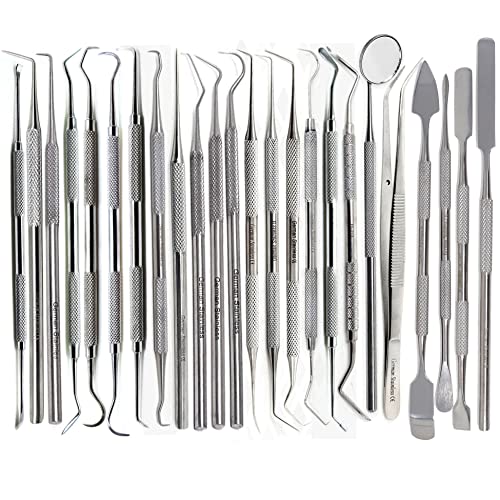
A2Z SCILAB 24pc Dental Hygiene Kit
by A2Z SCILAB
$29.99
- 24 pieces covering probes, scalers, mouth mirror, and multiple instrument shapes
- O.R. grade stainless steel for surgical-level durability
- Variety of instrument shapes designed for all mouth areas
4. SURGICAL ONLINE Student Professional Training Kit (10pc) — Best Budget Entry Point
At $24.99, the SURGICAL ONLINE kit is the most affordable option reviewed and serves a clear purpose: giving first-semester dental hygiene students a functional set of instruments to begin preclinical practice without a significant financial commitment.
What is included: This 10-piece kit covers the fundamentals — plaque remover, tartar scraper, dental scaler, tooth pick, and mouth mirror. These are the instruments you will use during your first preclinical labs to learn basic scaling motions, instrument grasp, fulcrum placement, and adaptation angles on typodonts.
Student-grade perspective: At $24.99, the instruments are functional for practice and skill development, but they are not designed for extended clinical patient care. The stainless steel construction will handle autoclave sterilization for a limited number of cycles, and the cutting edges will dull faster than German AISI 420 instruments. For learning fundamental hand motions and developing the modified pen grasp, this performance level is entirely appropriate.
The training kit approach: Many dental hygiene students adopt a two-kit strategy: buy an affordable training kit like this for preclinical practice during the first year, then invest in a higher-quality clinical kit (like the Premium Instruments or ARTMAN set) when patient care begins. This approach protects your investment — preclinical practice involves mistakes, dropped instruments, and aggressive scaling on hard typodonts that can damage even quality instruments.
Who should buy this: First-semester dental hygiene students who need basic instruments for preclinical labs. Students who are unsure whether dental hygiene is the right career path and want to minimize upfront costs before committing to a premium kit. Students who want a backup or practice set to use at home without risking their clinical instruments.
Pros:
- Most affordable kit at $24.99 — lowest financial barrier to entry
- Covers fundamental instruments for preclinical practice
- Stainless steel construction suitable for introductory lab work
- Professional-grade design at a student-friendly price
Cons:
- Not recommended as a primary kit for clinical patient care
- Cutting edges will dull faster than higher-grade steel instruments
- Limited autoclave longevity compared to German AISI 420 steel
- Does not include explorers, periodontal probes, or curettes

SURGICAL ONLINE Student Professional Training Kit (10pc)
by SURGICAL ONLINE
$24.99
- Professional-grade 10-piece kit at the most affordable price point
- Includes plaque remover, tartar scraper, dental scaler, and mouth mirror
- Stainless steel construction suitable for student practice
5. INSTUMAX Complete Gracey Curette Set (7 PCS + Explorer) — Best Specialized Instrumentation
The INSTUMAX Gracey curette set at $92.66 is not a general-purpose starter kit — it is a specialized instrument set that fills the most important gap in dental hygiene clinical education. The complete Gracey curette collection (1/2 through 13/14) plus a UNC15/23 explorer gives you the area-specific subgingival instruments that define advanced dental hygiene clinical practice.
Complete Gracey set: This kit includes all seven standard Gracey curette pairs — 1/2, 3/4, 5/6, 7/8, 9/10, 11/12, and 13/14. Each pair is designed for specific tooth surfaces, and having the complete set means you can select the correct instrument for every scaling scenario in every quadrant of the mouth. This is not optional knowledge — the NBDHE board exam tests Gracey curette selection extensively, and clinical board exams require you to demonstrate correct curette adaptation during patient care.
UNC15/23 explorer included: The inclusion of a UNC15/23 explorer is a thoughtful addition. This explorer is the standard tactile instrument for detecting subgingival calculus deposits after scaling — you will use it to verify that your Gracey curettes have removed all deposits from the root surface. Having the explorer that pairs with your curettes in a matched set ensures consistent tactile feedback.
Silicone handles: The ergonomic silicone handles are the standout physical feature. Dental hygiene students spend hours practicing scaling strokes, and hand fatigue is a real issue — studies show that dental hygienists have among the highest rates of carpal tunnel syndrome of any healthcare profession. Silicone handles reduce the grip force needed to maintain control during lateral pressure strokes, which reduces hand and wrist fatigue during extended clinical sessions.
Premium steel construction: The instruments are made from premium autoclavable stainless steel with a finish designed to maintain edge sharpness through repeated sterilization cycles. The blade geometry of each Gracey curette is precise — the 60-70 degree offset angle that defines area-specific curettes is consistent across all seven pairs.
Who should buy this: Dental hygiene students who have a basic instrument kit (scalers, mirror, probe) and need to add the full Gracey curette set for clinical rotations. Students preparing for clinical board exams who need to practice area-specific instrumentation. Students who experience hand fatigue during extended scaling practice and want ergonomic handles.
Pros:
- Complete Gracey curette set (1/2 through 13/14) — all area-specific curettes in one purchase
- UNC15/23 explorer included for post-scaling evaluation
- Ergonomic silicone handles reduce hand fatigue during extended use
- Premium autoclavable stainless steel construction
Cons:
- At $92.66, this is a specialized purchase on top of a basic instrument kit
- Does not include scalers, mouth mirror, or periodontal probe — not a standalone starter kit
- 8 total pieces means limited coverage outside of curettes and explorer
- Silicone handles have a different feel than standard metal — some students prefer traditional grip

INSTUMAX Complete Gracey Curette Set (7 PCS + Explorer)
by INSTUMAX
$92.66
- Complete Gracey curette set: 1/2, 3/4, 5/6, 7/8, 9/10, 11/12, and 13/14 plus UNC15/23 explorer
- Ergonomic silicone handles for reduced hand fatigue during extended scaling
- Premium autoclavable stainless steel construction
Choosing the Right Kit for Your Skill Level and Budget
Not every dental hygiene student needs the same kit at the same time. Here is a framework for matching your purchase to your stage in the program.
First Semester (Preclinical Labs)
Recommended: SURGICAL ONLINE Training Kit ($24.99) or A2Z SCILAB 24pc Kit ($29.99)
During preclinical labs, you are learning fundamental motions on typodonts — scaling strokes, fulcrum placement, modified pen grasp, and instrument adaptation angles. You are not treating live patients, so instrument refinement matters less than having tools to practice with. The A2Z SCILAB 24-piece kit is particularly good here because the variety of instrument shapes lets you practice with everything your coursework covers.
Second Semester to Early Clinicals
Recommended: Premium Instruments 10 Pcs Set ($38.99)
As you transition from typodonts to patient care, instrument quality becomes directly relevant. The German AISI 420 steel in the Premium Instruments set gives you sharper edges for effective calculus removal, better tactile sensitivity for detecting deposits, and reliable autoclave durability. This is the point where investing in quality pays off in better clinical evaluations.
Clinical Rotations and Board Exam Prep
Recommended: ARTMAN INSTRUMENTS Kit ($97.35) + INSTUMAX Gracey Curette Set ($92.66)
For clinical rotations and board exam preparation, you need the full instrument arsenal. The ARTMAN kit covers your daily assessment and scaling instruments with the added benefit of a sterilization cassette. The INSTUMAX Gracey curette set adds the area-specific subgingival instruments you need for advanced periodontics and clinical board demonstrations. Together, these two kits give you a professional-grade instrument collection for approximately $190.
How Instrument Knowledge Translates to NBDHE Board Exam Success
The NBDHE (National Board Dental Hygiene Examination) is not just a written test — it evaluates your understanding of clinical practice, and instrumentation is one of the most heavily tested domains. Here is how hands-on instrument experience directly improves your board exam scores.
Instrument Identification Questions
The NBDHE presents images or descriptions of instruments and asks you to identify them. Students who have physically held, used, and maintained instruments can recognize them instantly. A student who has only seen instruments in a textbook may confuse a sickle scaler with a curette or mistake a Gracey 11/12 for a Gracey 13/14. Tactile and visual familiarity from clinical practice eliminates this confusion.
Clinical Scenario Questions
These questions describe a patient scenario and ask which instrument is the correct choice. For example: "A patient presents with moderate subgingival calculus on the distal surface of tooth #19. Which instrument should the hygienist select?" The answer requires knowing that the distal surface of a posterior tooth calls for a Gracey 13/14 curette — knowledge that is automatic for students who have practiced area-specific instrumentation but requires active recall for students who only studied from notes.
Adaptation and Activation Questions
The NBDHE tests your understanding of how instruments are used — blade adaptation angles, lateral pressure, stroke direction, and fulcrum placement. Students who have performed thousands of scaling strokes develop an intuitive understanding of these concepts. When the exam asks about the correct adaptation angle for a Gracey curette (the lower third of the blade adapted to the tooth surface at 60-80 degrees), students with clinical experience answer from muscle memory.
Study tip: Combine hands-on instrument practice with our free NBDHE practice exams to reinforce the connection between clinical skills and board exam knowledge. OpenExamPrep offers 10 free AI-powered questions per day — ask about Gracey curette selection, periodontal probing technique, or any instrumentation topic.
Instrument Care and Maintenance
Your instruments are an investment. Proper care extends their useful life and maintains the performance you need for clinical work and board exams.
Sharpening
Dental hygiene instruments require regular sharpening to maintain effective cutting edges. A dull curette or scaler will burnish (polish) calculus instead of removing it, leading to incomplete debridement and poor clinical outcomes. Most programs teach students to sharpen instruments using a flat sharpening stone with mineral oil. Signs an instrument needs sharpening: the blade reflects light along the cutting edge (a sharp edge does not reflect), the instrument slides over deposits instead of engaging them, or you need excessive lateral pressure to remove calculus.
Autoclave Sterilization
Always follow your program's sterilization protocol. Standard autoclave parameters are 250-275 degrees Fahrenheit at 15-30 PSI for 15-30 minutes. Place instruments in a sterilization cassette or individual pouches — never load loose instruments directly into the autoclave chamber. After sterilization, allow instruments to dry completely before storage. Storing damp instruments promotes corrosion, even in high-grade stainless steel.
Storage
Store instruments in a cassette, instrument roll, or individual sheaths. Never toss instruments loose into a bag or drawer — blade-to-blade contact dulls cutting edges and can chip instrument tips. If using a carrying case without individual slots, wrap each instrument in a protective sleeve or separate them with foam padding.
Free NBDHE and RDA Exam Prep Resources
Knowing your instruments is essential, but passing the board exam requires mastering the full scope of dental hygiene and dental assisting knowledge. OpenExamPrep offers free resources for both exams:
- Free NBDHE Study Guide — Complete coverage of all National Board Dental Hygiene Examination topics including instrumentation, periodontics, pharmacology, and patient management
- Free RDA Exam Prep — Study guide for the Registered Dental Assistant examination covering clinical procedures, infection control, and dental materials
- AI Tutor — 10 free questions per day — ask about Gracey curette selection, periodontal probing, instrument sharpening, or any dental hygiene topic
- Practice Quizzes — Test your knowledge with free practice questions covering instrumentation, patient assessment, and clinical decision-making
Final Recommendations
For first-semester students on a budget: Start with the SURGICAL ONLINE Training Kit ($24.99) for preclinical lab work. You will learn fundamental scaling motions without a large financial commitment, and you can upgrade to clinical-grade instruments when patient care begins.
For the best value across your entire program: The Premium Instruments 10 Pcs Set ($38.99) offers German AISI 420 steel at a price that respects a student budget. The superior edge retention and tactile sensitivity make this the strongest recommendation for students transitioning from preclinical to clinical practice.
For the most instruments per dollar: The A2Z SCILAB 24pc Kit ($29.99) gives you 24 different instruments for less than $1.25 each. Ideal for programs that require a wide variety of instrument types or for students who want a comprehensive practice set.
For clinical rotations with full organization: The ARTMAN INSTRUMENTS Kit ($97.35) is the best choice for students in active clinical rotations. The included sterilization cassette solves the organization and instrument protection problem that every clinical student faces, and the instrument quality is suitable for patient care.
For advanced periodontal instrumentation: The INSTUMAX Gracey Curette Set ($92.66) is the definitive purchase for students who need the complete area-specific curette collection for clinical boards. The silicone handles and premium steel make extended scaling sessions more comfortable and more effective.
Whichever kit you choose, remember that your instruments are tools for both learning and testing. The hours you spend practicing scaling, probing, and exploring with your own instruments build the muscle memory and clinical judgment that the NBDHE and clinical boards evaluate. Start your board exam preparation today with our free NBDHE study guide and AI-powered practice questions.
As an Amazon Associate, OpenExamPrep earns from qualifying purchases. All recommendations are based on editorial review.

 Free CE
 Study guide on Mometrix
 Practice exams on ExamEdge